Weight loss medicines work in several ways. Some act on appetite and hormone signals, while others reduce how much dietary fat the body absorbs.
- Semaglutide, tirzepatide, orforglipron and liraglutide act on hormone receptors involved in appetite and metabolism.
- Other medicines affect appetite or related brain pathways. These include combination products and older stimulant appetite suppressants.
- Orlistat, by contrast, works in the gut, reducing fat absorption.
- Setmelanotide is used for particular genetic and acquired causes of obesity.
Options sold without a prescription include a lower-strength orlistat medicine and dietary supplements. Still, these are different product categories.
Researchers have also studied compounds that act on several hormone receptors at once.
Some of these medicines and research compounds are peptides, and some are not. Orforglipron, for example, is a small molecule that acts on the same receptor as semaglutide.
How the main options compare
Prescription hormone receptor medicines
| Option | How it works | Medical role or research focus | Main finding or limitation |
|---|---|---|---|
| Semaglutide | GLP-1 receptor agonist | Long-term weight management in adults | A 68-week trial reported an average reduction of 14.9 percent; nausea and diarrhea were the most common adverse events |
| Tirzepatide | GIP and GLP-1 receptor agonist | Long-term weight management in adults | A 72-week trial reported an average reduction of 20.9 percent at the highest dose studied; digestive side effects are common |
| Orforglipron | Small-molecule GLP-1 receptor agonist | Long-term weight management in adults | Taken by mouth; in a 72-week trial, adverse events led 5.3 to 10.3 percent of participants to stop treatment |
| Liraglutide | GLP-1 receptor agonist | Long-term weight management in adults | A 56-week study reported average weight reduction of 7.4 percent |
Other prescription medicines
| Option | How it works | Medical role or research focus | Main finding or limitation |
|---|---|---|---|
| Phentermine with topiramate | Appetite suppression, combined | Long-term weight management in adults | Not for use in pregnancy, because topiramate raises the risk of birth defects |
| Naltrexone with bupropion | Appetite and reward signaling | Long-term weight management in adults | Carries warnings about suicidal thoughts, seizure risk and raised blood pressure |
| Orlistat | Blocks absorption of some dietary fat | Weight loss and weight maintenance; a lower strength is sold without a prescription | A modest average effect, with digestive effects tied to fat in the diet |
| Older stimulant appetite suppressants | Appetite suppression | Short-term use only | Not used in people with a history of cardiovascular disease |
| Setmelanotide | Melanocortin-4 receptor agonist | Particular genetic and acquired causes of obesity | Studied in those conditions; the findings do not establish effectiveness for obesity from other causes |
Compounds still under study, and supplements
| Option | How it works | Medical role or research focus | Main finding or limitation |
|---|---|---|---|
| Retatrutide | GIP, GLP-1 and glucagon receptor agonist | Studied for weight reduction in adults | An 80-week trial reported an average reduction of 25.0 percent at the highest dose studied; digestive side effects were common |
| Cagrilintide | Amylin analog, on its own | Studied for weight reduction in adults | In a 68-week four-group trial it reduced weight more than placebo; it was not formally compared against semaglutide |
| CagriSema | Cagrilintide combined with semaglutide | Studied for weight reduction in adults | The combination produced greater weight reduction than either component alone in the same trial |
| Survodutide, mazdutide and pemvidutide | Glucagon and GLP-1 receptor agonists | Studied for weight reduction in adults | Separate trials studied different populations over different periods |
| Zenagamtide, formerly amycretin | GLP-1 and amylin activity in one molecule | Studied for weight reduction, and in type 2 diabetes | In a study of 125 adults across several groups, the highest-dose group had an estimated 24.3 percent reduction at 36 weeks |
| Supplement ingredients | Varies by ingredient | Marketed for weight loss | Evidence is limited, inconsistent or inconclusive |
What do GLP-1, GIP, glucagon and amylin actually do?
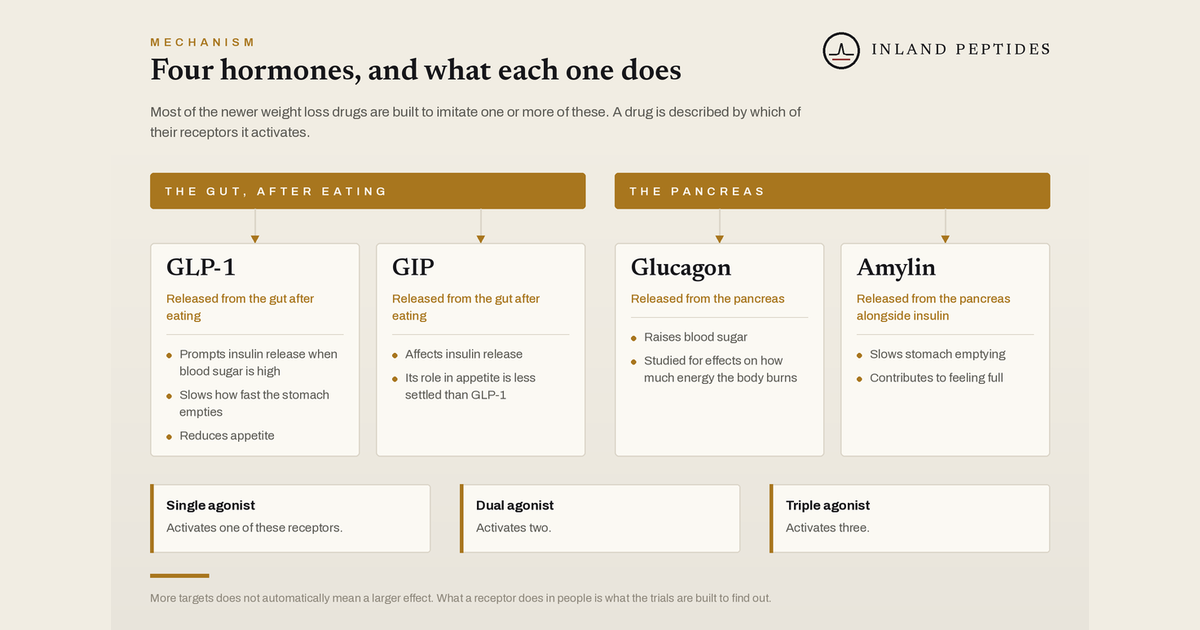
They are hormones the body already makes, and most of the newer weight loss drugs are built to imitate one or more of them.
GLP-1, short for glucagon-like peptide-1, is released from the gut after eating. It prompts insulin release when blood sugar is high, slows stomach emptying and reduces appetite.
GIP, short for glucose-dependent insulinotropic polypeptide, also comes from the gut after eating and affects insulin release. Its part in appetite is less settled than GLP-1’s.
Glucagon, in contrast, raises blood sugar. Researchers have also studied its effects on energy use.
Amylin is released from the pancreas alongside insulin. It also slows stomach emptying and adds to the feeling of being full.
A drug that activates a receptor is called an agonist. Single, dual and triple agonists activate one, two or three receptors, respectively.
However, more targets does not automatically mean a larger effect.
Prescription medicines used for weight loss
These medicines differ in their mechanisms, medical uses and the outcomes their trials measured.
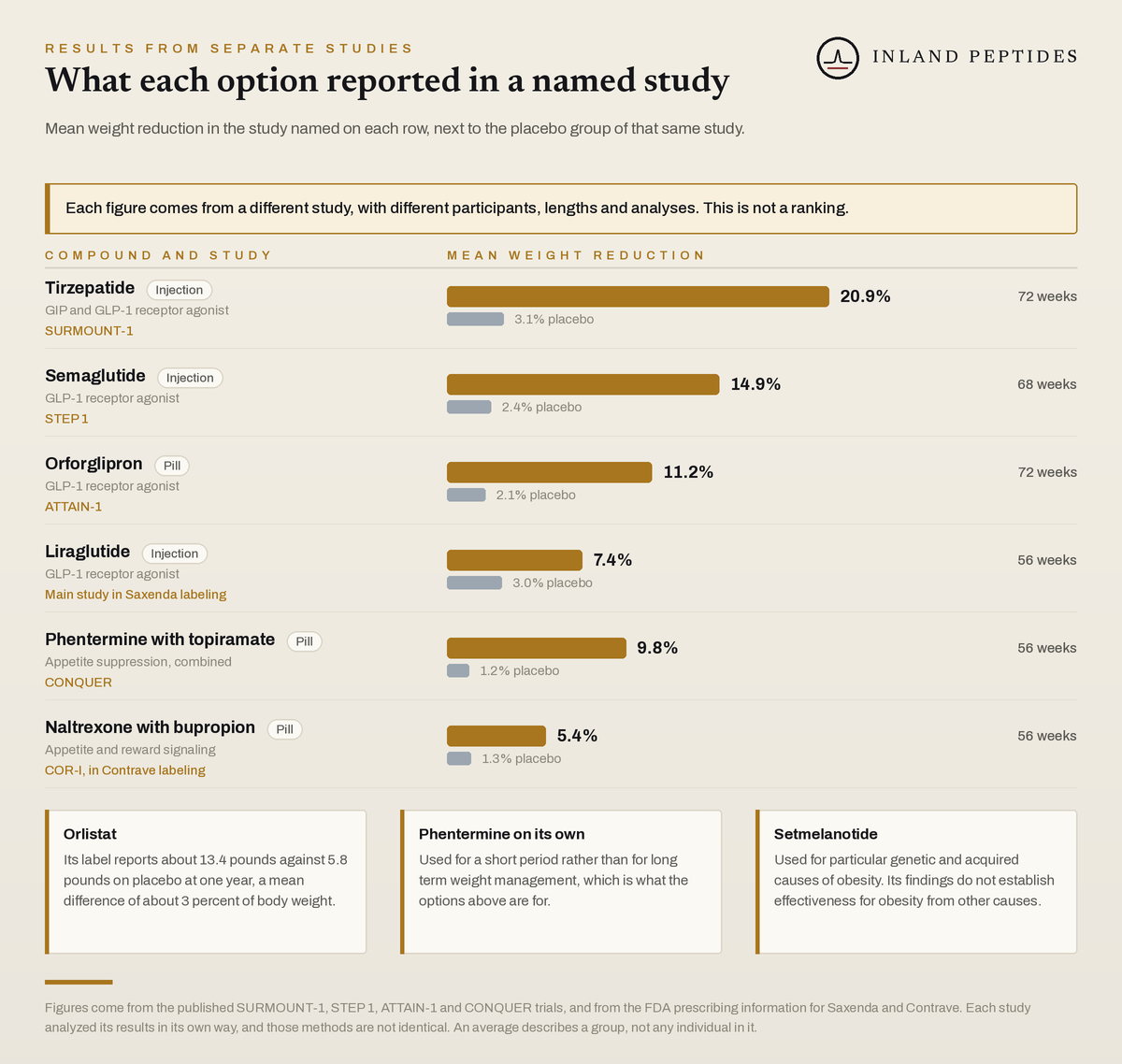
The percentages below are averages from individual studies, not predictions for a particular person.
Semaglutide
Semaglutide is a peptide that acts on the GLP-1 receptor.
Wegovy contains semaglutide and is used for weight management. Ozempic contains the same ingredient but is used in type 2 diabetes.
The 68-week STEP 1 trial enrolled 1,961 adults without diabetes. Average weight reduction was 14.9 percent against 2.4 percent with placebo.
Nausea and diarrhea were the most common adverse events.
Its labeling carries a boxed warning about thyroid C-cell tumors seen in rodents given semaglutide. Whether the same risk applies to people is not known.
Tirzepatide
Tirzepatide, by contrast, is a peptide that acts on two receptors, GIP and GLP-1.
Zepbound contains tirzepatide and is used for weight management and moderate to severe obstructive sleep apnea in adults with obesity. Mounjaro contains the same ingredient but is used in type 2 diabetes.
The 72-week SURMOUNT-1 trial enrolled 2,539 adults without diabetes. At the highest dose studied, average weight reduction was 20.9 percent against 3.1 percent with placebo.
Digestive adverse events were the most common. Its labeling also carries a boxed warning about thyroid C-cell tumors seen in rats given tirzepatide.
Orforglipron
Orforglipron activates the GLP-1 receptor, like semaglutide. Yet it is a small molecule taken as a pill.
Its molecule type and formulation differ from peptide medicines, even though they share a receptor target.
The ATTAIN-1 trial randomized 3,127 adults with obesity and without diabetes for 72 weeks. At the highest dose studied, average weight reduction was 11.2 percent against 2.1 percent with placebo.
Digestive adverse events were the most common. Adverse events led 5.3 to 10.3 percent of participants in the orforglipron groups to stop treatment, against 2.7 percent with placebo.
Its labeling carries a boxed warning about thyroid C-cell tumors seen in rodents given drugs that act on this receptor, rather than in rodents given orforglipron.
Liraglutide
Liraglutide is an earlier GLP-1 receptor agonist, sold as Saxenda for weight management and as Victoza for type 2 diabetes.
The main study in its labeling enrolled 3,731 adults without diabetes. Average weight reduction was 7.4 percent at 56 weeks against 3.0 percent with placebo.
Nausea, diarrhea, constipation and vomiting are among the common adverse reactions.
Its labeling also carries a boxed warning about thyroid C-cell tumors seen in rats and mice given liraglutide.
Other prescription options
These options include medicines that affect appetite and brain pathways, and one that works in the gut.
Qsymia combines phentermine, an appetite suppressant, with topiramate, a drug used for seizures and migraine. The 56-week CONQUER trial randomized 2,487 adults who were overweight or obese and had at least two weight-related conditions. At the higher dose studied, average weight reduction was 9.8 percent against 1.2 percent with placebo.
It is not used in pregnancy. Its labeling states that topiramate taken in the first trimester raises the risk of birth defects, including cleft lip and cleft palate.
Similarly, Contrave combines naltrexone, used in addiction treatment, with the antidepressant bupropion. In the 56-week COR-I trial in its labeling, average weight reduction was 5.4 percent against 1.3 percent with placebo.
It carries a boxed warning about suicidal thoughts and behaviors. Bupropion can also cause seizures, and the combination can raise blood pressure and resting heart rate.
Orlistat blocks absorption of some dietary fat. Across the pooled one-year trials in its labeling, average weight loss was about 13.4 pounds against 5.8 pounds with placebo, a difference of roughly 3 percent of body weight.
Its side effects are mainly digestive and are affected by the amount of fat in the diet.
Older stimulant appetite suppressants, including phentermine on its own, are used only for a short period rather than for long-term weight management. Their labeling rules them out for people with a history of cardiovascular disease, among other conditions.
Setmelanotide
Setmelanotide is a cyclic peptide that activates the melanocortin-4 receptor, part of a brain pathway that regulates hunger.
It is used for particular causes of obesity rather than for weight management in general. Its labeling covers acquired hypothalamic obesity, Bardet-Biedl syndrome and certain inherited deficiencies that disrupt that same pathway.
As a result, findings in these conditions do not establish effectiveness for obesity from other causes.
Which other compounds have researchers studied?
Researchers have studied several other compounds, including molecules that activate multiple hormone receptors.
Retatrutide
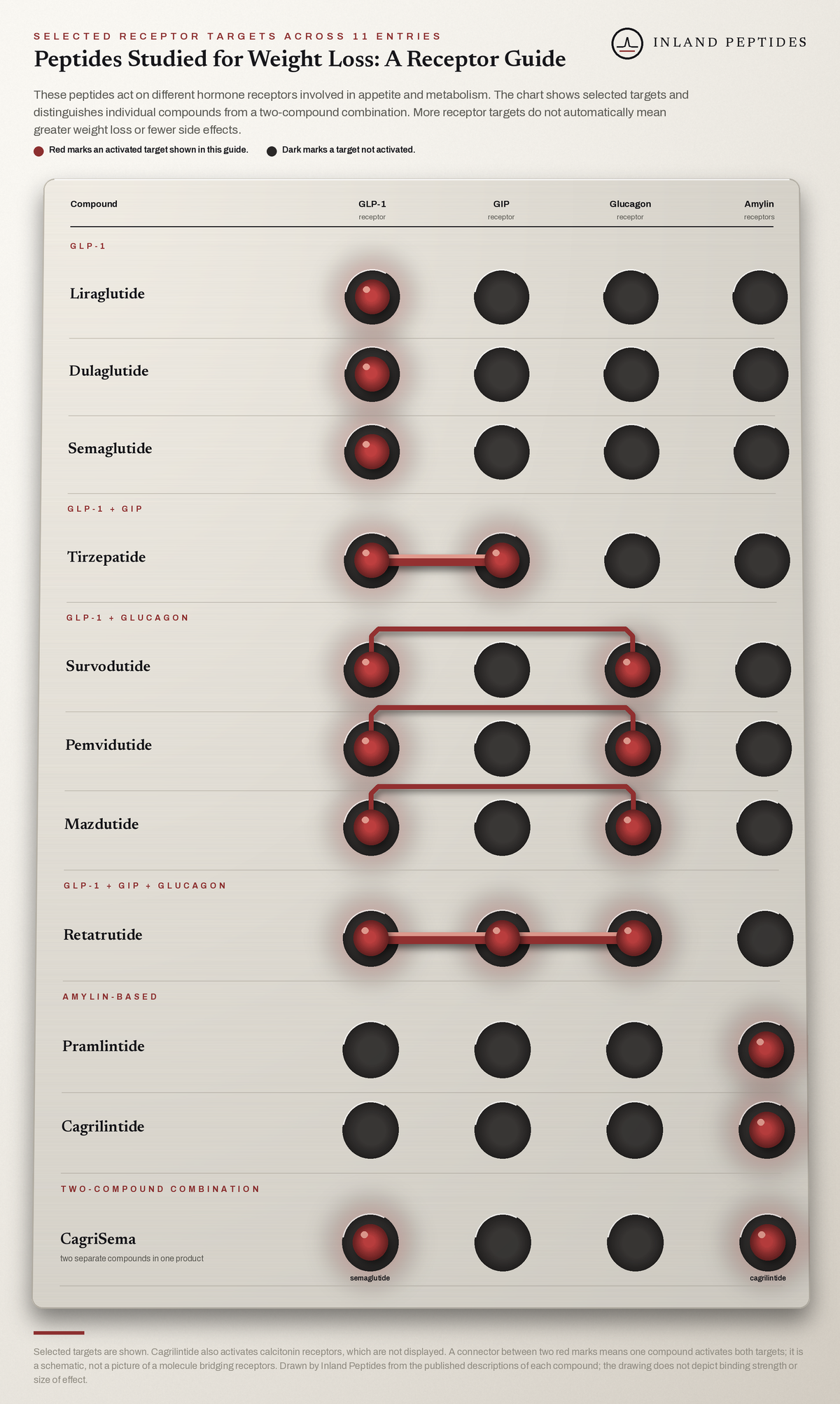
Retatrutide acts on three receptors: GIP, GLP-1 and glucagon.
The 80-week TRIUMPH-1 trial randomized 2,339 adults with obesity and without diabetes to retatrutide or placebo. Average weight reduction at the highest dose studied was 25.0 percent against 3.9 percent with placebo.
Digestive adverse events were the most common.
Cagrilintide and CagriSema
Cagrilintide is an amylin analog. CagriSema combines cagrilintide with semaglutide, so the names refer to different compounds or combinations.
REDEFINE 1 tested all three against placebo in 3,417 adults over 68 weeks. Average weight reduction was 20.4 percent with CagriSema, 14.9 percent with semaglutide alone, 11.5 percent with cagrilintide alone and 3.0 percent with placebo.
The trial formally tested the combination against each component separately. Both comparisons favored the combination.
However, it did not formally test semaglutide against cagrilintide. Their numerical results alone do not establish that one was more effective than the other.
Digestive adverse events were much more common with CagriSema than with placebo, and were mostly mild to moderate and temporary.
A later open-label trial, reported by the manufacturer, compared CagriSema against tirzepatide over 84 weeks. It did not meet its goal of showing that CagriSema was not meaningfully less effective than tirzepatide within the trial’s specified margin.
Even so, falling short of that goal is not the same as showing tirzepatide is better.
Survodutide, mazdutide and pemvidutide
All three activate glucagon and GLP-1 receptors. But each has been studied separately.
For survodutide, the 76-week SYNCHRONIZE-1 trial enrolled 725 adults with obesity and without diabetes. At the higher dose studied, average weight reduction was 13.0 percent against 5.4 percent with placebo.
Digestive adverse events, usually mild to moderate, affected 89.7 percent of participants at that dose and 47.9 percent of the placebo group.
For mazdutide, the 48-week GLORY-1 trial enrolled 610 Chinese adults. At the higher dose studied, average weight reduction was 14.0 percent, while the placebo group gained 0.3 percent.
Digestive adverse events were the most frequent and mostly mild to moderate. Adverse events led 0.5 percent of participants at that dose to stop treatment, against 1.0 percent with placebo.
For pemvidutide, a 48-week trial in 391 adults without diabetes reported an average reduction of 15.6 percent at the highest dose studied against 2.2 percent with placebo. Those figures come from the manufacturer rather than from a published trial report.
The announcement also describes nausea and vomiting as the most common adverse events, mostly mild to moderate.
Zenagamtide, formerly amycretin
Zenagamtide combines GLP-1 and amylin receptor activity in one molecule. In contrast, CagriSema combines two molecules.
A phase 1b/2a study tested it in 125 adults aged 18 to 55 with overweight or obesity, at one research center in Texas.
The study primarily assessed safety, tolerability and how the body processes the compound. Weight change was a secondary outcome.
In the group given the highest dose, estimated average weight reduction was 24.3 percent at 36 weeks, against 1.1 percent with placebo.
Digestive adverse events were the most common. Many participants also withdrew, with a high proportion leaving for reasons unrelated to adverse events.
What about over-the-counter products?
Orlistat is one example of a weight loss medicine available without a prescription.
Alli is orlistat at a lower strength than the prescription version, and it works the same way, by blocking absorption of some dietary fat. Its label covers use by overweight adults alongside a reduced-calorie, low-fat diet.
Still, a nonprescription medicine is a different category from a dietary supplement.
Do weight loss supplements work?
In general, the evidence for the ingredients commonly marketed this way is limited, inconsistent or inconclusive.
The NIH fact sheet on these supplements reviews them one at a time.
- Green tea preparations. Reported weight loss effects are small and unlikely to make a meaningful difference. Concentrated extracts have also been linked to liver injury; those findings should not be applied to ordinary tea drinking.
- Bitter orange. Weak and conflicting evidence, with safety concerns.
- Chitosan. Higher-quality trials found little effect on weight.
- Chromium and conjugated linoleic acid. Small reported effects of uncertain value.
- Raspberry ketone. Too little research to draw a conclusion.
- Garcinia cambogia. Findings conflict, reported effects are small, and long-term safety is uncertain.
In short, being available in a store or online does not establish that something is safe or that it works.
Which weight loss medication is best?
There is no single best option for everyone.
Instead, the choice depends on the diagnosis, medical history, other medicines, side effects and individual response.
An average weight reduction of 20 percent can include people who lost considerably more and people who lost much less.
In other words, trial averages describe groups, not individuals.
These studies also differ in participants, duration and methods. So ordering their percentages would not produce a fair ranking.
A well-designed trial comparing two treatments directly provides stronger comparative evidence than results drawn from unrelated studies.
A qualified clinician can assess which medical options fit a person’s circumstances.
What are the main differences between weight loss medications?
- Mechanism. Some act on hormone receptors, some on appetite and other brain pathways, and one works on fat absorption in the gut.
- Medical context. Some medicines are used for long-term weight management, others for short periods or particular causes of obesity.
- Evidence. The research ranges from large published trials to company-reported results and, for supplements, to limited and conflicting studies.
- Safety. The concerns differ by drug: digestive effects for the hormone receptor drugs, pregnancy risk for topiramate, seizure and blood pressure concerns for bupropion, cardiovascular history for the older stimulants.
- Individual response. Two people on the same medicine can get very different results.
This article is educational and is not medical advice.
Compare them head to head
- Semaglutide vs Tirzepatide
- Retatrutide vs Tirzepatide
- Retatrutide vs Semaglutide
- Semaglutide vs Liraglutide
- Dulaglutide vs Semaglutide
- CagriSema vs Semaglutide
- CagriSema vs Tirzepatide
- Cagrilintide vs Semaglutide
- Cagrilintide vs Pramlintide
- Survodutide vs Retatrutide
- Mazdutide vs Retatrutide
- Pemvidutide vs Retatrutide