Semaglutide stays active in the body longer than liraglutide, although both work by activating GLP-1 receptors.
Both were developed by Novo Nordisk and are ingredients in prescription medicines for type 2 diabetes and weight management.
Direct trials have compared them in adults without diabetes and in adults with type 2 diabetes.
Semaglutide vs. liraglutide at a glance
| Semaglutide | Liraglutide | |
|---|---|---|
| What it is | A modified peptide that acts like the hormone GLP-1 | A modified peptide that acts like the hormone GLP-1 |
| Receptor it activates | GLP-1 | GLP-1 |
| Familiar brands and main uses | Ozempic and Rybelsus (type 2 diabetes); Wegovy (weight management) | Victoza (type 2 diabetes); Saxenda (weight management) |
| Approximate half-life | About one week | About 13 hours |
| FDA approval | Used in FDA-approved prescription medications | Used in FDA-approved prescription medications |
| Main comparative finding | More average weight loss and a larger drop in blood sugar in the direct trials | Less average weight loss and a smaller drop in blood sugar in the direct trials |
What is semaglutide?
Semaglutide is a modified peptide that acts like the hormone GLP-1 and remains in the body for a long time.
Semaglutide products have different approved uses. Ozempic and Rybelsus are prescribed for type 2 diabetes; Wegovy is prescribed for weight management.
What is liraglutide?
Liraglutide is a modified peptide that also acts like GLP-1 and leaves the body faster.
Victoza is prescribed for type 2 diabetes.
Saxenda is a separate liraglutide product prescribed for weight management. Both are injections.
Research-use-only products labeled semaglutide or liraglutide cannot be assumed to match the quality, safety or effects of the preparations used in clinical trials.
The main differences
The same target
GLP-1 is a hormone your gut releases when you eat. It prompts the pancreas to release insulin when blood sugar rises, slows the stomach’s emptying and signals fullness to the brain.
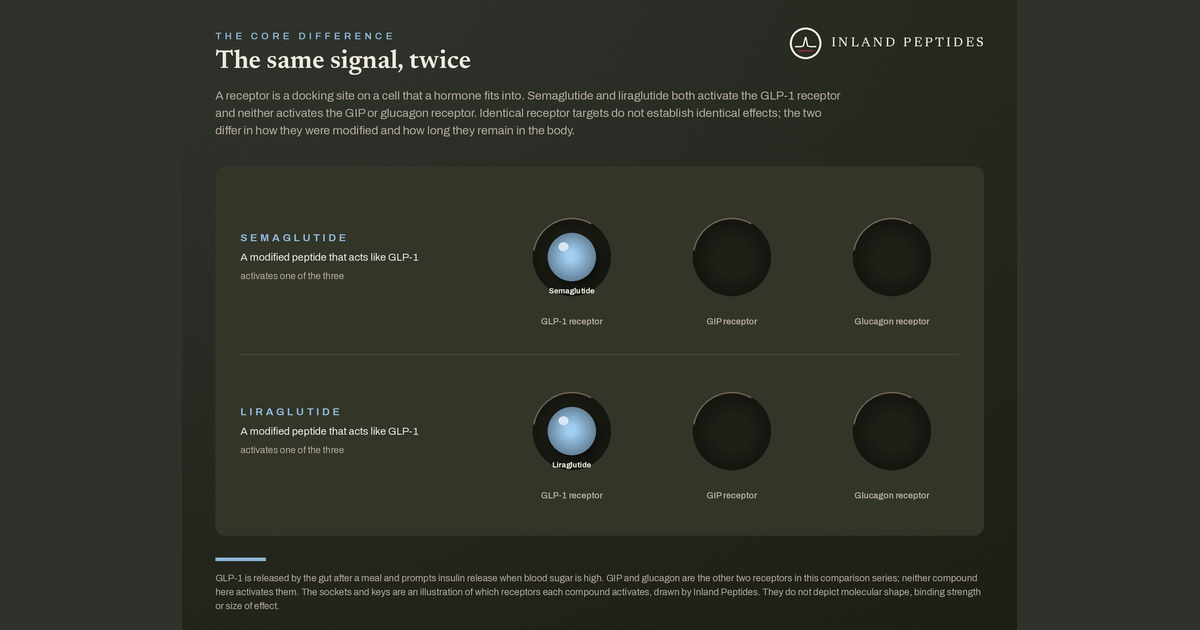
A receptor is a docking site on a cell that a hormone can activate. Both compounds activate GLP-1 receptors, but not GIP or glucagon receptors.
Still, the same receptor target does not guarantee the same effects. One key difference is how long each compound remains in the body.
How long each one lasts
Natural GLP-1 breaks down within minutes. Modifications help both compounds bind to a blood protein and resist breakdown, so they remain in the body longer.
Half-life is the time it takes for the level of a compound in the blood to fall by half.
For the injectable products discussed here, liraglutide’s half-life is about 13 hours, while semaglutide’s is about one week. However, these figures do not mean the compound disappears or stops working at that point.
What have direct comparisons found?
In direct trials, semaglutide produced more average weight loss than liraglutide in adults without diabetes, and a larger drop in average blood sugar in adults with type 2 diabetes.
Weight management in adults without diabetes
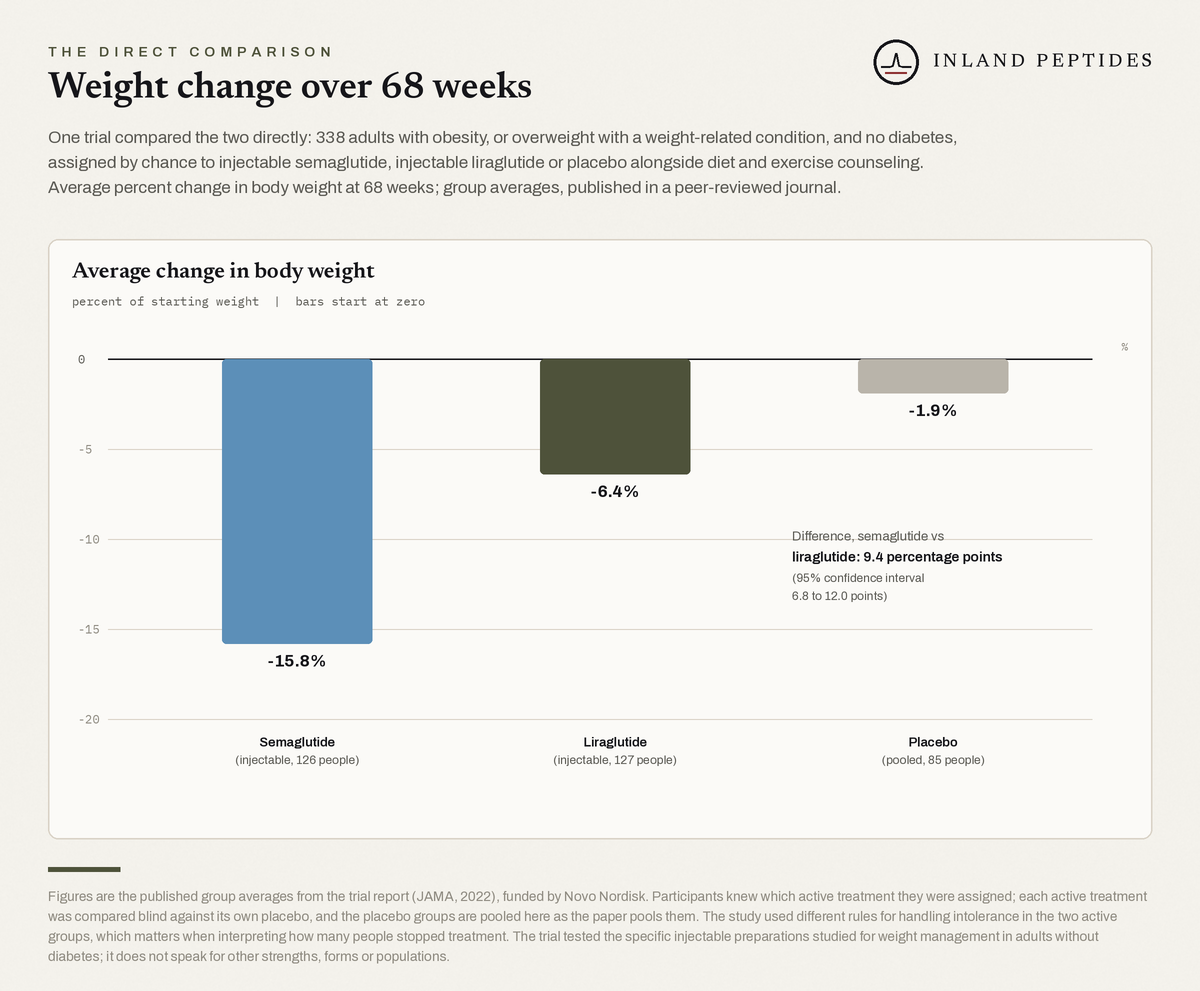
A 68-week trial enrolled 338 adults with obesity, or overweight with a weight-related condition, and no diabetes. Participants were assigned by chance to injectable semaglutide, injectable liraglutide or placebo, an inactive look-alike, alongside diet and exercise counseling.
Average body weight fell by about 16 percent with semaglutide and about 6 percent with liraglutide, a difference of about 9 percentage points. The placebo groups, by contrast, lost about 2 percent. These are group averages, so individual results can differ.
About 71 percent of people on semaglutide lost at least a tenth of their starting weight, against about 26 percent on liraglutide.
More people on liraglutide stopped treatment during the trial, for any reason, than on semaglutide: about 28 percent against about 14 percent.
About 13 percent stopped liraglutide because of reported health problems, compared with about 3 percent on semaglutide. Trials record these events whether or not treatment caused them.
The study used different rules for handling intolerance in the two groups, which matters when comparing treatment-stopping rates.
The trial tested specific injectable preparations in adults without diabetes and was funded by Novo Nordisk. Participants knew which active treatment they received. Each treatment was also compared with a matching placebo without revealing those assignments.
Blood sugar in adults with type 2 diabetes
A separate 30-week trial compared the two in 577 adults with type 2 diabetes who were taking oral diabetes medicines. HbA1c, a blood test that reflects average blood sugar over about three months, fell by 1.7 percentage points with semaglutide and 1.0 point with liraglutide. Average weight also fell by about 5.8 kilograms and 1.9 kilograms.
This trial tested different doses and a different population from the weight-management trial. Its findings do not cover every dose or formulation. Participants and researchers also knew the assigned treatment. Novo Nordisk sponsored the trial.
How do the reported side effects compare?
Digestive problems were the most common reported side effects with both compounds, though their frequency varied between the trials.
In the weight-management trial, about 84 percent of people on semaglutide and 83 percent on liraglutide reported a digestive effect, against 55 percent on placebo. Nausea was the most common with both, at about 60 percent. Constipation, diarrhea and vomiting were each somewhat more frequent with semaglutide. Most digestive events were mild to moderate and temporary, although some mild symptoms persisted.
Injection site reactions were reported by about 11 percent of participants receiving liraglutide and none receiving semaglutide in that trial.
In the diabetes trial, digestive effects were more frequent with semaglutide than with liraglutide, about 44 percent against 38 percent, and more people on semaglutide stopped because of reported health problems, about 11 percent against 7 percent.
These trials do not establish that either compound is safer overall.
The prescription products of both compounds carry the same boxed warning. In rodents, both caused tumors of the thyroid’s C-cells. Whether that applies to people, though, is unknown.
These products must not be used by people with a personal or family history of medullary thyroid carcinoma, a rare thyroid cancer, or MEN 2, an inherited condition that raises its risk.
The labels also warn about pancreatitis (inflammation of the pancreas), gallbladder disease, kidney injury from dehydration and low blood sugar when combined with insulin or other medicines that increase insulin release.
So what is the difference?
Semaglutide and liraglutide activate the same receptor, but semaglutide remains in the body longer.
In the direct trials, semaglutide produced more average weight loss in adults without diabetes and a larger drop in blood sugar in adults with type 2 diabetes. Side effects were mostly digestive with both, and the trials do not establish that either is safer overall.
Even so, greater average weight loss in a trial does not establish the best choice for every person. A clinician can explain prescription treatment options based on a person’s health and medical history.