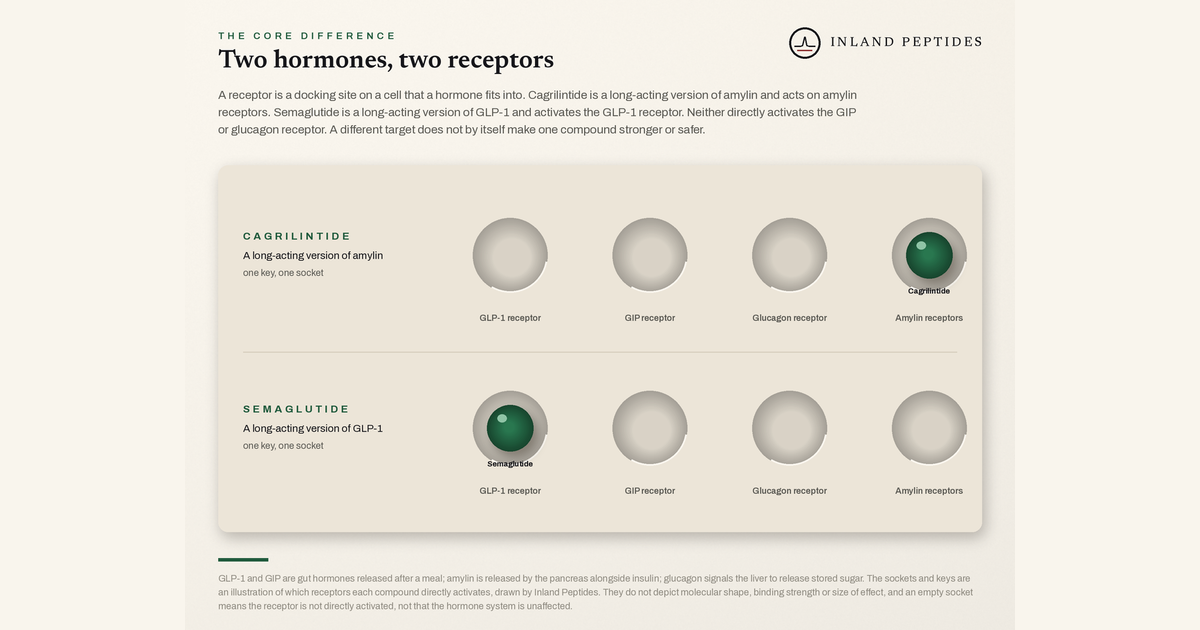
Cagrilintide acts on amylin receptors, while semaglutide activates the GLP-1 receptor.
Amylin and GLP-1 are hormones released after a meal. Both help signal fullness, but they act through different receptors, or docking sites on cells.
Novo Nordisk developed both compounds. Randomized trials have studied them in separate groups within the same study.
Cagrilintide vs. semaglutide at a glance
| Cagrilintide | Semaglutide | |
|---|---|---|
| What it is | A long-acting version of the hormone amylin | A long-acting version of the hormone GLP-1 |
| Hormone target | Amylin receptors | GLP-1 receptor |
| Developer | Novo Nordisk | Novo Nordisk |
| Main uses or research areas | Studied for weight management, alone and combined with semaglutide as CagriSema | Prescribed for type 2 diabetes, weight management and related conditions |
| FDA approval | Sold for research use only. Not FDA-approved for human use. | Used in FDA-approved prescription medications |
| Key evidence distinction | Individual-compound groups in randomized weight-management and diabetes trials | Large trials of its own, plus individual-compound groups in the same randomized trials |
What is cagrilintide?
Cagrilintide is a long-acting, laboratory-made version of amylin, a hormone the pancreas releases alongside insulin.
It is an amylin analogue, meaning it resembles natural amylin. Scientists modified it to last longer in the body and activate amylin receptors.
Cagrilintide has been studied alone and with semaglutide. The combination is called CagriSema. Its findings, though, cannot be assigned to cagrilintide alone.
What is semaglutide?
Semaglutide is a long-acting, laboratory-made version of GLP-1, a hormone released by the gut after eating.
It is a GLP-1 receptor agonist. An agonist switches a receptor on, as the natural hormone does.
It is the compound in several prescription medicines, including Wegovy for weight management and Ozempic for type 2 diabetes.
However, these approved medications are distinct from research-use-only products. So an RUO label does not establish the quality, safety or effects demonstrated for clinical-trial preparations.
How do their hormone targets differ?
Cagrilintide activates amylin receptors, while semaglutide activates GLP-1 receptors. Yet the natural hormones have overlapping roles in appetite and blood sugar regulation.
What amylin normally does
Amylin slows stomach emptying, helps regulate food intake and reduces glucagon release after a meal. Glucagon tells the liver to release sugar into the blood.
What GLP-1 normally does
GLP-1 prompts insulin release when blood sugar rises, slows stomach emptying and signals fullness to the brain.
What has been demonstrated?
Trials measured changes in body weight and blood sugar. But those findings do not establish that cagrilintide reproduces every effect of natural amylin.
A different target does not by itself make one compound stronger or safer than the other.
What have studies found when the two were compared?
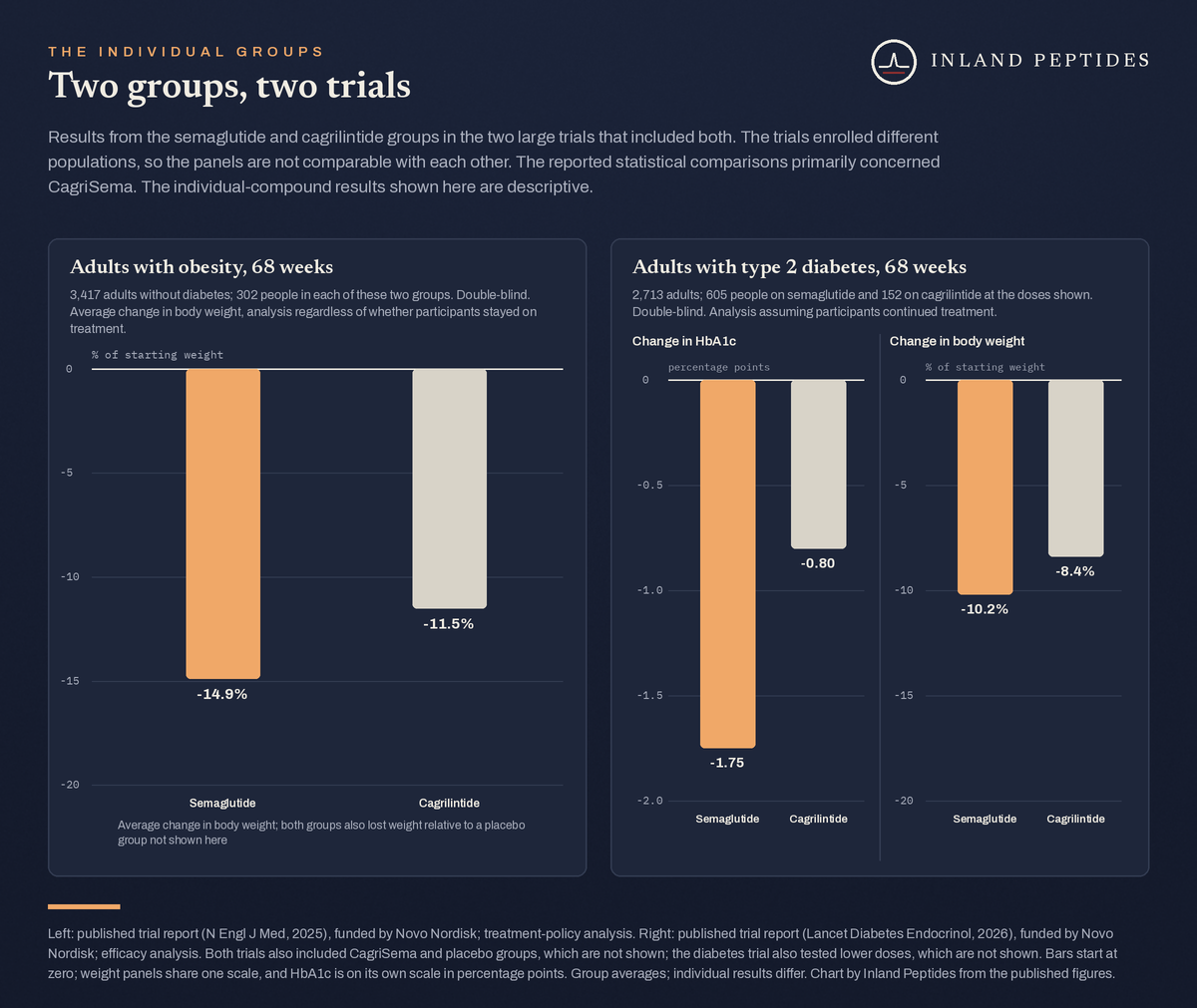
Semaglutide groups had larger average weight reductions in two large trials. In the diabetes trial, semaglutide also produced a larger average reduction in blood sugar.
Both compounds were included, but the main statistical comparisons focused on CagriSema. So the group averages alone do not establish statistically significant superiority of one individual compound over the other.
In adults with overweight or obesity
A 68-week trial enrolled 3,417 adults without diabetes who had obesity, or overweight with a related health condition. Participants were assigned by chance to CagriSema, semaglutide alone, cagrilintide alone or placebo, an inactive look-alike. Neither participants nor researchers knew who received what. The semaglutide and cagrilintide groups had about 300 people each.
Average body weight fell by about 15 percent with semaglutide and about 11.5 percent with cagrilintide. In contrast, the placebo group lost about 3 percent.
These estimates account for participants regardless of whether they stayed on treatment. An analysis assuming continued treatment estimated weight reductions of about 16 percent with semaglutide and 12 percent with cagrilintide. In other words, the analyses answer different questions.
Novo Nordisk funded the trial.
In adults with type 2 diabetes
A separate 68-week diabetes trial enrolled 2,713 adults with type 2 diabetes whose blood sugar was not well controlled on common oral diabetes medicines. Again, neither participants nor researchers knew who received what. At the doses relevant here, about 600 people received semaglutide and about 150 received cagrilintide.
HbA1c reflects average blood sugar over about three months. It fell by about 1.75 percentage points with semaglutide and 0.8 percentage points with cagrilintide. Average weight fell by about 10 percent and 8 percent, respectively.
These estimates, though, assume continued treatment. Cagrilintide also produced greater HbA1c and weight reductions than placebo. Novo Nordisk funded the trial.
An earlier, smaller trial
A 32-week trial in 92 adults with type 2 diabetes gave about 30 people each CagriSema, semaglutide or cagrilintide. HbA1c fell by about 1.8 percentage points with semaglutide and about 0.9 with cagrilintide. Average weight fell by about 5 percent with semaglutide and about 8 percent with cagrilintide.
Unlike the larger trials, this study reported greater average weight loss in the cagrilintide group. Novo Nordisk funded it.
What the comparisons establish
Cagrilintide alone reduced average weight and HbA1c compared with placebo in the diabetes trial. Semaglutide groups had larger average weight reductions in both large trials and a larger HbA1c reduction in the diabetes trial.
Still, the individual-group differences described here do not establish which compound would produce better results for a particular person.
How do the reported side effects compare?
Digestive events were reported less often with cagrilintide in both large trials. Serious-event rates differed between studies, so the findings do not establish which compound is safer overall.
An adverse event is a health event reported during a study, whether or not treatment caused it. Digestive events, serious events and events leading someone to stop treatment describe different aspects of safety.
In the obesity trial
About 74 percent of participants receiving semaglutide and 54 percent receiving cagrilintide reported digestive events, compared with 40 percent receiving placebo. These included nausea, vomiting, diarrhea, constipation and stomach pain.
Serious events, such as those requiring hospitalization, occurred in 27 of 302 participants receiving cagrilintide, about 9 percent, and 15 of 302 receiving semaglutide, about 5 percent. The placebo rate, meanwhile, was about 6 percent.
About 4 percent receiving semaglutide and 3 percent receiving cagrilintide stopped treatment because of an adverse event, compared with about 4 percent receiving placebo.
In the diabetes trial
Digestive events were reported in about 54 percent receiving semaglutide, 40 percent receiving cagrilintide and 28 percent receiving placebo.
Serious events were reported in about 13 percent receiving semaglutide, 11 percent receiving cagrilintide and 9 percent receiving placebo. About 7 percent receiving semaglutide and 5 percent receiving cagrilintide stopped treatment because of an adverse event.
In the smaller 32-week trial, about 80 percent receiving cagrilintide and 71 percent receiving semaglutide reported an adverse event of any kind.
These are reported events, not proof that the compounds caused them.
Established warnings for semaglutide
Semaglutide’s prescription labels carry a boxed warning about thyroid C-cell tumors observed in rodents. Whether it causes these tumors in humans is still unknown.
The labels say semaglutide should not be used by people with a personal or family history of medullary thyroid carcinoma, a rare thyroid cancer, or MEN 2, an inherited condition that raises that risk.
Other warnings include pancreatitis, or inflammation of the pancreas, gallbladder disease, dehydration-related kidney injury and severe digestive reactions. Low blood sugar is a concern when semaglutide is combined with insulin or medicines that increase insulin release.
Cagrilintide’s trial findings do not provide the same breadth of safety evidence as the larger research record behind semaglutide’s prescription products.
So what is the difference?
Cagrilintide activates amylin receptors. Semaglutide, by contrast, activates GLP-1 receptors.
The large trials reported greater average weight reductions with semaglutide and fewer digestive events with cagrilintide. Their serious-event findings, however, did not consistently favor either compound.
So these findings do not establish a universal best option. A qualified clinician can explain prescription treatments for weight management or blood sugar control and assess their suitability.