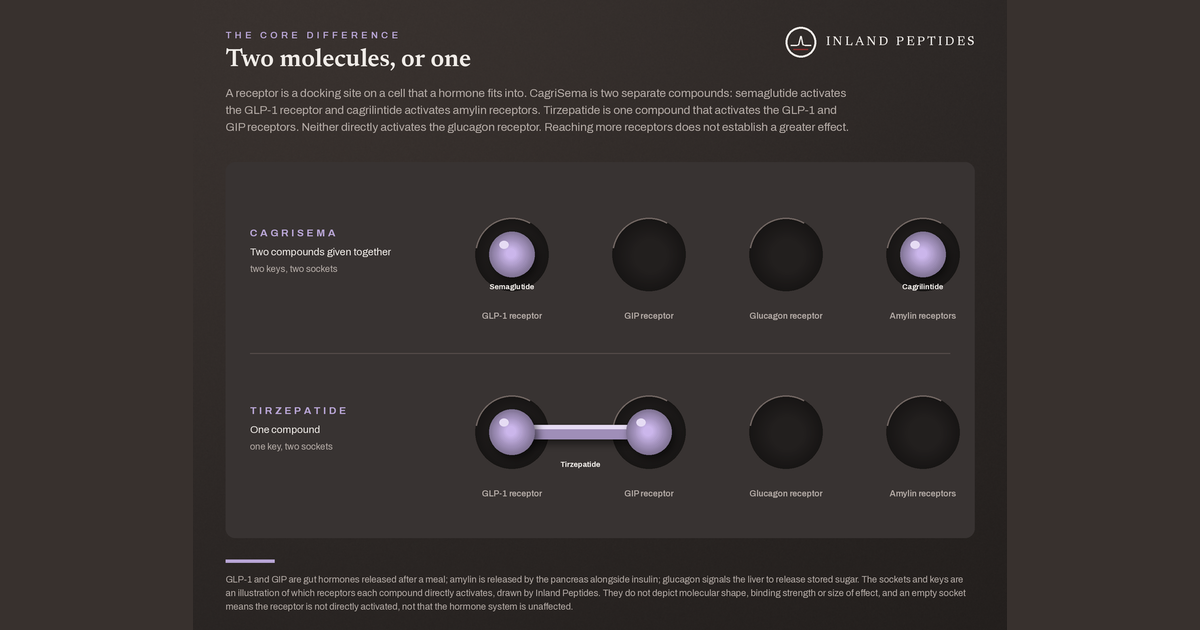
CagriSema combines two compounds, cagrilintide and semaglutide, while tirzepatide is one compound that activates two hormone receptors, GIP and GLP-1.
Combining two compounds does not automatically produce a greater effect than one. Direct trials have compared CagriSema with tirzepatide in people with obesity and in people with type 2 diabetes.
CagriSema vs. tirzepatide at a glance
| CagriSema | Tirzepatide | |
|---|---|---|
| What it contains | Two compounds given together: cagrilintide and semaglutide | One compound: tirzepatide |
| Hormone targets | Amylin receptors (cagrilintide) and the GLP-1 receptor (semaglutide) | GIP and GLP-1 receptors |
| Main research areas | Weight management and type 2 diabetes | Prescribed for type 2 diabetes and weight management |
| Developer | Novo Nordisk | Eli Lilly |
| FDA approval | Sold for research use only. Not FDA-approved for human use. (Semaglutide on its own is used in FDA-approved medications.) | Used in FDA-approved prescription medications |
| Main comparative finding | Less average weight loss than tirzepatide in an 84-week obesity trial; more weight loss in a 60-week type 2 diabetes trial that compared lower doses | More average weight loss than CagriSema in the obesity trial; less in the diabetes trial. The two trials used different doses and populations |
What is CagriSema?
CagriSema combines cagrilintide and semaglutide, two compounds developed by Novo Nordisk.
Cagrilintide is a long-acting version of amylin, a pancreatic hormone that signals fullness. Semaglutide is a modified peptide that acts like the gut hormone GLP-1 and is used in several prescription medicines.
CagriSema is not another name for cagrilintide alone. The combination is being studied for weight management and blood sugar control in type 2 diabetes.
What is tirzepatide?
Tirzepatide is a single laboratory-made peptide from Eli Lilly that reaches two receptors, GIP and GLP-1, from one molecule.
That is the structural contrast with CagriSema, which pairs two separate compounds. Tirzepatide is the active ingredient in Mounjaro, prescribed for type 2 diabetes, and Zepbound, prescribed for weight management. Both are injections.
Research-use-only products labeled cagrilintide, semaglutide or tirzepatide are distinct from approved medications and the preparations used in clinical trials.
How do their hormone targets differ?
Both activate the GLP-1 receptor. CagriSema also acts on amylin receptors through cagrilintide, while tirzepatide also activates the GIP receptor.
GLP-1 is a hormone your gut releases when you eat. It prompts the pancreas to release insulin when blood sugar rises, slows the stomach’s emptying and signals fullness to the brain.
GIP is a second gut hormone released with meals that also prompts insulin release.
Amylin is released by the pancreas alongside insulin after a meal. It slows the stomach’s emptying and produces a feeling of fullness.
A receptor is a docking site on a cell. CagriSema activates its targets through two separate molecules, while tirzepatide activates its targets through one.
Glucagon signals the liver to release stored sugar. Neither CagriSema nor tirzepatide directly activates the glucagon receptor.
What have direct comparisons found?
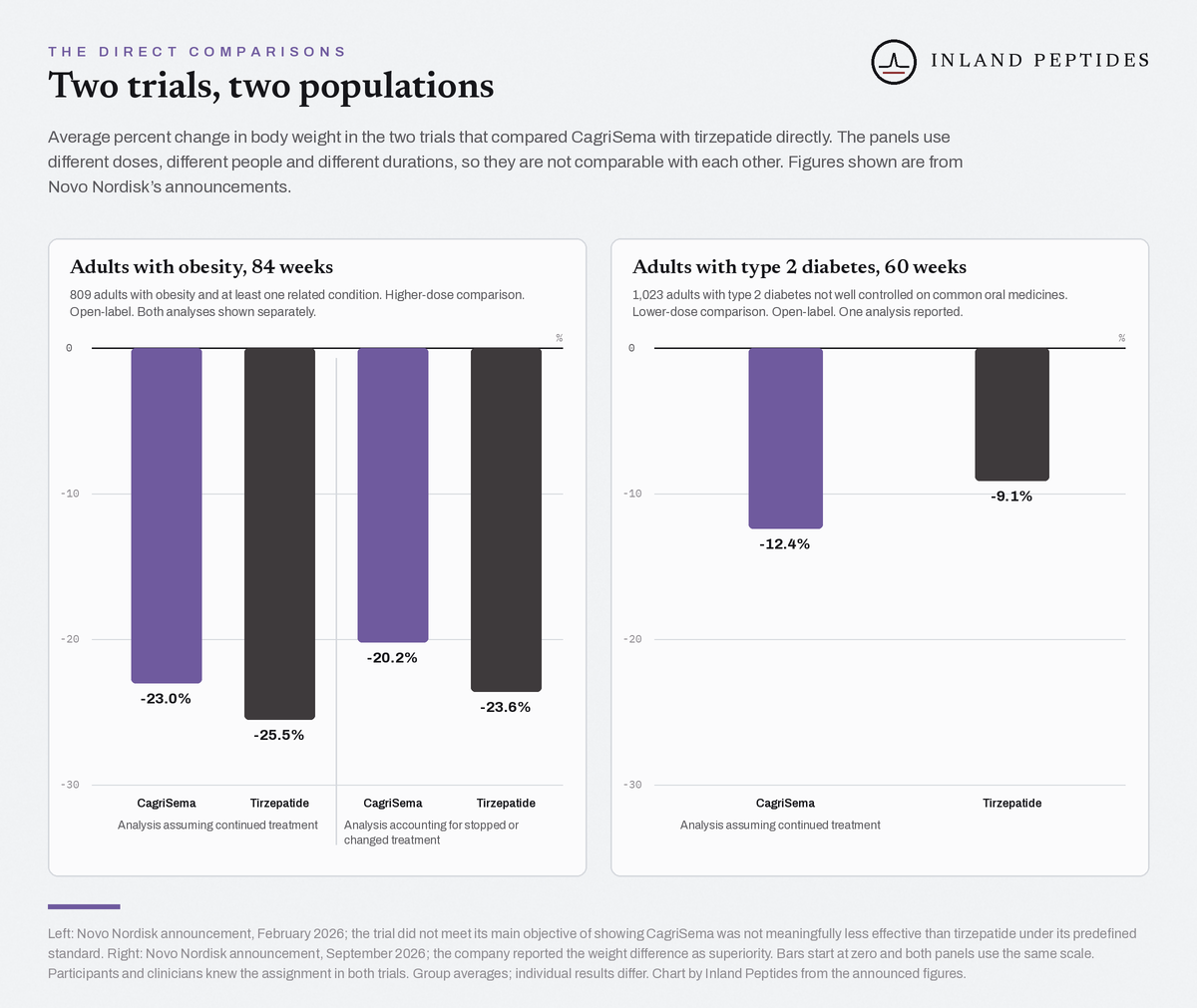
The two trials reported different results, but they tested different doses in different groups of people.
In adults with obesity: the higher-dose comparison
Novo Nordisk announced results from an 84-week trial in 809 adults with obesity and at least one related health condition. Participants were assigned by chance to the higher-dose CagriSema combination tested in this trial or to a higher tirzepatide dose.
The trial aimed to show that CagriSema was not meaningfully less effective than tirzepatide for weight loss, using a standard set before the study began. But it did not meet that objective.
Average weight reduction was greater with tirzepatide in both analyses Novo Nordisk reported. Assuming participants continued treatment, estimated weight loss was about 23 percent with CagriSema and 25.5 percent with tirzepatide. Regardless of whether participants continued their assigned treatment, the estimates were about 20 percent and 24 percent, respectively.
Participants and clinicians knew which treatment was assigned. The figures also come from Novo Nordisk’s announcement.
In adults with type 2 diabetes: the lower-dose comparison
In a separate 60-week trial in adults with type 2 diabetes whose blood sugar was not well controlled on common oral diabetes medicines, Novo Nordisk compared a lower CagriSema dose with a lower tirzepatide dose.
Average weight fell by about 12 percent with CagriSema and about 9 percent with tirzepatide. Novo Nordisk reported significantly greater average weight loss with CagriSema at the doses tested.
HbA1c, a blood test reflecting average blood sugar over about three months, fell by about 1.7 percentage points in both groups. Novo Nordisk reported that CagriSema met the study’s standard for not being meaningfully less effective on this measure. Still, that does not prove identical effects.
These figures assume continued treatment. Participants and clinicians also knew which treatment was assigned, and the results come from Novo Nordisk’s announcement.
Why these results are not interchangeable
The trials used different doses, enrolled different groups and ran for different lengths of time. These differences limit comparisons between the studies but do not prove why their results differed.
Both treatment groups had substantial average weight reductions in each trial. Even so, the findings do not establish what would happen with other doses or in other groups.
Each one against placebo
Each also has trials against placebo, an inactive look-alike given to a comparison group, in adults with obesity, or overweight with a related condition, and no diabetes. In a 68-week CagriSema trial of 3,417 adults, average weight fell by about 20 percent with CagriSema and about 3 percent with placebo, in an analysis estimating the effect regardless of whether participants stayed on treatment. It was funded by Novo Nordisk and published in a medical journal.
In a separate 72-week tirzepatide trial of 2,539 adults, average weight fell by about 15 to 21 percent across the three doses tested and about 3 percent with placebo, in the same kind of analysis. It was funded by Eli Lilly.
These separate trials, however, cannot establish which compound produces greater weight loss in a direct comparison.
How do the reported side effects compare?
Digestive side effects were common in trials of both. Yet the announcements of the direct comparisons do not provide enough safety data to establish which has fewer side effects.
In CagriSema’s published placebo-controlled trial, about 80 percent of participants receiving CagriSema reported digestive effects, compared with about 40 percent receiving placebo. These included nausea, vomiting, diarrhea, constipation and stomach pain. Most were temporary and mild to moderate.
In tirzepatide’s published placebo-controlled trial, digestive effects were also the most common, mostly mild to moderate and concentrated during dose increases. About 4 to 7 percent of participants receiving tirzepatide stopped because of adverse events, compared with under 3 percent receiving placebo.
These findings come from separate trials and cannot establish which compound has more side effects.
The 84-week announcement describes CagriSema’s digestive effects as mostly mild to moderate and lessening over time. The 60-week announcement describes CagriSema as well tolerated overall, without detailed safety results. But neither announcement provides side-by-side adverse-event rates.
Tirzepatide’s prescription labels carry a boxed warning about thyroid C-cell tumors observed in rats. Whether it causes these tumors in humans, though, is unknown.
The labels say tirzepatide should not be used by people with a personal or family history of medullary thyroid carcinoma, a rare thyroid cancer, or MEN 2, an inherited condition that raises that risk. Other warnings include pancreatitis, or inflammation of the pancreas, gallbladder disease, dehydration-related kidney injury and severe digestive reactions.
Semaglutide’s prescription labels carry the same boxed warning and similar restrictions. Its labeling concerns one component of CagriSema and does not establish the complete safety profile of the combination.
These trials do not establish that either compound is safer overall.
So what is the difference?
CagriSema combines amylin and GLP-1 activity through two compounds, while tirzepatide activates GIP and GLP-1 receptors through one.
Novo Nordisk reported greater average weight loss with tirzepatide in the higher-dose obesity comparison and with CagriSema in the lower-dose type 2 diabetes comparison. Those findings concern the particular doses and participants studied.
A qualified clinician can explain prescription options for weight management or blood sugar control and assess whether one is suitable for an individual.