Cagrilintide is a long-acting amylin analogue studied for weight management, while pramlintide is a short-acting amylin analogue prescribed alongside mealtime insulin for diabetes.
Both are laboratory-made versions of amylin, a hormone the pancreas releases with insulin after a meal. Their effects last for different lengths of time, and their studies have focused on different medical uses.
The studies discussed here tested the compounds separately, so their results cannot tell us which would work better in a direct comparison.
Cagrilintide vs. pramlintide at a glance
| Cagrilintide | Pramlintide | |
|---|---|---|
| What it is | A long-acting amylin analogue | A short-acting amylin analogue |
| Hormone target | Amylin receptors; also activates calcitonin receptors in laboratory studies | Amylin receptors |
| Main uses or research areas | Studied for weight management, alone and with semaglutide as CagriSema; also studied for blood sugar control in type 2 diabetes | Prescribed as an add-on to mealtime insulin in type 1 and type 2 diabetes |
| Studies in people | Placebo-controlled trials in adults with obesity and in adults with type 2 diabetes | Placebo-controlled trials in adults with diabetes on insulin, plus smaller obesity studies |
| FDA approval | Sold for research use only. Not FDA-approved for human use. | Used in FDA-approved prescription medications |
What is cagrilintide?
Cagrilintide is a long-acting, laboratory-made version of amylin developed by Novo Nordisk and studied mainly for weight management.
An analogue is a modified version of another molecule. Cagrilintide has an attached fatty-acid chain that helps it stay in the body longer.
Cagrilintide has been studied alone and with semaglutide. The combination is called CagriSema. Its results do not tell us what cagrilintide would do on its own.
Research-use-only products are different from the preparations tested in clinical trials. A cagrilintide label alone does not show that a product has the same quality, safety or effects.
What is pramlintide?
Pramlintide is a short-acting, laboratory-made version of amylin sold as SymlinPen, a prescription injection for people with type 1 or type 2 diabetes who use mealtime insulin and have not reached their blood sugar goals on insulin alone.
Pramlintide is approved for diabetes, rather than weight management. Researchers have also studied it for weight loss.
How are they connected to amylin, and how do they differ?
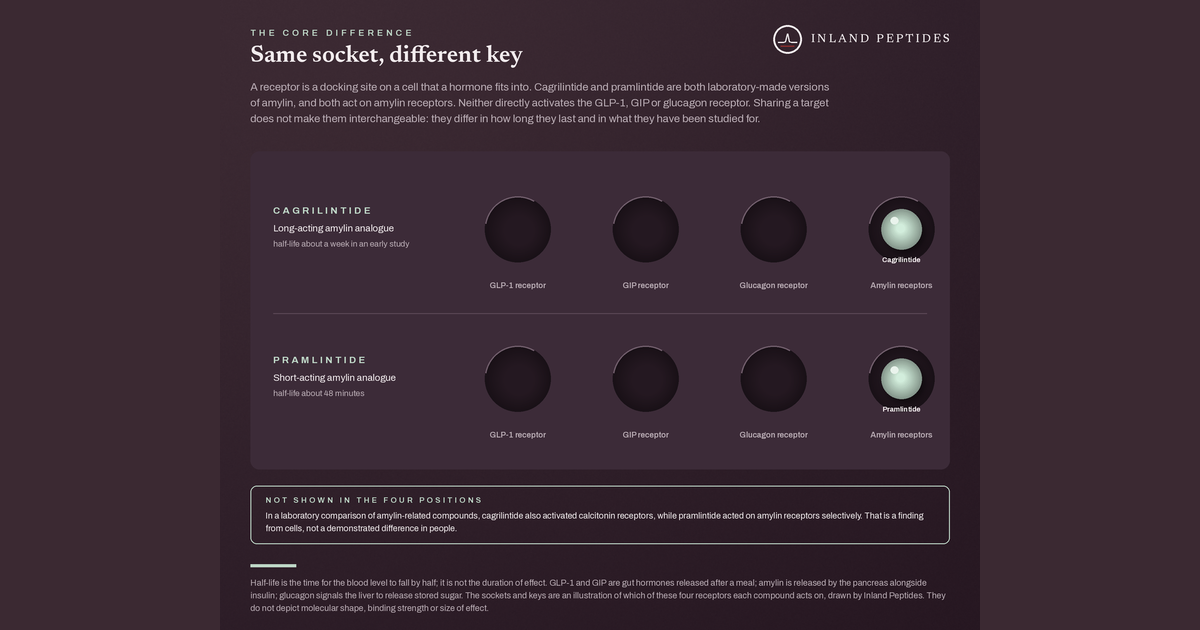
Both activate amylin receptors, docking sites on cells that respond to amylin. Pramlintide is short-acting; cagrilintide was designed to last longer.
What amylin does
Amylin slows stomach emptying, helps regulate food intake and reduces glucagon release after a meal. Glucagon tells the liver to release sugar into the blood.
These are effects of natural amylin. Human studies tested whether the two compounds could produce similar effects.
How long each one lasts
Pramlintide has a half-life of about 48 minutes, according to its prescribing information. Cagrilintide’s was about a week in an early study. Half-life describes how quickly the blood level falls by half, not exactly how long the effects last.
Which receptors they activate
A laboratory comparison found that cagrilintide activated both amylin and calcitonin receptors, while pramlintide acted selectively on amylin receptors. These cell-based findings do not tell us which compound would produce better weight loss or fewer side effects in people.
What has human research found?
People receiving either compound lost more weight than those receiving placebo in separate studies. Pramlintide also modestly lowered blood sugar when added to insulin treatment for diabetes.
Cagrilintide in adults with obesity
A 26-week trial studied cagrilintide in adults without diabetes who had obesity, or overweight with high blood pressure or abnormal cholesterol. It compared several doses with placebo, an inactive look-alike, and with liraglutide.Average weight fell by about 6 to 11 percent with cagrilintide and 3 percent with placebo. These estimates assume participants stayed on treatment. The highest cagrilintide dose also produced more weight loss than liraglutide. Novo Nordisk funded the trial.
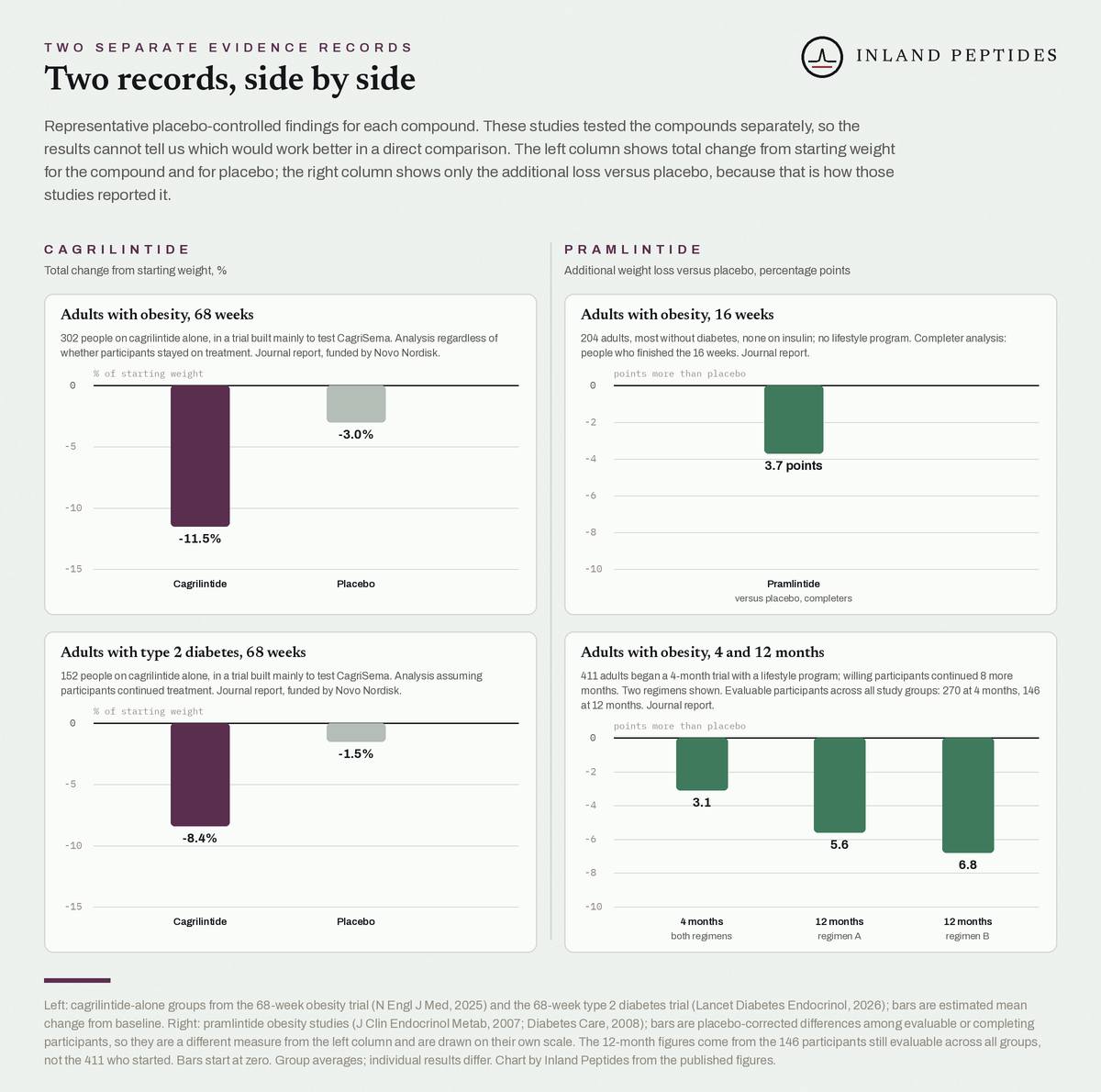
A later 68-week trial focused mainly on CagriSema but included 302 adults receiving cagrilintide alone. Participants had obesity, or overweight with a related health condition, and did not have diabetes.Average weight fell by about 11.5 percent with cagrilintide and 3 percent with placebo. These estimates account for participants whether or not they stayed on treatment. Novo Nordisk funded the trial.
Cagrilintide in adults with type 2 diabetes
A 68-week diabetes trial also included a cagrilintide-alone group, with 152 adults whose blood sugar remained high despite common oral diabetes medicines. The main outcome was HbA1c, a blood test reflecting average blood sugar over about three months.
HbA1c fell by about 0.8 percentage points with cagrilintide, while it rose slightly with placebo. Average weight fell by about 8 percent with cagrilintide and 1.5 percent with placebo. Both differences were statistically significant.These estimates assume participants continued treatment without needing extra treatment to control blood sugar. Novo Nordisk funded the trial.
Pramlintide in adults with diabetes on insulin
The pramlintide label describes trials lasting 26 to 52 weeks in people with type 1 or type 2 diabetes taking insulin. Researchers kept insulin doses as stable as possible to help measure what pramlintide added.
At about six months, HbA1c had fallen by about 0.3 percentage points more with pramlintide than with placebo. People receiving pramlintide lost an average of about 2 to 3.5 pounds, while placebo groups gained a small amount.
In a separate type 1 diabetes study, researchers allowed insulin adjustments. Adding pramlintide did not lower HbA1c more than placebo, but the pramlintide group lost weight while the placebo group gained.
These results came from people with diabetes taking insulin. They do not tell us what would happen in people without diabetes.
Pramlintide in adults with obesity
Pramlintide has also been studied for obesity, including at doses higher than those used in approved diabetes treatment. A 16-week study enrolled 204 adults with obesity. Most did not have diabetes, and none were taking insulin. Among people who completed treatment, weight loss was about 3.7 percentage points greater with pramlintide than with placebo.
A 12-month study began with 411 adults with obesity following a lifestyle program. After four months, participants could choose to continue for another eight months. Two pramlintide regimens produced about 3 percentage points more weight loss than placebo at four months.
At 12 months, those two regimens produced about 5.6 and 6.8 percentage points more weight loss than placebo. Most pramlintide groups maintained their earlier weight loss, while the placebo group regained weight.Only 146 of the original 411 participants met the criteria for the 12-month analysis. That smaller group may not represent everyone who started the study.
What these studies tell us
Both compounds produced greater average weight loss than placebo. But the studies used different doses, lasted different lengths of time, and involved people with different health conditions and other treatments. Their percentages cannot tell us which compound would work better if tested against the other.
How do the reported safety findings compare?
Nausea and other digestive problems were common in studies of both compounds. Pramlintide also carries a boxed warning about severe low blood sugar when used with insulin.
An adverse event is a health problem reported during a study. Treatment may or may not have caused it.
Cagrilintide
In the 26-week trial, 41 to 63 percent of people receiving cagrilintide reported digestive problems, compared with 32 percent receiving placebo. Nausea was the most common. Across all treatment groups, about 4 percent stopped treatment because of an adverse event.
In the 68-week obesity trial, about 54 percent receiving cagrilintide reported digestive problems, compared with 40 percent receiving placebo. Serious events, such as those requiring hospitalization, were reported in about 9 percent receiving cagrilintide and 6 percent receiving placebo. About 3 percent receiving cagrilintide stopped treatment because of an adverse event.
In the 68-week diabetes trial, about 40 percent receiving cagrilintide reported digestive problems, compared with 28 percent receiving placebo. Serious events were reported in about 11 percent receiving cagrilintide and 9 percent receiving placebo. About 5 percent receiving cagrilintide stopped treatment because of an adverse event.
Pramlintide
Pramlintide’s boxed warning says that using it with insulin increases the risk of severe low blood sugar, especially in type 1 diabetes. These episodes typically occur within three hours of an injection. The combination requires medical supervision.
The label says pramlintide should not be used by people who cannot sense their own low blood sugar or who have confirmed gastroparesis, a condition in which the stomach empties very slowly.
In the studies summarized in the label, about 48 percent of people with type 1 diabetes receiving pramlintide reported nausea, compared with 17 percent receiving placebo. In type 2 diabetes, the rates were about 28 percent and 12 percent. Nausea usually became less common over time.
Why the safety results cannot be ranked
Pramlintide was studied alongside insulin. The cagrilintide studies discussed here did not add it to mealtime insulin. Because the treatments and participants differed, their side-effect rates cannot tell us which compound is safer.
So what is the difference?
Pramlintide is short-acting and prescribed alongside insulin for diabetes. Cagrilintide is long-acting and has been studied for weight management and blood sugar control. Both act on amylin receptors, but they are different compounds with different research histories.
Both produced weight loss in their own studies. Those results do not show which would work better for a particular person.
A doctor can explain prescription treatments for blood sugar or weight management and whether they suit a person’s health needs.