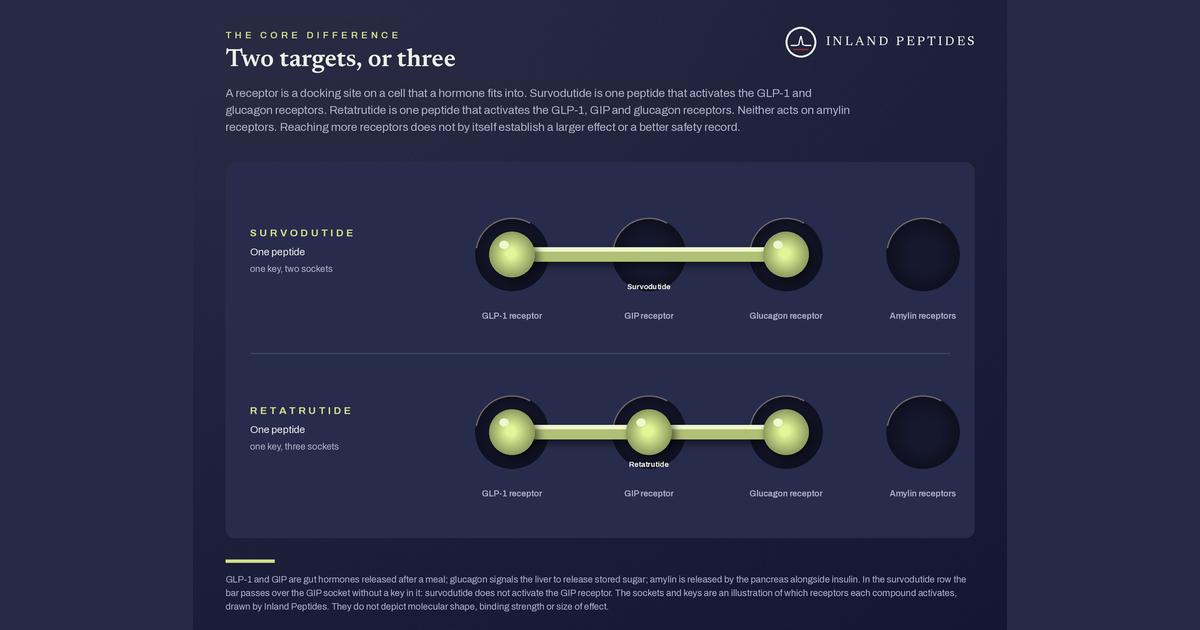
Survodutide activates two hormone receptors, GLP-1 and glucagon, while retatrutide activates three: GLP-1, glucagon and GIP.
Both are laboratory-made peptides studied for weight management, type 2 diabetes and fatty liver disease. Survodutide’s liver studies include biopsy findings, while the retatrutide study discussed here measured liver fat through scans.
Their studies tested them separately, so the results cannot tell us which would work better in a direct comparison.
Survodutide vs. retatrutide at a glance
| Survodutide | Retatrutide | |
|---|---|---|
| What it is | One peptide that activates two receptors | One peptide that activates three receptors |
| Hormone targets | GLP-1 and glucagon | GLP-1, glucagon and GIP |
| Developer | Co-invented by Zealand Pharma and Boehringer Ingelheim; developed by Boehringer Ingelheim | Eli Lilly |
| Main research areas | Weight management, type 2 diabetes and fatty liver disease | Weight management, type 2 diabetes and liver fat |
| FDA approval | Sold for research use only. Not FDA-approved for human use. | Sold for research use only. Not FDA-approved for human use. |
| Studies discussed here | Two 76-week trials against placebo (without and with type 2 diabetes) and two liver trials against placebo | Two 80-week trials against placebo (without and with type 2 diabetes), a 40-week diabetes trial and a liver substudy |
What is survodutide?
Survodutide is a single laboratory-made peptide that activates the receptors for two hormones, GLP-1 and glucagon.
Zealand Pharma and Boehringer Ingelheim co-invented it. Boehringer Ingelheim funds and leads its development, including trials in people with and without type 2 diabetes and studies of fatty liver disease.
What is retatrutide?
Retatrutide is a laboratory-made peptide from Eli Lilly that activates three receptors: GLP-1, glucagon and GIP.
It shares the GLP-1 and glucagon targets with survodutide and adds GIP, so the two overlap on two of three signals rather than matching exactly.
Its human research spans weight management, type 2 diabetes and liver fat. Clinical-trial results, though, do not establish the quality, safety or effects of research-use-only products labeled survodutide or retatrutide.
How do their hormone targets differ?
Both activate the GLP-1 and glucagon receptors. Retatrutide also activates the GIP receptor, which survodutide does not.
A receptor is a docking site on a cell. GLP-1 is a gut hormone released when you eat. It helps the pancreas release insulin when blood sugar rises, slows stomach emptying and signals fullness. GIP is another gut hormone that helps trigger insulin release after meals.
Glucagon signals the liver to release stored sugar. Researchers are also studying how activating its receptor affects energy use and fat stored in the liver.
Activating three receptors instead of two does not by itself mean more weight loss or fewer side effects.
What has research found on weight?
Each compound has lowered weight compared with placebo in its own trials. A placebo is an inactive look-alike given to a comparison group.
The weight results below include people who stopped treatment as well as those who continued.
Survodutide
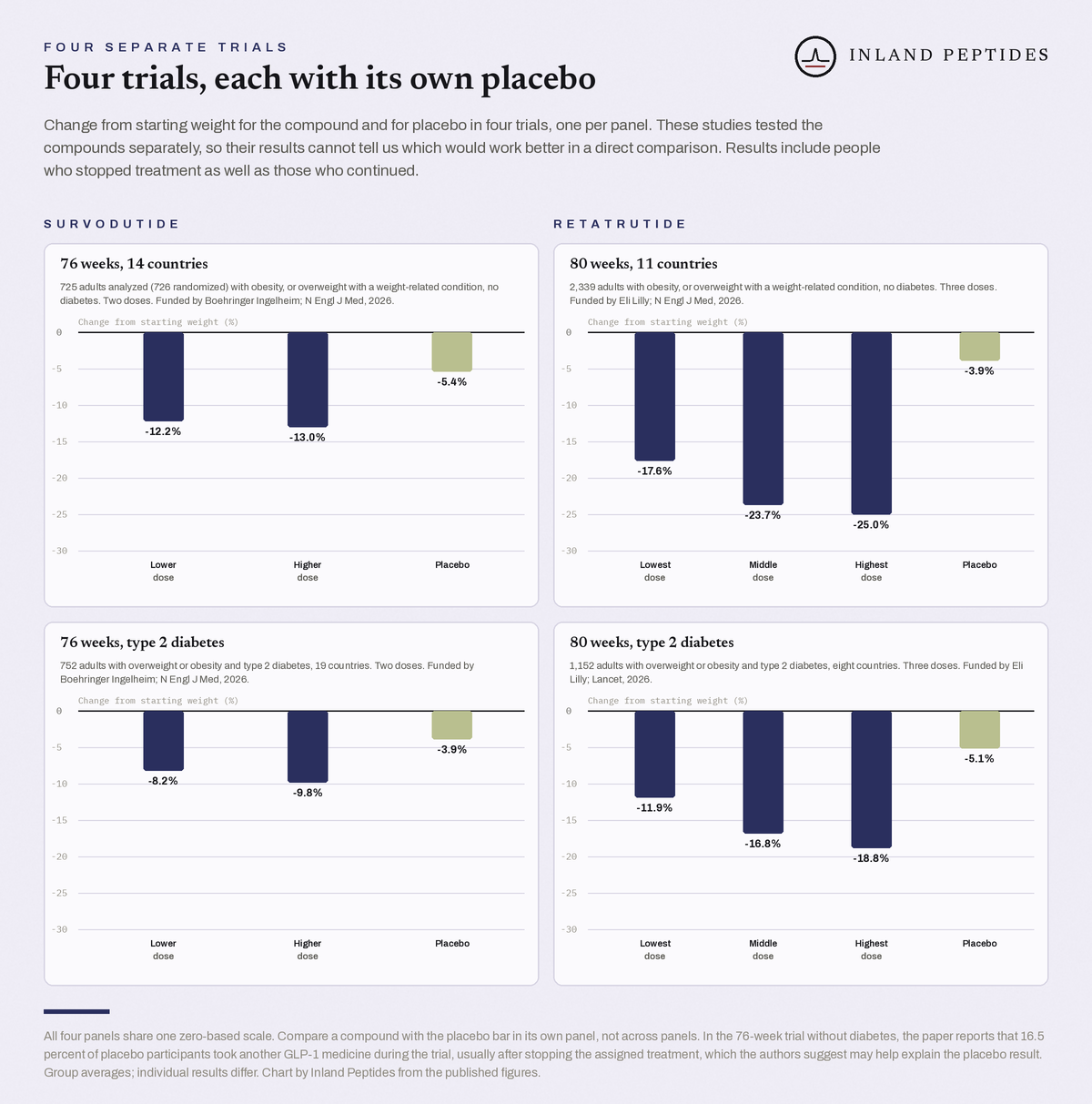
In a 76-week trial, average weight fell by about 12 percent with the lower survodutide dose and 13 percent with the higher one, compared with about 5 percent with placebo. The results included 725 adults without diabetes who had obesity, or overweight with a weight-related condition. Boehringer Ingelheim funded the trial.
The placebo group lost more weight than the researchers expected. About 16.5 percent of that group reported taking another GLP-1 medicine during the trial, usually after stopping the assigned treatment. The authors suggest this may help explain the placebo result.
In a 76-week diabetes trial, average weight fell by about 8 and 10 percent across two survodutide doses, compared with about 4 percent with placebo. The trial included 752 adults with overweight or obesity and type 2 diabetes. Boehringer Ingelheim funded it.
Retatrutide
In an 80-week trial, average weight fell by about 18, 24 and 25 percent across three retatrutide doses, compared with about 4 percent with placebo. The Lilly-funded trial included 2,339 adults without diabetes who had obesity, or overweight with a weight-related condition.
In a separate 80-week diabetes trial, average weight fell by about 12, 17 and 19 percent across three retatrutide doses, compared with about 5 percent with placebo. It included 1,152 adults with overweight or obesity and type 2 diabetes.
Why these results do not show which works better
The survodutide trials ran for 76 weeks and the retatrutide trials for 80 weeks. They also differed in their participants, doses and placebo results.
These results show how each compound performed against placebo. But they cannot establish which would produce more weight loss in a direct comparison.
What has research found on blood sugar?
Both compounds lowered HbA1c in studies of people with type 2 diabetes. HbA1c is a blood test that reflects average blood sugar over about three months. Changes in HbA1c are measured in percentage points.
In the 76-week survodutide diabetes trial, HbA1c fell by about 0.9 and 0.8 percentage points across two doses, compared with about 0.2 with placebo. The average starting level was about 7.4 percent.
Retatrutide lowered HbA1c by about 1.7 to 1.9 percentage points in a 40-week diabetes trial, compared with about 0.8 with placebo. The average starting level was about 7.9 percent. The Lilly-funded trial included 537 adults whose diabetes was inadequately controlled with diet and exercise alone.
The trials differed in starting blood sugar, other diabetes treatment and duration. So their results cannot establish which compound lowers blood sugar more.
What has research found on the liver?
Both compounds reduced liver fat in imaging studies. A separate survodutide trial also found improvement in MASH, a form of fatty liver disease, through liver biopsies.
MASLD is a form of fatty liver disease linked to metabolic problems such as type 2 diabetes or excess weight. MASH involves liver inflammation and cell damage as well as fat buildup. Fibrosis means scarring.
In a 48-week trial of 293 adults with MASH and liver scarring, biopsies showed improvement in MASH without worsening of scarring in about 43 to 62 percent of people receiving survodutide, compared with about 14 percent receiving placebo. Boehringer Ingelheim funded the trial.
In a 48-week liver trial of 216 adults with overweight or obesity and MASLD, about 69 percent receiving survodutide had at least a 30 percent reduction in liver fat, compared with about 29 percent receiving placebo. These results include people who stopped treatment. Participants had signs of liver inflammation or scarring.
A liver substudy of 98 adults with fatty liver disease measured liver fat by scan at 24 weeks within a 48-week retatrutide trial. Average liver fat fell by about 43 to 82 percent from its starting amount across four doses, with almost no change with placebo. This measures the average reduction, rather than the share of people reaching a reduction target in the survodutide study.
Still, a scan showing less liver fat does not by itself establish that scarring has improved.
These findings also do not establish whether either compound prevents liver failure or the need for a transplant. None of these studies directly compared survodutide with retatrutide.
How do the reported side effects compare?
Digestive problems were the most common adverse events with both compounds.
An adverse event is a health problem reported during a study, whether or not the treatment caused it. Because these trials studied different groups for different lengths of time, their rates cannot tell us which compound causes fewer side effects.
Survodutide
In the 76-week trial without diabetes, about 61 to 65 percent of people receiving survodutide reported nausea, compared with 17 percent receiving placebo. Vomiting and diarrhea were also common. Most digestive problems, though, were mild to moderate.
About 24 to 25 percent receiving survodutide stopped treatment because of an adverse event, compared with about 5 percent receiving placebo.
Serious adverse events were reported in about 8 percent of the survodutide groups and 6 percent of the placebo group. This category includes problems that require hospitalization or are otherwise medically significant. Average heart rate rose by about 3 beats per minute in the survodutide groups. No deaths were reported.
In the 76-week diabetes trial, about 26 percent receiving survodutide stopped treatment because of an adverse event, compared with about 9 percent receiving placebo. Serious adverse events occurred in about 8 to 9 percent of the survodutide groups and 11 percent of the placebo group.
Retatrutide
In the 80-week trial without diabetes, about 29 to 42 percent of people receiving retatrutide reported nausea, compared with 15 percent receiving placebo. Diarrhea was reported by about 25 to 34 percent, compared with 14 percent.
About 4 to 11 percent stopped retatrutide because of an adverse event, compared with about 5 percent receiving placebo. Serious adverse events occurred in about 8 to 11 percent of the retatrutide groups and 5.5 percent of the placebo group. Average pulse rate rose initially and then declined.
In the 80-week diabetes trial, up to 6 percent reported low blood pressure and up to 7 percent reported abnormal skin sensations, such as tingling. Placebo rates, by contrast, were about 1 percent or less. The study counted people who stopped treatment because of an adverse event or death together: 4 to 12 percent across the retatrutide groups, compared with 5 percent receiving placebo.
So what is the difference?
Survodutide targets GLP-1 and glucagon receptors. Retatrutide adds GIP as a third target. Their separate studies have reported reductions in weight, blood sugar and liver fat, with digestive problems common in both compounds’ trials.
The additional receptor does not establish that retatrutide works better. A direct trial would be needed to compare the compounds’ effects and side effects.
A clinician can explain medical treatment options for weight management, blood sugar control or liver disease and whether they suit an individual’s needs.