Semaglutide copies the action of one gut hormone, GLP-1, while tirzepatide copies the action of two, GLP-1 and GIP.
Your gut releases both hormones when you eat. They prompt the pancreas to release insulin when blood sugar rises. GLP-1 also slows stomach emptying and helps signal fullness to the brain.
Both compounds are used in medicines for type 2 diabetes and weight management. Researchers have compared them directly to measure differences in weight loss and blood sugar.
Semaglutide vs. tirzepatide at a glance
| Semaglutide | Tirzepatide | |
|---|---|---|
| What it is | A laboratory-made copy of the hormone GLP-1 | A laboratory-made peptide that acts like both GIP and GLP-1 |
| Hormone signals it copies | One: GLP-1 | Two: GIP and GLP-1 |
| Familiar brands | Ozempic and Rybelsus (type 2 diabetes); Wegovy (weight management) | Mounjaro (type 2 diabetes); Zepbound (weight management) |
| FDA approval | Used in FDA-approved prescription medications | Used in FDA-approved prescription medications |
| Direct comparison trials | Less average weight loss in the obesity trial; smaller drop in average blood sugar and weight in the diabetes trial | More average weight loss in the obesity trial; larger drop in average blood sugar and weight in the diabetes trial, at the amounts studied |
Approved uses depend on the specific medication containing each compound.
What is semaglutide?
Semaglutide is a laboratory-made version of GLP-1, modified to stay active in the body for days rather than minutes.
Semaglutide is the compound in Ozempic and Rybelsus, which are prescribed for type 2 diabetes, and Wegovy, which is prescribed for weight management. Rybelsus is a tablet, while Ozempic and Wegovy have injectable and tablet forms.
What is tirzepatide?
Tirzepatide is a laboratory-made peptide that activates the receptors for two gut hormones, GIP and GLP-1.
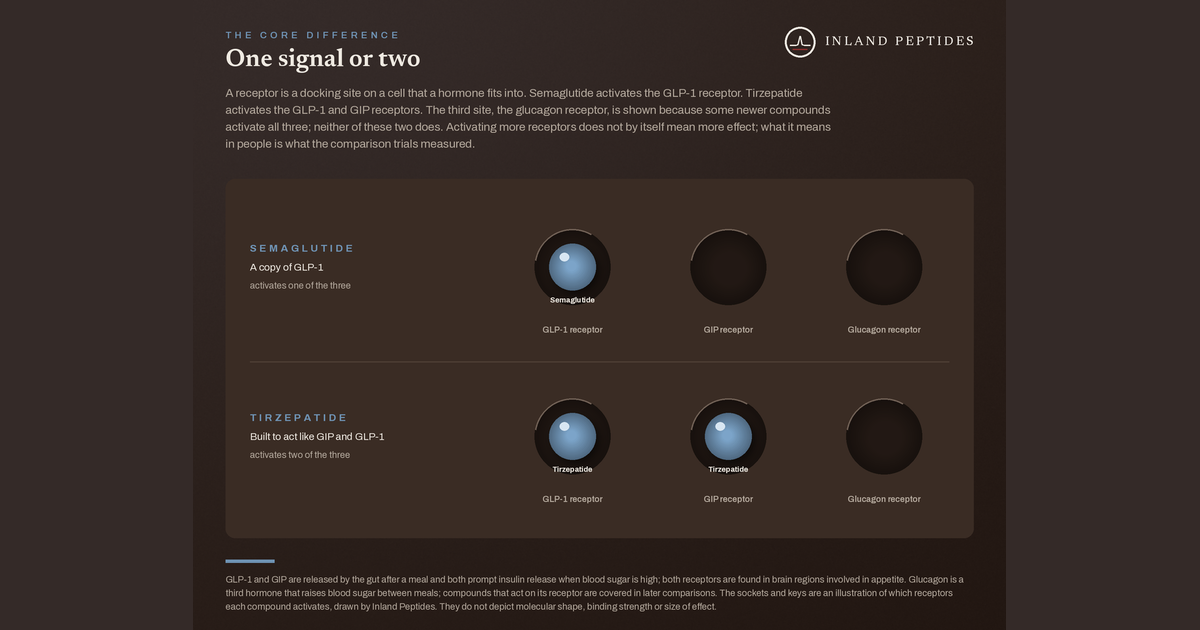
A receptor is a docking site on a cell that a hormone can activate. Semaglutide activates one of these receptor types; tirzepatide activates two.
Tirzepatide is the compound in Mounjaro, prescribed for type 2 diabetes, and Zepbound, prescribed for weight management. Both are injectable medications.
Prescription products and research preparations
Research preparations sold under these compound names are not interchangeable with prescription medications. The findings below describe the pharmaceutical products used in the studies.
The main differences
One hormone signal or two
Semaglutide activates the GLP-1 receptor only. Tirzepatide, by contrast, activates the GLP-1 receptor and the GIP receptor.
Both receptor types are found in brain regions involved in appetite. GLP-1 helps regulate food intake, and animal studies suggest that activating GIP receptors may contribute to this effect.
Another relevant receptor responds to glucagon, a hormone that raises blood sugar between meals. Neither semaglutide nor tirzepatide activates it. Other compounds being studied activate all three receptor types.
Activating more receptors does not automatically make a medicine more effective. Direct comparison trials show how the medicines performed in the people studied.
Different products
Semaglutide comes in injectable and tablet products, but tirzepatide comes in injectable products only.
What have studies found?
Tirzepatide produced greater average weight loss in both direct comparison trials discussed below. In the diabetes trial, it also lowered average blood sugar more.
In people with obesity, without diabetes
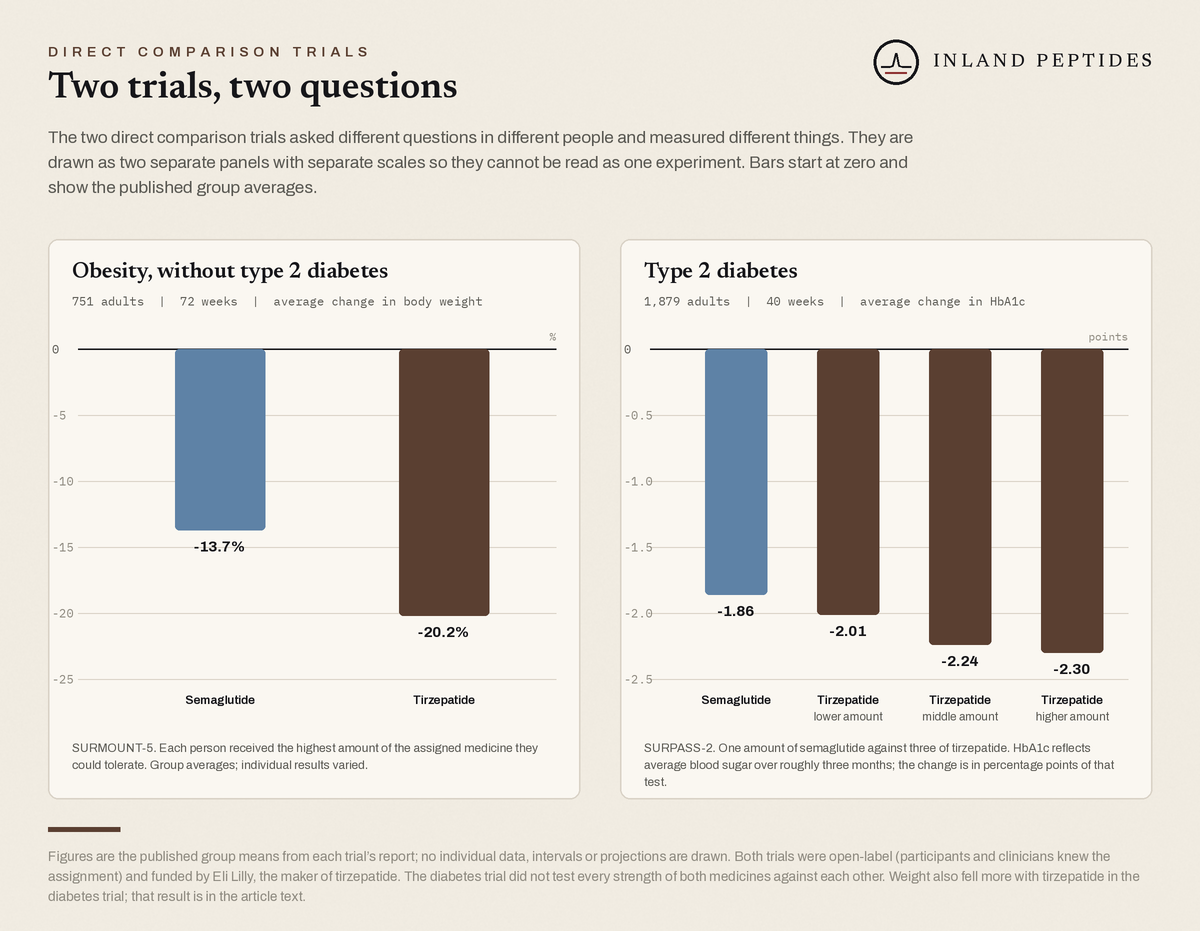
A 72-week trial called SURMOUNT-5 compared the two in 751 adults with obesity who did not have type 2 diabetes. Each person received the highest amount of their assigned medicine that they could tolerate.
Average weight fell by about 20 percent with tirzepatide and 14 percent with semaglutide. Individual results varied.
Participants and clinicians knew which medicine was assigned, which can influence results. Eli Lilly, the maker of tirzepatide, funded the trial.
In people with type 2 diabetes
A 40-week trial called SURPASS-2 compared the two in 1,879 adults with type 2 diabetes. The main measure was HbA1c, a blood test that reflects average blood sugar over roughly three months.
Each amount of tirzepatide tested lowered HbA1c and body weight more than the amount of semaglutide used in the trial.
Researchers compared three amounts of tirzepatide with one amount of semaglutide, rather than every available strength of both medicines. Participants and clinicians also knew which medicine was assigned. Eli Lilly funded this trial too.
Outside of trials
A large records study compared adults with overweight or obesity prescribed either compound using the diabetes brands. Researchers matched 18,386 patients with similar recorded characteristics.
People receiving tirzepatide were more likely to lose at least 5, 10 or 15 percent of their body weight within a year. Among those still receiving treatment at 12 months, weight loss was about 7 percentage points greater with tirzepatide. More than half of each group stopped treatment during follow-up.
People were not randomly assigned a medicine, so differences the matching could not capture may have influenced the results. The study found no significant difference in selected moderate to severe digestive events recorded in medical files, such as pancreatitis and gallbladder problems. It excluded ordinary nausea and vomiting because medical records do not capture them reliably.
What the studies do not show
The obesity and diabetes trials studied different populations and outcomes. Neither established which medicine better prevents heart attacks or strokes, or which is safer over many years. Follow-up lasted 72 weeks in the obesity trial and 40 weeks in the diabetes trial.
How do the reported side effects compare?
The most common side effects of both compounds are digestive: nausea, vomiting, diarrhea, constipation and stomach pain.
In the diabetes trial, nausea, diarrhea and vomiting occurred at broadly similar rates and were mostly mild to moderate. Digestive effects were also the most common side effects in the obesity trial. Most were mild to moderate and occurred while the study amounts were being increased.
In the diabetes trial, serious adverse events were reported in 5 to 7 percent of people receiving tirzepatide and 3 percent receiving semaglutide. These were events reported during treatment, though not necessarily caused by it. This difference alone does not establish which medicine is safer.
Prescription medications containing either compound carry a boxed warning about thyroid C-cell tumors found in rodents. Whether this risk applies to people is unknown. They must not be used by people with a personal or family history of medullary thyroid carcinoma, a rare thyroid cancer, or MEN 2, an inherited condition that raises its risk.
The prescribing information also warns about inflammation of the pancreas, gallbladder problems, kidney injury from dehydration, severe digestive reactions, allergic reactions, low blood sugar with insulin or similar medicines, and complications of diabetic eye disease.
These risks and a person’s medical history matter alongside the study results.
So what is the difference?
Semaglutide copies one gut hormone signal and tirzepatide copies two.
In the obesity trial discussed here, tirzepatide produced greater average weight loss. In the diabetes trial, it also produced a greater reduction in average blood sugar at the amounts compared.
Whether either medicine is suitable depends on a person’s health, other medicines and medical history. A qualified clinician can assess those factors.