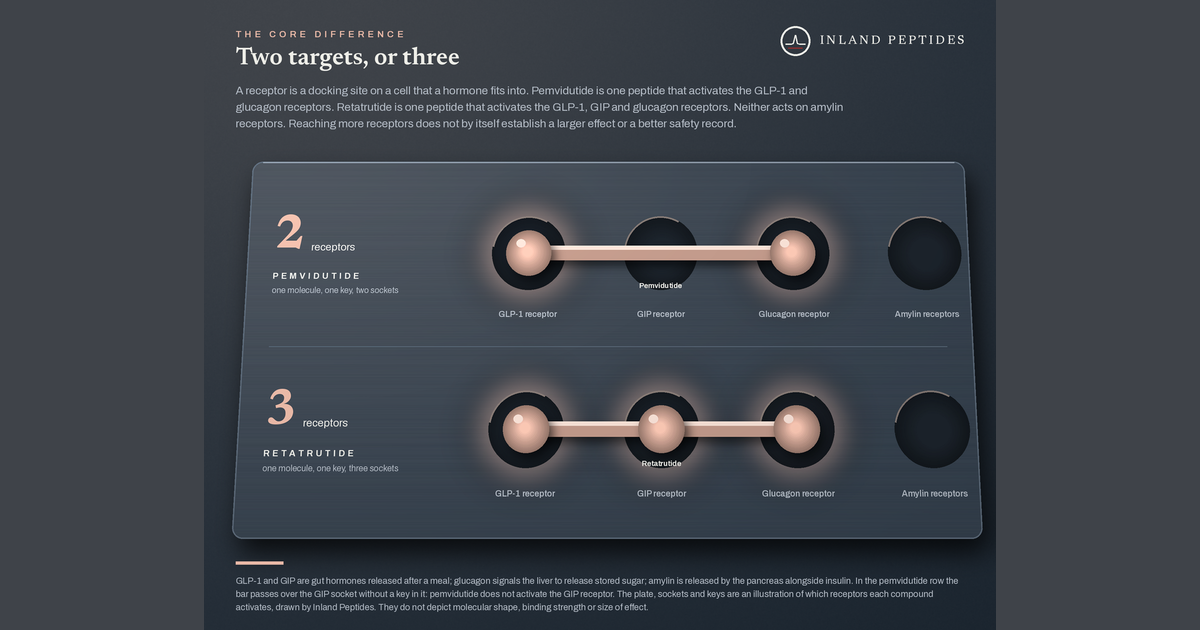
Pemvidutide activates two hormone receptors, GLP-1 and glucagon, while retatrutide activates three: GLP-1, glucagon and GIP.
Both are laboratory-made peptides studied for weight loss and fatty liver disease.
Their research differs too. Retatrutide has been tested in large, long-term weight-loss trials, while pemvidutide has a smaller weight trial. It also has a liver-biopsy trial in MASH, a form of fatty liver disease involving inflammation and cell damage.
They have been tested separately, so these results cannot tell us which would work better in a direct comparison.
Pemvidutide vs. retatrutide at a glance
| Pemvidutide | Retatrutide | |
|---|---|---|
| What it is | One peptide that activates two receptors | One peptide that activates three receptors |
| Hormone targets | GLP-1 and glucagon | GLP-1, glucagon and GIP |
| Developer | Altimmune | Eli Lilly |
| Main research areas | Fatty liver disease, weight management and alcohol-related conditions | Weight management, type 2 diabetes and related conditions |
| FDA approval | Sold for research use only. Not FDA-approved for human use. | Sold for research use only. Not FDA-approved for human use. |
| Main distinction in the evidence | Liver-biopsy trial in MASH; one 48-week weight trial of 391 adults | 80-week weight trials with thousands of participants; liver fat measured by scan in a small substudy |
What is pemvidutide?
Pemvidutide is a peptide from Altimmune that activates GLP-1 and glucagon receptors.
Its human studies include a liver-biopsy trial in MASH, smaller studies using liver-fat scans, and a 48-week weight trial in people without diabetes. It is also being investigated for alcohol use disorder and alcohol-related liver disease.
What is retatrutide?
Retatrutide is a peptide from Eli Lilly that activates the GLP-1, glucagon and GIP receptors.
Pemvidutide works on the first two of those; retatrutide carries the same GLP-1 and glucagon activity and adds GIP, a difference that runs through the rest of this comparison.
Its human studies have examined weight loss, with and without type 2 diabetes, as well as liver fat. Clinical-trial results do not establish the quality, safety or effects of research-use-only products labeled pemvidutide or retatrutide.
How do their receptor targets differ?
Both compounds act on the GLP-1 and glucagon receptors. Retatrutide also acts on the GIP receptor.
A receptor is a docking site on a cell. GLP-1 is a gut hormone released after eating. It helps the pancreas release insulin when blood sugar rises, slows stomach emptying and signals fullness to the brain.
Glucagon signals the liver to release stored sugar. Researchers are also studying how activating its receptor affects energy use and fat stored in the liver.
GIP is another gut hormone released after eating. It also helps trigger insulin release and affects fat tissue. Researchers are studying how its receptor contributes to weight loss.
Activating three receptors instead of two does not by itself mean more weight loss or fewer side effects.
What have weight-loss studies reported?
Each compound has lowered weight compared with placebo in its own trials. A placebo is an inactive look-alike given to a comparison group.
Pemvidutide
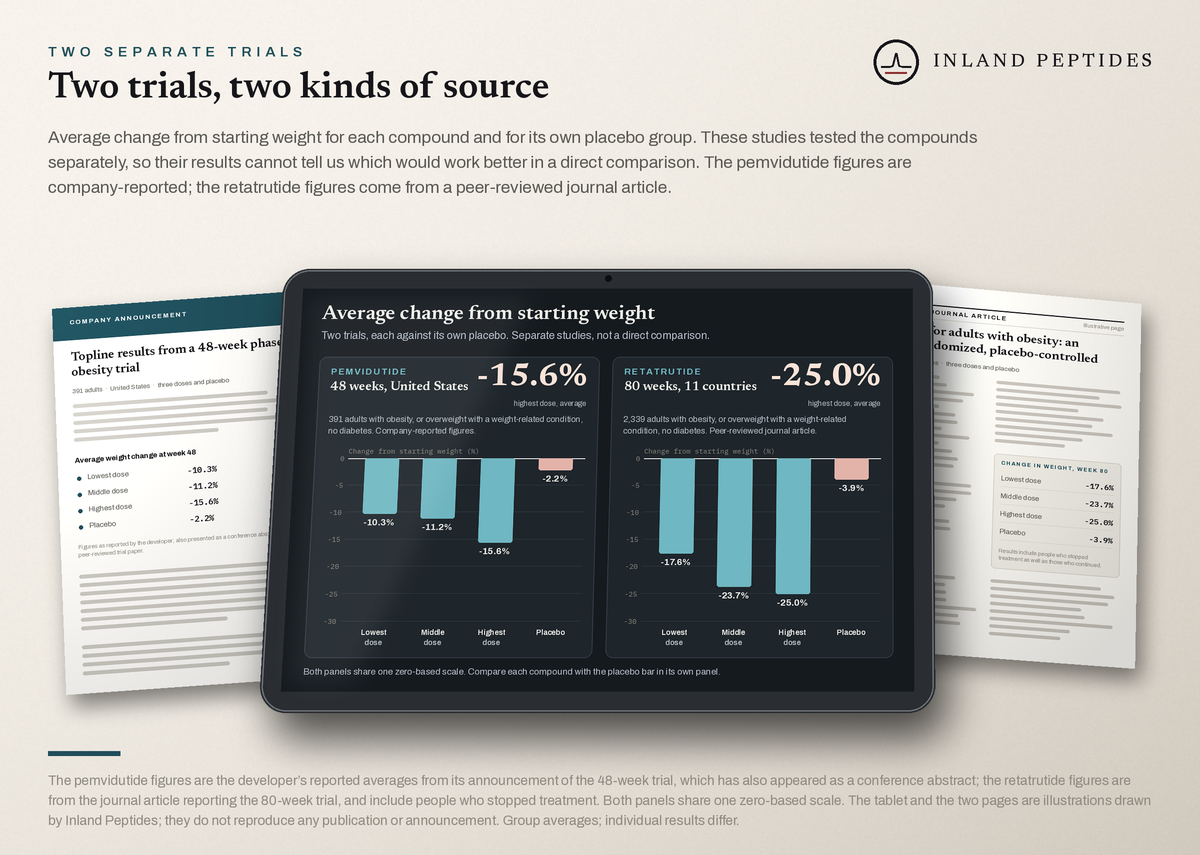
In a 48-week trial, average weight fell by about 10, 11 and 16 percent across three pemvidutide doses, compared with about 2 percent with placebo. The trial included 391 U.S. adults without diabetes who had obesity, or overweight with a weight-related condition. Altimmune reported these figures in its announcement of the results; they also appeared in a conference abstract.
In a separate liver trial involving people with MASH, Altimmune’s 48-week announcement reported average weight reductions of about 4.5 and 7.5 percent across two doses, compared with about 0.2 percent with placebo.
Retatrutide
In an 80-week trial, average weight fell by about 18, 24 and 25 percent across three retatrutide doses, compared with about 4 percent with placebo. The Lilly-funded trial included 2,339 adults in 11 countries without diabetes who had obesity, or overweight with a weight-related condition.
The results include people who stopped treatment as well as those who continued.
Why these results do not show which works better
The pemvidutide trial ran for 48 weeks, while the retatrutide trial ran for 80 weeks. They also differed in their participants, doses and placebo results.
Each trial shows how a compound performed against placebo. But their percentages cannot establish which would produce more weight loss in a direct comparison.
What does the liver research add?
Pemvidutide’s liver-biopsy trial assessed MASH resolution and changes in scarring. Retatrutide’s liver study instead measured fat through scans and assessed related blood markers.
MASLD is fatty liver disease linked to metabolic problems such as type 2 diabetes or excess weight. MASH also involves inflammation and liver-cell damage. Fibrosis means scarring.
Pemvidutide
In a biopsy trial of 212 adults with MASH and moderate to advanced liver scarring, MASH resolved without worsening of scarring in about 58 and 52 percent of people receiving pemvidutide, compared with 20 percent receiving placebo. Biopsies were assessed at 24 weeks.
However, the trial did not establish a significant improvement in scarring without worsening of MASH. About 33 and 36 percent receiving pemvidutide met that goal, compared with 28 percent receiving placebo. Altimmune funded the trial, which took place in the United States and Australia.
A 12-week study of 94 adults with MASLD measured liver fat by scan. Average liver fat fell by about 47 to 69 percent from its starting amount across three doses, compared with about 4 percent with placebo. In a 24-week extension involving 64 participants, reductions were about 56 to 76 percent, compared with 14 percent.
Retatrutide
A liver substudy of 98 adults with fatty liver disease measured liver fat by scan at 24 weeks within a 48-week retatrutide trial. Average liver fat fell by about 43 to 82 percent from its starting amount across four doses, with almost no change with placebo. The study also assessed blood markers related to liver injury and scarring, but did not use biopsies to assess MASH resolution or changes in scarring.
What the liver studies do and do not show
Less fat on a scan does not by itself establish that MASH has resolved or scarring has improved. Blood tests provide related information, while biopsies allow researchers to examine liver tissue directly.
The pemvidutide biopsy trial found MASH resolution without worsening of scarring, but did not establish a significant improvement in its scarring endpoint at 24 weeks. In contrast, the retatrutide substudy’s main finding was a reduction in liver fat.
These studies do not establish whether either compound prevents liver failure or the need for a transplant. None directly compared the two compounds.
What side effects have studies reported?
Digestive problems were the most common adverse events with both compounds.
An adverse event is a health problem reported during a study, whether or not treatment caused it. Because these trials studied different groups for different lengths of time, their rates cannot tell us which compound causes fewer side effects.
Pemvidutide
In the 48-week weight trial, Altimmune reported nausea in about 26 to 60 percent of people receiving pemvidutide, compared with 11 percent receiving placebo. Vomiting occurred in about 6 to 28 percent, compared with 3 percent. Most digestive problems, though, were mild to moderate.
About 5 to 20 percent receiving pemvidutide stopped treatment because of an adverse event, compared with 6 percent receiving placebo. One person had a serious event judged related to treatment, a case of vomiting.
During the first 24 weeks of the biopsy trial, about 22 to 41 percent receiving pemvidutide reported nausea, compared with 14 percent receiving placebo. None of the nausea was severe. Serious adverse events occurred in about 2 to 4 percent, compared with 3 percent; none were judged treatment-related. One person receiving pemvidutide and two receiving placebo stopped treatment because of an adverse event.
Retatrutide
In the 80-week trial, about 29 to 42 percent of people receiving retatrutide reported nausea, compared with 15 percent receiving placebo. Diarrhea occurred in about 25 to 34 percent, compared with 14 percent.
About 4 to 11 percent stopped retatrutide because of an adverse event, compared with about 5 percent receiving placebo. Serious adverse events occurred in about 8 to 11 percent of the retatrutide groups and 5.5 percent of the placebo group. Average pulse rate rose initially and then declined.
So what is the difference?
Pemvidutide targets GLP-1 and glucagon receptors, while retatrutide adds GIP as a third target.
Separate studies have reported weight loss and reductions in liver fat with both compounds. Pemvidutide’s biopsy trial also examined MASH resolution and liver scarring.
The additional receptor does not establish that retatrutide works better. A direct trial would be needed to compare their effects and side effects.
A clinician can explain medical treatment options for weight or liver health and whether they suit an individual’s needs.