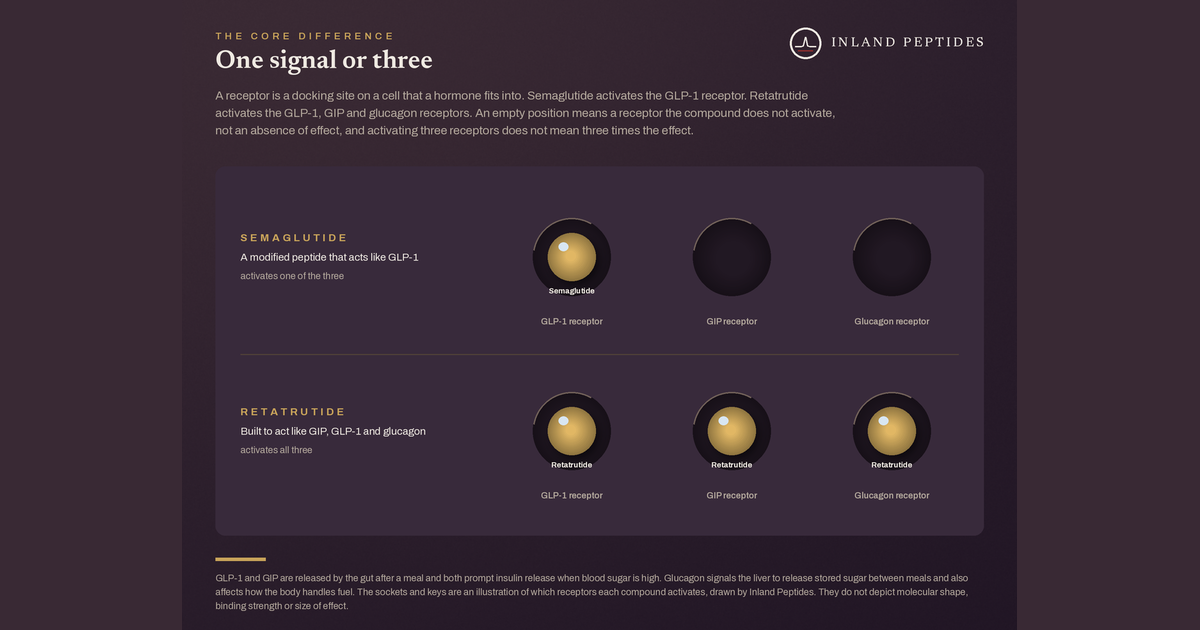
Retatrutide activates three hormone receptor types, GLP-1, GIP and glucagon, while semaglutide activates GLP-1 receptors.
Semaglutide, developed by Novo Nordisk, is the compound in prescription medicines for type 2 diabetes and weight management. Retatrutide, developed by Eli Lilly, is studied for the same conditions.
A large trial compared the two directly. The figures discussed here come from Lilly’s announcement rather than a peer-reviewed study report.
Retatrutide vs. semaglutide at a glance
| Retatrutide | Semaglutide | |
|---|---|---|
| What it is | One peptide that acts on three hormone receptors | A modified peptide that acts like GLP-1 |
| Hormone receptors it activates | Three: GLP-1, GIP and glucagon | One: GLP-1 |
| Main uses or research areas | Studied for weight management and type 2 diabetes | Prescribed for type 2 diabetes and weight management |
| Familiar brands | No prescription brand | Ozempic and Rybelsus (type 2 diabetes); Wegovy (weight management) |
| FDA approval | Sold for research use only. Not FDA-approved for human use. | Used in FDA-approved prescription medications |
| Main difference in the evidence | Published placebo-controlled trials; a direct comparison with Ozempic reported in a Lilly announcement | Published trials plus years of prescription use; the direct comparison covers Ozempic in adults with type 2 diabetes |
What is retatrutide?
Retatrutide is a single peptide molecule from Eli Lilly that activates three receptors at once: GLP-1, GIP and glucagon.
Semaglutide works through one of those pathways; retatrutide engages all three from a single molecule, which is the central contrast in this comparison.
Its clinical program has looked at weight loss, type 2 diabetes and related problems including fatty liver, knee osteoarthritis pain and sleep apnea.
What is semaglutide?
Semaglutide is a modified peptide developed by Novo Nordisk. It acts like GLP-1 but stays active for days, compared with minutes for the natural hormone.
Semaglutide products have different approved uses. Ozempic and Rybelsus are prescribed for type 2 diabetes; Wegovy is prescribed for weight management.
So a finding about one semaglutide product does not automatically apply to the others.
Research-use-only products labeled retatrutide or semaglutide cannot be assumed to match the quality, safety or effects of the preparations used in clinical trials.
The main differences
One receptor or three
GLP-1 is a hormone your gut releases when you eat. It prompts the pancreas to release insulin when blood sugar rises, slows the stomach’s emptying and signals fullness to the brain.
A receptor is the docking site on a cell that a hormone fits into. Semaglutide activates the GLP-1 receptor.
Retatrutide, by contrast, activates that receptor and two more.
GIP is a second gut hormone released with meals that also prompts insulin release.
Glucagon signals the liver to release stored sugar between meals. Its signaling also affects how the body handles fuel, including fat in the liver.
Three targets do not automatically mean greater effectiveness. In the study that introduced retatrutide, obese mice lost more weight when the glucagon receptor’s effect on energy use was added to the appetite effects of the other two receptors. That finding came from mice, so it does not establish the same effect in people.
Trials of the whole retatrutide molecule also do not isolate how much each receptor contributes to its effects.
What has comparative research found?
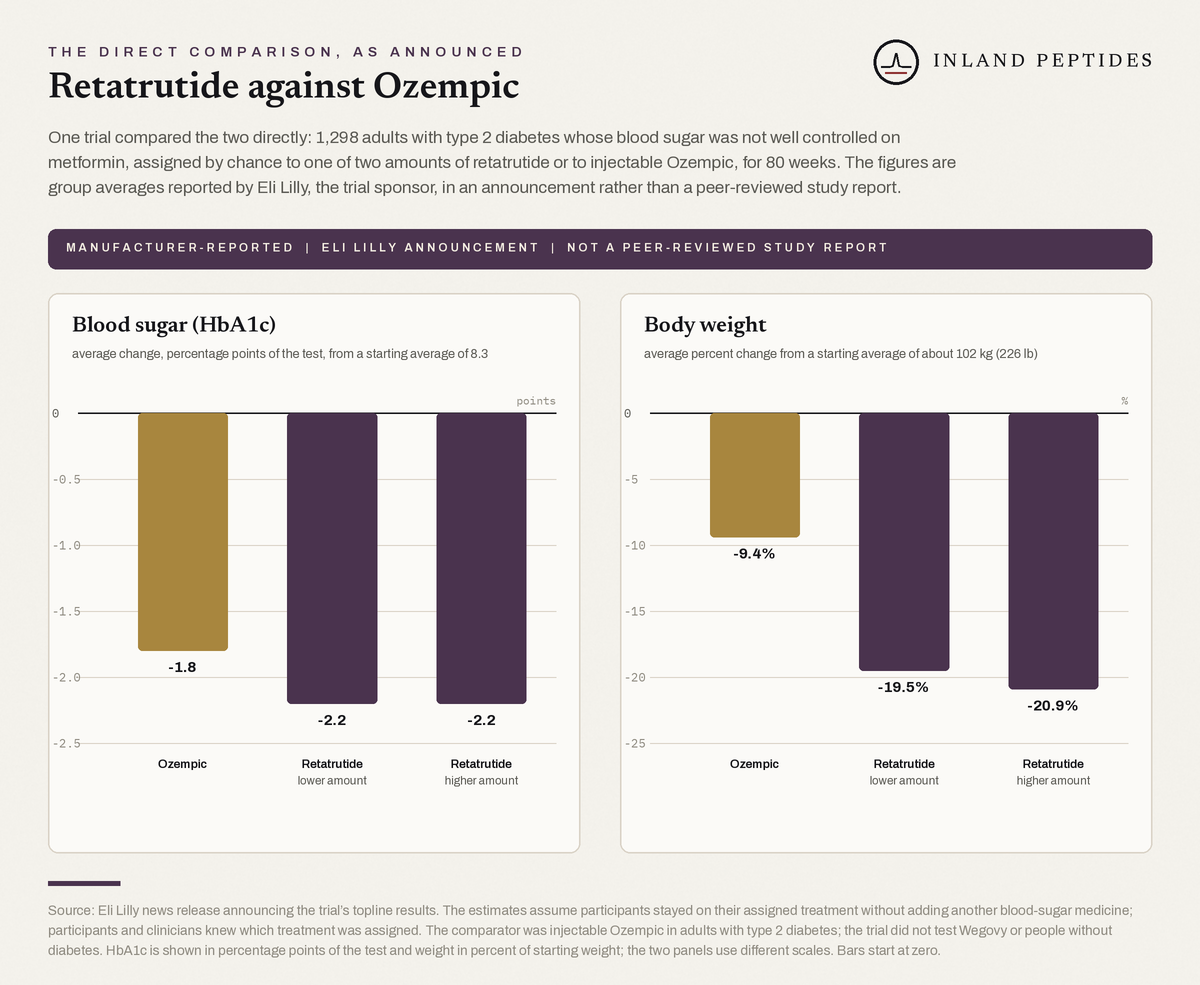
In a direct trial reported by Eli Lilly, retatrutide lowered blood sugar more and produced about twice the weight loss of injectable Ozempic in adults with type 2 diabetes over 80 weeks.
The direct comparison with Ozempic
Lilly reported an 80-week trial involving 1,298 adults with type 2 diabetes whose blood sugar was not well controlled on metformin, with or without a second oral diabetes medicine. Participants were assigned by chance to two retatrutide groups or injectable Ozempic.
HbA1c, a blood test that reflects average blood sugar over about three months, fell by an average of 2.2 percentage points with either amount of retatrutide and 1.8 points with Ozempic.
Average body weight fell by about 20 to 21 percent with retatrutide and about 9 percent with Ozempic. These are group averages, so individual results can differ.
These figures come from Lilly’s announcement, rather than a study report reviewed by independent experts.
Participants and clinicians also knew which treatment each person received.
The estimates assume participants stayed on their assigned treatment without adding another blood-sugar medicine.
What the comparison does not cover
The trial tested injectable Ozempic in adults with type 2 diabetes. It did not test Wegovy, the separate semaglutide product used for weight management, and it did not include people without diabetes.
These results therefore do not establish how retatrutide compares with other semaglutide products or in other populations.
Each compound on its own
For context, each compound has its own trials against placebo, an inactive look-alike given to a comparison group, in adults with obesity, or overweight with a weight-related condition, and no diabetes. In an 80-week retatrutide trial of 2,339 adults, average weight fell by about 18 to 25 percent across three amounts, against about 4 percent with placebo. It was funded by Eli Lilly.
In a separate 68-week semaglutide trial of 1,961 adults using injectable semaglutide studied for weight management, average weight fell by about 15 percent, against about 2 percent with placebo. It was funded by Novo Nordisk.
Those two trials studied different people for different lengths of time, so their percentages do not establish a direct comparison.
How do the reported side effects compare?
Digestive effects were common with both compounds in the direct trial, though their frequency varied by symptom.
Lilly reported diarrhea in 28 to 33 percent of people on retatrutide and 26 percent on Ozempic, and nausea in 21 to 24 percent against 21 percent. Most reported events, however, were mild to moderate and resolved during treatment.
Unusual skin sensations, such as tingling, affected 5 to 7 percent of participants receiving retatrutide, compared with about 3 percent receiving Ozempic. About 5 to 8 percent stopped retatrutide because of reported health problems, compared with about 3 percent on Ozempic. These events are recorded whether or not treatment caused them.
In an earlier 48-week retatrutide trial in adults with obesity, or overweight with a weight-related condition, heart rate increased in a way that depended on the amount, peaked around 24 weeks and then declined.
Semaglutide’s prescription products carry established warnings. The Ozempic and Wegovy labels carry a boxed warning that semaglutide caused thyroid C-cell tumors in rodents. Whether that applies to people, though, is unknown.
These products must not be used by people with a personal or family history of medullary thyroid carcinoma, a rare thyroid cancer, or MEN 2, an inherited condition that raises its risk.
The labels also warn about pancreatitis (inflammation of the pancreas), gallbladder disease, kidney injury from dehydration and worsening of diabetic eye disease.
Reported side effects do not capture every possible risk. A shared receptor target does not establish an identical safety profile, and a manufacturer’s summary is not the full safety record of a trial.
So what is the difference?
Retatrutide activates three hormone receptors, while semaglutide activates one.
Lilly reported greater blood-sugar reductions and about twice the average weight loss with retatrutide versus injectable Ozempic in adults with type 2 diabetes. Unusual skin sensations and stopping treatment because of reported health problems were more frequent with retatrutide.
Still, that finding covers one semaglutide product in one population. It does not settle how retatrutide compares with Wegovy or in people without diabetes.
A clinician can explain prescription treatment options based on a person’s health and medical history.