Third-party peptide testing is performed by an outside laboratory. Manufacturer testing is performed inside the company that produced the peptide. Neither approach automatically produces more reliable results. The method used, the competence and impartiality of the laboratory, how the sample was selected and handled, and whether anyone can verify the findings all matter.
The name on a test report tells you who performed the analysis. It does not necessarily tell you who selected the sample, how it was handled, or whether the result was independently checked. An outside laboratory can do poor work, and an in-house laboratory can do excellent work.
The methods may be similar. The key differences are who controls the sample, performs the analysis, and can verify the result.
How Do Third-Party and Manufacturer Testing Compare?
| Third-party testing | Manufacturer testing | |
|---|---|---|
| Who performs the testing | A laboratory that does not belong to the company selling the product | The company’s own laboratory, or a quality group inside the company |
| Who selects and collects the sample | Can be the manufacturer, an independent sampling organization, or laboratory personnel, depending on the arrangement. Paying for a test and choosing the sample are separate jobs | Company personnel or an independently arranged collector may select the sample; in-house analysis does not, by itself, establish who chose it |
| Who pays for the analysis | The party that commissioned the test | The manufacturer |
| Potential conflicts of interest | Commercial relationships may create pressure. The outside laboratory must protect the impartiality of its reporting | The company is reporting on its own product. Regulated drug manufacturing addresses this by calling for a quality unit separate from production |
| Testing equipment and methods | Varies by laboratory. Highly capable laboratories and limited ones both exist | Varies by manufacturer, and can be better or worse than an outside laboratory it might hire |
| Laboratory accreditation | May or may not be accredited. Accreditation covers only the specific activities in the laboratory’s published scope | May or may not be accredited. The same scope limit applies |
| Reliability of results | Depends on the method, laboratory competence, impartial reporting and sample condition, not outside status alone | Depends on the same things |
| Independent verification | The issuing laboratory may confirm the report’s authenticity, but not whether the sample represents a batch | Internal records may be reviewed or independently audited; an outside retest can provide additional evidence |
| Limitations of the findings | Covers the tests performed on the sample submitted. Other properties require their own tests | The same limits apply to the submitted sample. Internal review does not replace independent verification |
What Is Third-Party Peptide Testing?
It means the analysis was performed by a laboratory that does not belong to the company selling the product.
The term identifies who performs the analysis, not who selected the vial, collected it, shipped it, or verified the report afterward.
For example, a company may choose a sample, send it to an outside laboratory, and pay for the analysis. The report describes the submitted sample and the tests performed. It does not establish that the sample represents every vial in the batch.
How Do Manufacturers Test Their Own Peptides?
Manufacturers use their own laboratories or internal quality-control departments. In regulated pharmaceutical manufacturing, these functions operate within documented quality systems.
FDA guidance for active pharmaceutical ingredients calls for a quality unit independent of production. That unit reviews manufacturing records and has responsibility for releasing or rejecting batches. Its oversight takes place within the company, rather than at an outside testing laboratory.
Well-run in-house testing can provide strong evidence. Without documented quality controls, however, the phrase ‘in-house tested’ reveals little about how the result was produced or reviewed.
The FDA guidance addresses manufacturers of active pharmaceutical ingredients. It is guidance, not a regulation that automatically governs every peptide supplier or laboratory. Whether drug regulations apply to a particular product depends on its intended use and other facts, not solely on a research-use disclaimer.
Is Third-Party Testing More Reliable Than Manufacturer Testing?
Not necessarily. Outside testing separates the laboratory from the seller, but reliability still depends on the method, the laboratory’s competence and impartiality, and how the sample was selected.
When a company provides only its own results, the company is also the source of the measurement. An outside report gives readers another organization to contact, although that alone does not guarantee impartiality or accuracy.
An outside laboratory can face commercial pressures, including the possibility of repeat business from the client paying for the test. ISO/IEC 17025 treats impartiality as something laboratories must actively protect. An internal laboratory is not biased or inferior simply because it belongs to the manufacturer.
Technical accuracy depends on the method, the equipment, the analyst, and the condition of the sample. Independence can help protect impartial reporting, but it does not by itself make an instrument more accurate. Both technical competence and impartiality matter.
Even competent laboratories can obtain different results. That is why accredited laboratories monitor their performance through proficiency testing and comparisons with other laboratories. One report is evidence from one measurement, not a guarantee that every laboratory would obtain an identical result.
Who Chooses the Samples Sent for Testing?
It depends on the arrangement, and it is not always the party that paid for the test. Commissioning a test, selecting which units to test, physically collecting them, submitting them and performing the analysis are five separate jobs, and they can sit with different people.
A manufacturer, an independent sampling organization, or laboratory staff may choose and collect the material, depending on the agreement. If the report does not say who did so, readers cannot determine how much control the seller had over the submitted sample.
A laboratory tests the material it receives. Unless it also selected and collected the sample, it may not know how that material was chosen or whether it represents the larger batch. The report describes findings from the submitted sample, subject to the limits of the methods used.
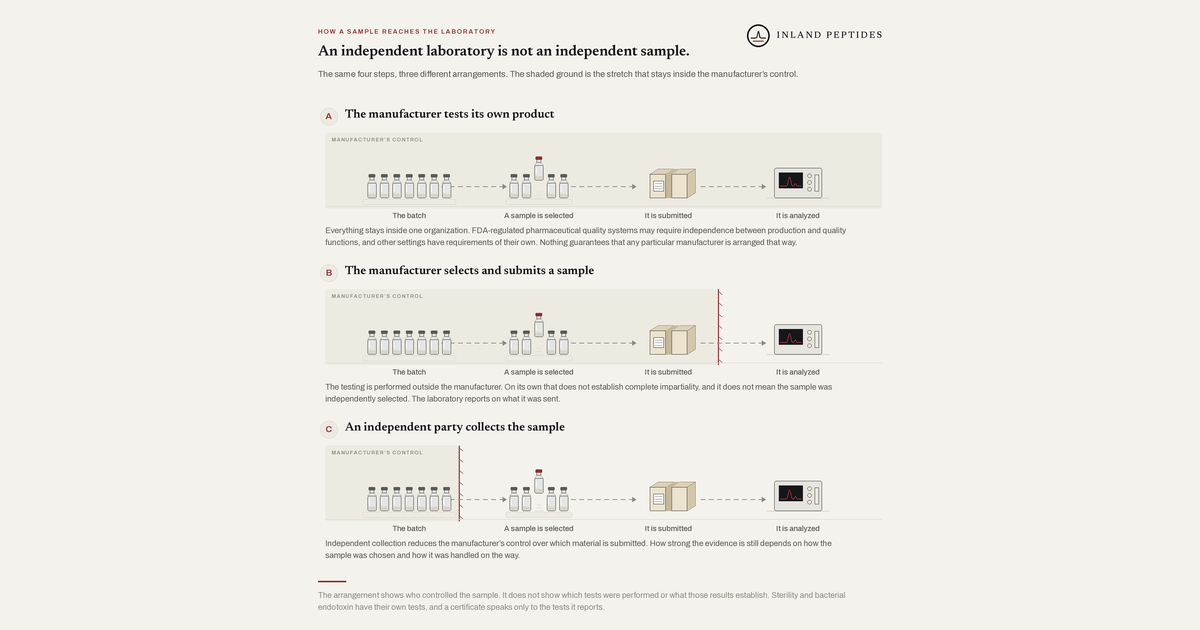
Three ways a sample can reach the laboratory
The manufacturer tests its own product. Selection, collection, handling and analysis all sit with one party.
The manufacturer selects a sample and submits it to an outside laboratory. The analysis sits outside the company. The selection does not. The phrase third-party tested can describe this.
An independent party collects the sample and submits it for testing. Both the selection and the analysis sit outside the company.
Both the second and third arrangements can be described as third-party testing. But in the second, the manufacturer still decides which sample goes to the outside laboratory. That difference matters when judging how representative the result may be.
Independent collection is a safeguard rather than a guarantee. It reduces the seller’s control over what gets tested, and it does not by itself establish that the sample represents the batch. How the units were selected, whether the handling was documented from collection to laboratory, and whether the batch was produced consistently all still matter.
In regulated pharmaceutical manufacturing, FDA guidance calls for samples that are representative of the batch they are taken from and the method to specify how many containers to sample, which part of the container to sample, and how much to take, with the numbers set by a written sampling plan.
Sampling can fall within a laboratory’s accredited scope. An organization that collects samples for later testing can itself be accredited. Either way, sampling is assessed on its own terms rather than covered automatically because the analysis was accredited. Laboratory independence and sample independence are two different things.
Whether a tested sample represents the rest of a batch depends on the sampling plan and the consistency of production.
Does ISO/IEC 17025 Accreditation Guarantee Accurate Results?
No. It is meaningful evidence of competence within a defined scope, and it is not a guarantee about any individual result.
ISO/IEC 17025 is the international standard for testing and calibration laboratories. It sets out requirements for the competence, impartiality and consistent operation of laboratories, covering personnel, equipment, methods, method validation, sampling, handling of test items, measurement uncertainty, and how results are reported. Accreditation to it means an accreditation body assessed the laboratory against those requirements and found it competent.
The limit is scope. Accreditation applies to the specific activities listed in the laboratory’s scope of accreditation, and does not automatically mean the laboratory is competent to perform every type of test it offers. A laboratory can be accredited for one analysis on a report and not for another. The scope is published by the accreditation body, and it is worth reading.
Laboratories are accredited, rather than certified, under ISO/IEC 17025. A claim of ‘ISO 17025 certification’ therefore deserves clarification. Accreditation is not a verdict on every service a laboratory offers, and lack of accreditation alone does not prove incompetence or dishonesty.
Can You Trust a Certificate of Analysis?
Only if you can verify the report and understand what was tested. A certificate describes specified tests on an identified sample. It cannot, by itself, prove that the report is genuine, that the sample matches the product you have, or that the methods were appropriate.
A report can accurately reproduce a laboratory’s recorded results and still be irrelevant to the vial being sold. Verification must establish who issued the report, which material was tested, and whether the test addressed the question being asked.
For active pharmaceutical ingredients, FDA guidance describes the information a certificate of analysis should carry: the substance and batch, tests performed, acceptance limits, numerical results where applicable, release date, authorized signature, and original manufacturer’s details. When intermediaries issue a new certificate, the guidance calls for additional traceability information, including the testing laboratory and the original batch certificate. These recommendations apply to that manufacturing context; they do not automatically bind every research peptide seller. A report with missing identifiers or test details may be difficult to verify.
Finished-drug manufacturing regulations allow a company to use a supplier’s report for some component tests only if the company conducts at least one identity test on that component and establishes the reliability of the supplier’s analyses through appropriate validation of their test results at appropriate intervals. That is a binding regulation rather than guidance.
How Can You Verify Third-Party Peptide Test Results?
Check the report with the issuing laboratory, then establish a traceable connection between the tested sample and the product being sold.
The report should identify the laboratory clearly enough for you to contact it independently. A logo alone is insufficient.
There should be a report or accession number the laboratory can look up, so that someone other than the seller can check the document.
The sample identification should connect to the product you were sold. A batch or lot number printed on both is the simplest form of that link, and accompanying records can serve the same purpose where the certificate itself does not carry one. What matters is that an identifiable connection exists and can be followed.
Check whether the dates are consistent. An older certificate may be valid for an older batch. Compare the report date, batch identity, storage history, and any stability or retest information with the product being sold.
Where a method generates numerical results, the report should provide the results and relevant acceptance limits, rather than only saying ‘conforms’.
If accreditation is claimed, the laboratory’s scope of accreditation should cover the tests on the report.
Two checks go beyond reading the document. First, contact the laboratory through independently obtained details and ask it to confirm the report against its records, including the sample identity, dates, and tests. Confirmation supports the document’s authenticity, but it does not prove that the result was accurate or that the submitted sample represented the full batch.
Second, an independently obtained sample can be tested by a different laboratory. That provides evidence about material the seller did not choose for the retest. Regulated manufacturers also retain reserve samples so batch quality can be evaluated later; those samples do not automatically make the original selection independent.
Does Third-Party Testing Mean a Peptide Is Safe?
No. A test result describes what the test measured. Safety, effectiveness and regulatory approval are different questions, and a test answers only the one it was run to answer.
A purity result describes how much of the detector signal came from the target compound. It is not a safety finding.
Sterility and bacterial endotoxin have their own tests. A properly performed sterility test gives evidence about sterility, within the limits of that test and what it was validated to cover. An identity or purity result establishes nothing about sterility when no sterility test was run.
No laboratory report confers regulatory approval. Whether an approved medicine exists containing the same substance is a separate question from whether the particular product in front of you is that medicine, and from how it is intended to be used.
Effectiveness is a clinical question. It is not something an analytical laboratory is asked or able to answer.
A laboratory report supports conclusions about the sample and measurements it documents. It cannot by itself establish the quality of every vial in a batch, or the safety or effectiveness of using the substance in people.