ISO/IEC 17025 accreditation is evidence that an independent body assessed a laboratory and found it competent for a defined set of activities.
It does not guarantee that every result is correct.
It also does not automatically cover every test the laboratory offers or establish that a product is safe.
“ISO 17025 accredited,” “ISO certified” and “third-party laboratory tested” mean different things. Only the first specifically describes an assessment of laboratory competence.
This guide explains what accreditation covers, how to check whether it applies to your peptide test, and what it cannot tell you.
What testing claims actually mean
Here is what each claim tells you and what you still need to check.
| The claim | What it can mean | What it does not establish |
|---|---|---|
| ISO/IEC 17025 accredited | An accreditation body assessed the laboratory’s competence for activities within a defined scope. | That your test is covered, that every result is correct, or that the report is authentic. |
| ISO 9001 certified | A certification body assessed the organization’s quality management system. | Technical competence to perform a particular test. This assessment does not normally examine it. |
| Third-party tested | A laboratory other than the seller ran the test. | How independent the laboratory is, who selected and prepared the sample, whether the laboratory is accredited, or whether all results were disclosed. |
| In-house tested | The manufacturer or seller ran the test. | Independent testing. The work may still be competent, but you need supporting methods and records. |
What ISO/IEC 17025 is
ISO/IEC 17025 is the international standard for testing and calibration laboratories.
ISO published the current edition in November 2017. This third edition was later reviewed and confirmed in 2023 and remains current.
That edition also widened the standard to cover sampling associated with subsequent testing or calibration.
An accreditation body assesses the laboratory’s competence, impartiality and consistent operation.
The assessment covers the laboratory’s quality management system: how it documents its work, handles samples, controls records and deals with problems.
It also examines technical competence:
- Whether staff are qualified
- Whether equipment is calibrated with documented metrological traceability
- Whether methods have been validated
- How measurement uncertainty is handled
- How the laboratory checks the reliability of its results, including through outside comparisons
Proficiency testing is one way to make those comparisons.
Several laboratories analyze comparable samples, and each one’s performance is evaluated against pre-established criteria.
The comparison value may come from a reference sample, the participants’ results, or another recognized procedure.
A2LA, a U.S. accreditation body, says that in most cases it requires at least one proficiency testing activity before granting accreditation.
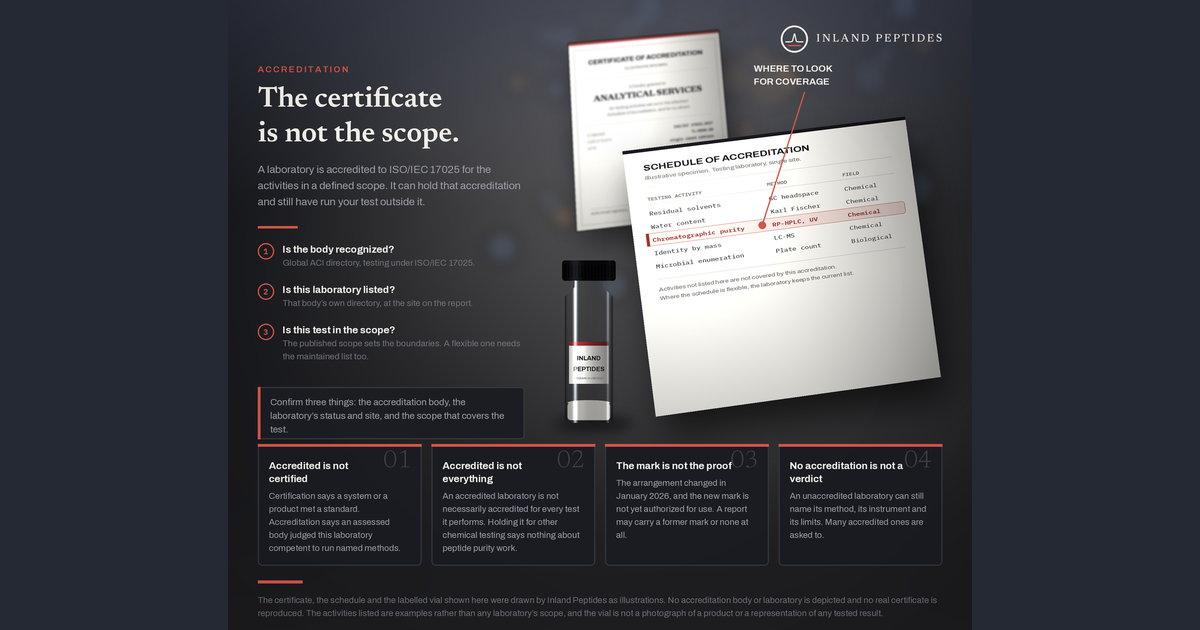
Accreditation and certification are different processes
Marketing copy sometimes uses these words interchangeably, but they mean different things.
The National Institute of Standards and Technology draws the line this way: certification checks credentials or conformity with requirements. Laboratory accreditation assesses the quality management system and competence to perform specific test methods within an approved scope.
Laboratories are accredited to ISO/IEC 17025 rather than certified to it.
A seller advertising “ISO 17025 certification” is using the wrong term. That wording alone, though, does not tell you whether the laboratory is accredited.
Instead, check which body granted the accreditation and which activities it covers.
ISO 9001 is a different standard, covering quality management systems in any kind of organization.
A2LA notes that ISO 9001 registration does not normally assess technical competence. ISO/IEC 17025 accreditation, by contrast, includes both a management system assessment and a technical competence evaluation.
A laboratory can hold ISO 9001 certification without holding laboratory accreditation.
A laboratory’s accreditation has limits
The scope determines whether accreditation covers the work on your report. A general accreditation claim does not answer that question.
The laboratory holds the accreditation. Its scope of accreditation describes the activities covered.
An accredited laboratory is not necessarily accredited for every test it performs.
That is because a laboratory chooses which activities to submit for accreditation. A2LA says organizations may apply for as many or as few tests as they wish; capabilities outside the scope are not covered.
A scope document typically identifies:
- The laboratory’s legal name and site
- The testing discipline, certificate number and validity information
- The activities, methods and limitations covered
Then check whether the work on your report falls within those activities and limits.
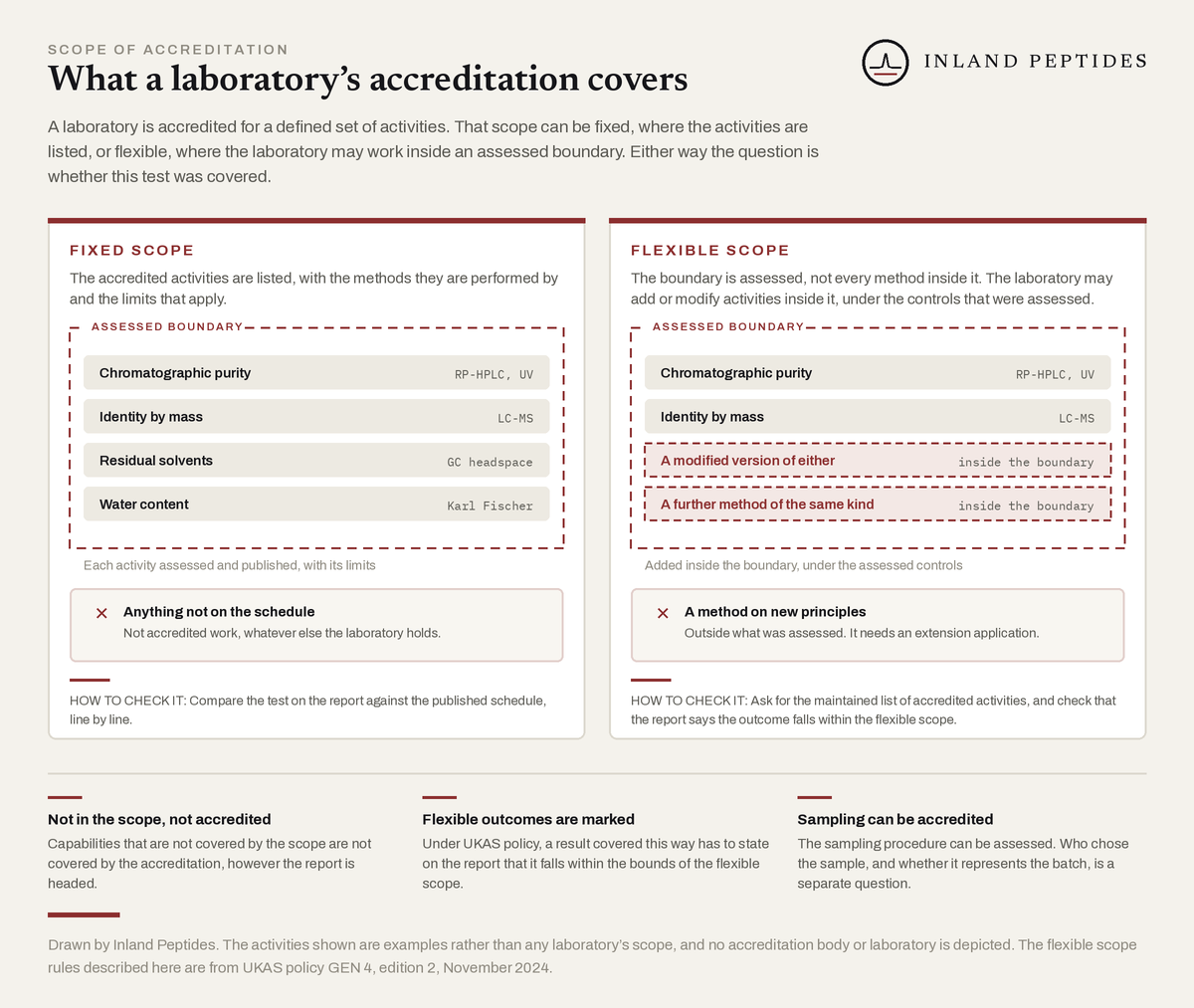
Fixed scopes and flexible scopes
With a fixed scope, compare the test, method and any limits against the published scope.
Some laboratories, though, hold a flexible scope, which requires a different check.
UKAS, the United Kingdom accreditation body, sets out how those work. A flexible scope lets a laboratory add or modify activities within assessed boundaries without a separate extension assessment each time.
UKAS sets several conditions:
- Activities based on principles outside the agreed boundaries require an application to extend the scope
- The laboratory must validate new or modified activities
- The laboratory must keep an up-to-date list of accredited activities and make it available on request unless there is good reason not to
- Reports must state when an outcome falls within the bounds of the flexible scope
- The published schedule must identify the areas of flexibility
So a method’s absence from the published schedule does not automatically mean the work was unaccredited.
For a fixed scope, check the published activities and limits.
For a flexible scope, you may also need the laboratory’s current activity list or confirmation from the laboratory or accreditation body.
Owning the equipment does not establish accredited status.
Accreditation for unrelated chemical testing does not establish that peptide purity testing is covered. Neither does having a chromatograph.
Who recognizes the accreditation body
Accreditation bodies are also evaluated through an international recognition arrangement.
Global Accreditation Cooperation Incorporated, or Global ACI, became fully operational on January 1, 2026. It took over the roles of the International Laboratory Accreditation Cooperation and the International Accreditation Forum.
The Global ACI Multilateral Recognition Arrangement (MRA) continues the international recognition previously provided through the ILAC MRA and IAF MLA.
Global ACI does not accredit laboratories itself. Instead, its Full Member accreditation bodies do that work.
A Full Member is an accreditation body accepted as a Global ACI MRA signatory. An Associate Member has not yet been accepted as a signatory.
Membership alone therefore does not establish recognition under the MRA.
Recognition applies to specific activities. So check that the body is recognized for testing under ISO/IEC 17025.
To verify an internationally recognized accreditation claim, check all three:
- The accreditation body is a Global ACI MRA signatory for testing under ISO/IEC 17025
- That body has accredited the laboratory and site named on the report
- The work on the report falls within the laboratory’s accredited scope
A laboratory can hold accreditation from a body that is not an MRA signatory.
That accreditation does not carry recognition under the arrangement. You would then need to evaluate the accreditation body and the laboratory’s scope separately.
How to verify an accreditation claim
Start with the report, then check the records held by the accreditation body.
- Find the testing laboratory’s name and location on the report. Accreditation applies to a named legal entity and site, so confirm the site that performed the work.
- Identify the accreditation body named in the claim. A certificate number can help you match the record, but not every accredited report displays one.
- Find the accreditation body in Global ACI’s directory of recognized bodies. Check its recognition for testing under ISO/IEC 17025, which is listed separately from calibration and other activities.
- Search the accreditation body’s own directory for the laboratory. Confirm its site and current status, then open its scope of accreditation.
- Check whether the scope covers the work on your report. For a fixed scope, compare the activity, method and limits. For a flexible scope, check the assessed boundaries and request the current activity list if needed.
- Contact the accreditation body if status or scope coverage is unclear, or if an accreditation document looks altered. It holds the authoritative accreditation record.
Claims that need a closer check
These details should prompt you to verify the claim:
- A badge or seal without enough information to identify the laboratory, accreditation body or accreditation record.
- “ISO certified” with no standard number and no body named.
- A certificate belonging to a different company, or to a different site of the same company.
- An expired certificate or a laboratory you cannot find in the accreditation body’s directory. Check its current status directly with the body.
- A scope that does not cover the work on the report. The accreditation may be genuine without covering that test.
- A seller’s claim standing in for the laboratory’s. Accreditation belongs to the laboratory, not to the company that sent it a sample.
An accreditation mark alone is not enough to verify a claim, especially during the current transition.
UKAS’s guidance on the mark change says the new Global ACI MRA Mark cannot be used until the registration process is complete. Previously authorized users may continue using the former ILAC MRA and IAF MLA marks during the transition, subject to existing agreements and the rules for their economy.
Global ACI’s published FAQ also currently says Full Members are not authorized to use the new mark in any economy.
A report may therefore carry a former mark or no mark. Under the currently published guidance, it should not yet carry the new one.
Check the directory entry and scope regardless of which mark appears.
What accreditation does not prove
Accreditation does not, by itself, establish any of the following:
- That every test on the report is accredited. A laboratory may perform both accredited and non-accredited work.
- That the tested sample represents the advertised batch. Sampling can be accredited as part of a testing laboratory’s scope or through a stand-alone sampling organization. That assesses the sampling procedure; it does not automatically establish how a particular seller’s sample was chosen or whether it represents the batch.
- That the report is authentic. Marks can be copied. Check accreditation through the body’s directory and confirm the test report with the issuing laboratory.
- That the material is safe to use. Laboratory accreditation is not product safety approval.
- That a purity result establishes peptide quantity, sterility or endotoxin levels. Each requires its own measurement and result.
- That the material remains in the condition tested. Shipping and storage can affect it after testing.
A laboratory without accreditation is not automatically a bad laboratory
Accreditation is often voluntary in commercial testing.
But some regulatory programs and purchasing agreements require it. A2LA provides accreditation for programs with those requirements.
Where accreditation is optional, a laboratory decides which activities to submit for assessment. The process takes money and staff time.
A small laboratory may use validated methods carefully without holding accreditation.
When evaluating a non-accredited laboratory, ask for evidence such as:
- Documented method validation
- Participation in proficiency testing
- Equipment calibration with documented metrological traceability
- The data behind a result, rather than a summary figure
- A willingness to confirm a report against its own records when contacted independently
Accreditation adds an independent assessment of competence.
The accreditation body assesses the laboratory and makes its status, scope and identifying details available.
Detailed assessment findings are not necessarily public. You can still verify the decision and scope without seeing every finding behind them.
Without accreditation, you need to evaluate the laboratory’s supporting evidence directly. Independent audits and proficiency-testing results may help, but they do not establish accredited status.
Comparing two reports
Compare what the reports document, rather than how many logos they display.
- Does each report name the laboratory clearly enough to contact it independently?
- Does each identify the method and testing activity clearly enough to check any accreditation claim?
- Does each have a report number the laboratory can verify and a batch or lot identifier linked to the product?
- Does each provide the measured result? A measurement does not always need a pass/fail threshold. If the report states that the sample complies with a requirement, it should identify that requirement.
- Where accreditation is claimed, does the scope cover the work on that report?
- Will the laboratory confirm the report when you contact it using independently verified details?
An accredited laboratory working inside its scope is the stronger starting point.
You still need to check how the sample was selected, what was measured, and how the material was handled after testing. Accreditation alone does not answer those questions.