To spot a fake peptide certificate of analysis (COA), verify the issuing laboratory, check the report details, and confirm that the tested sample matches the batch being sold.
A certificate can look convincing and still say little about the vial you are buying. Documents can be altered, copied, or reused for products they were never meant to describe.
Ask three questions: Did the laboratory issue this report? Does it describe the batch being sold? Do the results support the seller’s claims? Even a genuine laboratory report can leave the last two questions unanswered.
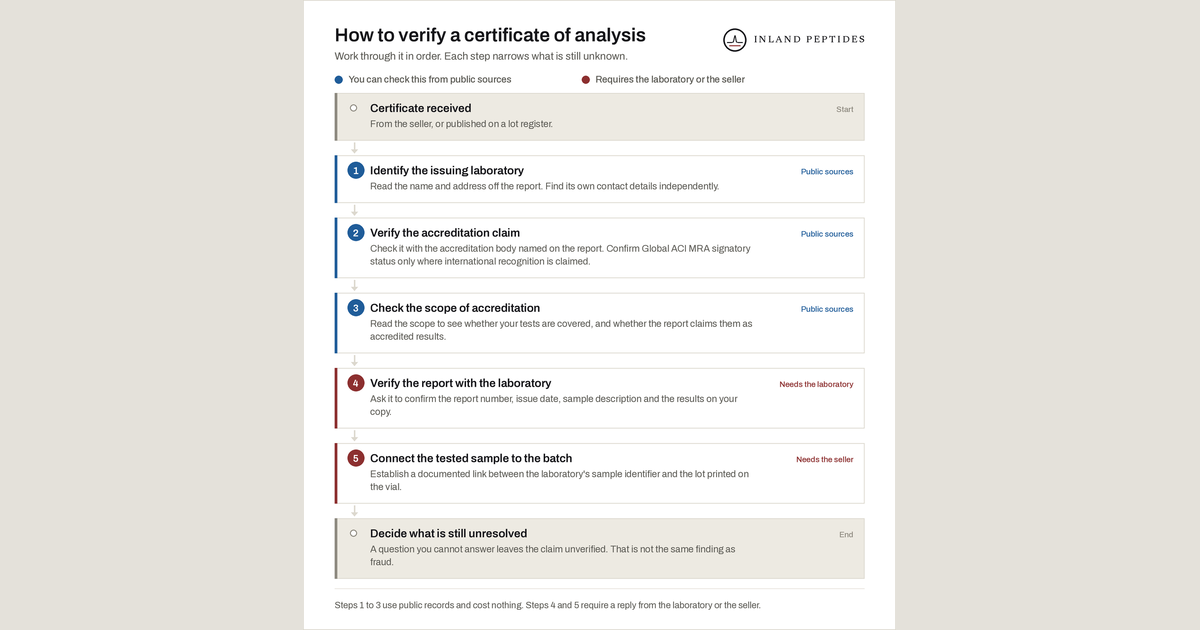
The seven-step verification procedure
Start with the certificate itself. Check accreditation only if the report or laboratory claims it.
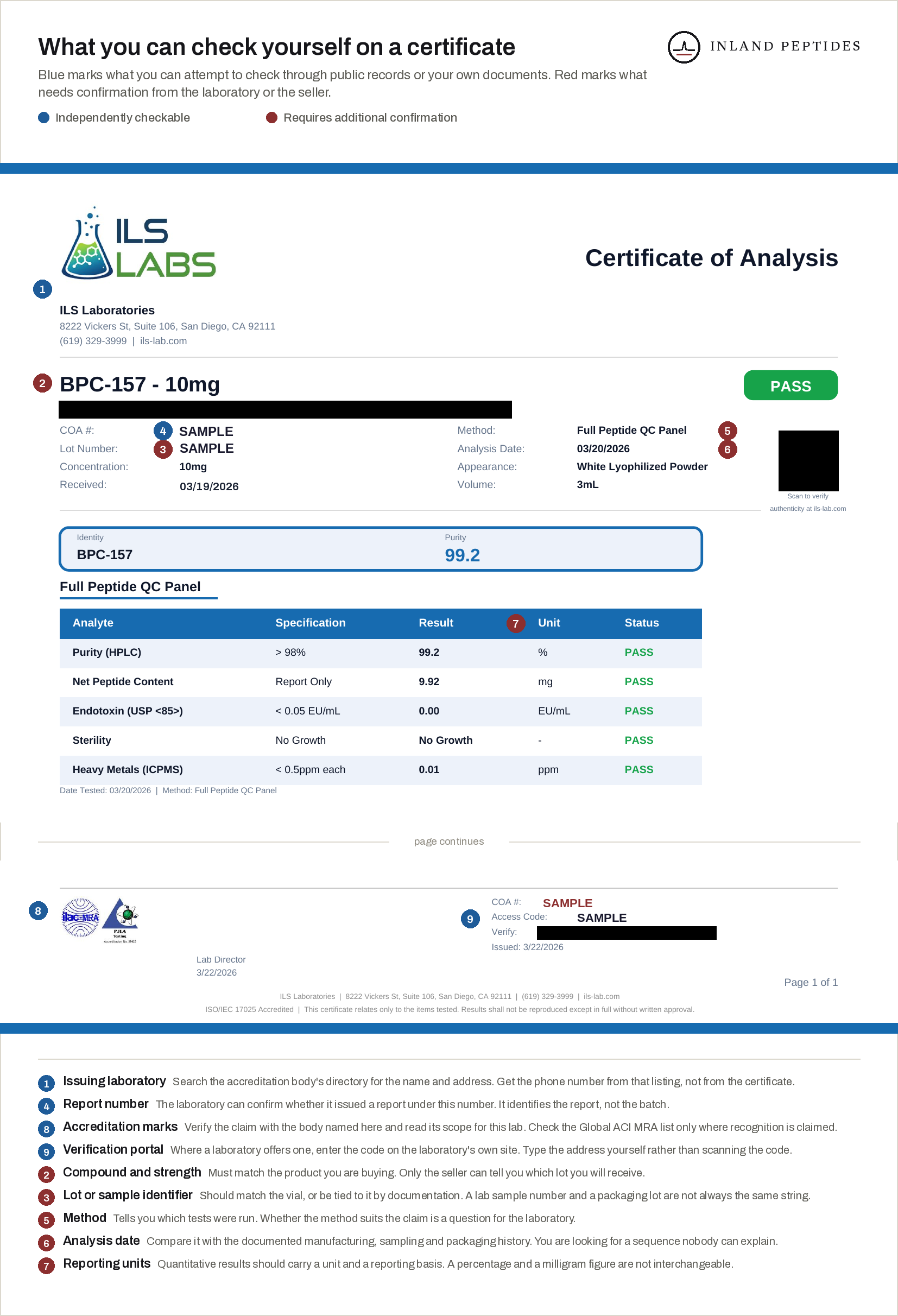
- Read the lot or sample identifier. Write it down. You will need a documented connection between the tested sample and the vial you receive. If the certificate has no identifiable sample reference, ask how it can be traced.
- Find the report or accession number. This identifies the laboratory report rather than the manufacturing batch. Use it when you contact the laboratory.
- Identify the laboratory. Then find its official contact details independently, not through information printed on the certificate.
- Check any accreditation claim with the body named on the report, using that body’s own directory of accredited laboratories. If the report also claims international recognition under the Global ACI Multilateral Recognition Arrangement, confirm the body is a recognized signatory for that scope.
- Read the accreditation scope, if one is claimed. Check whether the listed tests fall within the laboratory’s scope and whether the report presents them as accredited results.
- Check the testing dates. Material may be tested before packaging or retested after delivery. Ask the seller to explain any unusual sequence.
- Contact the laboratory. Provide the report number, sample identifier, and issue date, then ask what the laboratory can confirm.
Checking the dates or tracing the sample may also require documentation from the seller. The laboratory can help verify the report, but not every product claim.
How certificates get falsified
A testing laboratory describes four forms of COA misrepresentation:
- Altered results. A real certificate with values changed, usually to turn a failing result into a passing one.
- Fabricated documents. A certificate created with no testing behind it.
- Lot reuse. A genuine certificate from an earlier lot presented with a new shipment.
- Misrepresented accreditation. The laboratory cannot be found, or it exists but is not accredited for the tests the report claims as accredited.
A reused certificate may be entirely genuine. The question is whether the sample it describes came from the batch being sold.
A documented case of certificate copying
In 2016, Alkemist Labs in Costa Mesa discovered certificates that closely copied its report format. The issue surfaced after an industry contact forwarded a sales email containing a report presented as Alkemist testing.
Chief executive Elan Sudberg searched the laboratory’s information management system for the lot and sample numbers. But he found no corresponding analysis in Alkemist’s records. He wrote that over the previous twenty years the laboratory had found copies of its certificates several times, attached to hoodia, green coffee bean extract, green tea, ginkgo and ginseng extract.
Sudberg advised buyers to ask which laboratory did the testing, then contact the laboratory directly.
Those cases involved botanical and supplement materials, not peptides. The lesson still applies: a professional layout and familiar laboratory name do not prove who issued a report.
When the testing itself is unreliable
A dry lab is a testing laboratory that issues results without running the analysis. John R. Endres described the practice in 2012 as a laboratory that, instead of testing, “provides fabricated testing results.”
In March 2012, Dateline NBC sent a deliberately adulterated supplement sample to Atlas Bioscience. The laboratory failed to identify the arsenic and lead in it and issued a report showing passing results.
The investigation showed that a report from a real laboratory can contain unreliable results. But it did not establish that every claimed test was skipped. Incorrect testing, unsuitable methods, fabricated results, and tests never performed are different failures. The investigation concerned dietary supplements, not peptides.
How to verify a report with the laboratory
Contacting the issuing laboratory is one of the strongest checks you can make. But confirmation has limits.
What to ask
Ask the laboratory to confirm as many of these details as it is authorized to disclose:
- The report or accession number.
- The issue date.
- The sample description, including what it received and when.
- The results shown on the copy you were given.
- Whether that report has since been revised or superseded.
Get contact information from the laboratory’s official website or an independently verified accreditation listing. That matters because a forged report may give a number controlled by the seller.
What the answer can and cannot establish
A laboratory may confirm that a report number is genuine without confirming that your copy is unchanged. Nor does confirmation, by itself, establish:
- That the copy you hold is unaltered.
- That the sample tested represents the batch being sold.
- That the laboratory, rather than the seller, selected the sample.
- That every vial in your shipment matches the tested material.
- That the results themselves are scientifically reliable.
A seller could attach a genuine report from one batch to a different shipment. The laboratory may confirm the report without knowing how the seller is using it.
Confidentiality can limit what a laboratory discusses. Sudberg noted that an agreement may prevent a supplier from naming its testing laboratory. A laboratory may also require client permission before confirming report details. If it cannot confirm them, the report remains unverified. That is not proof of fraud, though.
If a seller says it cannot share test results
Ask for the specific reason. When a company told ConsumerLab that it could not release heavy metal results “in compliance with FDA standards,” ConsumerLab asked the FDA, which replied that it was “not aware of any general regulation that prohibits companies from sharing their own testing results” for heavy metals with customers. That exchange concerned food products rather than peptide certificates.
The FDA was addressing a supposed general prohibition on sharing a company’s own results. It did not mean, however, that every report must be disclosed. Contractual and confidentiality restrictions may still apply. When supporting documents are unavailable, the seller’s claim remains unverified.
How laboratory accreditation actually works
A laboratory that claims ISO/IEC 17025 accreditation is making a claim you can check. Start with the accrediting body.
On January 1, 2026, Global Accreditation Cooperation Incorporated took over the international recognition functions previously run by ILAC and IAF. Its Multilateral Recognition Arrangement replaced the ILAC MRA and the IAF MLA.
The division of labor matters for verification. Global ACI operates the recognition arrangement between accreditation bodies; it does not assess and accredit laboratories itself. Instead, accreditation bodies do that, and each maintains its own directory of the laboratories it has accredited.
Older ILAC marks: an ILAC MRA mark does not by itself indicate fraud. Under Global ACI transition rules, authorized organizations may continue using legacy marks until the new mark becomes legally available and the required notice is issued.
The six checks that make up an accreditation claim
- Identify the accrediting body. Look for its name, accreditation number, or mark. A laboratory that does not claim accreditation may still issue genuine test results.
- Verify the claim with that body directly. Accreditation bodies publish their own directories; the ANSI National Accreditation Board, for example, publishes a searchable directory of the laboratories it accredits.
- Check the laboratory’s accreditation status and any listed validity dates.
- Review its scope of accreditation for the testing you care about.
- Check whether the report actually claims that its results were obtained under accreditation. Accredited laboratories may also perform work outside their scope.
- Only if international recognition is claimed, confirm the body is a recognized signatory for the applicable scope, using the Global ACI signatory lists. Testing under ISO/IEC 17025 is one of eleven main scopes the arrangement covers.
A legitimate accreditation body does not have to take part in the international arrangement, so its absence from those lists is not a finding against the laboratory. Where recognition is claimed, Global ACI notes that not all accreditation bodies that are members of Global ACI are also signatories to the MRA. In other words, membership and signatory status are different things.
Reading a scope of accreditation
A scope is not a general endorsement. ANAB instead describes it as a document listing a laboratory’s specific test or calibration capability.
In practice a scope describes capability through combinations of methods, analytes, sample matrices and measurement ranges. Some laboratories also operate under a flexible scope that lets them adapt methods within defined limits. Global ACI itself divides recognition into levels and sub-scopes rather than a single yes or no.
Accreditation is not a blanket endorsement of every result. A report can include work inside and outside the laboratory’s accredited scope. Check the scope before assuming any particular test is covered.
ISO 9001 is not ISO/IEC 17025
ISO 9001 certification addresses a quality-management system. ISO/IEC 17025 accreditation, by contrast, addresses competence in specified laboratory activities. ANAB says accredited laboratories have been assessed to all the requirements of ISO/IEC 17025.
ANAB flags the substitution directly: where a laboratory cites ISO/IEC 17025 but produces only an ISO 9001 certificate when asked, “chances are it is not accredited.” Holding ISO 9001 does not make a laboratory dishonest. But it does mean the 17025 claim has not been evidenced.
What peptide certificates actually report
A peptide COA may include several different measurements. The four below answer different questions.
| Result | What it reports | What it does not tell you |
|---|---|---|
| Identity | Evidence that the material is the labeled peptide, often a measured molecular mass | Every structural feature; mass alone cannot distinguish all of them |
| Purity | The target peak’s share of the integrated peak area under the stated method | The share of the powder’s weight, or the milligrams in the vial |
| Net peptide content | What percentage of the powder’s weight is peptide rather than salts and water | The milligrams of target peptide in a given vial |
| Contaminants | Endotoxin, heavy metals and other named residues | Anything outside the panel that was run |
Purity and peptide content are often confused. An HPLC area-percent purity figure describes the detector response under one method, not the proportion of the powder’s mass that is peptide. A sample can be highly pure by that measure and still be well under 100 percent peptide by weight, because counter-ions and absorbed water add mass without adding peptide.
On identity, USP describes amino acid analysis for separating leucine from isoleucine, which weigh the same, and chiral testing for amino acids built in the mirror-image form.
For a fuller explanation, see our guide, How to Verify Peptide Quality and Read a Certificate of Analysis. Here, the important point is knowing what a reported result can and cannot establish.
What a genuine certificate still does not establish
Even a genuine certificate has limits:
- It describes the sample submitted, not every vial in the batch.
- It does not establish that the product is safe or correctly labeled.
- It covers only the tests that were ordered and completed.
ConsumerLab adds three failure modes that leave the document intact: a forgiving test, a test performed incorrectly, and results from a different product or formulation than the one you are buying.
Three certificates compared
A certificate may be authentic, unresolved, or inconsistent with the available evidence. The examples below show the difference.
| Verified | Unresolved | Clear discrepancy | |
|---|---|---|---|
| Laboratory | Laboratory identity independently confirmed, including the stated address or verified contact details | Accreditation listing unavailable, or laboratory identity not yet independently confirmed | The named laboratory denies the reported identity or contact details |
| Report number | The laboratory confirms the report and the details it is permitted to disclose match the copy | The laboratory will not discuss it, or needs client permission first | The laboratory, correctly identified, confirms it issued no such report |
| Lot identifier | The sample identifier matches the vial, or documents connect the laboratory sample to the packaging lot | Identifiers differ and no mapping has been supplied yet | The same lot number appears across unrelated production batches |
| Accreditation | If accredited results are claimed, the published scope covers the relevant activities | Accreditation not claimed, not independently established, or scope unclear | The claimed accreditor denies issuing the accreditation or the certificate number is false |
| Dates | Dates fit the documented product history | Unusual sequence without an explanation | Dates conflict with documented production history |
These scenarios are illustrative, not findings about any named laboratory. An unresolved question is a reason to seek evidence, not a finding of fraud.
What to do when something does not match
Ask for the document or explanation that would resolve the problem:
- The certificate for the lot you will actually receive. Not a sample report. The one matching the vial that ships.
- The laboratory’s name, address and report number, so you can verify it without going through the seller.
- Documentation linking the tested sample to the packaging lot, where the two identifiers differ.
- The scope of accreditation, or the accreditation certificate number, so you can look the scope up yourself.
- The method and the reference material used for any quantity result, since a milligram figure means little without the standard it was measured against.
If a seller cannot share the evidence, the claim stays unverified. Still, that does not establish fraud.
Commissioning your own testing
These advanced checks are more suitable for organizations that regularly commission independent testing. They are drawn from how laboratories are audited.
- Send a characterized reference material and ask the laboratory to report its purity, without supplying the specification sheet. You already know the expected answer.
- Ask for a test on a compound that should not be present. A clean result is mildly reassuring and no more than that, since reporting an absence says little about analytical competence.
- Have a finished product tested whose ingredient amounts you already know, and compare.
- Split a sample between two laboratories. Differences point you at questions to ask rather than at dishonesty, and only when the methods, sample preparation, detection limits and reporting bases are comparable enough for the numbers to mean the same thing.
No single check proves competence or fraud. Endres recommends ongoing laboratory qualification, including site visits and periodic reassessment. Repeatedly identical figures across separate production batches or implausibly rounded results can be a warning sign. Ask for an explanation before drawing conclusions.
The checklist to run before you buy
Use this checklist before relying on a COA. A missing answer is a question to investigate.
- The certificate names a laboratory, with an address.
- If the laboratory claims accreditation, its current listing can be verified through the accrediting body.
- If international MRA recognition is claimed, the accrediting body is a Global ACI MRA signatory for the relevant scope.
- If the report claims accredited test results, the relevant activities appear within the laboratory’s scope.
- The certificate carries a lot or sample identifier, and the seller can tie it to the vial you will receive.
- The dates fit the documented manufacturing, packaging and receipt history.
- Quantitative results carry a unit and a reporting basis, and qualitative results state plainly what was determined.
- The laboratory confirms what it is able to confirm about the report.
Laboratory confirmation matters, but it does not prove that the seller is shipping the tested batch or that your copy of the report is unchanged.