A Facebook Marketplace listing advertises a $50 T-shirt. Printed across the back is a menu of 15 peptide compounds, including retatrutide, tirzepatide, BPC-157 and TB-500, each accompanied by a claimed benefit.
The seller’s description reads: “Peptide t-shirts for sale multiple sizes dm for info.” There are no individual peptide prices on the shirt. Instead, the printed menu makes the clothing listing a promotion for peptides and invites interested buyers into private messages.
Similarly, three other Marketplace listings collected by Inland Peptides follow the same pattern: stickers printed with peptide names and strengths, a $1 storage-case post illustrated with vials and a stocked refrigerator, and another shirt reading “GOT PEPTIDES?” and “ASK ME ABOUT PEPTIDES.”
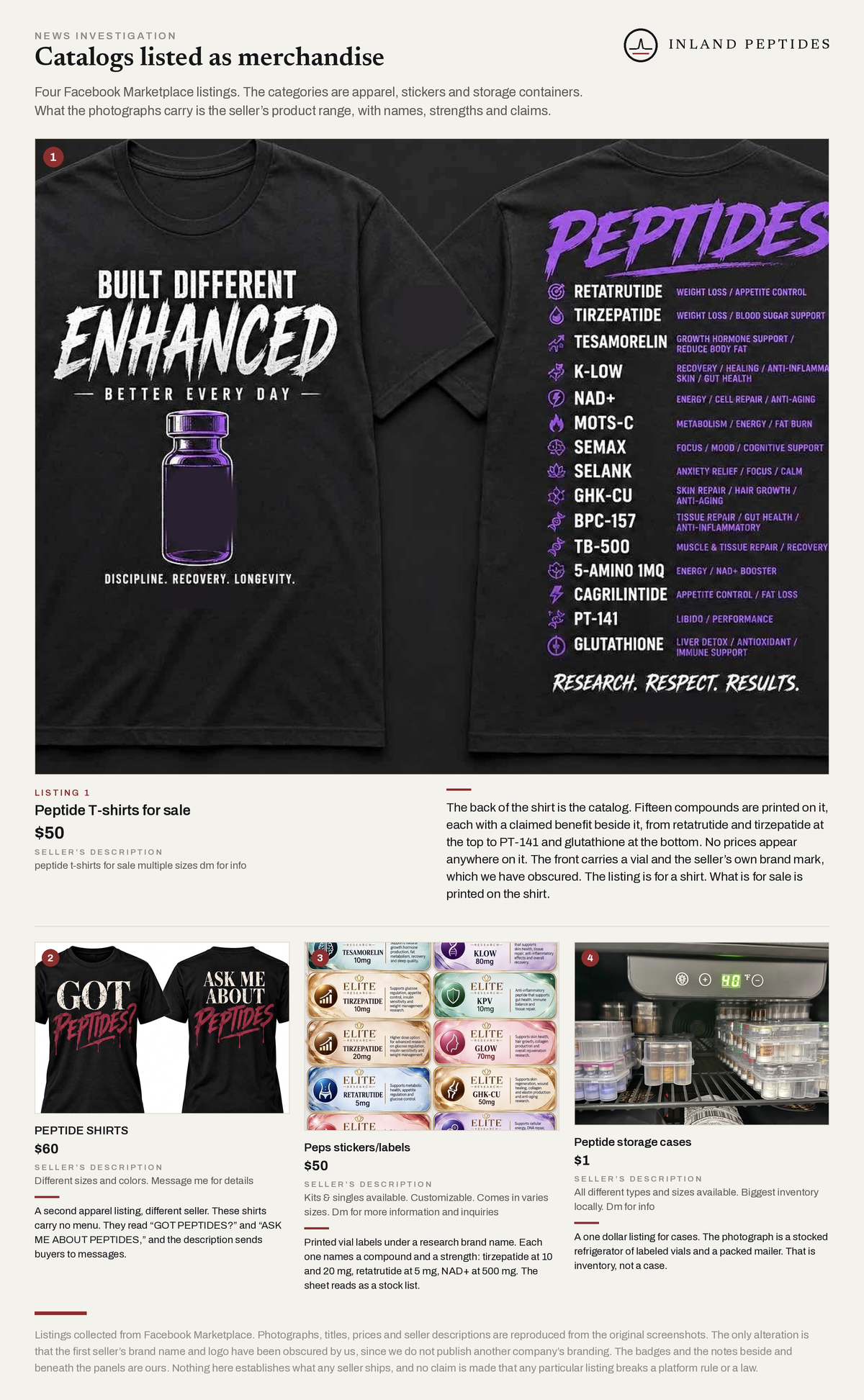
None of these listings expressly offers peptides for sale, and the screenshots do not establish whether any peptide transaction occurred. What they show is how merchandise can be used to advertise a range of peptide products.
Beyond Marketplace, the same questions follow other peptide advertisements: Who is behind the account? Where would the products come from? And what independent evidence supports the seller’s quality claims?
Common Seller Claims and What to Check
A few recurring claims reveal what buyers need to verify before placing an order.
| The claim | The red flag | What to verify |
|---|---|---|
| “We are a US company.” | No registered business name, no physical address, or an address that does not match a real location. | Look up the business name in the state registry. Put the address into a mapping service or a public geocoder. |
| “We manufacture our own peptides.” | No facility details, no named location, no evidence of production capability. | Ask where it is made and what the facility is registered as. A reseller that admits reselling is more credible than a reseller claiming a factory. |
| “Ships from the USA.” | Tracking that begins overseas, or long transit times with no domestic scan. | Check where the first tracking scan happened, not where the label was printed. |
| “Third-party tested.” | No laboratory named, no report, or the same report attached to several products. | Ask for the report covering your lot number, then contact the laboratory to confirm it issued that report. |
| “99% purity.” | A round number with no method, no laboratory and no date. | Ask what the figure measures. Purity against what, by which method, in which lot. |
| “For research use only.” | The same page promises weight loss, muscle growth or anti-aging. | Read what the product pages actually claim. Regulators do. |
The Sellers Behind the Ads
The merchandise listings are only one route. Paid advertisements can conceal important information about the accounts and businesses promoting the products.
Meta’s community standards prohibit content that contains merchandise depicting non-medical drugs, and separately prohibit attempts to buy, sell or trade prescription drugs outside narrow exceptions. Its advertising standards bar ads that promote the sale of merchandise depicting high-risk drugs.
Meta’s policies restrict some drug-related sales and advertising, including certain depictions on merchandise. Their application to any particular peptide listing depends on the product and the platform’s classification.
Paid Facebook advertisements collected for this article show another pattern: the same promotional artwork appearing under different account names.
Two accounts with very few followers published the same RT50 advertisement. The artwork, opening sentence and closing invitation to request a catalog and wholesale pricing through WhatsApp match.
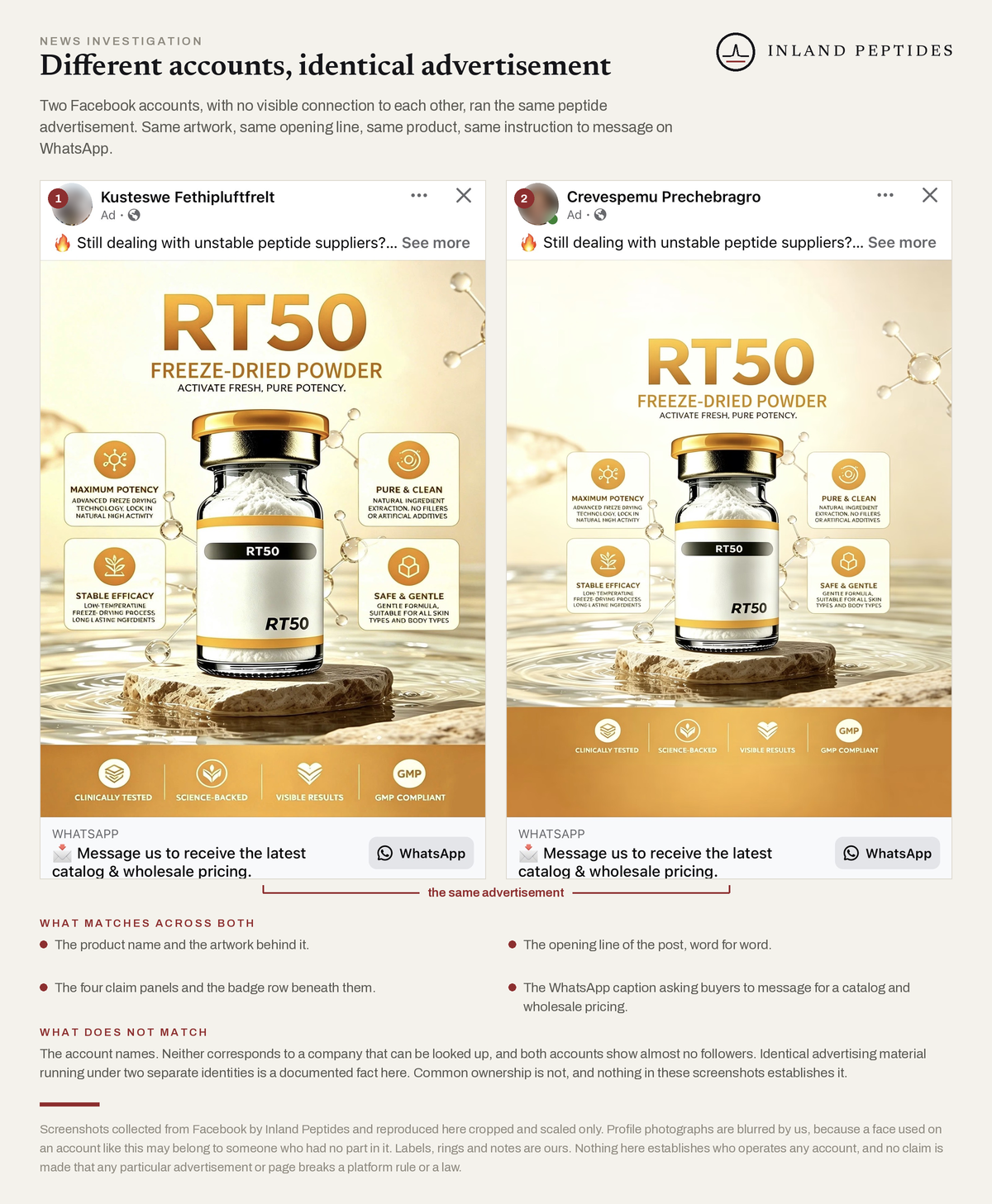
The screenshots establish that two differently named accounts used identical advertising. They do not establish who operates either account, but they give buyers a reason to look beyond the profile name.
The Federal Trade Commission has warned that social-media platforms do not always thoroughly vet advertisers. In 2025, consumers reported more than $95 million in losses from scams involving purchases made after seeing social-media ads across all product categories.
The Middlemen and the Manufacturing Claims
The ads raise questions about where the products are kept, who manufactures them and whether the seller controls the inventory it advertises.
Three separate Facebook accounts promoted a Texas peptide warehouse identity and domestic delivery. Two displayed nearly identical artwork, including the same bundles, purity badge and payment logos; the third used different artwork while repeating the warehouse claim.
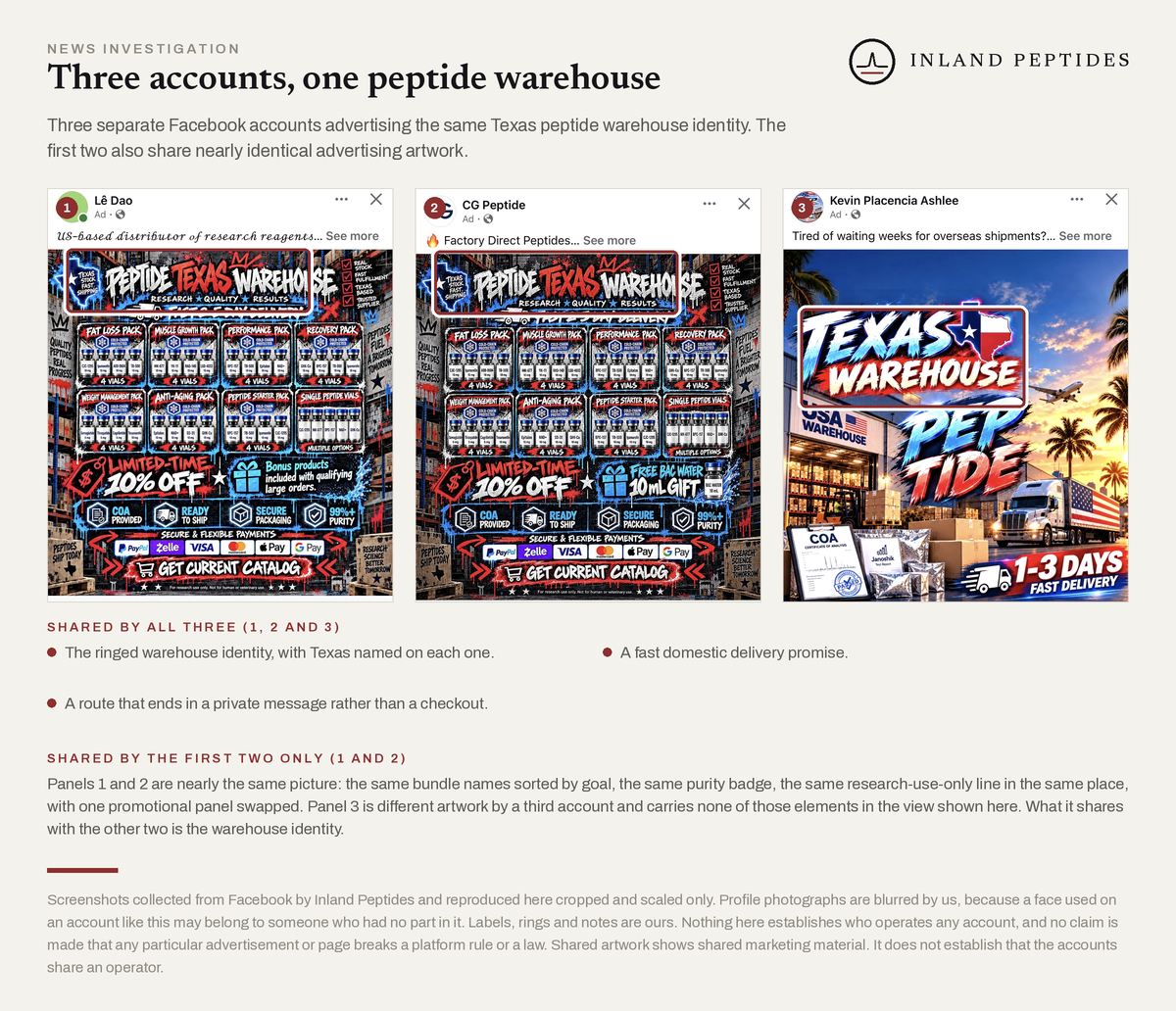
The advertisements claim a Texas warehouse, but none of the three provides a verifiable warehouse address in the screenshots. That is a reason to ask where the inventory is actually held.
Another advertisement describes the seller as a professional peptide manufacturer. The accompanying video shows shelves stocked with vials and asks whether viewers are tired of being scammed, before directing them to private messages.
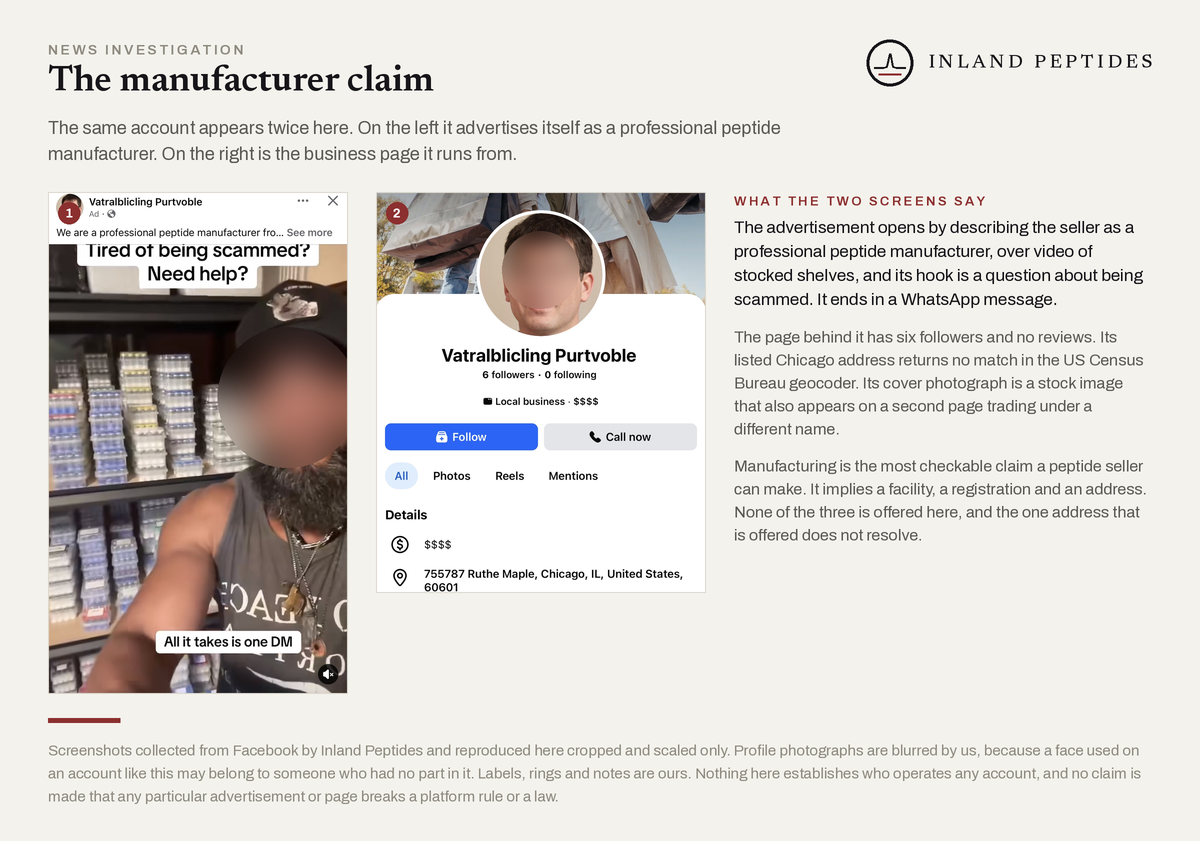
How peptide scams blur where a seller really is
A seller can claim a U.S. presence while referring to four different locations:
- Business registration. Where the company is legally registered, which may not be where it operates.
- Manufacturing. Where the peptide was produced, including by a contract manufacturer.
- Inventory. Where the seller actually holds stock, if it holds any.
- Shipping origin. Where a parcel first enters the delivery network, which may differ from the seller’s address.
A business may be registered in the United States while using overseas manufacturing or fulfillment. The red flag is not that arrangement; it is claiming domestic manufacturing, inventory or shipping that cannot be substantiated.
The FDA has reported fraudulent compounded products whose labels named pharmacies that did not exist or licensed pharmacies that had not made the products. Those cases illustrate why a printed identity is not enough to establish a product’s origin.
Importing and reselling are ordinary business practices. Instead, the concern is a middleman claiming to be a manufacturer or hiding who is responsible for an order.
Consider an illustrative markup: a vial bought for $5 and offered for $50. However, the price difference alone says little. Shipping, returns, storage and independent testing can cost money, and a transparent seller may provide services that an anonymous middleman does not.
Therefore, buyers should ask what the markup covers. If the seller cannot produce a traceable laboratory report, identify the testing laboratory or provide an accountable business identity, its quality claims remain unverified.
The Business Identities Behind the Ads
Some of the accounts in these advertisements also present themselves as businesses. That gives buyers specific names, addresses and claims to check.
Three pages listed U.S. street addresses. Each was entered exactly as displayed into the US Census Bureau geocoder; none returned a match. Two control addresses in the relevant ZIP codes resolved during the same test. The fourth page gave no street address.
Two of the four pages use the same cover photograph under different names. One has no listed address and is categorized as a restaurant. Their visible follower counts range from zero to six.
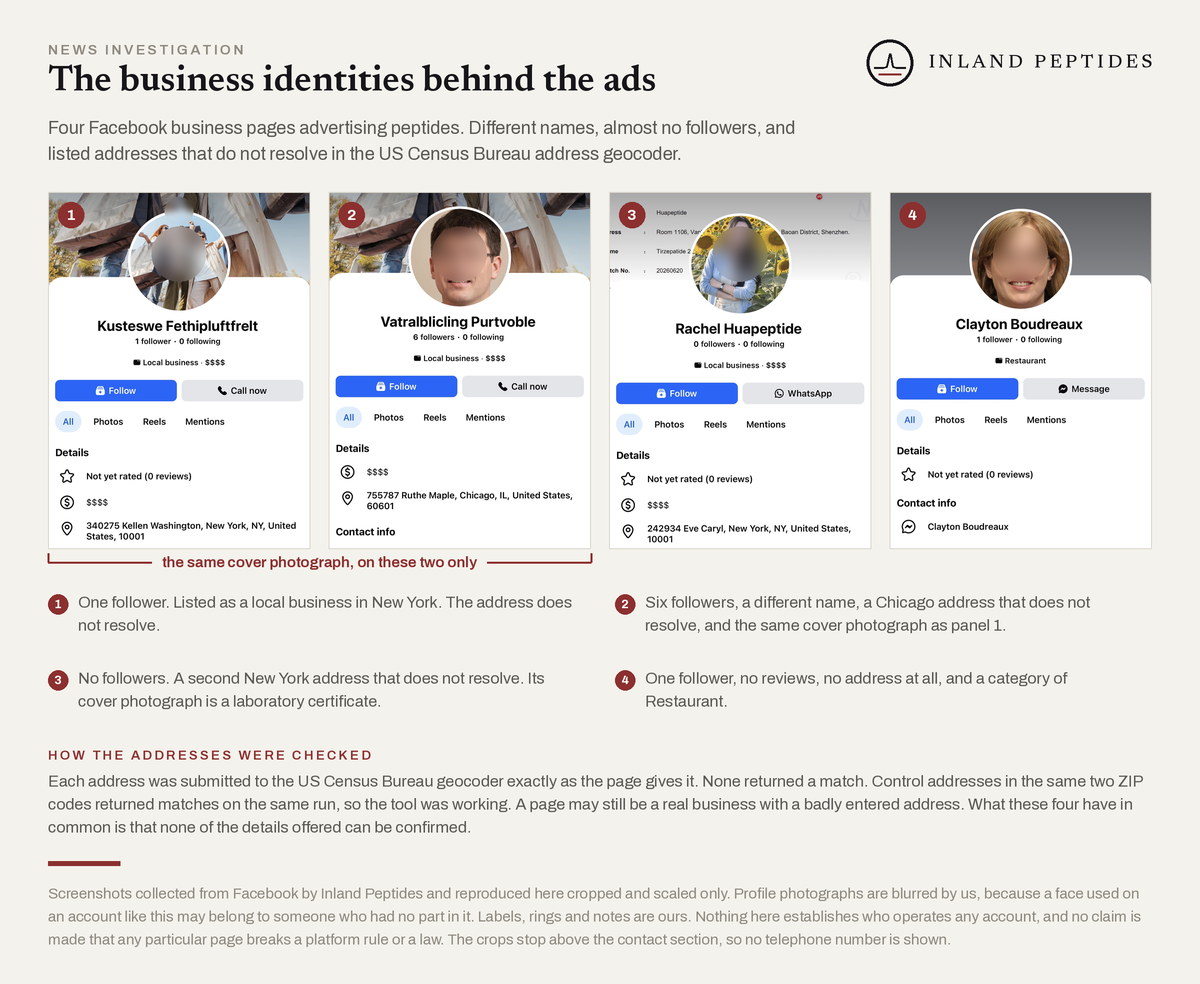
A failed geocoder match does not prove that a business address is fictitious. Combined with limited business details and reused imagery, however, it makes verification more important.
One page calls itself “Rachel Huapeptide” and identifies as a local New York business. Its cover photograph shows a laboratory certificate bearing the name Huapeptide. The certificate lists an address in Baoan District, Shenzhen. That does not establish where the Facebook account is operated or where any advertised inventory is located.
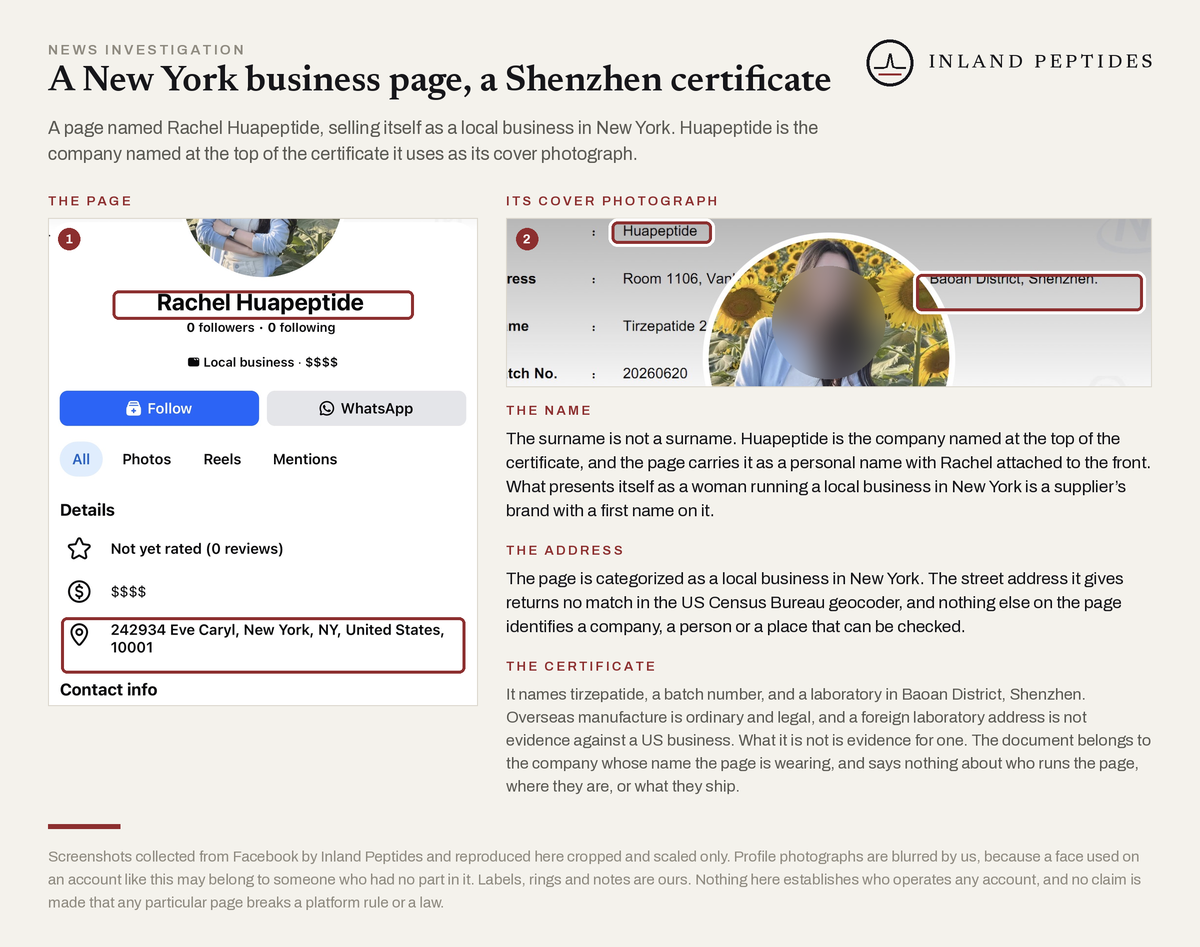
A foreign laboratory address is not evidence against a U.S. business. But the certificate does not verify who operates this particular Facebook page, and the page’s stated New York address did not resolve in the Census check.
A supplier’s certificate is not the same as independent verification of the products a seller distributes. A meaningful COA should be authentic, connected to the correct lot and supported by records linking the tested material to the items offered for sale.
Research Only, Sold Like Retail
The marketing gives another clue to the audience sellers are trying to reach: their promotions.
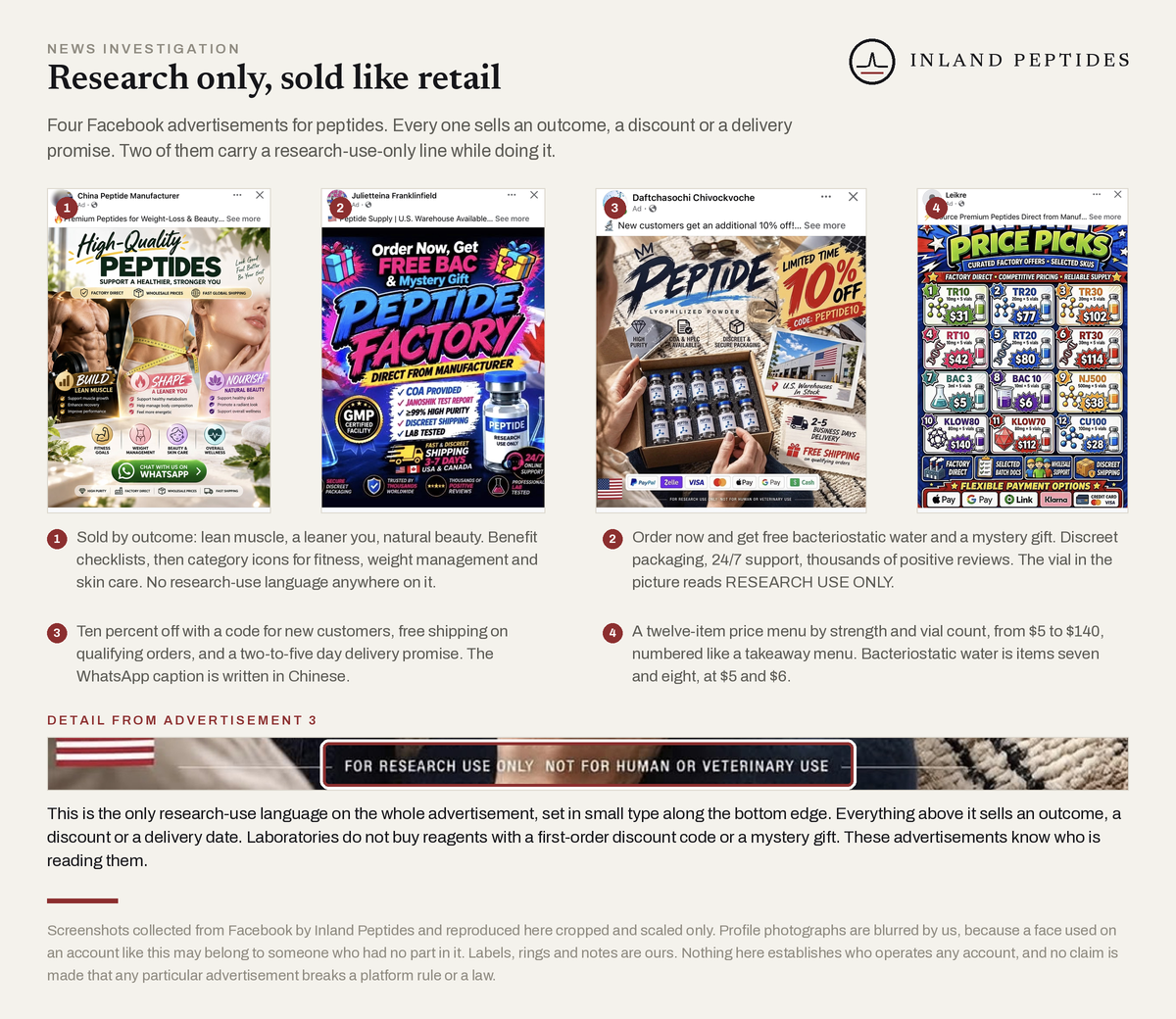
Laboratory buyers need reliable identity, specifications, lot traceability and testing documentation. Against that backdrop, flash sales, buy-one-get-one offers, free-shipping thresholds and loyalty rewards are notable signs of consumer-style marketing for products labeled for research only.
The concern is sharper when these promotions appear beside bundles organized around fat loss, anti-aging or recovery. A research-use disclaimer and a consumer wellness pitch send conflicting messages about the intended buyer.
In a March 2026 warning letter the FDA cited a California seller’s product pages describing appetite suppression, reductions in body weight and changes in lipid profiles. The agency concluded that the marketing indicated intended human drug use despite research-use disclaimers.
The seller also used coded names for retatrutide and tirzepatide, referring to them as GLP-1-R and GLP-2 peptide products.
A second letter that August raised similar concerns about a Florida seller. The FDA cited descriptions of effects in people despite research-oriented wording on the product pages.
Both letters also discussed bacteriostatic water sold alongside peptides intended for reconstitution. The FDA treated that combination as evidence of intended injection. One of the Texas warehouse ads offers bacteriostatic water as a promotional gift.
A “research use only” label does not cancel the message conveyed by the rest of an advertisement.
What Was Actually in the Vials
Seller claims are one part of the story. A 2024 study in the Journal of Medical Internet Research examined what happened when researchers actually ordered semaglutide from selected online sellers.
Researchers searching for semaglutide without a prescription collected 1,080 links. Among them, 317 were pharmacy links, and 134 led to 59 websites the study classified as illegal using public verification databases.
The team ordered from six low-priced sellers that did not require prescriptions. Three orders were never delivered. The other three produced vials that researchers subjected to laboratory analysis.
- All three vials contained more semaglutide than labeled, exceeding the stated quantities by 28.56% to 38.69%.
- Semaglutide accounted for only 7.7% to 14.37% of the total vial powder by mass, although the sellers advertised 99% purity. In one vial, just 3.86 mg of 50.1 mg of powder was semaglutide.
- Chromatography detected no peptide-like impurities. Researchers could not identify the remaining material and said further analysis would be needed.
- Endotoxin was detected in all three samples, although no viable microorganisms were detected during testing.
- Packaging and labeling failed roughly 60% of the visual inspection criteria.
The important distinction is between the amount of semaglutide and its share of the total powder. Each vial contained more semaglutide than the label stated, yet most of the powder consisted of unidentified material. This is the difference between peptide chemical purity and peptide mass fraction.
These results do not describe the entire peptide market. The researchers deliberately chose six inexpensive, high-risk sellers, and only three orders yielded products for testing. The investigation documents both non-delivery and significant discrepancies in the products that arrived.
A Los Angeles Times feature also reported questionable business addresses among online peptide sellers.
When Buyers Became the Investigators
In the absence of a comprehensive, authoritative directory of tested peptide suppliers, buyers have turned to Reddit discussions, Facebook groups and WhatsApp chats to compare seller experiences and share laboratory reports.
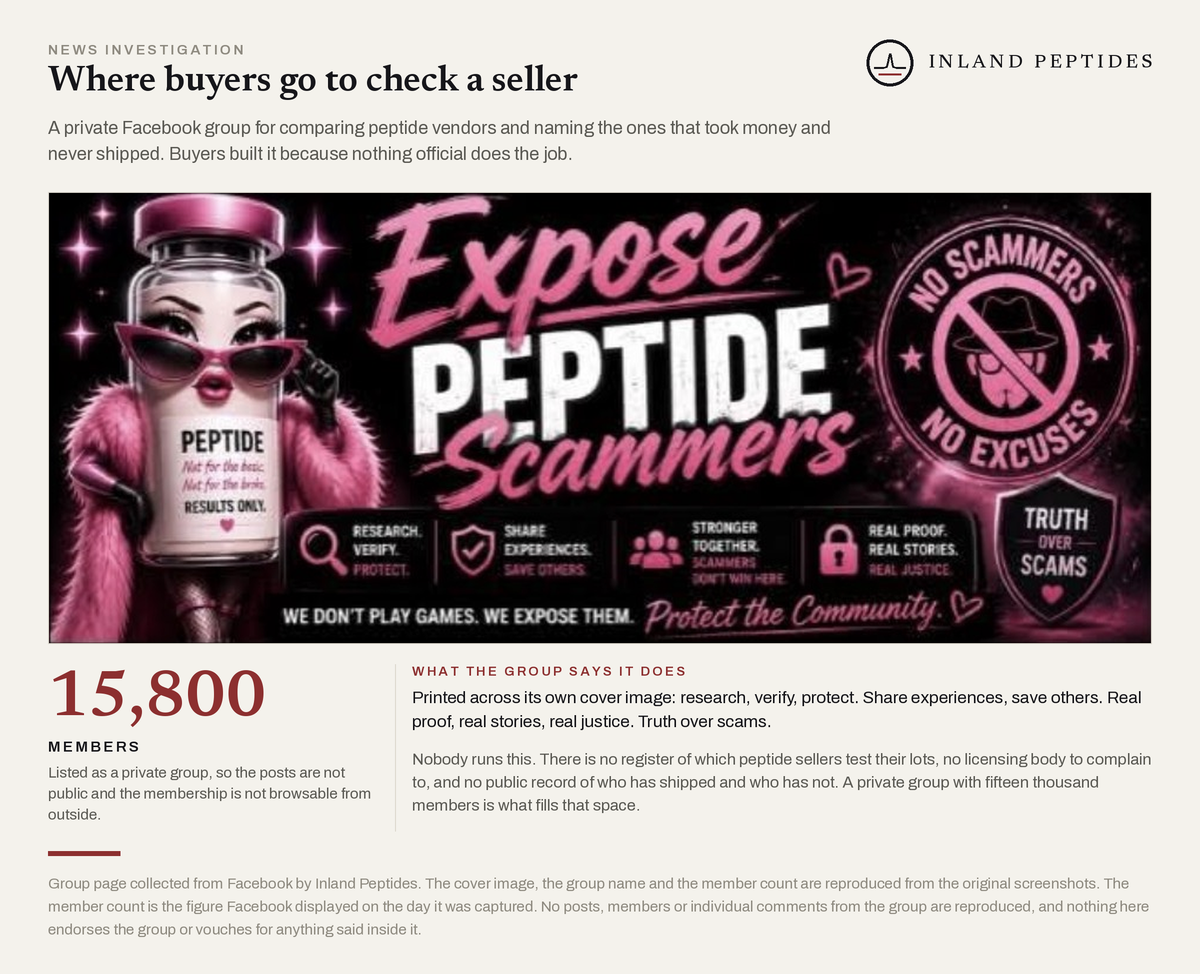
Independent group testing can provide useful information, particularly when the sample and laboratory report can be verified. But those communities bring another trust problem: participants may not know whether a recommendation is independent or commercially motivated.
- An endorsement may come from the seller using another account.
- Some recommendations may involve payments or undisclosed affiliate relationships.
- A posted test report may relate to a different product or batch.
- A group moderator may also have a commercial connection to a supplier.
A group can alert members to complaints about missing orders. It cannot, by itself, verify what is inside a vial. For that, the laboratory report and its connection to the product matter more than anonymous endorsements.
Red Flags of Peptide Scams Before You Pay
These warning signs are most useful when considered together:
- Shifting identities. Several accounts, several business names, or a name that changed recently. Search the business name and the phone number and see what else comes back.
- Unverifiable U.S. claims. Check the registered business name and address. A failed geocoder match calls for further investigation, not an automatic finding of fraud.
- Manufacturer claims without a facility. Ask where the product is made, who operates the facility and what evidence supports the claim.
- Disguised listings. Product names hidden in merchandise imagery or coded spellings are reasons to question how the seller advertises.
- Retail promotions on research-only products. BOGO deals, flash sales and free-shipping thresholds can signal that the advertising is aimed at individual consumers.
- Certificates that will not hold up. No lot number, no laboratory name, no date, no method, or the same report turning up across different products.
- Unsupported purity figures. Ask which method was used, which lot was tested and whether the number describes peptide chemical purity or peptide mass fraction.
- Limited buyer protection. Cryptocurrency, wires, gift cards and friends-and-family transfers can make payment disputes more difficult.
- Anonymity. No company name, no address, no named person, and no way to reach anyone who is accountable.
Start with independently verifiable details: the company name, its registered address and the laboratory behind the COA. Ask the laboratory to confirm it issued the report and check whether the lot number matches the material offered. The FTC also recommends searching the seller’s name with “scam” or “complaint.”
A purity result cannot establish sterility or endotoxin levels; those require different tests. Even an authentic laboratory report describes the material tested at that time. It does not automatically establish the condition of every vial months later.
If You Have Already Paid
Preserve evidence and contact the payment provider promptly. Dispute and reporting procedures can have deadlines.
- Save the listing, seller profile, full message thread and product page as screenshots.
- Keep the order confirmation, the receipt, the payment record and any tracking number.
- Contact the payment provider promptly to ask about disputes or chargebacks.
- Report the advertisement or account through the platform’s reporting process.
- Report the fraud. The FTC takes reports at ReportFraud.ftc.gov.
- Photograph the vial, the label and the packaging before anything is opened or discarded.
Reporting will not guarantee a refund, but it preserves a record and can help authorities identify repeated complaints.
The Cost of Lost Trust
For legitimate research suppliers, the damage extends beyond individual losses. Every unfulfilled order and unsupported quality claim makes it harder for buyers to assess businesses that do provide traceable products and testing.
The most direct safeguards are basic: a verifiable company identity, honest descriptions of manufacturing and fulfillment, clear shipping and refund terms, and batch documentation that can be checked with the issuing laboratory.
Sellers who provide those records give buyers something more meaningful than an anonymous endorsement: evidence they can check.
Until that becomes routine, too much of the burden remains with the buyer, who may have little more than a vial, an advertisement and a certificate whose connection to the product is unclear.