Sterility testing checks a sample for living microorganisms, while endotoxin testing checks for a toxic substance that comes from the outer layer of certain bacteria.
The difference matters because that substance is not alive. It can still be in a material after every living organism in it is gone. That is how a sample can pass a sterility test and still contain endotoxin.
Sterility Testing vs. Endotoxin Testing: Key Differences
| Feature | Sterility testing | Endotoxin testing |
|---|---|---|
| What it looks for | Living microorganisms, such as bacteria and fungi | Endotoxin from Gram-negative bacteria |
| Main USP standard | Chapter 71, Sterility Tests | Chapter 85, plus Chapter 86 for lab-made reagents |
| What the result looks like | Growth or no growth | A number, or a pass or fail against a set limit |
| What it cannot tell you | Anything about how much endotoxin is present | Anything about whether living microorganisms are present |
What each test finds, and what its result cannot tell you.
What Does Sterility Testing Actually Measure?
Sterility testing measures whether any living microorganisms in the sample will grow under the conditions of the test.
The usual test is a culture test. The lab puts part of the sample into liquids that bacteria and fungi grow well in. It keeps them warm and watches to see whether anything multiplies. Only living organisms multiply, so that is all this test is able to find.
The standard method is USP General Chapter 71, Sterility Tests. USP stands for United States Pharmacopeia, which publishes official standards for medicines.
How long it takes
At least 14 days, according to the FDA’s Pharmaceutical Microbiology Manual. The lab uses two different growth liquids held at two different temperatures. That way, organisms needing oxygen and organisms that grow without it both get a chance to show up.
What a “no growth” result establishes
A no growth result means nothing grew in the samples that were tested, in those growth liquids, over that period of time.
It is not proof that every vial in a batch is sterile. A sterility test usually examines selected vials rather than every vial in a batch. Confidence in an entire batch’s sterility comes from how the product was made and how contamination was controlled during manufacturing. USP covers that in a separate chapter, USP 1211, Sterility Assurance.
There is also a way for this test to give a misleading answer. Some products slow or stop microbial growth on their own, even when no preservative has been added. The FDA manual notes that a negative result is not valid if a lab’s suitability testing shows this effect. That is because the product may have held back growth that would otherwise have happened. This is why labs check for that interference before they trust a result.
Culture testing is not the only method
Other tests can look for signs of microorganisms without growing them, but they do not automatically replace a standard culture-based sterility test.
One is PCR, short for polymerase chain reaction. PCR looks for a microorganism’s genetic material, which can be present whether or not the organism is alive. A PCR result should not be described as “no growth,” because nothing was grown.
What Are Bacterial Endotoxins?
Bacterial endotoxins are substances found in the outer layer of certain bacteria called Gram-negative bacteria. Scientists call these substances lipopolysaccharides, or LPS.
Endotoxin is released when Gram-negative bacteria die and break open. The FDA’s inspection technical guide on bacterial endotoxins and pyrogens puts it this way: “the release of LPS from bacteria takes place after death and lysis of the cell.” Living bacteria can shed it as well, in small pieces of their outer layer. Schwechheimer and Kuehn describe this as separate from the cell dying.
Either way, endotoxin can be in a material whether or not live bacteria are, and killing bacteria can release it rather than remove it.
It is also difficult to take back out. Endotoxins “are not removed by sterilizing or microbiological filters,” the guide states, and “it is difficult to remove endotoxins from products once present.” Filtering, radiation and ethylene oxide gas all have limited effect on how much endotoxin a product contains.
The guide names the common sources: the water used in manufacturing, packaging parts, and the chemicals, raw materials and equipment used to prepare a product.
Killing bacteria and removing endotoxin are two different jobs
Sterilization targets living microorganisms. Depyrogenation removes or destroys fever-causing substances, including endotoxin.
Filters fine enough to sterilize a liquid do not reliably take dissolved endotoxin out of it. The usual ways of killing microorganisms do not necessarily reduce it either. Endotoxin can be reduced or destroyed, but it takes a process designed and tested for that job. One example is the very high dry heat used on glass vials. A step aimed at microorganisms cannot be assumed to have dealt with endotoxin as well.
Endotoxins are one kind of pyrogen
A pyrogen is anything that can cause a fever, and bacterial endotoxin is only one of them.
The same FDA guide notes that fever-causing substances “can be produced by some gram positive bacteria, mycobacteria, fungi and also viruses.” An endotoxin test covers bacterial endotoxin, so a negative result does not rule out every substance capable of causing a fever.
How Do Laboratories Test for Endotoxins?
Laboratories mix the sample with a reagent that reacts when endotoxin is present. They then read that reaction in one of two ways. A limit test answers only whether endotoxin is above or below one set level. A quantitative test reports an amount.
The long-standing reagent is Limulus amebocyte lysate, abbreviated LAL, which is made from horseshoe crab blood. Endotoxin sets off a clotting reaction in it. Labs read that reaction in three ways:
- Gel-clot watches whether the mixture forms a firm clot.
- Turbidimetric measures how cloudy the mixture becomes.
- Chromogenic measures a color change caused by the reaction.
Gel-clot is usually run as a limit test, though it can also be used to estimate an amount. The turbidimetric and chromogenic methods are the ones that normally produce a number.
Results are reported in endotoxin units, written EU. Endotoxin units measure endotoxin activity rather than the weight of the substance itself. A result in EU/mg is endotoxin units per milligram of material, and a result in EU/mL is endotoxin units per milliliter of liquid. Whether an amount is acceptable depends on a limit set for that product and its intended use. There is no single limit that applies to everything.
Tests that do not use horseshoe crab blood
USP General Chapter 86, Bacterial Endotoxins Test Using Recombinant Reagents, became official in May 2025. Recombinant reagents are made in a laboratory instead of being taken from an animal. Engineered cells produce the reacting protein, so the test does not depend on horseshoe crab blood. Chapter 86 covers two kinds, recombinant Factor C and recombinant cascade reagents.
Chapter 86 does not replace Chapter 85, and no laboratory is required to use it. A lab that chooses it has to show the method works for the specific material being tested, because some materials interfere with the reaction. The FDA tells sponsors using recombinant reagents to confirm the method is suitable for its intended purpose.
What changed in the FDA’s 2026 endotoxin guidance?
The FDA updated its endotoxin guidance in March 2026 to make room for wider use of these lab-made reagents.
The agency issued Edition 2 of its 2012 guidance Pyrogen and Endotoxins Testing: Questions and Answers. It described the change as minor updates reflecting current thinking, and said it “removed certain references to Limulus Amoebocyte Lysate (LAL) testing” to allow for “a broader scope of recombinant reagents.” The agency tied that to Chapter 86 and to a longer-term goal of reducing animal testing.
The update does not make every alternative method automatically acceptable. A lab using one still has to validate it and show it performs as well as or better than the standard method.
Can a Sterile Peptide Still Contain Endotoxins?
Yes, a peptide sample can show no microbial growth in a sterility test and still contain endotoxin that a laboratory can measure.
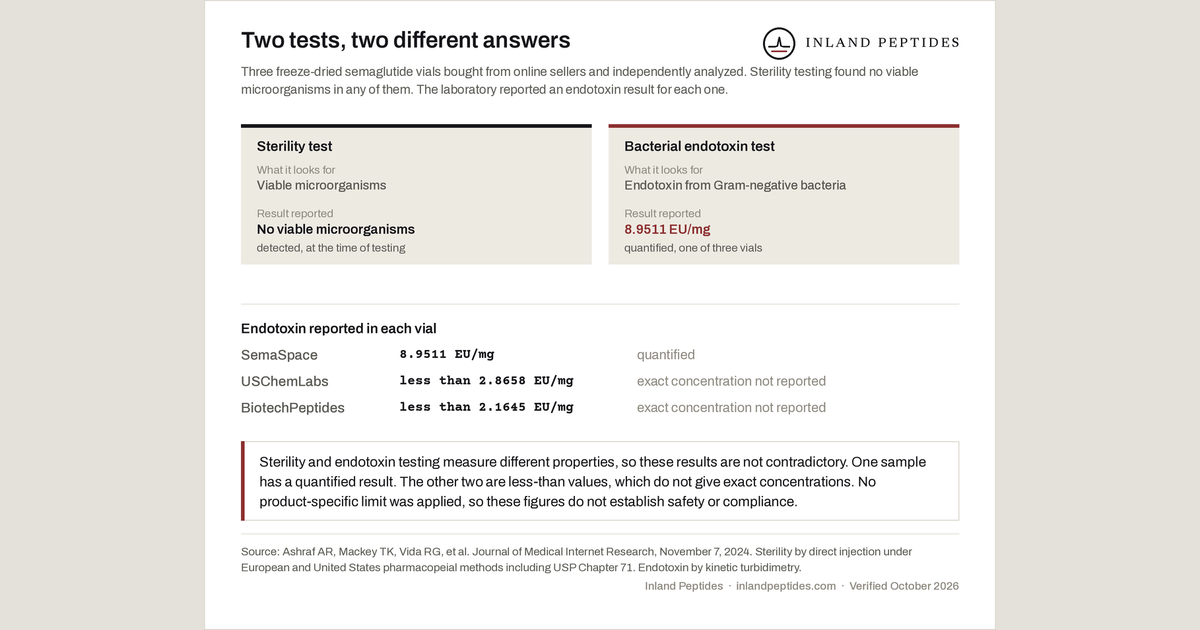
Researchers led by Amir Reza Ashraf bought three freeze-dried semaglutide products from online sellers and had them analyzed. They published the results in the Journal of Medical Internet Research in November 2024.
Sterility testing found no viable microorganisms in the three samples, which the authors reported as “devoid of viable microorganisms at the time of testing.” The laboratory reported an endotoxin result for each of them.
One sample had a quantified result of 8.9511 EU/mg. The other two were reported as less than 2.8658 EU/mg and less than 2.1645 EU/mg. Those two results do not tell you the exact endotoxin concentrations in those samples. Only one of the three vials carries a quantified figure.
The sterility test was a culture test performed by direct injection. It followed the standard methods published by the European and United States pharmacopeias, including USP Chapter 71. The endotoxin test was a separate kinetic turbidimetric assay, which is the cloudiness method described above.
These three vials came from selected online sellers that the researchers identified as operating illegally. They do not show how common endotoxin contamination is among research peptides generally. The researchers could not determine where the endotoxin came from. Because the study did not apply a product-specific endotoxin limit, these findings alone do not establish whether the samples were safe or met an applicable endotoxin standard.
How to Read Sterility and Endotoxin Results on a COA
To read sterility or endotoxin results on a certificate of analysis (COA), check the test performed, the reported result, the method used and any applicable limits. A COA summarizes testing on an identified material or batch. It may come from a manufacturer, supplier or testing organization, so it is not necessarily an independent laboratory’s report.
No growth
Nothing grew in the samples that were tested, in the growth liquids the report names, over the period it states.
Not detected
The method did not find the substance at or above the smallest amount it is capable of finding. That describes how sensitive the method is, rather than showing that the substance is absent. The report should state that smallest amount, called the detection limit, because without it “not detected” has no scale.
Below the limit of quantification
The amount was too low for the method to measure reliably. A method can usually detect less than it can accurately measure. That is why a report carries two limits. One is the smallest amount it can find at all. The other is the smallest amount it can put a reliable number on.
A measured number
An amount inside the range the method can measure accurately, reported in endotoxin units. EU/mg and EU/mL are related but not interchangeable, and converting one into the other requires knowing how much material was dissolved in how much liquid. A “less than” value is reported differently: it tells you the result came in below that figure without giving an exact amount.
What to look for on the report
- Which test was performed. A report may cover one of these tests and not the other.
- The method or standard cited. USP 71, USP 85, USP 86, or a named alternative method.
- The limit the result was compared to. The same number can pass against one specification and fail against another.
- A report number, and the sample or batch it belongs to. The report should name the material the result came from.
A test that is missing is not evidence of a problem by itself. But a report cannot tell you about a property it never measured. So it is worth checking which tests appear on the page at all.
Material supplied for laboratory research and a sterile medicine prepared for injection are held to different requirements, because they are tested for different purposes. Which requirements apply depends on the product and how it is actually used, not on the wording of a label.
Does 99% Peptide Purity Mean a Product Is Sterile?
No, a 99% purity result does not establish that a product is sterile, and it says nothing about how much endotoxin the product contains.
An HPLC purity result shows how much of the signal the instrument detected came from the target peptide, under one particular method. Sterility and endotoxin are different properties, and each one has its own test.
The Bottom Line
Sterility, endotoxin content and purity are three separate measurements. A sterility test checks whether anything living grows under the conditions of the test. An endotoxin test either measures endotoxin activity or checks it against a set limit. An HPLC purity result shows how much of the detected signal came from the target peptide, which answers neither of the other two questions.
A report showing only one of these results cannot establish the other two.