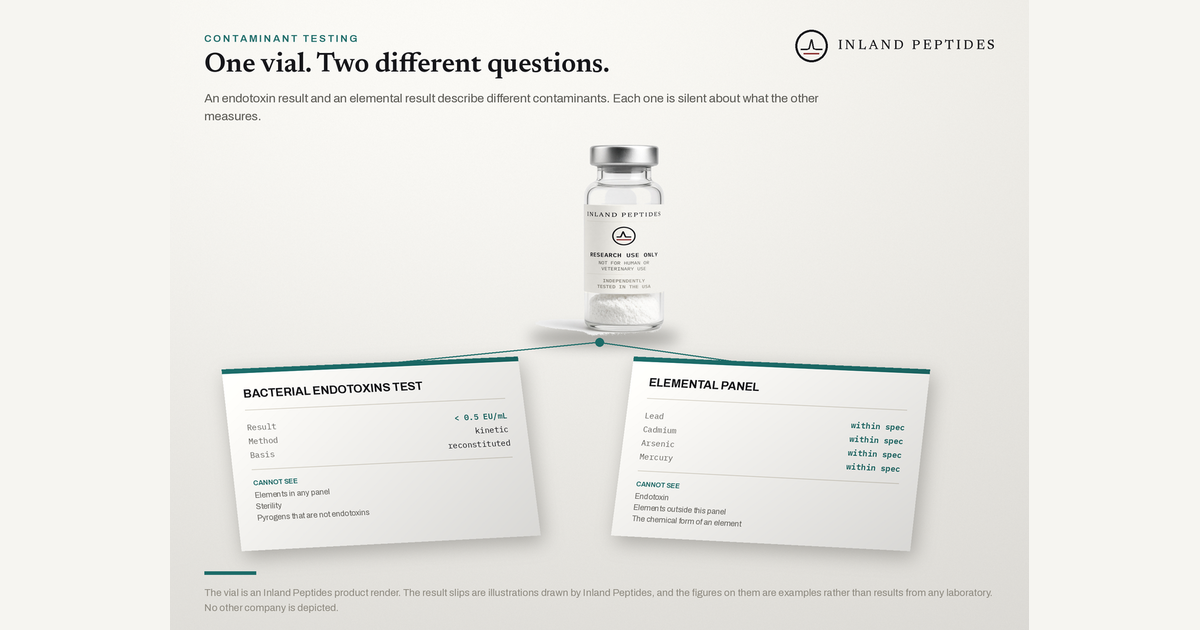
Endotoxin testing looks for bacterial endotoxins, while heavy metal testing measures the specific elements included in the laboratory’s panel.
Passing one does not establish a passing result for the other.
Neither one on its own establishes that a product is safe.
The tests also use different methods, reporting units, and acceptance limits.
The two tests side by side
| Endotoxin testing | Elemental impurity testing | |
|---|---|---|
| What it looks for | Bacterial endotoxins, which are lipopolysaccharides from the outer membrane of Gram-negative bacteria. | Specified chemical elements, commonly including lead, cadmium, arsenic and mercury. |
| Typical methods | The bacterial endotoxins test, using either Limulus amebocyte lysate or recombinant reagents. | Plasma-based elemental analysis, commonly ICP-MS or ICP-OES. |
| Reporting units | Endotoxin units, reported as EU/mL, EU/mg, or EU per vial or container. | Mass per mass or mass per volume, such as µg/g, µg/mL or ppm. |
| What it does not cover | Living bacteria, sterility, and pyrogens that are not endotoxins. Results can be affected by the sample itself. | Elements outside the panel, and the chemical form the element is in. |
What does endotoxin testing detect?
It is designed to detect bacterial endotoxins, rather than living bacteria or every possible pyrogen.
Endotoxins are lipopolysaccharides found in the outer membrane of Gram-negative bacteria.
They can be released when bacterial cells break apart.
Living bacteria also release outer membrane vesicles during growth. These small membrane packages carry lipopolysaccharide.
Killing the bacteria does not necessarily remove endotoxin already present.
Ordinary sterilizing filtration does not reliably remove it either.
A sterile sample can still contain endotoxin. Conversely, a result showing no detectable endotoxin does not establish sterility.
Gram-positive bacteria and fungi do not produce this type of endotoxin. An endotoxin test therefore does not establish whether those organisms are present.
A pyrogen is a substance that can cause fever. Endotoxins are one type. FDA guidance calls for assessing the risk of non-endotoxin pyrogens and says a rabbit pyrogen test may be more appropriate when that risk exists.
So a result showing no detectable endotoxin does not rule out every fever-producing substance.
What does “heavy metal testing” detect?
It detects the specific elements the laboratory included in the panel.
“Heavy metal testing” is the common label. Elemental impurity testing is the more precise description, and it is the term the current standards use.
The label does not mean the laboratory tested for every metal.
Check which elements the method covered and which results the report provides.
ICH Q3D, the international guideline on elemental impurities, groups elements by toxicity and likelihood of occurrence. Class 1 includes arsenic, cadmium, mercury, and lead.
These four commonly appear in elemental impurity panels.
The guideline also covers other elements. Examples include cobalt, nickel, and vanadium in class 2A; silver, gold, palladium, platinum, selenium, and thallium in class 2B; and barium, chromium, copper, lithium, molybdenum, antimony, and tin in class 3.
A panel covering only the four class 1 elements does not establish results for the other elements.
A standard elemental result reports the total measured amount of an element but does not identify its chemical form.
Different chemical forms can have different toxicities. Identifying them requires a separate analysis called speciation.
How are the tests performed?
The bacterial endotoxins test
The test uses a reagent that reacts when endotoxin is present.
The harmonized test chapter describes both limit testing and quantitative testing.
For example, a gel-clot limit test gives a positive or negative result at the dilution tested.
Testing a series of dilutions can also estimate endotoxin concentration.
Other methods quantify endotoxin by measuring changes in cloudiness, color, or fluorescence.
The traditional reagent is Limulus amebocyte lysate, made from horseshoe crab blood.
Recombinant reagents provide another option without using lysate collected from horseshoe crab blood.
FDA’s March 2026 revision broadened its endotoxin guidance to accommodate recombinant reagents. Sponsors should still verify that the selected assay is suitable for its intended purpose.
The compendial reference for the test is USP General Chapter 85.
USP approved Chapter 86 in July 2024. The final text was published for early adoption in November 2024 and became official in May 2025.
The published chapter states that, unless an individual monograph specifies otherwise, its tests are alternative methods subject to General Notices 6.30.
Elemental analysis
For these plasma-based methods, a prepared liquid sample is typically introduced as a fine mist into a hot plasma.
Two common techniques measure the resulting signals:
- ICP-MS, inductively coupled plasma mass spectrometry, separates the resulting ions by their mass-to-charge ratio.
- ICP-OES, inductively coupled plasma optical emission spectrometry, measures the light each element emits.
Both techniques are used for pharmaceutical elemental impurity testing. One published study describes a validated ICP-MS method developed under USP General Chapter 233 for a drug substance.
Sample preparation also affects the result. Solid material often needs digestion or dissolution before analysis.
ICH Q3D calls for procedures suitable for their intended purpose and specific to each elemental impurity identified for control.
A method name alone does not show that the method was suitable for the peptide sample tested.
Interference, and why dilution appears on reports
Samples can interfere with the endotoxin test because their physical and chemical properties can affect the assay.
Inhibition suppresses the reaction, while enhancement exaggerates it.
Either can distort the result.
Laboratories use inhibition and enhancement testing to check for these effects.
Dilution can reduce interference, but there is a limit. The maximum valid dilution is the greatest dilution at which the assay can still detect the applicable endotoxin limit.
Beyond that dilution, endotoxin at the specification limit could go undetected.
FDA guidance points to the rabbit pyrogen test when interference cannot be resolved through dilution within that limit or other validated sample preparation.
Elemental analysis also needs recovery checks. The laboratory adds a known amount of an element and measures how much it recovers to assess whether the method works in that sample.
How should you read the units?
Read the unit before the number.
Endotoxin units, abbreviated EU, describe endotoxin activity. The reporting basis tells you how to interpret the number.
- EU/mL is a concentration in liquid.
- EU/mg expresses endotoxin activity relative to the mass of material.
- EU per vial or container expresses the total activity in that container.
For example, take a hypothetical result of 0.5 EU/mL.
In a vial holding 2 mL, that is 1 EU in the vial. In a vial holding 10 mL, the same concentration is 5 EU.
The concentration is identical, but the total per vial differs fivefold.
Converting EU/mL to EU per vial requires the relevant volume. Converting to EU/mg also requires the material’s mass. Sample preparation and any dilution corrections must be clear.
Elemental results also need a reporting basis.
- µg/g is micrograms of element per gram of material.
- µg/mL is micrograms per milliliter of solution.
- ppm means parts per million. For a mass-to-mass result, 1 ppm equals 1 µg/g.
A dry-material result and a result for a prepared solution use different bases. Converting between them requires the sample mass, solution volume, and any dilution factors.
Why there is no universal safe number
Pharmaceutical limits depend on exposure.
An endotoxin limit, for instance, depends on the route of administration and the maximum amount administered over the relevant period.
Elemental impurity limits also account for exposure, but they use a separate calculation.
ICH Q3D lists permitted daily exposures in micrograms per day. Its parenteral values for class 1 elements are 15 for arsenic, 2 for cadmium, 3 for mercury, and 5 for lead.
Converting a daily exposure limit to a concentration limit requires the maximum daily amount of product.
At the permitted limit, concentration in micrograms per gram multiplied by product amount in grams per day equals exposure in micrograms per day.
Consider a hypothetical pharmaceutical calculation using the parenteral lead limit of 5 µg per day.
At 1 gram of material per day, the concentration limit is 5 µg per gram.
At 10 grams per day, the same 5 µg per day becomes 0.5 µg per gram.
The permitted daily exposure stays the same, but the concentration limit changes with the daily product amount.
These pharmaceutical examples do not establish safety limits for research material.
ICH Q3D applies to finished drug products and excludes products used during clinical development.
Its values can also differ by administration route.
For example, cadmium’s oral limit is 5 µg per day and its parenteral limit is 2. Mercury’s values are 30 and 3, respectively. Arsenic and lead, by contrast, have matching oral and parenteral values.
The guideline’s principles can still help assess impurities while a commercial manufacturing process is being developed.
A limit for a pharmaceutical product with a defined dose and route does not establish that a research vial is safe.
What do “not detected,” “below quantification” and “passes” mean?
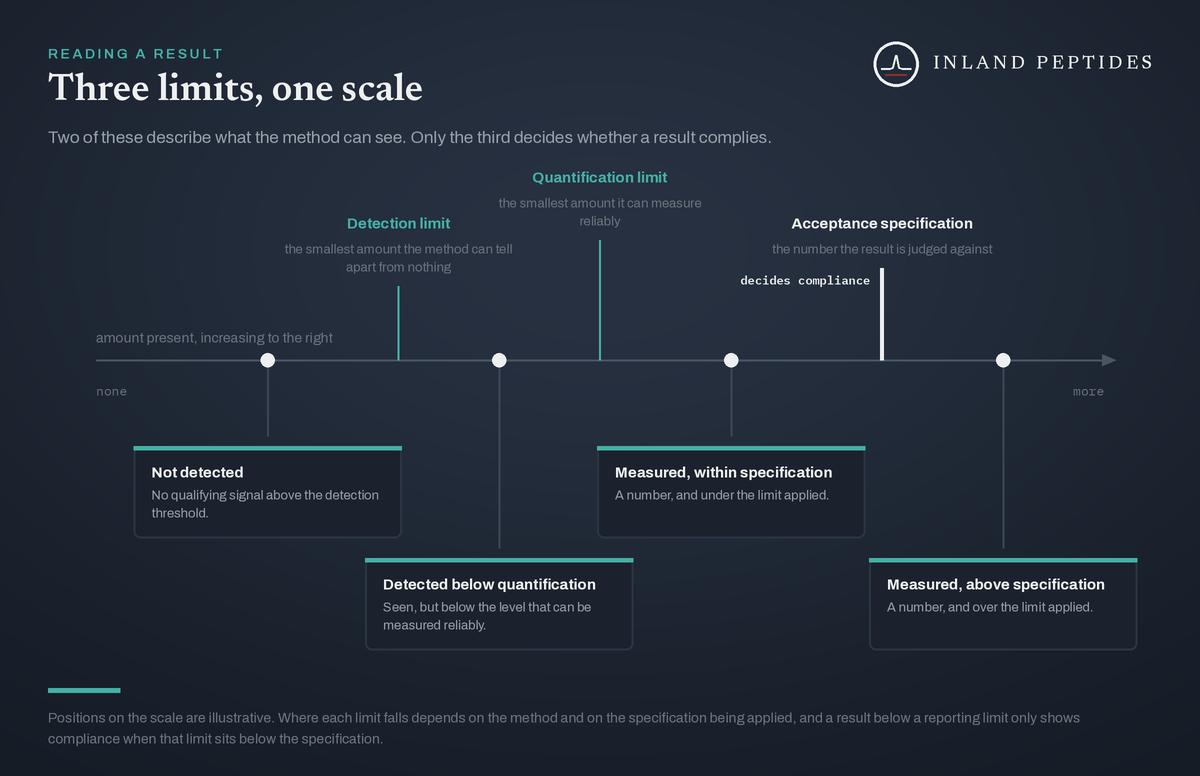
They describe detection, measurement, and compliance with a specification.
- The detection limit is the lowest amount the method can reliably distinguish from background.
- The quantification limit is the lowest amount it can measure with acceptable accuracy and precision. It is generally higher than the detection limit.
- The acceptance limit is the maximum allowed under the specification being applied.
“Not detected” means no qualifying signal was found above the method’s detection threshold in that sample.
It does not mean zero, and a more sensitive method could report a number.
“Detected below quantification” means the substance was detected, but its amount was too low for reliable measurement.
“Below quantification” alone does not establish whether the substance was detected.
Ask the laboratory how it uses that phrase if the report gives no detection qualifier.
A measurable amount can still be below the acceptance limit.
A “pass” statement should identify the specification applied.
A laboratory’s chosen specification is not automatically a legal requirement.
Can a sample pass one test and fail the other?
Yes, in either direction.
One hypothetical sample meets its endotoxin specification but has lead above its elemental specification. It passes one test and fails the other.
Another meets the specifications for every element tested but exceeds its endotoxin limit. The outcomes are reversed.
Each failure concerns a contaminant the other test does not measure.
A result below a detection or quantification limit cannot establish compliance if that reporting limit is higher than the acceptance limit. The method must be sensitive enough to assess the specification.
Neither test replaces identity testing, measured peptide quantity, chromatographic purity, sterility testing, or other separate assessments.
Likewise, high chromatographic purity does not establish the absence of endotoxin or elemental impurities.
What should appear on the report?
Check that the report provides:
- Sample and batch identification, matching the vial.
- The named assay or analytical method.
- For elemental work, the list of elements in the panel.
- The result, with its reporting units.
- The reporting basis, meaning whether the figure refers to a liquid sample or to dry material.
- The relevant detection or quantification limits.
- The acceptance specification, wherever a pass or fail conclusion is given.
- The laboratory identification, and a way to verify the report with the laboratory that issued it.
In pharmaceutical manufacturing, elemental impurity control does not always require testing every finished batch. Instead, the FDA elemental impurities guidance allows a risk-based approach supported by appropriate evidence and controls.
But that pharmaceutical control strategy does not establish why a particular research-product report has no result.
A missing result establishes neither a passing result nor that testing never occurred.