Does a peptide certificate of analysis actually expire?
No. A COA remains a historical record of what a laboratory measured in the material it tested. Time does not erase those results.
A COA may still list a product expiration date or retest date. Those dates concern the material, not the historical test record. When a date passes, the material may need a new assessment, but the earlier laboratory findings remain a record of what was tested.
What changes over time is how much the COA can tell you about the material today. It describes the condition at the time of testing, not what happened during later storage or shipping.
An older COA can be an accurate record and still provide too little information to judge a product’s current condition.
What does the date on a peptide COA actually tell you?
It depends on which date you mean. A COA can list dates for manufacture, sample collection, laboratory testing and report issuance. Each marks a different event.
For example, a report issued in March might describe a sample collected in January from a batch manufactured the previous August. All three dates can be correct.
| Date on the report | What it establishes | What it does not establish |
|---|---|---|
| Date of manufacture | When the material was produced | How it was stored afterward, or whether it was tested at all |
| Date the sample was collected | When the tested material was taken out of the batch | Whether that sample represents the rest of the batch |
| Date the laboratory received the sample | When the laboratory received the sample | How the sample was packed, stored or transported before it arrived |
| Date testing was performed | The point in time the measurements describe | The condition of the material before or after that day |
| Date the report was issued | When the laboratory released its findings | Anything about the material. A later issue date does not make the results more current |
| Retest date, where one is assigned | When the material should be examined again to confirm it still meets its specification | That the material has degraded, or that it becomes unusable once that date passes |
| Expiration date, where one is assigned | The end of the period the supporting stability data covers | That anyone tested the material on that date |
The test date tells you when the measurements were made. It does not, by itself, establish the material’s condition today.
Should a certificate carry its own expiration date?
Not always. The answer depends on the type of report, the material and the requirements that apply to it.
For a drug ingredient produced under pharmaceutical manufacturing standards, API retesting guidance states that an applicable expiry date should appear on the label and COA, while a retest date should appear on the label, the COA, or both.
An independent analytical report is different. It describes testing of a submitted sample. The issuing laboratory generally does not control the batch from which that sample came.
Applicable requirements depend on the material, its intended use and the regulatory context. A product’s label alone does not establish which manufacturing standards apply.
If an independent laboratory puts a validity period or suggested retest date on its report, treat that as a statement about its own report or testing. It is not a universal peptide shelf life.
Can peptide purity change after laboratory testing?
Yes. A peptide can degrade or otherwise change after testing. The changes depend on the molecule, its formulation and its environment.
Water can break peptide bonds through hydrolysis. Oxygen and light can alter certain amino acids. Peptides can also stick to vial surfaces or clump together without a chemical reaction.
Published peptide stability research shows that pH, temperature, oxygen, light and trace metals can affect peptide stability. Their effects vary from one molecule to another.
For example, oxytocin is sensitive to ultraviolet light under certain pH conditions. Octastatin degrades faster in phosphate buffers than in glutamate buffers. Liraglutide can form aggregates, with solution pH affecting how readily that happens.
Each peptide has different vulnerabilities. That is why a single set of storage rules for all peptides can be misleading.
Some peptides have compound-specific data. In a 1997 study, researchers measured the degradation of octastatin in several buffers. They predicted that a solution in 0.01 molar acetate buffer at pH 4.0 and 20 degrees Celsius would take about 84 days to fall to 90 percent of its original concentration.
That was a prediction for one peptide under specific conditions, not a measured shelf life. It cannot be applied to other peptides or formulations.
What a peptide’s structure can and cannot tell you
A peptide’s amino acid sequence can suggest likely chemical weak points. A BPC-157 formulation review uses this approach to identify possible degradation pathways, but it does not show how a stored product actually behaves.
That kind of analysis can help researchers decide what to test. It cannot replace stability measurements.
The review did not present new stability measurements. Its authors noted that the laboratory work needed to confirm these predictions had not been published.
How do storage conditions affect peptide stability?
Temperature, water, light, oxygen and packaging can all affect stability. How much they matter depends on the peptide and its formulation.
- Temperature. Heat generally speeds up chemical reactions, although the rate varies by compound.
- Moisture. Water can enable degradation reactions, even in freeze-dried material.
- Light. Ultraviolet or visible light can alter peptides that contain certain sensitive amino acids.
- Oxygen and trace metals. Oxygen permits oxidation; traces of metals such as iron or copper can speed it up.
- The container. Peptides may stick to glass or plastic. For small amounts of material, this loss can matter even without chemical degradation.
Dry material is often more stable than the same material in solution. That is one reason peptides are commonly sold as freeze-dried powders. But drying does not guarantee stability.
Freeze-dried material can still change. Research on dried peptides and proteins shows that moisture can affect degradation rates in complex ways. In some materials, degradation rises steadily as moisture increases. In others, it stays low until the moisture level crosses a threshold.
A semaglutide stability study provides an example. Researchers heated dry semaglutide and measured changes in its secondary structure. Its alpha-helical content fell modestly at 60 degrees Celsius and almost completely at 80 degrees Celsius, while degradation-related impurities increased.
Those findings came from high-temperature stress testing. They do not establish how long a vial lasts in a refrigerator or predict the stability of another peptide.
What is the difference between a COA date, an expiration date, and a retest date?
They answer different questions. Confusing these dates can make a COA appear more current or more conclusive than it is.
A COA date records when a sample was tested or when the report was issued. It does not establish how long the product will remain stable.
An expiration date marks the period for which stability data support a product under specified storage conditions. For finished drug products in the United States, expiration-date requirements require an expiration date supported by stability testing and consistent with labeled storage conditions.
An expiration date does not mean anyone tested the product on that day. It marks the end of the period supported by stability data.
An expiration date is not automatically a fixed number of months after manufacture. The stability-testing requirements require a written stability program, defined sample sizes and test intervals, suitable methods, and testing in the marketed container-closure system.
A retest date means the material should be checked again before further use. ICH stability guidance defines it as the date after which samples should be examined to confirm that the material still meets its specifications.
Retest dates are common for active pharmaceutical ingredients rather than finished medicines. An expiration date marks the end of a supported period. A retest date calls for another check before the material continues in use.
Beyond-use dates are different again. They apply to compounded preparations and are not the same as manufacturer-assigned expiration dates.
Accelerated stability studies use elevated heat or humidity to speed up degradation. They can support shelf-life estimates, but they do not replace long-term data under the intended storage conditions.
Does an old certificate still prove the product is safe?
No. A COA, whether old or new, reports only the characteristics actually tested. It does not establish overall safety.
A report covering identity, purity and peptide content addresses those three chemical characteristics in the tested material. It does not establish sterility or endotoxin levels unless those tests were also performed.
Representative batch sampling allows laboratory results to support conclusions about a lot, not just the portion tested. But it cannot prove every vial is identical or describe the condition of an individual vial today.

To apply the results to a particular vial, you also need traceability. Lot numbers and supporting records connect the tested sample to the material being evaluated.
A matching lot number is only a starting point. The COA must be authentic, the sample must have come from the stated lot, and the sampling must have been representative enough to support the claim.
Without that evidence, the COA may describe material unrelated to the vial in question. Its age then becomes the smaller concern.
When is retesting necessary?
Retesting may help when an unanswered quality question would change a decision. Several situations warrant closer examination:
- A substantial period has passed since testing, and no relevant stability data cover that time.
- The storage or shipping history is unknown or incomplete.
- The powder, vial or stopper shows a visible change.
- The original report did not test a characteristic that now matters.
The test must answer the question. Repeating a purity test will not establish sterility or endotoxin levels; those require separate tests. The new sample must also represent the material being evaluated.
There is no universal retesting interval. Any schedule should be supported by evidence for the compound, formulation and storage conditions.
How can you evaluate an older COA?
Start with what the COA establishes. Then identify what it leaves unanswered and what other records might fill those gaps.
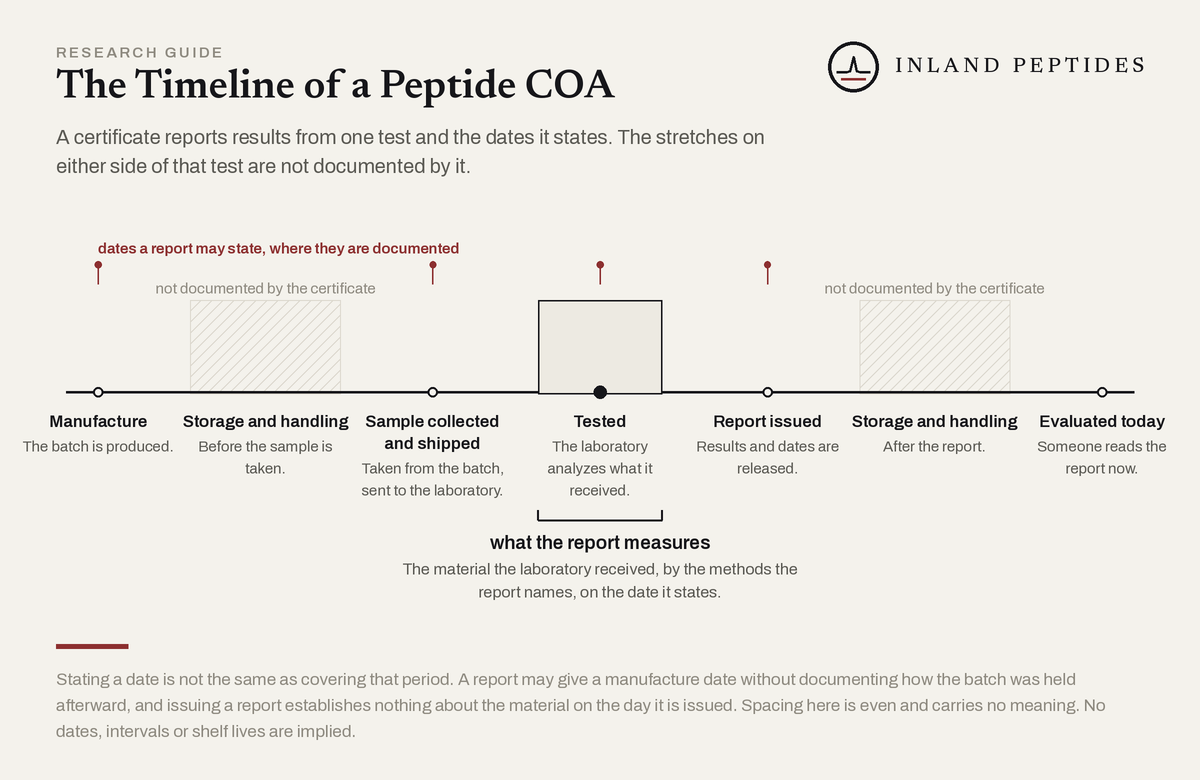
Consider a sample tested in January 2025, with the COA issued three weeks later. Someone reviews that report in October 2026, about 21 months after testing.
If the issuing laboratory confirms the COA is authentic, it establishes the measurements, method, specifications, sample and test date. Those results describe the sample in January 2025.
It does not establish how the material was stored afterward, whether untested characteristics meet requirements today, or whether a specific vial came from the tested lot.
To address those gaps, examine storage records, stability data for that peptide formulation, and evidence linking the vial to the tested lot. Further testing may be needed if important questions remain.
Do not assume a peptide degraded simply because 21 months have passed. Without relevant stability evidence, elapsed time alone establishes neither stability nor deterioration.
What an older certificate can and cannot do
An older COA can remain useful evidence of past testing. It cannot, by itself, establish a product’s present condition.
To judge how useful an older report remains, ask four questions:
- Does stability information exist for that compound in that formulation?
- Is the storage history known?
- Can the tested lot be traced to the material in hand?
- Do the attributes that were tested match what the decision depends on?
When these questions have documented answers, an older COA can remain informative. Without those answers, even a recently issued report may leave important gaps.