A certificate of analysis reports what a laboratory found in the specific vials it tested. It does not report what is in the vial in front of you.
That is not a reason to distrust certificates. Testing a sample and reasoning from it to the rest of the lot is ordinary pharmaceutical quality control, and the reasoning is often sound. How sound depends on what was measured, how the sample was chosen, and what is known about the process that made the lot. Those three things, rather than the certificate itself, decide how much it proves.
| Batch testing | Individual vial testing | |
|---|---|---|
| What is tested | A number of units drawn from a production lot | One specific vial |
| What it establishes directly | That the units tested met the stated specifications | What was in that one vial |
| What extends it to the rest of the lot | A representative sampling plan and a documented, consistent process | Nothing. The result applies to that vial |
| Typical use | Release of a lot by its manufacturer | Independent verification that a lot matches its certificate |
| Main limitation | May not detect a problem affecting only some units | Says nothing about the vial you still intend to use |
The two answer different questions. Neither one tells you about a vial that has not been opened.
What Is a Batch, and What Is a Lot?
A batch is a quantity of material made in one production run and intended to be uniform throughout.
A lot is either that whole batch or a specific identified portion of a batch, having uniform character and quality within specified limits. The two words are often used interchangeably, and for reading a certificate the difference rarely matters.
What does matter is that a certificate describes a lot, not a product. Two lots of the same compound from the same manufacturer are separate populations of material, tested separately. A certificate for one says nothing about the other.
Who holds which records
The lot number is the thread that connects a document to a physical group of vials, but no single party holds the whole history.
- The manufacturer holds the batch production record: what was made, when, from which materials, under which conditions, and what the in-process checks showed.
- Your supplier holds purchasing and distribution records connecting what it received to what it shipped and to whom.
- The independent laboratory holds its own records: what sample it received, when, from whom, what methods it ran, and what it found.
An independent laboratory can confirm that it received a sample identified with a given lot number and report what its analysis showed. It cannot confirm how that lot was manufactured, because it was not there. A certificate with no lot number cannot be tied to any of these records, which is why the number matters more than it looks.
Why Do Laboratories Test Samples Instead of Every Vial?
Because the tests that answer the chemical questions consume what they measure.
High-performance liquid chromatography dissolves the contents of the vial and pushes them through a column. A sterility test transfers the contents into growth media. An endotoxin test consumes the sample it reads. Karl Fischer titration for moisture dissolves the sample as well. Run these on all thousand vials in a lot and you would have a thousand results and nothing left.
Absolute sterility of a lot cannot be practically demonstrated without complete destruction of every finished article. That is the regulator’s own statement of the limit, from the rule on sterility testing, which goes on to say that product sterility testing does not provide absolute assurance of sterility, and that assurance comes primarily from validating the manufacturing process rather than from testing finished units.
Not every measurement destroys the vial
Some attributes can be checked without opening anything. Automated visual inspection examines cake appearance, fill level and closure seating through the glass. Units can be weighed.
Spectroscopic methods read through the container as well. FDA’s framework for process analytical technology describes analyzers that offer nondestructive measurements carrying information about physical and chemical attributes. In published work, near infrared spectroscopy has measured residual moisture in lyophilized protein products sealed in glass vials, with precision comparable to the destructive titration that serves as the reference method.
The limits of those methods are real and specific. The same study found that the measurement had to be matched to one formulation: changing the concentration of a sugar used as a stabilizer shifted the reading, because its signal overlapped the signal for water. A later comparison of near infrared and frequency modulated spectroscopy found both lost accuracy below about one percent moisture, and were better between one and five percent. These are calibrated methods, not universal readers.
What they offer is a different set of answers rather than the same answers for free. Reading through a container can show that a cake looks wrong, that a vial is light, that a stopper is seated badly, or how much moisture the cake holds. It does not establish how many milligrams of peptide the vial contains, what share of that material is the target compound by weight, or whether the contents are sterile.
So the position is narrower than saying all testing is destructive. Several attributes can be checked on every unit, by methods validated for the specific product. The attributes a certificate usually reports are not among them.
How Are Vials Chosen for Testing?
Under the pharmaceutical manufacturing rules, samples must be representative and properly identified, and the sampling plan has to be written before it is used, stating both the method of sampling and the number of units to be tested from each batch.
Representative has a specific meaning there. A representative sample is drawn on rational criteria, such as random selection, and is intended to accurately portray the material being sampled. Three vials taken off the front of the first tray are a sample. They are not necessarily a representative one.
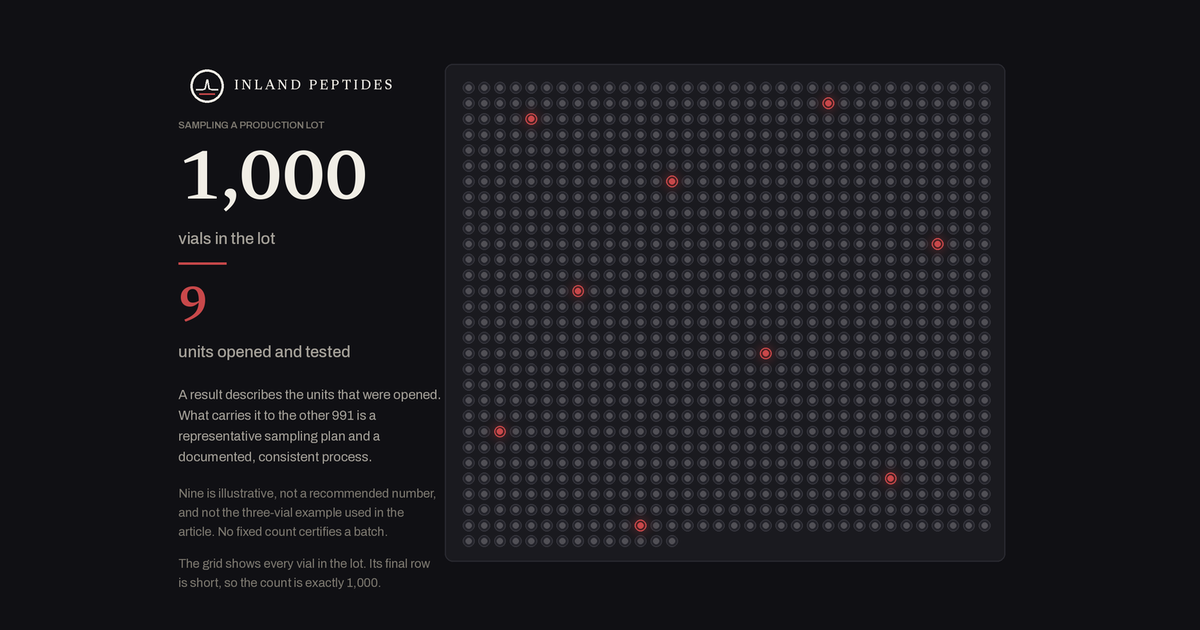
Where the units come from matters as much as how many. Heat does not reach every vial equally during freeze-drying, and published validation practice accounts for that by sampling fixed positions: the four corners and the center of each shelf, and the top, middle and bottom shelves, so the result covers the positions most likely to differ.
There is no universal number. How many units should be tested depends on the size of the lot, the risk the product carries, and how much is known about the consistency of the process behind it. The FDA has observed that a lot of 100,000 units would require more samples than a smaller one. No particular number of vials guarantees a batch.
What Does a Passing Certificate Actually Establish?
That the units tested met the specifications listed, by the methods stated, on the date stated. Everything beyond that is inference.
How far the inference reaches depends on four things: the property being measured, how uniform the material was before it was divided into vials, whether the sample was genuinely representative, and whether the process behind it is documented and controlled.
A worked example
Take a lot of 1,000 vials filled from a single batch of peptide. Before filling, that material was one quantity in one container. Identity and purity are properties of that material, so if three vials drawn from across the filling run confirm the right molecule at the same purity, that supports a conclusion about the rest of the lot.
It does not establish one by itself. How much weight those three results carry depends on whether the sampling plan was designed to be representative and whether the manufacturing process is documented and consistent. Three vials from a validated process with batch records behind it support a great deal. Three vials from an undocumented process support very little. The certificate can look identical in both cases, which is why the records behind it matter as much as the results on it.
Content, sterility and endotoxin levels depend on more than the starting material. They are affected by what happened during filling and sealing, which can vary from one vial to the next. A vial can be underfilled. A stopper can seat badly. One container can be contaminated while its neighbors are clean. For these, a small number of passing results carries less weight than it does for identity and purity, and the gap widens as the process behind the lot becomes less controlled.
What Do the Individual Tests Measure?
Each one answers a narrower question than its name suggests. Identity and purity describe the material. Content, sterility and endotoxin describe a particular unit, and none of the five is a statement about the lot until a sampling plan and a manufacturing record carry it there.
Testing panels also vary. A certificate may report any combination of these, and the absence of a test is itself worth noticing.
| Test | What it answers | What the strength of the inference rests on |
|---|---|---|
| Identity | Is this the right compound? | Whether the material was uniform before filling, and whether the method can distinguish close analogues |
| Purity | What share of the detected signal comes from the target compound? | Area percent is a ratio of detector response, not of mass. It does not establish how much peptide the vial holds by weight |
| Content | How much peptide is in this vial, by weight? | Fill consistency through the run, and whether units were drawn across it rather than from the start |
| Sterility | Did the tested sample show growth? | A negative result is evidence, not proof. Assurance comes from validated aseptic controls rather than from the test |
| Endotoxin | How much bacterial endotoxin is present? | The sampling plan, and whether units were pooled |
No test speaks for a whole lot on its own. It takes the sampling plan and the manufacturing record to extend it.

What Can Batch Testing Miss?
Anything that varies from vial to vial rather than across the batch as a whole.
Fill variation. A low fill would not be readily apparent after freeze-drying, and sub-potency in a vial can be a serious situation. Those are the words of the inspection guidance on lyophilized products. A short-filled vial of white powder looks much like a correctly filled one.
The same guidance makes the point in reverse. Assaying a vial with a higher fill weight produces a higher potency result that does not represent the batch. A sampled vial can be unrepresentative in either direction, and the certificate will not say which.
Localized problems. The agency describes an inspection in which warped trays caused a moisture problem in some dosage units in a batch. Some, not all. It records another in which a firm inspected every vial visually and still failed to identify a defective one that had been partly stoppered before lyophilization.
Pooling. When several units are combined into one composite sample, a single bad unit is diluted by the good ones around it. Pooling is therefore kept small: the recommendation for endotoxin testing is no more than three units per composite. A pooled result can pass while one of the units inside it would have failed on its own.
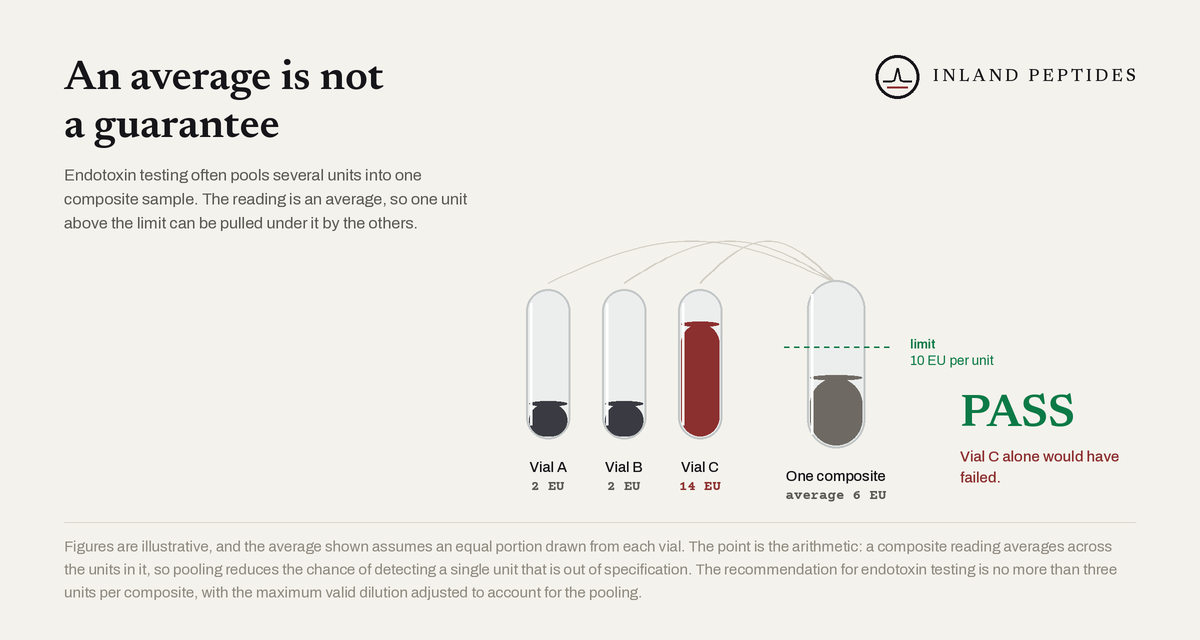
The agency states the general limit directly. Merely testing samples after the lyophilization cycle has finished may be insufficient to justify releasing the remaining units.
What Would Testing an Individual Vial Add?
It establishes the condition of that one vial: whether it was correctly filled and sealed, how much moisture its cake holds, how much peptide it contains by weight, and whether its contents grow organisms in culture.
The first two of those can be answered without opening it, on every unit rather than a sample, using methods validated for that product. Spectroscopic readings through the glass can also indicate what the material appears to be.
The last two cannot. Measuring peptide content by weight, or testing for viable organisms, means opening the vial and consuming the contents. For those questions there is no procedure that answers them and leaves the vial usable.
What individual chemical testing offers is verification of a claim rather than of a dose. Pulling a vial at random from a lot already in distribution and testing it independently checks whether the material matches the certificate issued for it. That is a real check on the supplier, the laboratory and the chain between them. It is not a guarantee about the next vial in the box.
How to Tell Sound Sampling From Inadequate Testing
The difference is usually visible on the document itself.
Sound practice leaves a trail:
- a lot number on the certificate that matches the laboratory’s own testing records, and that the manufacturer and the supplier can match to their separate production and distribution records
- the number of units tested, not merely that testing occurred
- the method used for each result
- a named laboratory, and whether it holds accreditation
- the date of testing
Thin documentation shows the opposite:
- no lot number, or one that leads nowhere
- no statement of how many units were examined
- results with no method attached
- the same certificate appearing against more than one lot
- an issuing laboratory that cannot be identified or contacted
None of this makes batch testing unreliable. Under proper manufacturing controls it is established pharmaceutical practice, and the regulations are built to make the inference from sample to lot trustworthy. They require in-process controls designed to validate the performance of the manufacturing processes that may be responsible for causing variability. Sampling is the last step in that system, not the whole of it.
Which is also the limit of the checklist above. A well-documented certificate shows that testing was done properly and can be traced. It is not evidence that the lot was manufactured under a controlled process, because that evidence sits in production records the certificate does not contain.
How Regulation Applies Depends on Intended Use
Everything above describes the system governing finished pharmaceuticals, which applies to drug products for administration to humans or animals.
Whether a particular product sits inside that system is decided by its intended use rather than by what its label says. Under the Federal Food, Drug, and Cosmetic Act a drug is an article intended for use in the diagnosis, cure, mitigation, treatment or prevention of disease, or intended to affect the structure or any function of the body. The FDA determines that intent from the available evidence, including a seller’s own website and product claims, and it has issued warning letters to peptide sellers concluding that their products were intended to be drugs for human use despite research-use statements on the labeling.
A genuine laboratory research material is a different thing from a product presented for human use, and the distinction decides which rules apply. It is not settled by a disclaimer.
For reading a certificate, the practical consequence is narrower. Where a supplier is not operating under pharmaceutical manufacturing requirements, nothing external obliges it to run a validated process, follow a written sampling plan, keep batch records, or test before release. A certificate from such a supplier may still be rigorous. It is worth reading on the evidence it presents rather than on an assumption about what stands behind it.
What a Certificate Can and Cannot Prove
It can establish that specific units, drawn in a stated way from a stated lot, met stated specifications by stated methods on a stated date.
It can support a conclusion about the identity and purity of the whole lot. How strongly depends on the sampling plan and on what is documented about the process that made it.
It cannot establish that every vial holds the same amount, that every vial is sterile, or that no individual unit was underfilled, damaged or badly sealed. No sampling plan establishes those things for units that were never examined, and a certificate that claims to is claiming more than testing can deliver.