A peptide is a short chain of amino acids. Amino acids are small molecules, and your body builds with about twenty standard ones. Link a few together and you have a peptide. Link a few hundred together and you have a protein.
Three things make this harder than it needs to be. Science has no agreed number separating a peptide from a protein. A peptide can be made by a body or by a factory, and people read more into that difference than it carries. And “prescription drug” sounds like a third item in the same list when it is a different kind of label entirely.
Peptides, Proteins and Prescription Drugs at a Glance
| Peptides | Proteins | Prescription drugs | |
|---|---|---|---|
| Type of category | Molecule | Molecule | Regulatory status |
| What it is | A short chain of amino acids | A long chain of amino acids | A medicine that needs a prescriber to authorize it |
| Does the body make it | Yes | Yes | Not applicable |
| Examples | Oxytocin, GLP-1, semaglutide | Insulin, growth hormone, antibodies | Semaglutide (a peptide), insulin (a protein), metformin (neither) |
| Is FDA approval required | Yes, to be marketed as a new medicine | Yes, to be marketed as a new medicine | Usually. New medicines need approval, but compounded preparations are a legal exception and are not FDA approved. |
| Can it overlap the others | Yes. A peptide can be a prescription drug. | Yes. A protein can be a prescription drug. | Yes. It can be a peptide, a protein, or neither. |
Peptide and protein describe molecules. Prescription describes how a product is sold. The categories overlap rather than competing.
What Are Peptides Made Of?
Peptides are made of amino acids, joined by a chemical connection called a peptide bond. That bond is where the name comes from.
Each link releases a water molecule, and what remains is a chain with a definite order. That order, called the sequence, is what makes one peptide different from another. The same amino acids in a different arrangement produce a different molecule with a different job, the way the same letters spell different words.
Chains also fold. Short ones stay fairly loose. Longer ones twist into specific shapes, and the shape is part of how they work. Two separate chains can also hold onto each other and act as a single unit, which matters for how the law counts them.
What Is the Difference Between a Peptide and a Protein?
Size is the difference. Peptides are short chains and proteins are long ones. Science has never settled on an exact number where one becomes the other, but United States regulation sets a line at 40 amino acids for its own purposes.
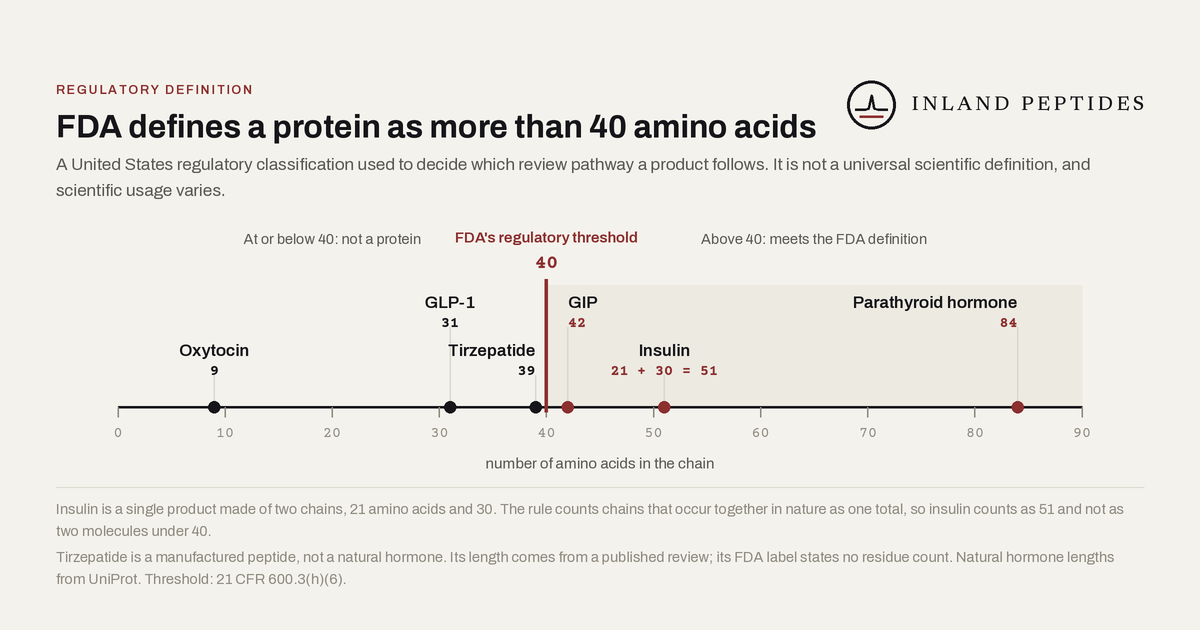
Textbooks draw the boundary in different places. Some treat a peptide as anything up to about 50 amino acids. Others use 2 to 20 for peptides, call 20 to 50 polypeptides, and reserve protein for anything larger. These are conventions rather than findings.
The regulatory line is exact. In a final rule published in February 2020, the FDA defined protein at 21 CFR 600.3(h)(6):
“A protein is any alpha amino acid polymer with a specific, defined sequence that is greater than 40 amino acids in size.”
Definition of the Term “Biological Product,” 85 FR 10057 (February 21, 2020)
The rule took effect on March 23, 2020, and it settles how to count a molecule with more than one chain. When two or more chains are associated the way they are in nature, all of their amino acids are added together.
That counting rule decides real cases. Human insulin is two chains held together, one of 21 amino acids and one of 30. Separately each is well under 40. Together they come to 51, which clears the threshold, so insulin is treated as a protein and reviewed as a biological product. The FDA moved insulin and several other products onto that pathway on the day the rule took effect.
The 40 amino acid line is a regulatory definition, not a biological one
FDA adopted the threshold to decide which products are reviewed as biological products and which are reviewed as drugs. It is a regulatory classification rather than a universal scientific definition. Scientific practice varies, and the same molecule can be called a peptide in one paper and a small protein in another. What the number does not do is describe any change in the molecule itself. Two chains on opposite sides of the threshold might behave very differently or almost identically, depending on their sequences. Crossing 40 amino acids is not what decides that.
The threshold also does not explain regulatory outcomes by itself. Tirzepatide is built on the GIP sequence, and the natural GIP hormone is 42 amino acids. That does not mean a few amino acids decided how tirzepatide is regulated. Tirzepatide is a modified synthetic peptide rather than natural GIP, and which pathway a product follows depends on the application its sponsor files and the statutory definitions that apply to it, not on a residue count by itself.
Are Peptides Naturally Found in the Human Body?
Yes. Your body makes and uses peptides constantly, and several of them are among its most important signals.
- Oxytocin is 9 amino acids.
- GLP-1, the hormone behind several newer diabetes and weight medicines, is 30 or 31 amino acids depending on the form.
- GIP is 42.
- Insulin totals 51 across its two chains.
- Parathyroid hormone, which helps manage calcium, is 84.
These molecules carry messages. One cell releases a peptide, another cell carries a receptor shaped to receive it, and something follows: glucose moves, calcium shifts, a muscle contracts.
Most do not last long. Natural GLP-1 is cleared from the blood within minutes. That short working life is a problem for anyone trying to turn a hormone into a medicine, and it explains much of what drug developers do to these molecules.
How Are Synthetic Peptides Different From Natural Peptides?
Often they are not different in sequence at all. Synthetic describes how a peptide was made, not what it is. Some manufactured peptides carry exactly the same amino acid sequence as the ones your body produces. Others are changed on purpose. There are four situations worth separating.
1. Peptides your body produces
Your own cells build these from your own amino acids, following instructions carried in your DNA.
2. Laboratory copies with the same sequence
Human insulin sold as medicine is made by putting the human insulin gene into bacteria or yeast and letting them produce it. The Humulin R label describes insulin human as produced by recombinant DNA technology using a laboratory strain of Escherichia coli.
A copy can also be part of a molecule. Parathyroid hormone is 84 amino acids, and teriparatide is the first 34 of them, the end that does the work. The Forteo label states that teriparatide has an identical sequence to the 34 N-terminal amino acids of the 84 amino acid human parathyroid hormone, and that it is manufactured using a strain of Escherichia coli modified by recombinant DNA technology.
Matching the sequence is not the same as being identical in every respect. A finished medicine also contains inactive ingredients, carries its own purity and impurity profile, and is delivered in a particular formulation. Manufactured proteins and peptides can also provoke an immune response in some patients. The sequence is one part of what a product is.
3. Peptides designed to act like a natural one
These are built on a natural sequence and changed deliberately, usually so they last longer. The label for semaglutide describes three changes to the GLP-1 backbone: a fatty di-acid attached at position 26, a change at position 8 that protects the molecule from the enzyme that would otherwise break it down quickly, and a further change at position 34. The fatty acid lets it bind to albumin, a protein already circulating in blood, which slows how fast it is cleared.
Natural GLP-1 lasts minutes. Semaglutide lasts long enough for weekly dosing. The molecule is not human GLP-1, and it was never meant to be.
4. Chemically modified and hybrid peptides
Some peptides are changed enough, or combine features of more than one hormone, that copy stops being a useful word. Tirzepatide is based on the GIP sequence, carries a fatty acid attachment, and acts on two different receptors, GIP and GLP-1. No single human hormone does that.
How Are Manufactured Peptides Made?
By chemical synthesis, or by recombinant production in living cells. A number of products use both.
Chemical synthesis. The chain is built one amino acid at a time on a solid support. Add an amino acid, wash, add the next, wash, repeat, then cut the finished chain loose. Every addition is a separate reaction with its own chance of falling short, so the steps compound.
Recombinant production. The instructions are inserted into living cells, usually bacteria or yeast, and the cells build the molecule. This is how human insulin and teriparatide are made. The molecule then has to be separated from everything else the cells produced.
Length is part of the choice, because cells assemble long chains more accurately than a long series of chemical steps can. It is not the only factor. Cells can build only with the amino acids biology gives them, so a peptide carrying unusual building blocks or a chemical attachment has to be finished in a laboratory whichever way it started. Cost, scale and how the molecule folds all feed into the decision as well.
Semaglutide is made both ways. Its label describes a peptide backbone produced by yeast fermentation, which is then chemically modified at three positions to attach the fatty acid and to protect the molecule from being broken down.
Neither process is self-verifying. What comes out of either one has to be measured before anyone knows what it contains.
Are Natural Peptides Safer Than Synthetic Peptides?
No. Where a peptide was made does not determine whether it is safe. Both halves of that assumption fail in practice.
Natural molecules can be extremely dangerous. Botulinum toxin, a protein produced by bacteria, is among the most poisonous substances known, and it is also an approved medicine in controlled amounts for specific uses. Its natural origin predicted neither outcome.
A peptide your body makes can also cause harm in the wrong amount. Insulin is essential, and too much of it sends blood sugar dangerously low. The molecule is natural either way.
Safety is a property of a specific product used by a specific person, and several things decide it:
- whether the molecule has been studied in humans, in what amounts, and for what purpose
- how the product is formulated, including its inactive ingredients, concentration and sterility
- the adverse effects it is known to cause, which approved peptide medicines carry and document like any other drug
- the individual taking it, including other conditions, other medicines, and how well the kidneys and liver clear it
- whether the material in a specific vial is actually what the label says it is
That last point is a measurement question rather than a chemistry question. It is why independent testing exists, and why a certificate of analysis tells you more about a given vial than a compound’s origin story does. Purity and content are also two different measurements, and purity alone does not tell you how much peptide is in the vial.
Can Peptides Be FDA-Approved Prescription Drugs?
Yes. Semaglutide, tirzepatide, liraglutide, teriparatide and oxytocin are all peptides sold as approved prescription medicines. Insulin, at 51 amino acids, is approved as a biological product instead.
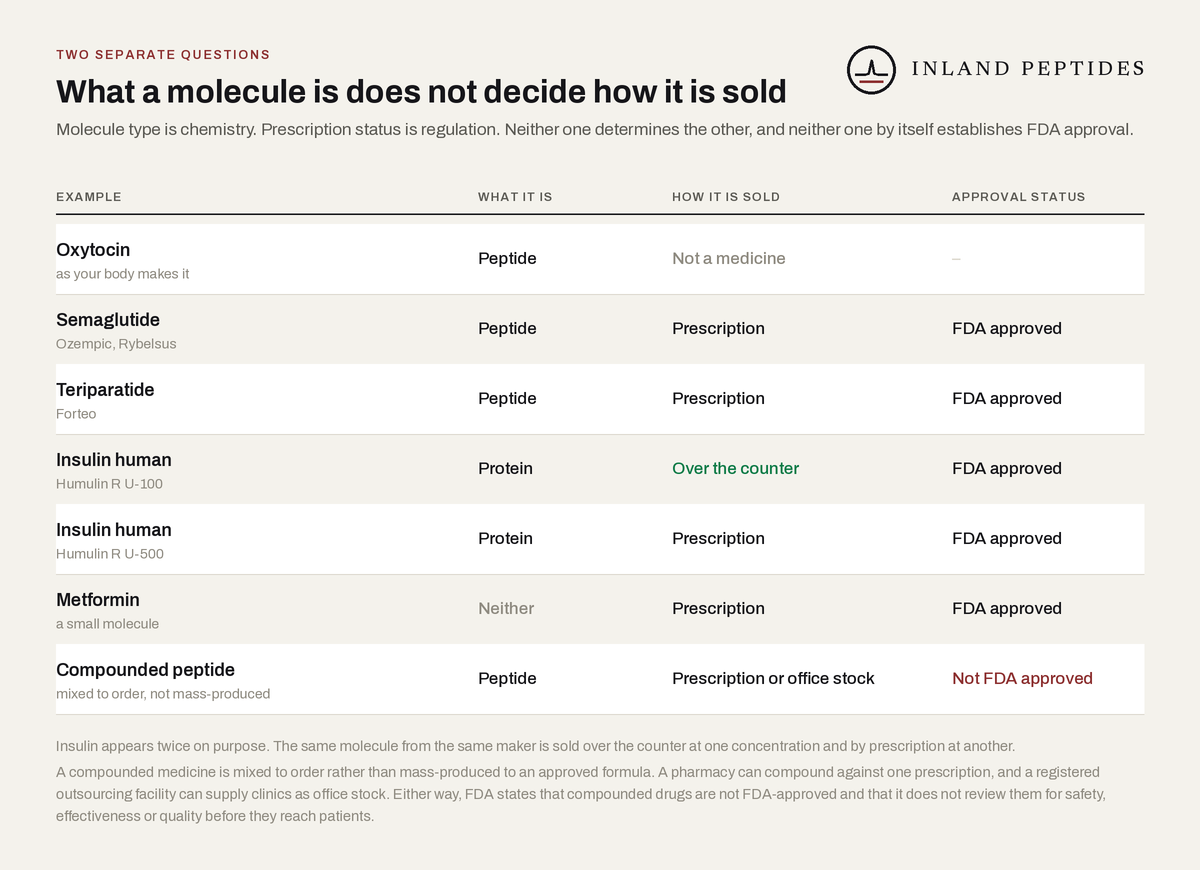
Needing a prescription does not mean a product is FDA approved
These are two different things. Compounded medicines are mixed to order rather than mass-produced to an approved formula. A pharmacy can compound against an individual prescription, and a registered outsourcing facility can also supply compounded preparations to clinics as office stock, without a prescription for a named patient. Either way the FDA states plainly that compounded drugs are not FDA-approved, and that it does not review them for safety, effectiveness or quality before they reach patients.
Approval also attaches to a product rather than to a molecule. It covers a specific formulation from a specific manufacturer, made at a specific facility, for a specific use, at specific strengths. A familiar molecule name appearing in an approval does not mean every preparation containing that molecule is approved.
And some approved medicines do not need a prescription at all
Insulin shows this directly. Humulin R U-100 is labeled as an over-the-counter drug, while Humulin R U-500 from the same manufacturer is a prescription drug. Same molecule, same brand, two concentrations, two different answers to the question of whether a prescriber has to be involved.
Most peptides, meanwhile, have never been approved for anything. Some went through early human trials and stopped. Some exist only in animal studies. Our Peptide Library records what the published research shows for each compound, including the many cases where it shows very little.
Why Are Peptide Medicines Usually Injected?
Because a swallowed peptide runs into two barriers, and most do not get past either one.
Digestion takes them apart. Stomach acid and digestive enzymes break peptide bonds. Those enzymes do not distinguish between the protein in a meal and a peptide medicine, so much of a swallowed dose is cut into fragments and amino acids before it can do anything.
What survives still has to cross the gut wall. Absorption means passing through the lining of the small intestine, and large water-loving molecules cross it poorly. Size is one factor rather than the whole explanation. Electrical charge, water solubility and how tightly the cells of the intestinal lining are joined together all affect how much gets through.
An injection skips both barriers, which is why most peptide medicines are given that way.
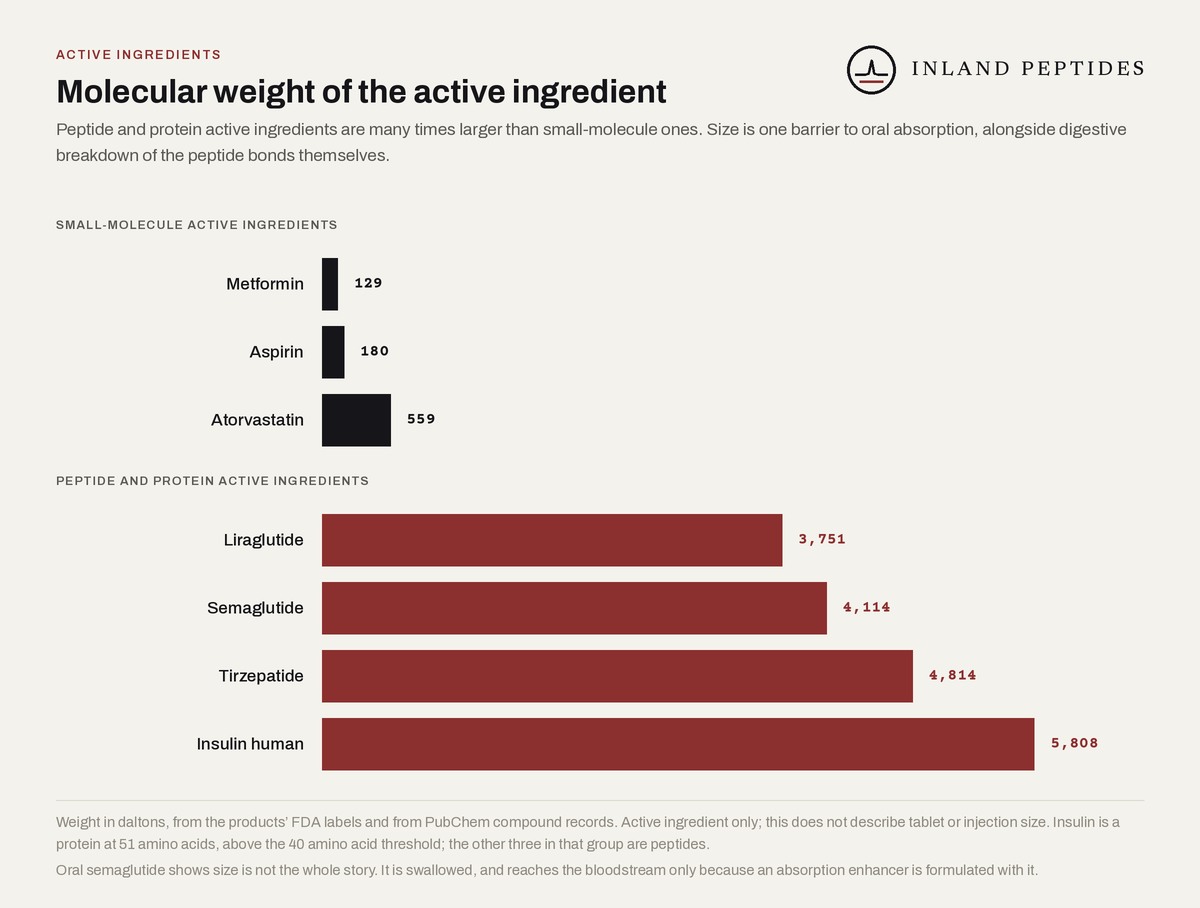
Swallowing a peptide is difficult rather than impossible. Oral semaglutide is sold as a tablet, and its label lists salcaprozate sodium among the inactive ingredients, an absorption enhancer included so that enough of the peptide reaches the bloodstream.
Molecular weight shows the scale of the size difference. Metformin weighs 129 daltons and aspirin 180, while liraglutide weighs 3,751, semaglutide 4,114, tirzepatide 4,814 and human insulin 5,808.
Manufacturing and verification challenges
Size creates two other practical problems.
They are harder to manufacture. A small molecule is assembled in a handful of chemical steps. A peptide of forty amino acids takes dozens of steps in sequence, and any one of them can leave a slightly wrong version behind: a chain missing an amino acid, or carrying a modification nobody intended. These related impurities are chemically similar to the target, which makes them hard to separate and hard to detect.
They are harder to verify. Confirming the identity and purity of a large molecule takes more than one method. How peptides are tested walks through what each laboratory technique measures and where each one is blind.
The Short Version
A peptide is a short chain of amino acids and a protein is a long one. Science has no exact dividing line, and the 40 amino acid figure used in United States regulation is there to sort review pathways, not to describe biology.
Prescription status is a separate question from both. Some prescription medicines are peptides, some are proteins, and most are neither. Requiring a prescription does not mean a product is FDA approved, and being FDA approved does not always mean a prescription is required.
Whether a peptide came from a cell or a laboratory tells you very little about whether it is safe or whether it works. What tells you that is what has been studied, in what amounts, in whom, and whether the material in front of you is what it claims to be.