Neither test is better overall. It depends on what you need to know about the sample.
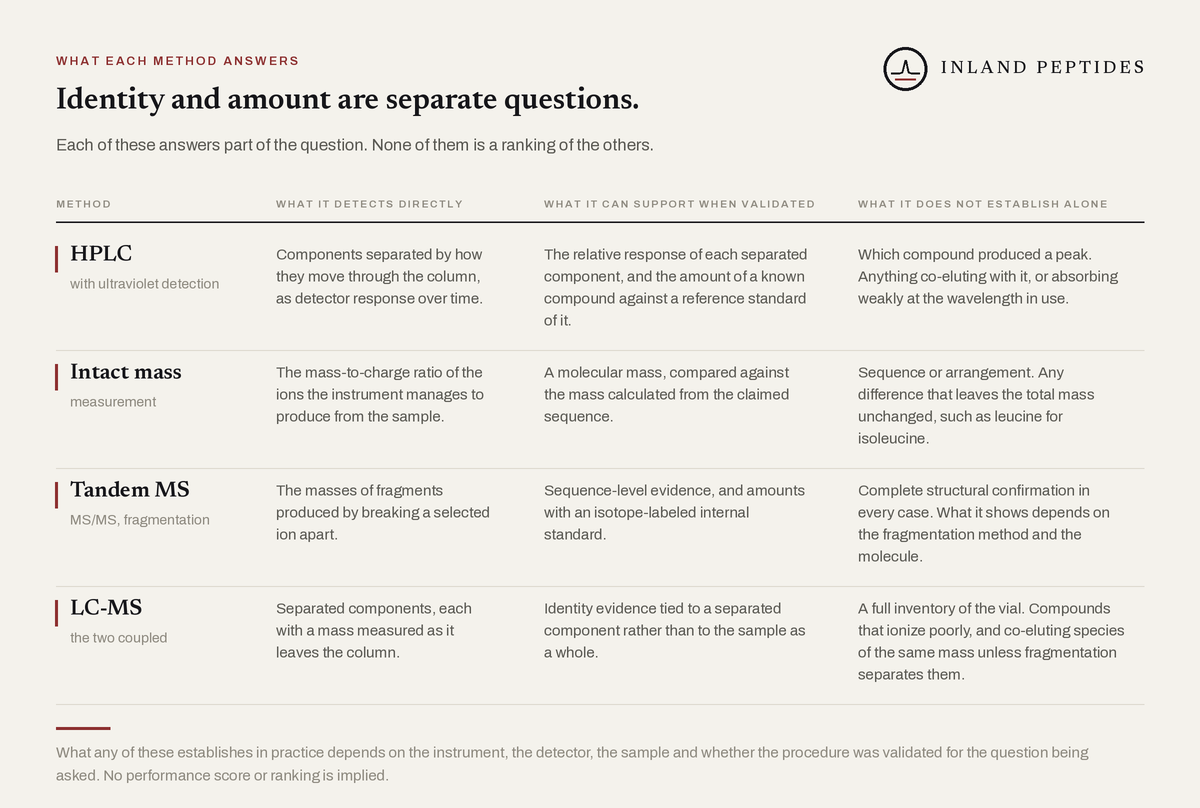
HPLC separates components of a sample and records their detector signals. Mass spectrometry measures the mass-to-charge ratios of ionized molecules to help determine molecular mass. Tandem methods can also provide evidence about molecular structure. With proper calibration, either technique can measure amounts. They are often used together because they answer different questions.
| HPLC | Mass spectrometry | |
|---|---|---|
| What it measures directly | How long each component takes to travel through a column, and how much detector response it produces | The mass-to-charge ratio of molecules that have been given an electrical charge |
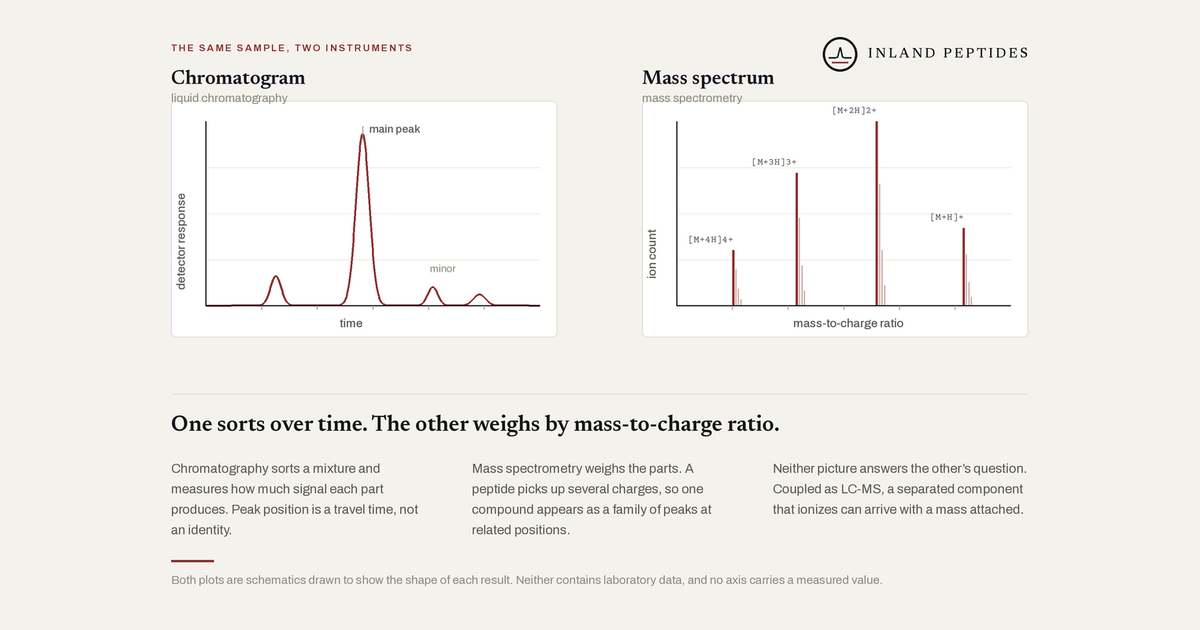
| What the result looks like | A chromatogram: peaks along a time axis | A spectrum: peaks along a mass-to-charge axis |
| What it can measure with proper calibration | The amount of a known compound, against a reference standard of that compound | The amount of a known compound, most reliably with an isotope-labeled internal standard |
| What it shows about structure | Nothing directly. Retention time is circumstantial evidence of identity | The molecular mass, which narrows the possibilities without fixing them. Tandem methods fragment the molecule and can give sequence-level evidence |
| What it does not establish on its own | Which compound produced a peak, or how much peptide the vial holds | The purity of the whole sample, since an impurity still has to ionize and be detected to appear at all |
| How much instruments differ | Detector type and wavelength change what is visible at all | Resolution, and whether the instrument can fragment a selected ion, change what can be told apart |
The key is knowing what each result establishes, and what it leaves unanswered.
How Does HPLC Separate Peptides?
HPLC separates peptides according to how they move through a column.
The sample is dissolved and pushed through a packed column by a liquid. Components that cling more tightly to the packing material move slowly. Components that cling less move quickly. When the method separates them, the compounds reach the detector at different times.
For peptides, this is usually reversed-phase chromatography. More water-repelling molecules tend to interact longer with the column’s packing material, so they move through it more slowly.
A detector at the outlet records how much signal arrives at each moment. Plotted against time, that gives a chromatogram: a flat baseline with peaks rising from it. The position of a peak is its retention time. The area under a peak reflects how much signal that component produced.
What Does an HPLC Purity Percentage Mean?
It means the target peak accounted for that share of the total detector signal. A result of 99 percent says the main peak produced 99 percent of the response the detector recorded.
That is a ratio of detector response rather than a ratio of mass, because detectors do not respond equally to everything. An ultraviolet detector sees what absorbs ultraviolet light. At around 214 nanometers it reads mainly the peptide bond, so most peptides respond. At 280 nanometers it reads aromatic side chains, so a peptide containing none of those responds weakly at that setting.
Anything that absorbs weakly or not at all at the wavelength used contributes little to the total the percentage was calculated from. Water, salts and counterions are the common examples. They are part of the powder, and they may not be represented in an ultraviolet chromatographic purity result.
A chromatographic purity figure is therefore not a statement about how many milligrams of peptide a vial holds. Assigning the actual peptide content of a reference material requires specialized primary methods, such as quantitative nuclear magnetic resonance or amino acid analysis by isotope dilution mass spectrometry. Researchers working on certified peptide standards note that even those methods are susceptible to interference from related peptide impurities. Mass spectrometry is one of the techniques used to make that measurement, not only to identify what is present.
Does One HPLC Peak Prove a Peptide’s Identity?
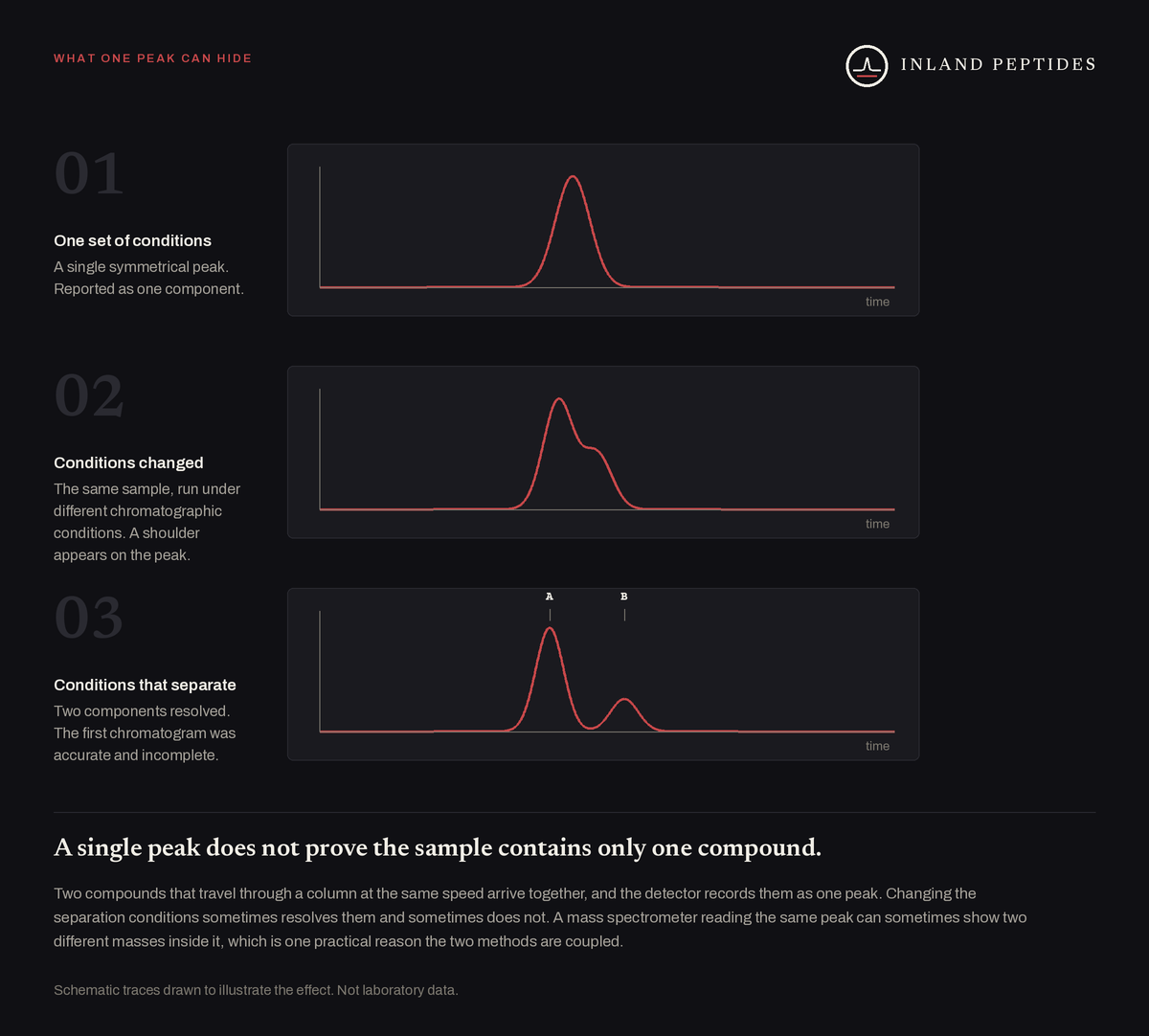
No. A single peak shows a dominant detector response under those conditions, but two or more compounds may be hidden within that peak.
Two different compounds can travel through a column at the same rate. When they reach the detector together, their signals can appear as one peak. The chromatogram may look clean even though more than one compound is present.
Chromatography can show that a sample behaves the way the expected compound behaves. If a reference standard of the same peptide leaves the column at 12.4 minutes under set conditions, and the sample produces one large peak at 12.4 minutes, that is meaningful evidence.
A chromatogram records retention times and detector signals, not molecular structure.
What Does Mass Spectrometry Measure?
The mass-to-charge ratios of ions, which can be used to work out molecular mass.
The sample is ionized, the instrument separates those ions by mass relative to charge, and a detector counts how many arrive at each value. The output is a mass spectrum: peaks along an axis of mass-to-charge ratio rather than time. The molecular mass worked out from it can then be compared against the mass calculated from the claimed sequence.
Not all mass spectrometers have the same resolution. A low-resolution instrument separates masses that differ by whole units. A high-resolution instrument can distinguish masses that differ by small fractions of a unit. Two certificates can both say mass spectrometry and describe very different measurements.
What Is the Difference Between Intact Mass and Tandem MS?
An intact mass measurement weighs the whole molecule. Tandem mass spectrometry, often written as MS/MS, selects a molecule, breaks it into fragments and weighs those.
Because a peptide tends to break at predictable points along its backbone, the pattern of fragment masses can be read back as sequence evidence. How much that evidence establishes depends on the fragmentation method, the instrument and the specific molecule, so it is not a guarantee of complete structural confirmation.
When reading a certificate, check whether the laboratory measured intact mass or performed tandem analysis. A single reported mass value does not provide the same structural evidence as a fragmentation study.
Can Mass Spectrometry Establish Purity?
Not from signal sizes alone, and not for a whole sample, though a calibrated method can measure the amount of a known compound accurately.
The obstacle is ionization. Molecules differ in how readily they take on a charge, and the instrument counts only what it manages to ionize. Two compounds present in equal amounts can produce very different signal sizes. Predicting how efficiently a given peptide will ionize is still an active research problem, which is a reasonable sign that it cannot be assumed.
So peak height in a mass spectrum is not a reliable measure of quantity unless the method has been calibrated for that specific compound. Done properly, with a known standard and usually an isotope-labeled version of the target as an internal reference, mass spectrometry is a precise quantitative method. Even then it measures the compound it was calibrated for. Saying what fraction of the whole sample is impurity is a different question, because each impurity has to ionize and be detected before it can be counted at all.
Why Doesn’t a Matching Mass Prove a Peptide’s Structure?
Because different structures can share the same mass.
A mass is a sum, and many arrangements add up to the same number. Leucine and isoleucine are the clearest case: they contain the same atoms arranged differently, so they weigh the same. A peptide with one substituted for the other has the same molecular mass as the correct sequence, and no intact mass measurement at any resolution will separate them. The same applies to order, since a peptide built from the right amino acids in the wrong sequence weighs what the right one weighs.
A published case shows how far this can go. During routine peptide mapping of a therapeutic antibody, analysts found a variant carrying a mass shift of 113 daltons at an abundance of up to 1.5 percent. The initial hypothesis was an added leucine or isoleucine. Multistage tandem mass spectrometry showed a two-amino-acid substitution involving valine and alanine instead, and a synthetic peptide built to that sequence confirmed it by matching both the retention time and the fragmentation pattern. The authors describe the work as an illustration of why high-resolution mass spectrometry and alternate fragmentation methods matter for resolving ambiguities between species of the same mass.
In that case, fragmentation data and comparison with a synthetic standard resolved the ambiguity. A matching intact mass is consistent with the claimed structure, but does not confirm it.
What Each Method Misses
Chromatography misses anything that travels through the column at the same speed as something else, and anything its detector responds to weakly at the wavelength in use. Mass spectrometry misses compounds that ionize poorly, and any difference that does not change the mass being measured.
Those limits can overlap. A compound that co-elutes with the main peak and also ionizes poorly, or that co-elutes and shares the same mass, can stay hidden from both. Running the two together narrows the gap considerably without closing it, and no pairing of methods guarantees that every impurity has been found.
Neither technique addresses sterility or bacterial endotoxin. Those require separate procedures, and no combination of chromatography and mass spectrometry speaks to them.
Why Are HPLC and Mass Spectrometry Used Together?
HPLC separates components, while mass spectrometry adds molecular-mass information. Together, they can tell us more about a sample than either method alone.
In LC-MS (liquid chromatography coupled to mass spectrometry), the column’s output flows directly into a mass spectrometer.
For compounds that separate and ionize well, LC-MS pairs a chromatographic peak with mass information. It still cannot characterize every substance in a vial. Two compounds that co-elute can be distinguished by intact mass only if their masses differ. Tandem methods can sometimes tell apart species of the same mass by their fragmentation patterns, but not always. A compound that ionizes poorly may produce little or no mass signal. The number of peaks in a chromatogram reflects what the method resolved, not necessarily how many components were in the sample.
What FDA Guidance Says
Pairing methods this way is also what current guidance recommends, though it is a conditional recommendation rather than a requirement to run any particular pair. The guideline on validating analytical procedures adopted by the FDA in 2024 says that where one procedure does not provide sufficient discrimination, a combination of two or more procedures is recommended to achieve the necessary selectivity, and that a lack of specificity in one procedure should be compensated by other supporting procedures unless appropriately justified. Its own worked example pairs a titration with an impurities test, not chromatography with mass spectrometry. The principle is that a known gap in one method should be covered by another, and which methods those are depends on the sample and the question.
FDA withdrew its 2021 guidance on certain highly purified synthetic peptide drug products in July 2026 because it no longer reflected the agency’s scientific thinking. The agency plans to revise and reissue that guidance. The separate 2024 guidance on validating analytical procedures remains current.
What Is Still Unknown When Both Tests Pass
How much peptide the vial holds, whether the contents are sterile, how much bacterial endotoxin is present, and whether an impurity escaped both methods.
Quantity. Both techniques can measure the amount of a known compound when calibrated against a standard, but a chromatographic purity percentage and a confirmed molecular mass are not those measurements.
Sterility and bacterial endotoxin. Neither technique addresses either question, and both require separate procedures.
An impurity that co-elutes with the main peak and either shares its mass or ionizes poorly. Additional fragmentation or a different analytical method may be needed to detect it.
Anything the method was not validated to detect. Selectivity belongs to a validated procedure applied to a particular question, not to an instrument in general.
What Should You Check on a Peptide Certificate of Analysis?
Check which method produced each number, what conditions it ran under, and whether the certificate reports measured values or only states that the sample conformed.
A chromatographic purity figure with no method stated is hard to interpret, because the number depends on the detector, the wavelength and the conditions.
A mass result is more informative when the certificate says whether the instrument was high resolution, and reports the measured value against the calculated one rather than stating only that it conforms.
A result from tandem analysis is stronger evidence of structure than an intact mass alone, and certificates rarely distinguish the two.
Both together are stronger than either alone, and still say nothing about quantity, sterility or endotoxin.
A certificate reporting chromatographic purity and a matching mass tells you about one tested sample under specific conditions. The sample produced a dominant chromatographic signal, and the detected component had the expected molecular mass. Those findings are useful, but they do not establish everything a reader might assume from the word purity.