Doctors do not have a single view of experimental peptides. They distinguish medicines backed by clinical trials from compounds promoted online with little human evidence. The first question is which peptide is being discussed.
Peptides are short chains of amino acids, the same building blocks that make up proteins, just smaller. They work as signals. Insulin, for example, is a peptide. A 2022 review in Signal Transduction and Targeted Therapy counted more than 80 peptide drugs on the global market. They include leuprolide for prostate cancer, octreotide for acromegaly, teriparatide for osteoporosis and desmopressin for diabetes insipidus.
BPC-157, TB-500, GHK-Cu and ipamorelin are among the experimental compounds promoted online and sold in vials labeled for research use. None is FDA-approved for human use. So their evidence cannot be judged by the success of established peptide medicines.
Approved medicines and investigational compounds follow different rules
The key distinction is the evidence required for approval. Approved peptide drugs undergo laboratory testing, controlled human trials and manufacturing review. Investigational compounds may have some of that evidence, but they have not completed the approval process.
Retatrutide shows that process in motion. The compound is an investigational triple receptor agonist from Eli Lilly. TRIUMPH-1 was a randomized, double-blind, placebo-controlled phase 3 trial in 2,339 adults. Participants on the highest dose lost 28.3% of their body weight over 80 weeks, against 2.2% on placebo. Still, 11.3% of that group stopped because of side effects. The results were presented at the ADA meeting in June 2026. That weight figure describes an idealized scenario in which every participant stayed on treatment and used no other weight loss drugs. Retatrutide is not approved, and Lilly states that it is legally available only to people enrolled in its trials.
Retatrutide and sleep apnea
The program is also where physicians outside obesity medicine started paying attention. Two phase 3 trials, TRIUMPH-1-OSA and TRIUMPH-2-OSA, enrolled 243 and 448 adults with moderate to severe obstructive sleep apnea. Both were published in October 2026 in the New England Journal of Medicine. The apnea-hypopnea index is the standard count of breathing interruptions per hour of sleep. In the trial of participants without type 2 diabetes, the 9 mg dose reduced it by 34.3 events. In contrast, placebo reduced it by 9.9. Lilly’s earlier announcement had put the reduction at as much as 36.1 events, a figure from a different analysis that reported no placebo comparison.
“I’m a cardiologist,” writes Afshine Emrani, a board-certified cardiologist in Los Angeles. “Before: CPAP or live with the breathing interruptions. After: an investigational triple agonist cut sleep apnea events by 30+ per hour.” Emrani added: “Still early, not approved, GI effects common.”

Emrani also acknowledged the limits: retatrutide remains investigational and gastrointestinal side effects are common. Its clinical trial program offers substantially more evidence than is available for BPC-157 or TB-500.
What the research on the popular compounds shows
The human evidence varies by compound, and a study of one peptide cannot establish the effects of another.
A 2026 scoping review in the Journal of Orthopaedic Experience and Innovation went looking for human data on the peptides most often promoted for recovery. For BPC-157 it found one uncontrolled retrospective report on knee pain, rated low quality, plus a registered phase 1 trial covering safety and pharmacokinetics only. For TB-500 it identified no robust surgical trials. The authors wrote that the literature supports “biologic plausibility but not clinical effectiveness,” and that “the absence of high-quality safety data should not be interpreted as reassurance.”
A separate 2026 systematic review identified three small human studies involving 30 participants in total. The authors rated the overall evidence as very low certainty.
KFF Health News examined the claims made for BPC-157 in October 2026 and reached the same place. A 2005 summary covering inflammatory bowel disease was called inadequate by FDA scientists, and the knee pain study had no control group. In fact, most of what exists is animal work.
Most BPC-157 research comes from one group
The research record has another limitation. STAT reported in February 2026 that nearly all published BPC-157 research traces to one research group in Croatia. Its lead investigator has authored more than 150 papers on the compound. Most of the roughly 200 BPC-157 papers on PubMed list that investigator or a close colleague as a main author. A Polish review team noted this and said it raises the risk of confirmation bias.
Ipamorelin and GHK-Cu
Ipamorelin has been tested in humans, but not for most of its advertised uses. A phase 2 randomized, placebo-controlled trial published in 2014 tested it for postoperative ileus after bowel resection. Median time to a first tolerated meal was 25.3 hours with ipamorelin against 32.6 hours with placebo, a difference that did not reach statistical significance. A nomination filed with FDA lists that trial and a 1999 pharmacokinetic study in healthy men as the human record. Yet it contains no human trial data for the uses it is now marketed for. Those uses include growth hormone deficiency, obesity and sarcopenia.
GHK-Cu has a different research history. The copper peptide has a long cosmetic history and a real mechanistic literature on collagen and wound repair. But its human studies are mostly cosmetic, built on topical creams and short trials. The most cited review was also written by the peptide’s original discoverer. None of that work tested injection. The orthopaedic reviewers found no surgical trials for it and flagged purity concerns specific to injectable use.
The gap between evidence and promotion
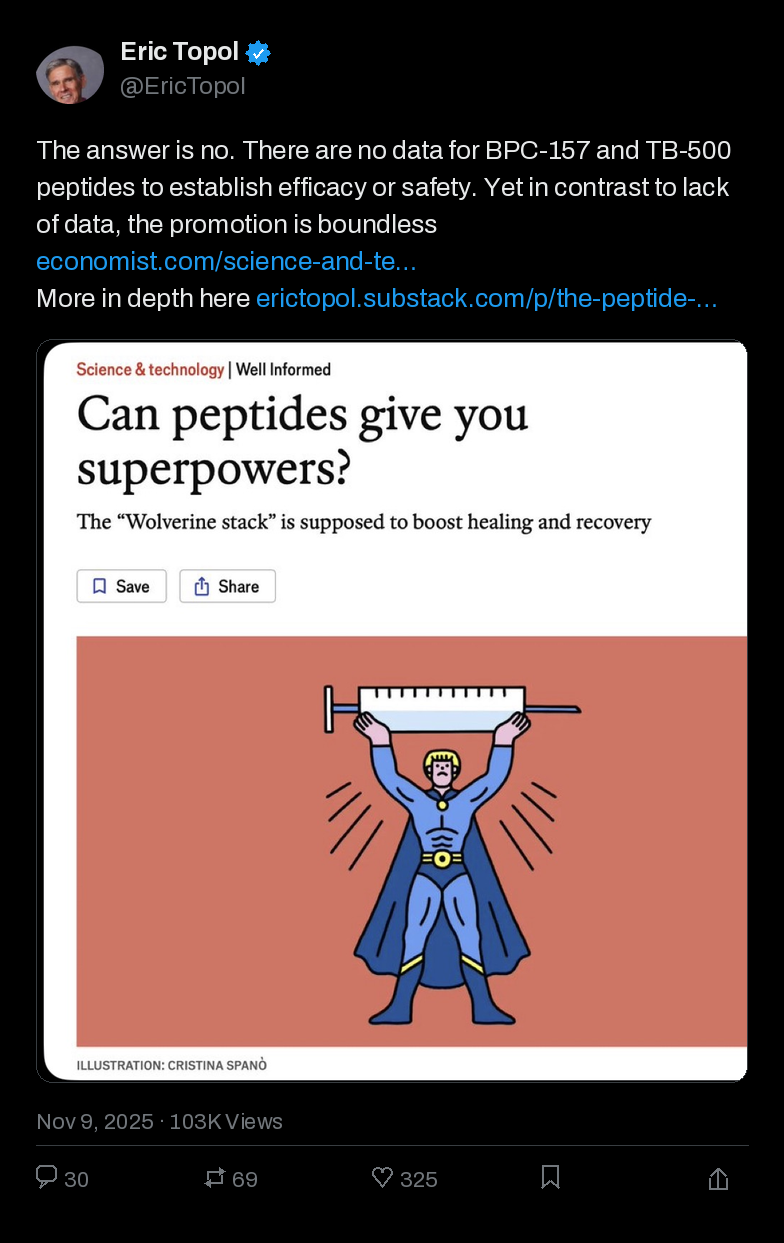
Researchers have also challenged the gap between clinical evidence and promotional claims. Eric Topol reviewed fifteen injectable peptides in his Ground Truths newsletter in July 2025. He concluded that no randomized human trial supports the benefits being claimed for them. Asked a few months later whether peptides deliver, he answered in a single word.
“The answer is no,” writes Eric Topol, a physician and researcher based in La Jolla, California. “Yet in contrast to lack of data, the promotion is boundless.”
Physicians sort the claims by what has been tested
Peptide claims circulate widely through podcasts and social media. Jordan D. Metzl is a sports medicine physician at the Hospital for Special Surgery in New York. He wrote in September 2026 that some peptide medications have been extensively studied and show meaningful benefits. But many others promoted for recovery, performance and longevity, he added, lack robust human research. Laboratory and animal results, he wrote, do not by themselves demonstrate benefit or long-term safety in people. He also called for “more rigorous research and evidence before widespread adoption.”
Carolyn Barber, an emergency physician and contributing writer at Fortune, summarized Metzl’s column on X. “Your friend’s podcast is NOT a clinical trial,” Barber wrote. She added: “Before you buy, ask ONE question: where’s the human trial data & how good is it?”
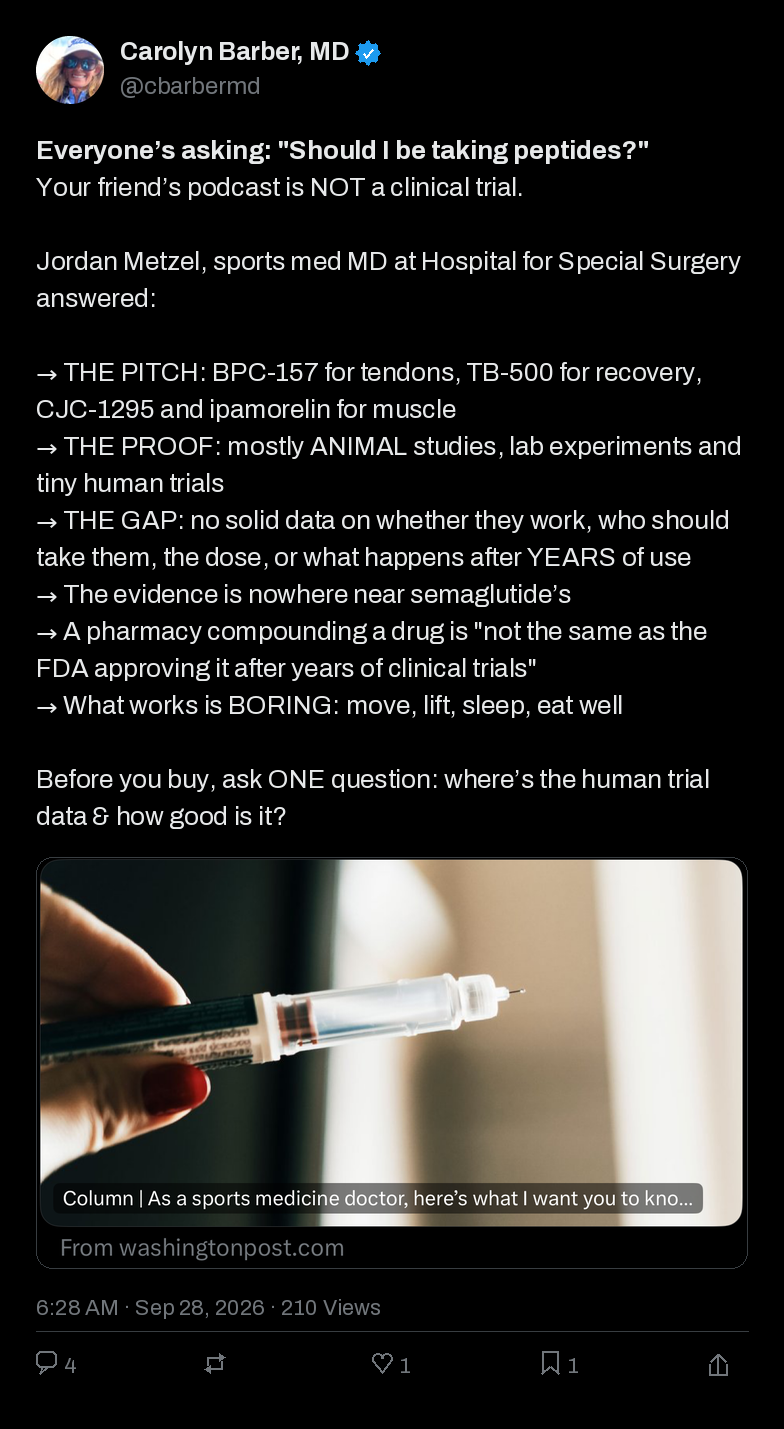
Barber attributed the comparison between pharmacy compounding and FDA approval to Metzl. The two processes are not equivalent, regardless of how a peptide is advertised.
Dose and safety are separate concerns. Paul Knoepfler is a cell and molecular biologist at the University of California, Davis. He told NPR that a substance can help at one dose and do nothing or cause harm at another. “You can’t just make up what dose to take,” he said. Still, not every physician in the conversation is a skeptic. Amanda Kahn, who runs a concierge practice in Manhattan, prescribes some peptides as an adjunct therapy and tells patients they are experimental. “I don’t overpromise that this is a cure-all,” she said.
Pharmacists field the same questions at the counter
Pharmacists must also address whether and how experimental peptides can be supplied. Mohammed Chammout is a community pharmacist who wrote in Pharmacy Times after the July advisory vote. He sorts the field into three groups for patients. The first is approved drugs such as semaglutide and tirzepatide. The second is peptides that might become compoundable under a prescription, and the third is gray market products. On the evidence he is direct, saying BPC-157 rests on a handful of small pilot studies in humans and TB-500 on no completed randomized controlled trials.
For compounding pharmacies, Chammout recommends checking Pharmacy Compounding Accreditation Board accreditation, compliance with United States Pharmacopeia compounding standards, and third-party purity documentation.
Matt Martin is a pharmacist and vice president of clinical services at PCCA. At the National Community Pharmacists Association meeting in October 2026, he told pharmacists to slow these conversations down. He urged them to ask two things: where the product came from, and who prescribed it. Products bought online as research chemicals, he noted, are not evaluated for microbial contamination, endotoxins or heavy metals. Nor does anything on the label commit anyone to having checked.
Where compounding ingredients must come from
The Alliance for Pharmacy Compounding addressed sourcing in a 2024 memo. In it, the group told state boards of pharmacy that bulk substances used in compounding must come from FDA-registered facilities. It also said they must not be labeled for laboratory or research use only. So a vial carrying a research use only label does not satisfy that criterion, whatever is inside it.
The level of oversight in pharmacy compounding is also debated. Scott Brunner, chief executive of the Alliance for Pharmacy Compounding, argues that state pharmacy boards provide licensing and inspections, a different regulatory system from drug manufacturing. Howard Sklamberg, a former FDA deputy commissioner, described the market as “really kind of a Wild West.” He also warned that quality control becomes more difficult as batch sizes grow.
Interest inside mainstream medicine is growing
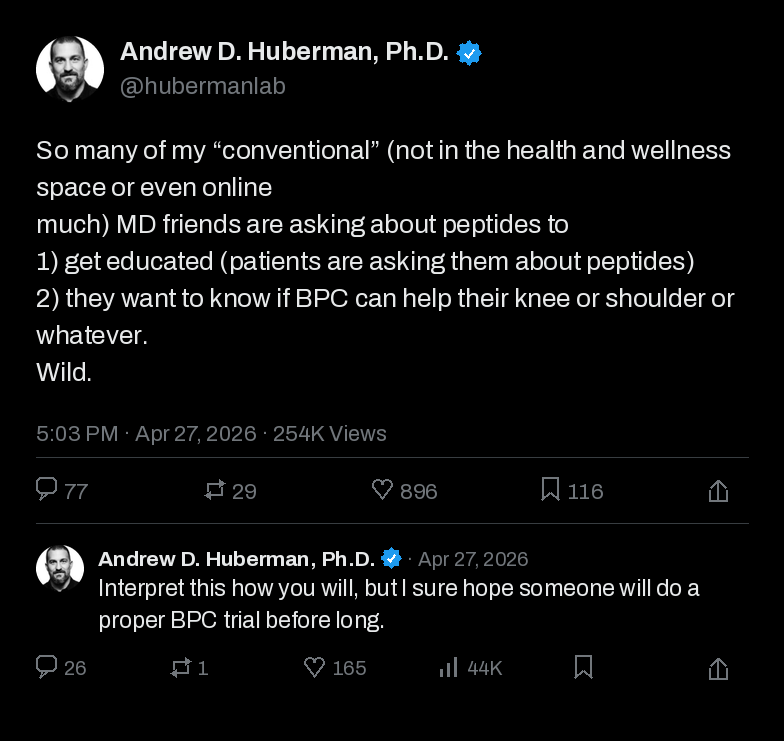
Curiosity about these compounds now extends to clinicians with no connection to the wellness industry. Andrew D. Huberman, a neuroscientist and associate professor of neurobiology at Stanford, described that shift in April 2026. He is not a physician, and his post is about what physicians are asking him.
“MD friends are asking about peptides,” writes Andrew D. Huberman, a neuroscientist at Stanford University. In a reply to his post, Huberman added: “Interpret this how you will, but I sure hope someone will do a proper BPC trial before long.”
What the October policy does
The FDA’s Pharmacy Compounding Advisory Committee met in July 2026 to consider seven peptides for the list of bulk substances compounding pharmacies may use. In its briefing document the agency proposed against including every one of them. The committee backed six peptides anyway, by narrow margins, and rejected the seventh.
That vote was non-binding, and agency staff scientists had opposed all six. They cited a lack of solid clinical trial data, inconsistent batch recipes and the risk of harmful immune reactions.
The draft enforcement policy
In October 2026 the Department of Health and Human Services filed a notice of availability for a draft enforcement policy. It covers those six compounds: BPC-157, epitalon, KPV, MOTS-c, semax and TB-500. The draft covers state-licensed pharmacies, federal facilities and licensed physicians that compound with them. HHS says it does not intend to take enforcement action against them. The draft is also open for written comment. It is an interim step while FDA works through rulemaking on the bulk substances list. The document also states that it establishes no rights and does not bind HHS or the public.
It is not approval. The notice itself says compounded drugs are not FDA-approved and that the agency does not review their safety, effectiveness or quality before marketing. Lawyers reading the draft describe it as conditional enforcement discretion, proposed substance by substance and route by route. Its conditions cover sourcing, certificates of analysis, adverse event reporting and labeling. Nothing in it produced a new study.
How some clinicians read it
Clinicians did not all read it that way. Alex Tatem is a board-certified urologist who helps lead the men’s health program at Urology of Indiana in Indianapolis. He announced the filing to his followers the day it appeared, in terms the document does not use.
“6 peptides are now legal for compounding and prescribing: BPC-157, TB-500, KPV, MOTS-C, Semax and Epitalon,” writes Alex Tatem, a urologist in Indianapolis. Tatem added: “Patients now have access to the highest quality medication possible.”
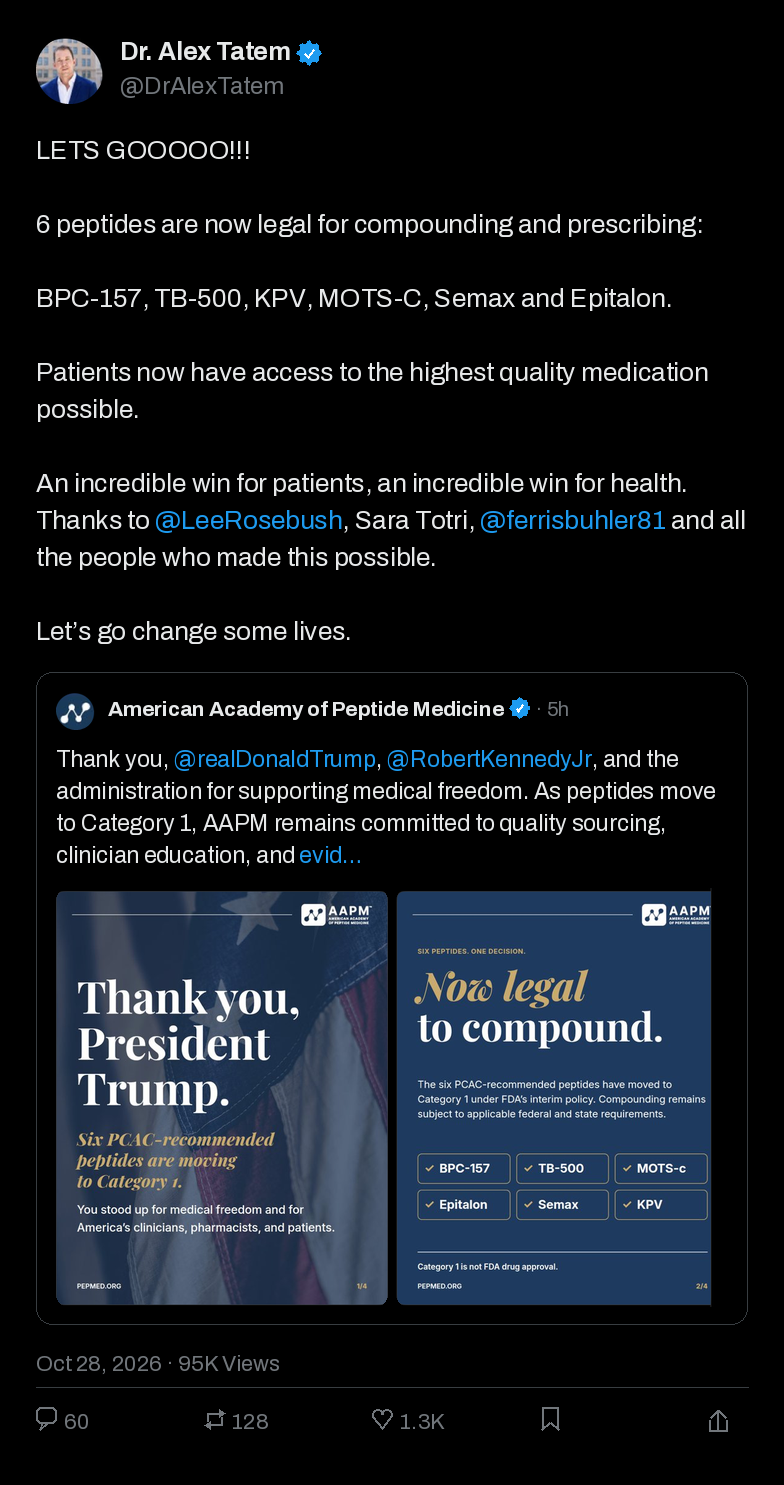
However, the federal filing does not go that far. It announces a draft policy open for comment, not FDA approval or placement of the six compounds on the 503A bulks list. Tatem’s reaction illustrates how differently clinicians may interpret the same regulatory announcement.
Where the disagreement sits
The advisory committee debate focused in part on how to respond to patients already seeking experimental peptides. Haleem Mohammed is chief medical officer of Gameday Men’s Health and a committee member. He said he “voted ‘yes’ for patient safety, the greater good, and medical freedom.” He also argued that restrictions could steer patients toward unregulated sellers.
Adriane Fugh-Berman, a professor of pharmacology and physiology at Georgetown University, argued that an existing market does not justify making unproven products available through compounding. Katrin Svensson, a peptide scientist at Stanford, stressed that natural origin is not evidence of safety. “Natural things can be toxic,” she said, and “you need to show they’re not harmful.”
The committee’s makeup also drew scrutiny. Six of its eight recently appointed members operated clinics that offered peptide treatments.
Why the trials have not happened
Clinical trials face practical obstacles. Christopher Milne is a former research director at the Tufts Center for the Study of Drug Development. He noted that recruitment is difficult when people can obtain a compound rather than risk receiving a placebo. Pinchas Cohen, a gerontology researcher at the University of Southern California, said investors withdrew support for MOTS-c trials. That was because products were already being sold outside clinical development.
Flynn McGuire, a physician at the University of Utah who published a review of BPC-157 in 2025, said he will not prescribe it until quality studies exist. “Medicine and science just don’t work fast,” he said. Knoepfler put the requirement plainly: “You must test these in clinical trials to be sure of anything positive or negative.”
For now, clinicians can explain what has actually been tested, how many people participated, and whether product identity and quality can be verified. Those answers are more reliable than assuming that popularity establishes medical benefit.