SS-31 is a lab-made peptide that binds to the inner membrane of mitochondria. MOTS-c is a natural peptide studied for its role in how cells use fuel.
SS-31, also called elamipretide, is the active ingredient in Forzinity, an FDA-approved prescription drug for Barth syndrome. Human MOTS-c studies have mostly measured the peptide the body makes. This review found no published study testing unmodified MOTS-c as a treatment in people.
SS-31 and MOTS-c at a glance
| Feature | SS-31 (elamipretide) | MOTS-c |
|---|---|---|
| What it is | A lab-made peptide of four amino acids; elamipretide is the same molecule | A natural peptide of 16 amino acids whose instructions are carried in mitochondrial DNA |
| Biological role studied | Binds cardiolipin, a fat concentrated in the inner mitochondrial membrane, and is proposed to help that membrane work | Proposed signal that changes how cells use sugar and fat, based on cell and mouse studies |
| Main research areas | Barth syndrome, primary mitochondrial muscle disease, heart and eye disease, muscle aging | Insulin resistance, obesity, exercise and age-related physical decline, mostly in mice |
| Human evidence | Barth syndrome and mitochondrial muscle-disease trials missed main walking and fatigue outcomes. A small older-adult study found an immediate energy-capacity difference significant in one analysis but not another. | No published study giving native MOTS-c to people was found; human studies mostly measure the body’s own levels |
| Regulatory status | Approved as Forzinity only to improve muscle strength in people with Barth syndrome weighing at least 30 kilograms, under accelerated approval | Not an FDA-approved drug |
| Important limits | Approval rests on strength gains in a small open-label extension; studies do not establish longer life or lasting everyday benefits in healthy older adults | Treatment effects come from cells and mice; a related compound, CB4211, is a different molecule |
What SS-31 is
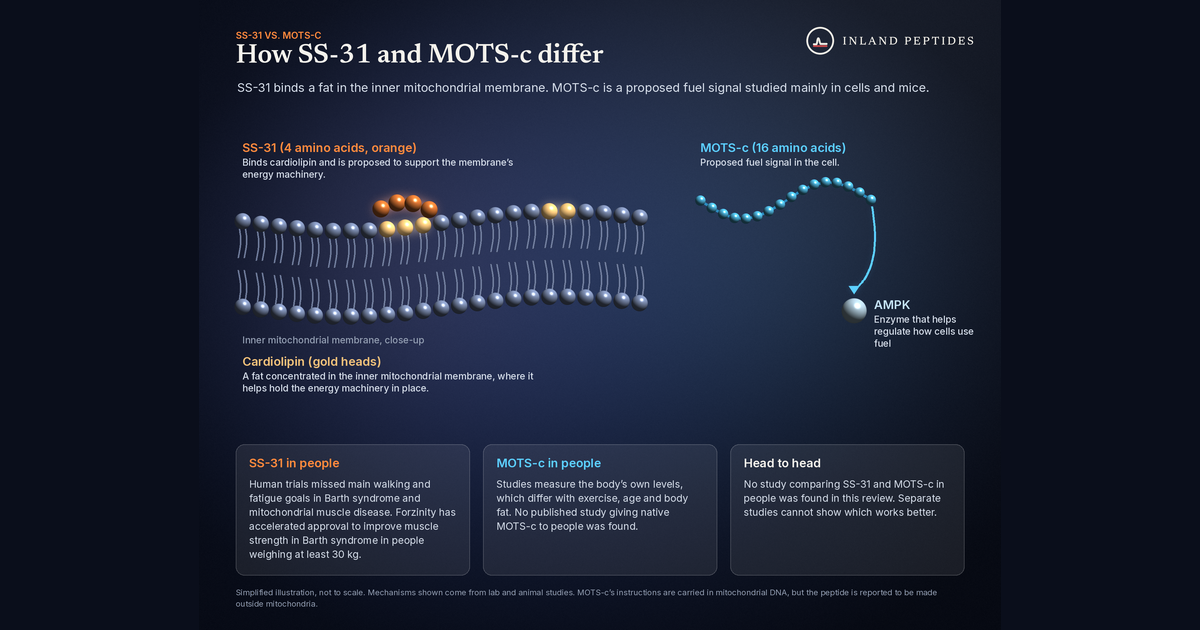
SS-31 is a chain of four amino acids. A review of elamipretide explains that the two names refer to the same molecule.
Forzinity’s approval does not cover research material sold as SS-31.
What MOTS-c is
MOTS-c is a chain of 16 amino acids. Its instructions are carried in mitochondrial DNA, a small set of genes inside mitochondria. These structures produce much of a cell’s energy.
The 2015 study that identified MOTS-c examined cells and mice. It reported that the peptide is made outside mitochondria, in the main body of the cell.
How SS-31 is thought to work
Mitochondria have two membranes. The inner one is folded many times and holds the machinery that turns food into usable energy.
Cardiolipin is a fat concentrated in this membrane. A review by SS-31’s developer describes how it helps maintain the folds and organize the machinery that produces energy.
In lab and animal studies, SS-31 bound to cardiolipin and helped preserve membrane structure and energy production. These findings do not establish the same benefits in people.
How MOTS-c is thought to work
Cell experiments in the 2015 study linked MOTS-c to AMPK, an enzyme that regulates fuel use. The mouse experiments pointed to muscle as a main target.
Has anyone compared SS-31 and MOTS-c directly?
No human study comparing the two was found in this review. Separate studies cannot establish which works better.
Human research on SS-31
Barth syndrome
Barth syndrome is a rare inherited disease, mostly in boys and men, in which cardiolipin is not made correctly. It causes muscle weakness, heart problems and fatigue.
Elamipretide did not significantly improve distance walked in six minutes or fatigue compared with placebo in a randomized trial in Barth syndrome. The 12 patients each received the drug for 12 weeks and placebo for 12 weeks, in random order.
Ten patients continued in an open-label extension, so everyone knew they were receiving elamipretide. The long-term follow-up compared their later results with measurements taken before treatment in the original randomized trial.
Walking distance in six minutes improved significantly by week 168.
Fatigue scores were lower, but the change at week 168 was not statistically significant.
Eight patients attended the week-168 assessment. One had stopped treatment earlier for personal reasons but continued the study visits.
Two others left the extension because of skin reactions, including hives and a drug rash.
Without a comparison group, the extension could not show how much of the improvement came from the drug. Practice, expectations and changes over time could also affect the results. Stealth BioTherapeutics, the drug’s maker, employed some authors.
What the FDA approved
The FDA approved Forzinity to improve muscle strength in adults and children with Barth syndrome who weigh at least 30 kilograms.
The Forzinity label says this accelerated approval rests on strength gains in the muscles that straighten the knee, measured during the extension. The randomized trial did not show a strength benefit over placebo.
The FDA judged those gains reasonably likely to predict a clinical benefit that still needs to be confirmed. Its approval letter requires a controlled trial to test that benefit. The agency can withdraw approval if the trial fails to confirm it.
This approval does not cover aging, general fatigue or longevity.
Older adults
A trial in 39 adults aged 60 to 85 tested a single infusion of elamipretide against placebo. Participants were generally healthy but had low mitochondrial function in a hand muscle.
Immediately after the two-hour infusion, the muscle’s maximum energy-production rate rose more with elamipretide than with placebo. Researchers measured this with a scanner. The difference was statistically significant as a percentage change, but not as an absolute change. The groups did not differ significantly a week later.
The planned test found no significant improvement in the muscle’s resistance to fatigue immediately after treatment. Exploratory analyses suggested a benefit at later measurements, but that finding needs confirmation in another study.
Stealth BioTherapeutics helped fund and design the study. Three authors had worked as paid consultants for the company.
Primary mitochondrial muscle disease
In a 24-week trial in 218 adults, elamipretide did not significantly improve walking distance in six minutes or fatigue compared with placebo. Participants had inherited mitochondrial muscle disease.
Walking distance and fatigue were the trial’s main goals. Stealth BioTherapeutics funded the trial.
Human research on MOTS-c
In an exercise study, 10 young men had higher MOTS-c levels in muscle and blood after hard cycling. Muscle levels remained higher four hours later; blood levels had returned to baseline.
An FDA review of MOTS-c found no published studies giving it to people and no human data on how the body processes it.
CohBar tested CB4211, a modified form of MOTS-c. Its findings cannot be applied to the original peptide. In company-reported results from a four-week study of 20 people with obesity and fatty liver, liver fat fell by similar amounts with CB4211 and placebo. This review found no peer-reviewed paper reporting those results.
What animal studies show for MOTS-c
In the 2015 study, MOTS-c protected mice on a high-fat diet from weight gain and insulin resistance, a reduced response to the hormone that helps control blood sugar.
Mice given MOTS-c in the exercise study performed better on physical tests, even when treatment began late in life. Their overall lifespan was not significantly longer.
Two senior authors of the exercise study reported being consultants and shareholders of CohBar.
Safety findings
Injection-site reactions were the most common side effects in the elamipretide trials. The Forzinity label also reports increases in a type of white blood cell, without symptoms. It warns of allergic reactions, including serious ones requiring emergency care.
The FDA review found no MOTS-c reports in the agency’s adverse event database. This does not establish safety or reveal how many people have used it. The FDA also raised concerns about immune reactions to injected MOTS-c.
What remains unknown
Confirmation of the Barth syndrome strength benefit in the required trial.
Whether SS-31 produces longer life or lasting improvements in daily activities in healthy older adults.
Whether MOTS-c given to people has the effects seen in mice.
