Longevity and cellular aging research examines how long people live, how long they stay healthy and how cells change with age. Medicines, supplements and experimental peptides have been studied for different parts of that process.
The compounds discussed here include:
Prescription medicines such as metformin and rapamycin, studied in aging as well as their established medical uses.
NAD+ and its precursors, nicotinamide riboside and nicotinamide mononucleotide.
Experimental peptides, including MOTS-c, SS-31 and Epitalon.
Dietary supplements such as coenzyme Q10, spermidine, creatine and resveratrol.
Understanding what each compound is and what its studies measured helps explain the findings and their limits.
What do longevity and cellular aging mean?
Lifespan is how many years a person lives. Healthspan is how many of those years are lived in good health.
Researchers at the National Institute on Aging have emphasized the years lived in good health alongside total lifespan.
Cellular aging involves changes within cells over time. Four processes help explain the research discussed here:
Cellular senescence. Cells stop dividing but remain alive, often changing what they release into surrounding tissue.
Mitochondrial function. Mitochondria help cells turn fuel into usable energy. Researchers can assess their function in tissues such as muscle.
Energy metabolism. The body’s handling of glucose and fat, which can change with age and activity.
Nutrient sensing. Cells respond to nutrient availability through signaling systems. Several compounds discussed here affect these pathways.
What aging markers can show
Studies often examine biological markers alongside measures of health or function. Examples discussed here include:
NAD+ levels in blood or tissue.
Mitochondrial measurements, such as how much energy muscle mitochondria can produce.
Telomeres, the repeated sequences at the ends of chromosomes, which shorten as cells divide.
DNA-based aging clocks, which estimate biological age from chemical marks on DNA.
A marker change is a research finding, but it does not by itself establish that someone became healthier or will live longer.
Measures such as walking distance, strength and symptoms help show whether a biological change is accompanied by a functional benefit.
Several studies below measured both, with different results.
How the main approaches compare
| Medicine, supplement or compound | What it is | Medical purpose or research question | Principal finding or limitation |
|---|---|---|---|
| Metformin | Prescription biguanide medicine | Type 2 diabetes; also studied in aging | In older adults, no additional improvement in physical performance when added to a lifestyle program; blunted some training gains in a separate exercise trial |
| Rapamycin (sirolimus) | Prescription immunosuppressant that blocks a nutrient-sensing signal called mTOR | Preventing transplant rejection; also studied in aging | Pooled animal studies reported longer lifespan; the human trials discussed here assessed body composition, function and safety |
NAD+ and its precursors
| Medicine, supplement or compound | What it is | Medical purpose or research question | Principal finding or limitation |
|---|---|---|---|
| NAD+ (nicotinamide adenine dinucleotide) | A coenzyme the body makes, not a peptide | Cellular energy metabolism | The human trials here tested specific precursors, not NAD+ products in general |
| Nicotinamide riboside | A precursor the body converts into NAD+ | Raising NAD+ and seeing what follows | Raised blood NAD+ in healthy older adults; improved walking distance in people with peripheral artery disease |
| Nicotinamide mononucleotide | A different NAD+ precursor | Raising NAD+ and seeing what follows | The main stepping-test outcome did not differ from placebo; secondary findings included walking and sleep improvements |
Experimental peptides
| Medicine, supplement or compound | What it is | Medical purpose or research question | Principal finding or limitation |
|---|---|---|---|
| MOTS-c | A 16 amino acid peptide encoded inside mitochondrial DNA | Whether a peptide the body makes can act on muscle metabolism | Treatment results are in mice; in people, exercise raises the body’s own MOTS-c |
| SS-31, also called elamipretide | A four amino acid peptide that binds a mitochondrial membrane fat | Improving how mitochondria produce energy | A brief energy-capacity finding depended on the analysis; a separate disease trial found no significant benefit on its main outcomes |
| Epitalon | A synthetic four amino acid peptide | Telomere maintenance and cellular aging markers | Lengthened telomeres in human cells in a dish; cell findings do not establish longer life or better health in people |
Dietary supplements
| Medicine, supplement or compound | What it is | Medical purpose or research question | Principal finding or limitation |
|---|---|---|---|
| Coenzyme Q10 | A supplement involved in mitochondrial energy transfer | Supporting mitochondrial function with age | Twelve weeks raised blood levels without changing muscle mitochondria or fitness |
| Spermidine | A supplement, also found in foods | Cellular housekeeping and immune aging | Immune responses improved within a small subgroup after a SARS-CoV-2 booster, with limited placebo comparison; another trial found little change in blood levels |
| Creatine | A supplement involved in muscle energy | Muscle strength and physical function in older adults | Pooled trials found a small strength benefit with resistance training; additional effects on muscle mass and function remained uncertain |
| Resveratrol | A plant compound sold as a supplement | Metabolic and vascular effects with age | Added to nicotinamide riboside in one circulation-disease trial, it did not add benefit |
Medicines studied in longevity and cellular aging research
Metformin and rapamycin have established medical uses. Their aging-related studies ask separate questions about metabolism, physical function and biological markers.
Metformin
Metformin is a biguanide medicine used with diet and exercise to improve blood sugar control in type 2 diabetes. It reduces glucose production by the liver and improves insulin sensitivity.
Its label carries a boxed warning about lactic acidosis, a rare but serious buildup of acid in the blood.
Its effects on energy metabolism have prompted research into aging-related outcomes.
The three trials below examined exercise responses, physical performance and a biological-age estimate.
A 12-week trial in 53 adults averaging 62 years compared metformin with placebo during aerobic training. Both groups lost fat and improved several blood sugar measures.
Insulin sensitivity improved more with placebo, and metformin reduced the training-related gain in muscle mitochondrial respiration. Fitness improved less with metformin, but that difference was not statistically significant.
Responses varied between participants, with some improving and others not.
A six-month trial in 114 adults aged 65 to 85 with obesity examined metformin alongside a diet and exercise program. The program improved physical performance, but adding metformin produced no additional improvement on that measure.
A two-year trial in 40 people without diabetes who were living with HIV found no statistically significant difference from placebo on its main aging-clock measure. Enrollment fell short of the planned number, limiting what the study could detect.
Rapamycin, also called sirolimus
Sirolimus is an immunosuppressant used to prevent kidney-transplant rejection and treat the lung condition lymphangioleiomyomatosis. It blocks a nutrient-sensing signal called mTOR.
Its boxed warning covers increased infection and lymphoma risks from immune suppression. The label also warns against use after liver or lung transplantation because of serious complications reported in those patients.
The aging interest comes from animal research.
A pooled analysis of animal studies examined 911 results from 167 papers across eight vertebrate species. Rapamycin extended lifespan, with an effect the authors found comparable to calorie restriction. Metformin did not significantly extend lifespan in the pooled analysis.
Results varied substantially between studies, and the authors found signs of publication bias, with positive findings more likely to be published.
Rapamycin trials in people
The human studies discussed here examined body composition, function and safety.
A 48-week trial in healthy adults compared rapamycin with placebo. Of 125 enrolled participants, 114 completed the study and were analyzed. The main outcome, fat surrounding the internal organs, did not change significantly.
Some secondary findings favored rapamycin: lean tissue mass and reported pain in women in one treatment group, and two quality-of-life scores in another. These findings did not apply uniformly across participants.
The tested formulation was absorbed differently from the commercial product, limiting generalization. The authors were employees and shareholders of the company that conducted the trial and recruited participants through its platform.
Adverse events were similar across groups, and blood safety measurements remained within normal ranges.
A 13-week trial in 40 adults aged 65 to 85 compared sirolimus with placebo alongside home exercise. Both groups improved on a chair-standing test. The main analysis found no statistically significant difference between groups, while additional analyses favored placebo.
More adverse events were recorded with sirolimus, including one serious infection considered possibly related to treatment.
These trials did not establish longer lifespan or healthspan for either medicine.
What is NAD+, and what do the supplements do?
NAD+, short for nicotinamide adenine dinucleotide, is a coenzyme, a helper molecule enzymes need to work. It is central to cellular energy metabolism.
The body makes NAD+. It is neither a peptide nor a protein, and its levels can vary with age and tissue.
NAD+ and its precursors
A precursor is a molecule the body can convert into NAD+.
Nicotinamide riboside and nicotinamide mononucleotide are two precursors studied in people. They are different molecules, so findings cannot automatically be transferred between them.
The precursor trials below also do not establish the effects of NAD+ products, other formulations or different delivery methods.
What the human studies measured
A crossover trial in healthy adults aged 55 to 79 compared nicotinamide riboside with placebo for six weeks each. Twenty-four people completed it. The supplement was well tolerated and raised NAD+ in blood cells by about 60 percent.
Exploratory results suggested lower blood pressure and aortic stiffness, particularly in participants with elevated blood pressure. The stiffness finding was not significant after adjustment for multiple comparisons. Body weight, energy use, strength and exercise performance did not change significantly.
The authors called for larger trials to test the possible cardiovascular effects.
Nicotinamide mononucleotide trials
A 12-week trial in 60 older adults examined nicotinamide mononucleotide. Its main stepping-test outcome did not differ significantly from placebo at either assessment.
Secondary findings included faster walking over four meters, higher blood NAD+ and related metabolites, and better reported sleep quality. No adverse effects were attributed to the supplement. A food company funded the trial, and three of its four authors worked for it.
Secondary findings need to be interpreted alongside the main outcome, sample size and number of comparisons. Testing many outcomes increases the possibility of a chance finding.
A 10-week trial in 20 older adults with mild cognitive impairment found that nicotinamide riboside raised blood NAD+ by about two and a half times without improving cognitive scores. Exploratory aging-clock estimates shifted in different directions within the supplement group; none of those changes was statistically significant.
A six-month trial in 90 people with peripheral artery disease, which narrows leg arteries, found improved six-minute walking distance with nicotinamide riboside compared with placebo.
The authors called for a larger confirming trial. The finding concerns people with that circulation disease.
Peptides and other experimental compounds
These three compounds act through different pathways, and their studies address different questions.
MOTS-c
MOTS-c is a 16 amino acid peptide encoded by mitochondrial DNA. Laboratory research identifies skeletal muscle as a target and describes effects on an energy-sensing enzyme.
Researchers have examined its role in metabolism and physical performance.
In the study that identified MOTS-c, treatment prevented age-related and diet-related insulin resistance, as well as diet-induced obesity, in mice.
A later study in mice and people found improved physical performance after MOTS-c treatment in young, middle-aged and old mice. Treatment begun late in life also increased physical capacity in mice. The human component found that exercise raised the body’s own MOTS-c in muscle and circulation.
The human observation concerns exercise, rather than the effects of administering MOTS-c.
These studies examined the natural sequence. Their findings cannot automatically be assigned to modified compounds.
SS-31, also called elamipretide
SS-31 and elamipretide identify the same four amino acid peptide, also called MTP-131 in the literature.
It binds cardiolipin, a fat in the inner mitochondrial membrane. Researchers have examined its effects on mitochondrial energy production.
A randomized study in 39 older adults aged 60 to 85 with low mitochondrial function assessed energy capacity in a hand muscle after a single infusion.
The immediate energy-capacity difference from placebo was statistically significant in one analysis but not another. No significant difference remained a week later.
The planned immediate fatigue-resistance comparison found no significant improvement. Exploratory follow-up analyses suggested a possible muscle-function effect a week later.
The drug’s developer helped fund and design the study.
A 24-week trial in 218 people with genetically confirmed mitochondrial muscle disease found no significant benefit over placebo on its main walking-distance and fatigue measures. Most adverse events were mild to moderate, and the authors described treatment as well tolerated.
Those findings concern a genetic disease population rather than healthy older adults.
Epitalon
Epitalon is a synthetic tetrapeptide, or four amino acid chain, developed from the amino acid composition of epithalamin. Epithalamin is a different preparation derived from the pineal gland.
Findings about pineal preparations cannot automatically be transferred to the synthetic peptide.
The research question is whether Epitalon affects telomere maintenance and markers of cellular aging.
A laboratory study in human cell lines reported longer telomeres after Epitalon treatment. In normal epithelial cells and fibroblasts, the change involved increased telomerase activity. Two breast cancer cell lines showed telomere lengthening through a different mechanism.
These cultured-cell findings do not establish longer life or improved health in people.
A review described small human studies of physiology and biomarkers and an older controlled study involving an eye condition. Those studies did not measure lifespan or healthspan.
Nonprescription products and dietary supplements
Dietary supplements and nonprescription medicines are different product categories. The examples below are supplement ingredients studied for aging-related outcomes.
Short-term tolerability in a small trial does not establish long-term safety.
Coenzyme Q10
Coenzyme Q10 helps transfer electrons in the mitochondrial energy-production process. The body makes it, and it is also sold as a supplement.
A 12-week trial in 40 older adults averaging about 74 years examined muscle mitochondria, glucose handling, fitness and body composition.
Blood CoQ10 levels rose, but muscle and mitochondrial levels did not. Mitochondrial function, glucose handling, fitness and body composition also showed no significant improvement.
Spermidine
Spermidine occurs naturally in foods such as wheat germ and aged cheese. Aging research has examined its effects on cellular maintenance and immune function.
A 13-week pilot in 40 adults over 65 studied spermidine beginning about a month after their third SARS-CoV-2 vaccine dose. It was well tolerated during the trial.
Among participants with a poor vaccine response, eight received spermidine and only two received placebo. Antibody and memory-cell responses strengthened within the small spermidine subgroup, and several immune-aging markers fell. The imbalance limited reliable comparisons with placebo.
A supplement company helped fund the study, and three authors disclosed supplement-company consultancies. The company reported no input into the design, analysis or manuscript.
A trial in 37 older men examined spermidine tolerability and circulating polyamine levels over four weeks. It was well tolerated, but blood and urine levels showed no substantial change, which the authors attributed to tight biological regulation.
Two authors worked for the company that made the supplement; the others received company funding.
Creatine
Creatine helps muscle cells meet short bursts of energy demand. Aging studies have examined strength and physical function.
A pooled analysis of eleven randomized trials in adults aged 60 and over found a small strength benefit from adding creatine to resistance training. The authors rated confidence in that finding as moderate.
Additional effects on muscle mass and physical function were not statistically significant, with low and very low confidence in the evidence, respectively.
The studies concerned generally healthy older adults, so the findings should not automatically be extended to frail or functionally limited people.
Resveratrol
Resveratrol is a compound found in grapes, berries and peanuts, also sold as a supplement.
In the peripheral artery disease trial discussed above, adding resveratrol to nicotinamide riboside did not improve walking distance beyond the precursor alone.
That finding concerns one combination in a specific disease population. It does not establish the effects of resveratrol alone.
Which approach is best?
There is no universal best option. These compounds address different biological processes and have been studied for different purposes.
The studies differ in participants, duration and outcomes, including walking distance, strength, mitochondrial energy capacity and biological-age estimates. Their results cannot be used to rank the compounds directly.
A qualified clinician can assess medical decisions in light of an individual’s health and medical history.
Differences worth understanding
The main distinctions involve molecule type, mechanism and the question studied.
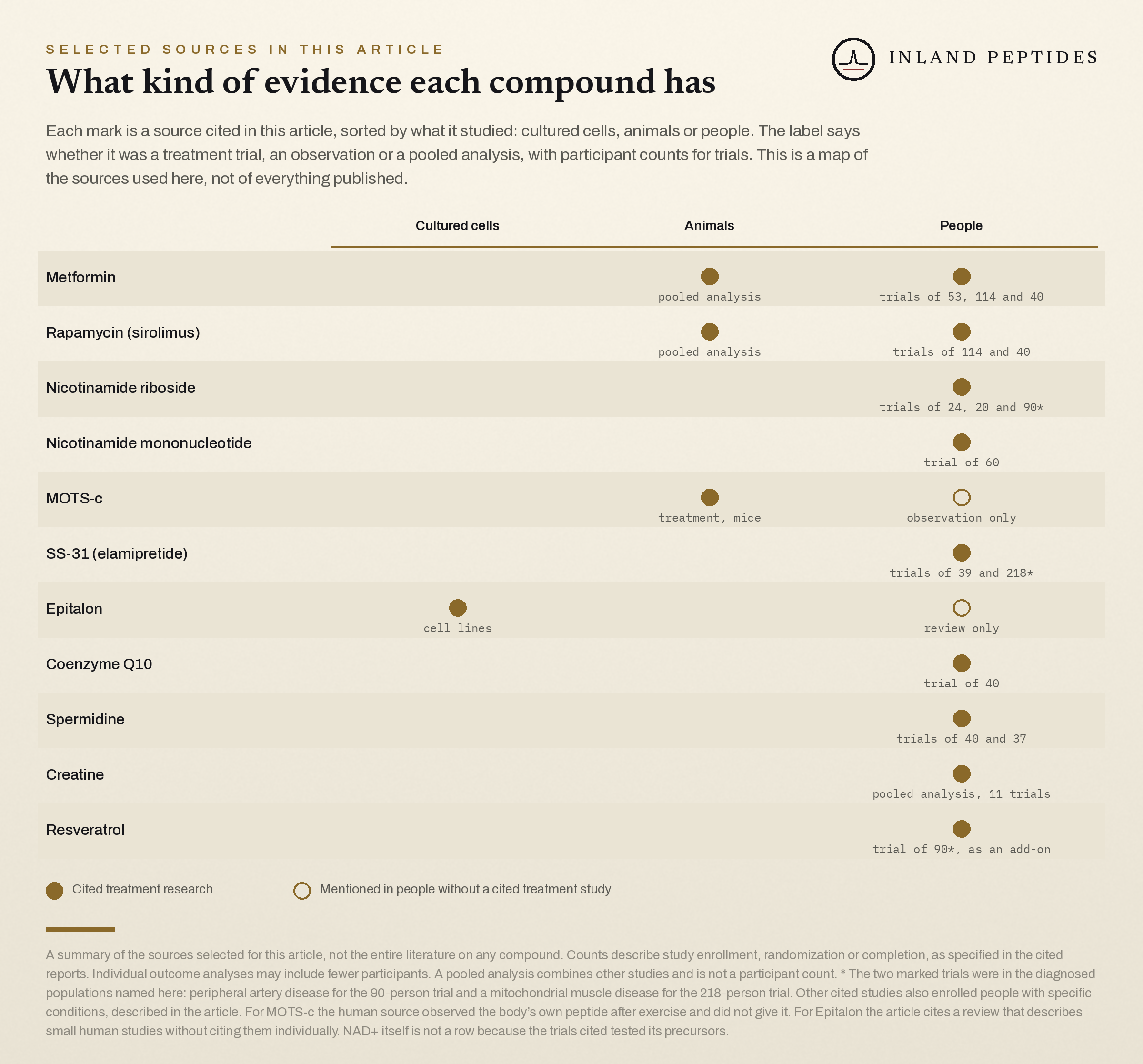
NAD+ is a coenzyme, while MOTS-c is a peptide. The cited NAD+ studies tested precursors in people; the MOTS-c treatment findings came from mice.
SS-31 and MOTS-c both involve mitochondria. SS-31 binds a membrane fat and is studied for energy production; MOTS-c is a signaling peptide studied for fuel handling and physical performance.
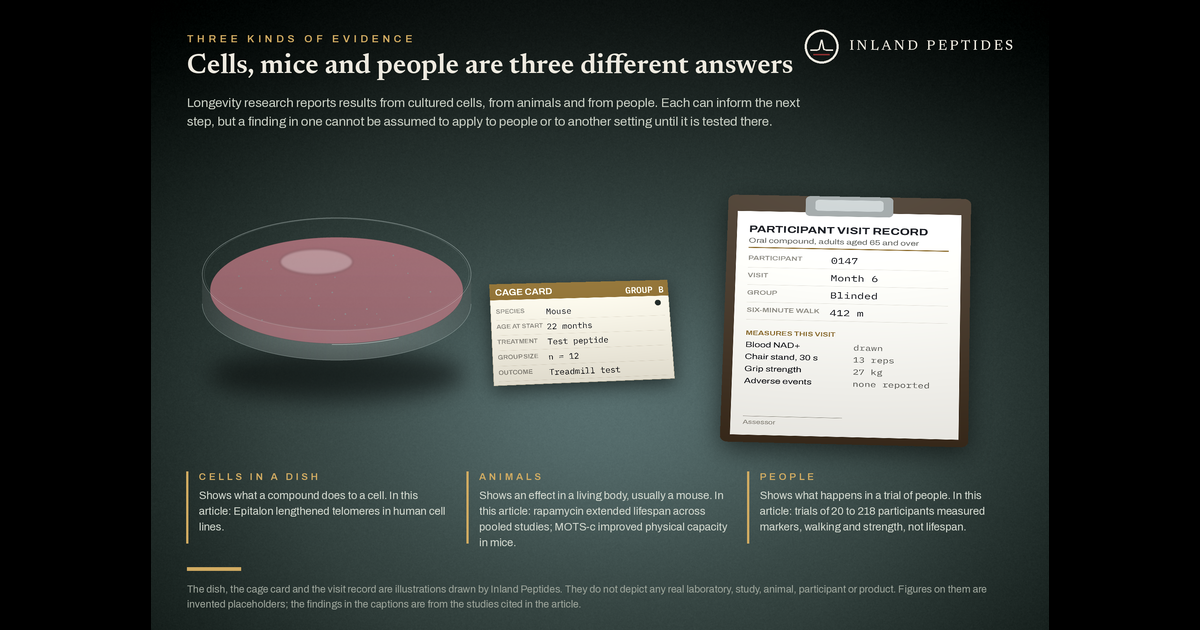
Evidence also differs by experimental setting, population and outcome. A human trial answers a different question from a cell experiment or an observation of a naturally occurring peptide.
This article is educational and is not medical advice.