Skin health and aging involves changes in moisture, texture, elasticity and wrinkles. Medicines, cosmetic ingredients, supplements and research compounds address different parts of that process.
Some products limit further sun damage. Others improve moisture or the appearance of lines. Experimental compounds have also been studied for skin-related effects in cells, tissue and people.
Understanding what each approach does, and what its studies measured, helps make sense of the claims.
Prescription medicines. Topical retinoids such as tretinoin, and injected treatments such as botulinum toxin products.
Nonprescription medicines. Sunscreens are an important example. In the United States, they are regulated as medicines.
Cosmetic ingredients. Retinol, retinaldehyde, niacinamide, vitamin C, hyaluronic acid, ceramides and moisturizers.
Dietary supplements. Oral collagen peptides and other ingredients taken by mouth.
Peptides. These include copper peptides such as GHK-Cu and AHK-Cu, and synthetic peptides used in cosmetic formulas. Their research differs by molecule and formulation.
Being sold without a prescription does not identify a product’s category. In the United States, a sunscreen, a moisturizer and a collagen supplement belong to different categories.
What changes in aging skin?
Skin changes through both chronological aging and sun exposure.
Chronological aging affects skin throughout the body. Over decades, it can become thinner, drier and less elastic.
Sun exposure adds changes such as coarser wrinkles, rough texture, uneven color and visible blood vessels.
One study compared sun-exposed forearm skin with sun-protected skin from the same 26 people. Formation of type I collagen, a structural protein in the deeper layer of skin, was 56 percent lower in the sun-exposed samples.
Collagen gives skin its strength. Elastin lets it spring back.
Aging changes these supporting tissues. Sun damage can also cause abnormal elastic tissue to accumulate in the deeper layer.
The skin barrier helps retain water in the outer layer. When it functions poorly, skin can feel dry.
Studies can measure several aspects of skin:
How much water the outer layer holds.
Whether the barrier keeps it there.
How the skin springs back.
What the surface looks like.
What is happening in the deeper layer.
These outcomes answer different questions. Improved hydration alone does not establish increased collagen, even if a product could affect both.
How the main approaches compare
| Option or ingredient | What it is | Main skin concern or research question | Reported finding and main limitation |
|---|---|---|---|
| Tretinoin | Prescription topical retinoid, a form of vitamin A | Fine wrinkles and other signs of sun damage | Trials report improvement in fine facial wrinkles; irritation is common |
| Botulinum toxin injection | Prescription injection, given by a clinician | Appearance of specific facial lines | Temporarily reduces certain lines; carries a warning about toxin effects spreading |
| Sunscreen | Nonprescription medicine in the United States | Limiting further sun damage | A 4.5-year randomized trial found less progression in its skin aging measure among daily users |
Cosmetic ingredients for aging skin
| Option or ingredient | What it is | Main skin concern or research question | Reported finding and main limitation |
|---|---|---|---|
| Retinol | Cosmetic form of vitamin A | Fine wrinkles in naturally aged skin | A 24-week trial improved fine wrinkling; it measured arm skin in people with a mean age of 87, not facial skin |
| Retinaldehyde | Cosmetic form of vitamin A | Facial sun damage | Reduced wrinkle and roughness measures at 18 weeks, with less irritation than retinoic acid in the same trial |
| Niacinamide | Vitamin B3 used in cosmetics | Fine lines, texture, blotchiness and spots | A 12-week trial in 50 women reported improved appearance compared with the same moisturizer without niacinamide |
| Vitamin C | Antioxidant used in cosmetics | Surface texture in sun-damaged skin | A small split-face study favored the tested serum; stability depends on formulation and storage |
| Hyaluronic acid | Water-binding molecule used in cosmetics | Hydration, elasticity and wrinkle depth | All five molecular sizes tested improved hydration and elasticity; wrinkle depth improved only at the two smallest |
| Ceramides and moisturizers | Cosmetic barrier ingredients | Dryness and barrier function | Help retain moisture and support the skin barrier; those roles do not alone establish increased collagen |
Peptides and supplements for skin health and aging
| Option or ingredient | What it is | Main skin concern or research question | Reported finding and main limitation |
|---|---|---|---|
| GHK-Cu | Copper complex of a three amino acid peptide | Studied for skin repair and appearance | A small post-laser study found no significant objective difference, while patient ratings favored GHK-Cu |
| AHK-Cu | A related copper peptide, with alanine in place of glycine | Studied in hair follicle biology | The commonly cited findings come from hair follicles and cultured cells, not from facial skin |
| Acetyl hexapeptide-8 | Synthetic peptide patterned on part of a nerve signaling protein | Appearance of lines around the eyes | A 4-week trial in 60 people reported improvement; the comparison group held about 15 people |
| Palmitoyl pentapeptide-4 | Synthetic peptide, also written pal-KTTKS | Appearance of facial wrinkles and fine lines | A 12-week trial in 93 women reported improvement against the same moisturizer without it; the study measured wrinkles, not collagen |
| Oral collagen peptides | Dietary supplement taken by mouth | Hydration, elasticity and wrinkle measures | Trials reported improvements versus placebo; one older subgroup retained improved elasticity at four-week follow-up |
| Beta-carotene supplement | Dietary supplement taken by mouth | Skin aging | The same 4.5-year sunscreen trial found no overall effect on its skin aging measure |
Prescription medicines used for aging skin
Topical retinoids act on the skin, while botulinum toxin injections reduce the muscle contractions that create certain lines.
Tretinoin
Tretinoin is a prescription form of vitamin A, also called retinoic acid, applied to the skin.
It is used for fine facial wrinkles and other signs of sun damage.
In a 48-week trial, 99 people with photoaged skin completed treatment with one of two tretinoin creams or the cream base alone. Both strengths improved facial photoaging, with similar results, but the higher strength caused more redness and scaling.
The collagen study described earlier also compared tretinoin cream with its cream base in 29 people over 10 to 12 months. Type I collagen formation increased in the tretinoin group and decreased in the control group.
Only 15 people received tretinoin, which limits the certainty and generalizability of that finding.
RENOVA tretinoin cream 0.02 percent is labeled to reduce fine facial wrinkles alongside sun avoidance and skin care. Its labeling states that it does not eliminate wrinkles or reverse photoaging.
Common reactions include peeling, dryness, burning, stinging, redness and itching.
The labeling advises against use during pregnancy and warns of increased susceptibility to sunburn.
Botulinum toxin injections
These prescription treatments act on muscle rather than directly on the skin surface.
Repeated muscle contractions fold the skin above them. Temporarily reducing those contractions can soften the associated lines.
BOTOX Cosmetic is used for temporary improvement in moderate to severe lines between the brows, around the outer eyes, across the forehead and in neck bands.
Botulinum toxin products carry a boxed warning about effects spreading beyond the injection site. They are administered by clinicians.
What do sunscreens do for skin aging?
Sunscreen reduces how much ultraviolet light reaches the skin, and regular use can help limit further sun-related skin aging.
A trial in Nambour, Australia assigned 903 adults under 55 to regular sunscreen use or use at their own discretion and followed them for 4.5 years. Assessors who did not know the assignments graded skin texture from casts taken at the beginning and end.
The regular-use group showed no detectable increase in the study’s skin-aging measure and less progression than the discretionary-use group.
Some outcome data were missing, and the study had limited ability to detect moderate effects.
U.S. sunscreen products carry a Drug Facts panel because they are nonprescription medicines.
Cosmetic ingredients
Cosmetic ingredients are used to improve skin appearance and feel. Studies often measure hydration, texture, tone or wrinkle appearance.
Many studies compare a formula containing an ingredient with the same cream or lotion base without it. That comparison base is called the vehicle.
Results apply to the formulation and conditions tested. Products listing the same ingredient can differ in concentration, stability and other ingredients.
Retinol and retinaldehyde
Both are forms of vitamin A, and neither is the same molecule as tretinoin.
Skin converts retinol to retinaldehyde, and retinaldehyde to retinoic acid, which is the active form.
Activity and irritation depend on conversion, concentration, formulation and stability. The distinction between cosmetic and prescription products alone does not determine how irritating a formula will be.
One retinol trial studied 36 adults with a mean age of 87. Over 24 weeks, fine wrinkling improved more on the arm receiving retinol lotion than on the arm receiving the vehicle.
The findings concern naturally aged arm skin, rather than facial sun damage.
A 125-person trial compared retinaldehyde, retinoic acid and a vehicle cream in people with facial photodamage.
Both active creams improved wrinkle and roughness measures at 18 weeks, while the vehicle produced no significant change. Improvements were less pronounced at 44 weeks.
Retinaldehyde was well tolerated. Retinoic acid caused more irritation, which affected continued use.
The abstract does not report a statistical comparison between the active creams, so it does not establish equal effectiveness.
Niacinamide
Niacinamide is a form of vitamin B3 used widely in cosmetic formulas.
A 12-week trial in 50 women aged 40 to 60 compared a niacinamide moisturizer on one side of the face with the same moisturizer without niacinamide on the other.
The niacinamide side showed greater improvements in fine lines, wrinkles, pigmented spots, texture, redness and yellowish tone.
These appearance findings do not establish increased collagen.
Vitamin C
Vitamin C is an antioxidant used in serums aimed at surface texture and tone in sun-damaged skin.
A three-month split-face study in 19 people with facial sun damage compared an ascorbic acid serum with its vehicle. Surface measurements favored the serum.
The small sample limits how confidently the findings apply to other people.
Ascorbic acid can degrade in water and with exposure to air and light. Formulation and storage therefore affect a product’s stability.
Hyaluronic acid, ceramides and moisturizers
These ingredients help explain the distinction between hydration and barrier care.
Hyaluronic acid binds water. Ceramides are fats in the skin barrier. Moisturizers can reduce water loss or draw water into the outer layer.
A 60-day trial in 76 women compared hyaluronan creams of five molecular sizes with vehicle creams around the eyes.
All five formulations improved hydration and elasticity. Significant wrinkle-depth improvement was reported only for the two smallest molecular sizes.
The findings illustrate why the form of an ingredient matters, alongside its name and concentration.

What does the research on skin peptides show?
Findings differ by molecule, formulation and the question studied.
Peptides are short chains of amino acids. Related peptides can share mechanisms, but results for one do not automatically apply to another.
GHK-Cu
GHK-Cu is a copper complex of the three-amino-acid peptide glycyl-histidyl-lysine. It occurs naturally in human plasma.
Laboratory research has examined its effects on cells, gene expression and wound models.
A randomized study examined aftercare with or without GHK-Cu products following carbon dioxide laser resurfacing around the mouth. Thirteen patients completed it.
Blinded assessment found no significant differences between groups in redness resolution, wrinkles or overall skin quality. Both groups improved after resurfacing.
Patient questionnaires favored GHK-Cu for perceived improvement in overall skin quality.
This small study concerns recovery after a procedure, rather than untreated aging facial skin.
AHK-Cu
AHK-Cu is a related copper peptide with alanine in the first position instead of glycine.
Its relationship to GHK-Cu does not establish that the two produce the same effects.
Laboratory AHK-Cu research found increased elongation of human hair follicles cultured outside the body and increased growth of cells from the follicle base.
The reported reduction in cell death was not statistically significant.
These hair-follicle and cell findings do not establish effects on facial skin aging.
Acetyl hexapeptide-8
This is a synthetic peptide, also listed as acetyl hexapeptide-3 and sold under the name Argireline. It is patterned on one end of SNAP-25, a protein involved in nerve signaling.
A four-week placebo-controlled study in 60 participants examined lines at the outer corner of the eye. Roughness decreased in the peptide group, and the graded assessment also favored it.
Three quarters of participants received the peptide, leaving about 15 in the placebo group.
The abstract reports roughness changes within each group, rather than a statistical test of the difference between groups.
Palmitoyl pentapeptide-4 (pal-KTTKS)
Palmitoyl pentapeptide-4, or pal-KTTKS, consists of five amino acids with an attached fatty acid.
A 12-week trial in 93 women aged 35 to 55 compared a moisturizer containing pal-KTTKS on one side of the face with the same moisturizer without it on the other.
Image analysis, expert grading and participant assessments favored the peptide formula for fine lines and wrinkles.
The peptide was designed to stimulate collagen production, but this trial measured wrinkle appearance. It did not demonstrate increased collagen.
Products sold under related trade names may contain other peptides or blends.
Peptides inside finished products
Cosmetic peptides are often combined with other active ingredients. A trial of the finished formula assesses their combined effect.
An eight-week comparison in 196 women examined a cosmetic regimen containing niacinamide, peptides, antioxidants and retinyl propionate against a tretinoin regimen. Both included sunscreen.
The cosmetic regimen produced greater wrinkle improvement at eight weeks and was better tolerated over that period. Results were described as comparable at 24 weeks.
The study compared complete regimens, so its results cannot be credited to an individual ingredient.
The initial eight-week comparison was shorter than other tretinoin trials discussed here.
Only 25 participants per group continued to 24 weeks, limiting the longer comparison.
Do oral collagen supplements work?
Some placebo-controlled trials have reported improvements in hydration, elasticity or wrinkles. How long those changes persist and whether they apply to other preparations remain uncertain.
Oral collagen peptides are digested and absorbed after being taken by mouth. Their findings should be assessed separately from research on topical copper peptides.
An eight-week trial in 69 women aged 35 to 55 reported improved elasticity with collagen hydrolysate compared with placebo. Moisture and water-loss findings were not statistically significant.
Four weeks after supplementation ended, elasticity remained significantly higher in an older subgroup. The reported follow-up finding concerned that subgroup, rather than the entire study population.
A 12-week trial in 64 people reported better hydration with a low-molecular-weight collagen peptide than with placebo at six and 12 weeks. At 12 weeks, a visual wrinkle assessment, three wrinkle measurements and two of three elasticity measures also favored collagen.
Longer-term persistence and results with other collagen preparations remain uncertain.
These measured improvements do not by themselves establish that the supplement selectively rebuilds skin collagen.
Several studies involved ingredient manufacturers. Authors in the 12-week collagen trial listed collagen-related companies as affiliations, while the niacinamide, pal-KTTKS and cosmetic-regimen studies listed a consumer products manufacturer.
Commercial involvement is relevant when assessing potential bias, alongside study design and reporting.
In the Australian sunscreen trial, beta-carotene supplementation produced no overall improvement in the skin-aging measure over 4.5 years.
Which option is best for skin health and aging?
There is no single best option, because these approaches are not aimed at the same thing.
The approaches address several overlapping concerns:
Limiting further sun damage. This is what sunscreen is used for.
Moisture and barrier function. Moisturizers, ceramides and hyaluronic acid are relevant here.
Wrinkles and tone. Cosmetic ingredients and peptide formulas are often studied for these appearance changes.
Medical and prescription cosmetic care. A clinician assesses the skin concern, medical history and suitability of treatment.
The regimen comparison above provides direct comparative evidence, but it compares complete routines rather than isolated ingredients.
The studies here differ in participants, body sites, duration and measurements. Their results cannot be ordered into a reliable ranking.
A dermatologist or other qualified clinician can assess which approach fits an individual’s concerns.
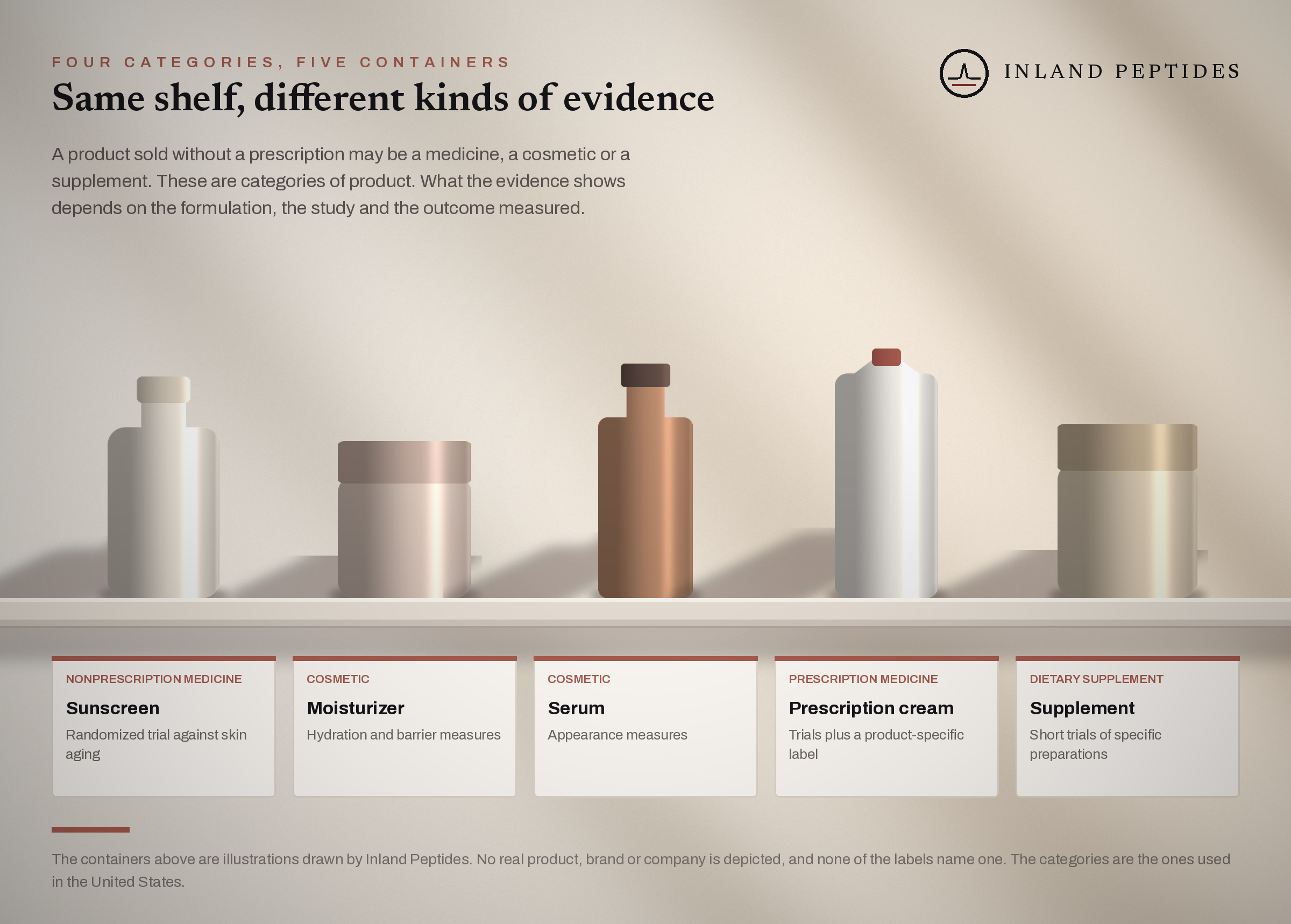
The differences that matter
The useful distinctions are the goal, the outcome measured and the product tested.
Sun protection aims to limit additional ultraviolet damage. Moisture and barrier care address water retention in the outer layer.
Wrinkle and texture studies assess appearance, while some studies also examine deeper tissue changes. These outcomes can overlap, but evidence for one does not establish another.
The copper-peptide studies discussed here concern cells, hair follicles or recovery after a procedure. Their findings do not establish the same effects in untreated aging facial skin.
For products containing several active ingredients, the observed result belongs to the tested formula. It cannot automatically be assigned to one ingredient.
This article is educational and is not medical advice.