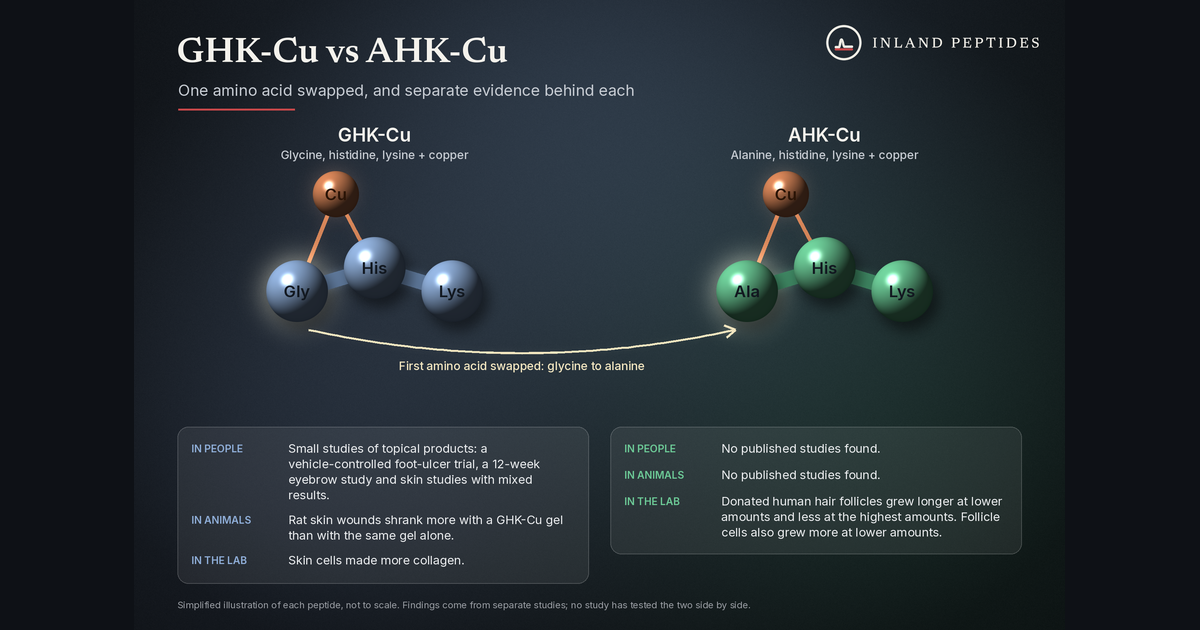
GHK-Cu and AHK-Cu are copper-bound peptides that differ in their first amino acid: glycine in GHK-Cu and alanine in AHK-Cu.
GHK-Cu has been studied in skin cells, animal wounds and human trials. AHK-Cu research centers on donated human hair follicles and cells in the lab. No published study comparing the two directly was identified.
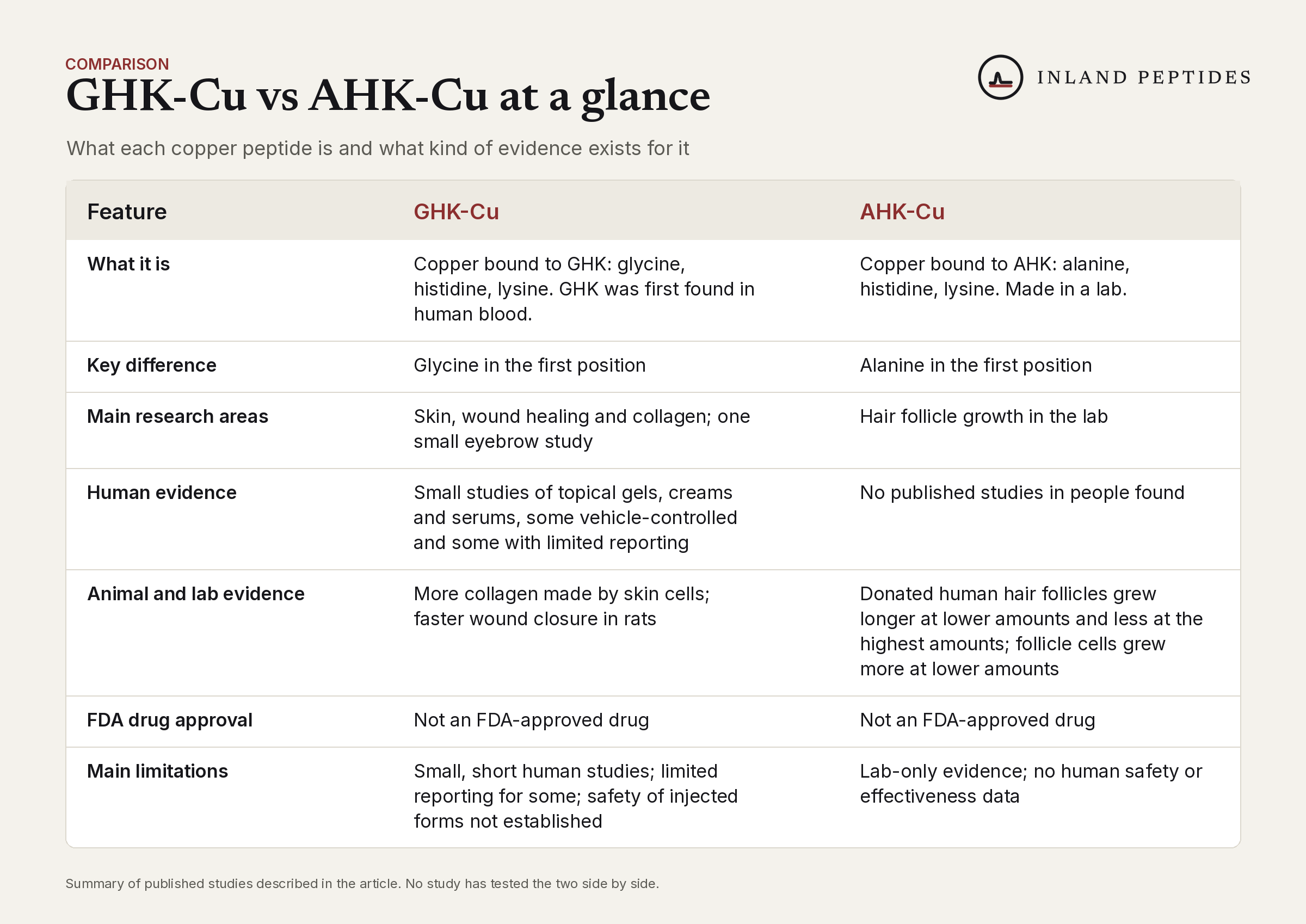
GHK-Cu and AHK-Cu at a glance
| Feature | GHK-Cu | AHK-Cu |
|---|---|---|
| What it is | Copper bound to GHK: glycine, histidine, lysine. GHK was first found in human blood. | Copper bound to AHK: alanine, histidine, lysine. Made in a lab. |
| Key difference | Glycine in the first position | Alanine in the first position |
| Main research areas | Skin, wound healing and collagen; one small eyebrow study | Hair follicle growth in the lab |
| Human evidence | Small studies of topical gels, creams and serums, some vehicle-controlled and some with limited reporting | No published studies in people found |
| Animal and lab evidence | More collagen made by skin cells; faster wound closure in rats | Donated human hair follicles grew longer at lower amounts and less at the highest amounts; follicle cells grew more at lower amounts |
| FDA drug approval | Not an FDA-approved drug | Not an FDA-approved drug |
| Cosmetic use | Cosmetic ingredient (copper tripeptide-1), found safe as used in cosmetics by an expert panel | No published cosmetic safety assessment found |
| Research products | Sold by some suppliers labeled research use only, a product label rather than an FDA category | Sold by some suppliers labeled research use only, a product label rather than an FDA category |
| Main limitations | Small, short human studies; limited reporting for some; safety of injected forms not established | Lab-only evidence; no human safety or effectiveness data |
What each compound is
Both are tripeptides, or chains of three amino acids, bound to copper. The “Cu” in each name stands for copper.
GHK-Cu
GHK is glycine, histidine and lysine. It was first identified in human blood in the early 1970s.
GHK-Cu is GHK bound to copper, listed on skin care labels as copper tripeptide-1. GHK without copper is a separate substance; its study results do not automatically apply to GHK-Cu.
AHK-Cu
AHK-Cu is alanine, histidine and lysine bound to copper. It is made in a lab.
The peptides share histidine and lysine, but their different first amino acid makes them separate molecules. Evidence for one does not establish the effects of the other.
GHK-Cu research on skin
In a cell study, GHK-Cu increased collagen production by fibroblasts, the cells that build skin’s supporting tissue. This does not establish a visible change in people.
In a rat wound study, researchers tested a GHK-Cu gel on wounds with reduced blood supply. After 13 days, wound area had fallen 64.5 percent with GHK-Cu, 45.6 percent with the same gel without it and 28.2 percent with no treatment.
Studies in people
Diabetic foot ulcers: in a placebo-controlled trial, all patients received standard wound care plus either a GHK-Cu gel or the same gel without it. For ulcers on the sole of the foot, the median reduction in wound area was 98.5 percent with GHK-Cu and 60.8 percent without it.
Collagen marker in thigh skin: in a one-month study of 20 volunteers, biopsies showed an increase in a marker of collagen production in 7 of 10 people using a copper peptide cream. The study compared active creams and had no inactive control. Its abstract does not describe randomization or blinding, and it did not measure wrinkles.
Face and eye creams: A review of topical GHK describes two 12-week studies involving 71 and 41 women. Both reported improvements in skin appearance, but the cited reports are conference abstracts rather than full trial papers.
Facial wrinkles: an eight-week study enrolled 40 women; 39 completed it. A serum containing GHK-Cu in a fat-based delivery carrier improved measured wrinkle depth and volume more than a plain serum. The control lacked both the peptide and carrier, so their effects cannot be separated. The serum maker helped fund the study. One participant stopped after mild skin reactions to both the test serum and an active comparison product.
After laser resurfacing: in a randomized trial, skin care regimens with and without GHK-Cu did not differ significantly on objective wrinkle and skin-quality measurements. Patients using GHK-Cu reported higher satisfaction. Thirteen people completed the study; the abstract does not establish whether the regimens were otherwise identical.
Hair research on both compounds
GHK-Cu
In a 12-week eyebrow study, 18 adults used a GHK-Cu serum on one eyebrow and the same serum without it on the other. A measured one-square-centimeter patch averaged about 30.5 hairs with GHK-Cu and 28.7 without it at the end, a statistically significant difference. Hairs were also slightly thicker with GHK-Cu. No side effects were reported.
This small study does not establish effects on scalp hair loss, other preparations or AHK-Cu.
A 15-day scalp study reported higher measured hair density after a serum containing GHK-Cu and four other ingredients was used with a scrub. It had no comparison group, and one author worked for the product’s maker. The change cannot be attributed to GHK-Cu.
AHK-Cu
In a hair-follicle study, researchers kept donated human scalp follicles from three donors alive in dishes for 12 days.
With lower amounts of AHK-Cu, follicles grew longer than those without it. At the two highest amounts tested, growth was inhibited.
Lower amounts also increased the growth of dermal papilla cells, which sit at the base of a follicle and help control hair growth. Some markers of cell death decreased, but the reduction in dying cells was not statistically significant.
The study tested neither GHK-Cu nor hair growth in living people.
Safety and regulatory status
Neither GHK-Cu nor AHK-Cu is an FDA-approved drug.
The Cosmetic Ingredient Review expert panel assessed copper tripeptide-1 with related peptides and found them safe as used in cosmetics under the uses and concentrations covered by its assessment. Most safety tests involved related peptides. The conclusion does not establish safety for every formulation, injections or AHK-Cu.
For injectable GHK-Cu proposed for compounding, the FDA listed safety concerns, including possible immune reactions and limited human safety data.
Searches of the medical literature found no published human safety data for AHK-Cu.
Both peptides are sold by some suppliers labeled “research use only.” This label does not indicate FDA approval for human use.
What the comparison shows
GHK-Cu has a longer research record, including human studies of topical products for wounds, wrinkles and eyebrows. Results are mixed, and several studies have design or reporting limits. AHK-Cu’s evidence centers on one laboratory study of donated hair follicles and follicle cells.
Whether AHK-Cu affects skin or hair in people, and how the two compounds compare in the same experiment, remain unanswered.