Research peptides sold online are not proven cancer cures, and anyone considering a peptide-based cancer treatment should discuss it with a licensed physician who treats cancer.
Doctors use leuprolide to lower testosterone in advanced prostate cancer and Lutathera to deliver radiation to certain neuroendocrine tumors.
Neuroendocrine tumors develop from cells that release hormones. Lutathera treats certain tumors that start in the digestive tract or pancreas and carry a receptor the drug can bind to.
What makes these treatments peptide-based?
Both treatments use a peptide, a short chain of amino acids. The peptide plays a different role in each.
Leuprolide changes the hormone signal that controls testosterone production.
In Lutathera, the peptide carries radioactive lutetium to cells with a matching receptor.
Researchers also use peptides in experimental vaccines to help immune cells recognize features of a tumor.
Approved medicines and experimental treatments
The U.S. Food and Drug Administration (FDA) approves a medicine for a particular use. Its label identifies the disease and the patients it can treat.
Some experimental peptides have reached human trials, where researchers monitor volunteers for side effects. Others have been studied only in cells or animals.
A product sold for laboratory research has no approval for cancer treatment. A similar name or amino acid sequence does not establish that it has the same composition or effects as a medicine tested in patients.
How to read a cancer study result
Researchers use standard response criteria to judge changes on scans. The FDA’s guidance on cancer trial endpoints explains the difference between delaying progression and helping patients live longer.
| Result reported | What it shows | What it does not show |
|---|---|---|
| Cancer cells died in a lab dish | A substance can damage cancer cells grown in the lab | That it reaches a tumor in the body, or that it is safe |
| Tumors grew more slowly or shrank in animals | An effect in a living animal | The same effect in people |
| A human study detected an immune response | Immune cells recognized the treatment’s target | Fewer recurrences or longer lives |
| A scan showed a partial response | The tumor shrank by at least the amount set for a formal response, also called a partial remission | The scan alone cannot tell how much the treatment helped |
| The cancer was stable on scans | The tumor did not shrink or grow enough to count as a response or progression | That treatment stopped growth; small changes still count as stable |
| Longer progression-free survival | More time before the cancer progressed or the patient died | That patients lived longer |
| Longer overall survival | Patients lived longer, counting deaths from any cause | That the cancer was cured |
| Complete remission | All signs and symptoms of cancer have disappeared | That the cancer will not come back |
| Cure | No trace of cancer remains, and it will not come back | Doctors often cannot say this for certain |
As the National Cancer Institute’s guide to cancer prognosis explains, cancer cells can remain after tests stop detecting them. That is why cancer can return after a complete remission.
Peptides already used in cancer treatment
Prostate cancer: lowering testosterone
Many prostate cancers depend on testosterone and related hormones called androgens. The National Cancer Institute fact sheet on prostate cancer hormone therapy explains how lowering androgen levels or blocking their effects can slow cancer growth.
The brain signals the testicles to make testosterone. A brain region called the hypothalamus releases gonadotropin-releasing hormone (GnRH), which prompts the pituitary gland to send that signal.
Leuprolide is a synthetic peptide that mimics GnRH. At first, leuprolide increases the hormone signal that stimulates testosterone production. With continued treatment, that signal weakens and testosterone falls.
An early rise in testosterone can briefly worsen symptoms such as bone pain. The leuprolide label for advanced prostate cancer calls this a tumor flare.
Degarelix is a synthetic peptide that blocks the GnRH receptor on the pituitary, so the signal drops without an early rise.
In the trial behind the degarelix label, 96% of men given degarelix had very low testosterone by day 3, compared with none of the men given leuprolide. By day 28, both groups had reached those levels, and over a full year the two drugs kept testosterone low at nearly the same rate.
That comparison measured testosterone. It did not show that tumors shrank faster or that men lived longer.
Lowering testosterone does not require a peptide. Relugolix, a pill that also blocks the GnRH receptor, is a small molecule, according to the relugolix label.
Approved uses and side effects
Leuprolide and degarelix are FDA approved for advanced prostate cancer. Doctors also use hormone therapy for some earlier-stage prostate cancers, often together with radiation.
Advanced prostate cancer can start growing again even while testosterone remains very low. Doctors call this castration-resistant prostate cancer.
Side effects of long-term hormone therapy can include:
Hot flashes, loss of sex drive and erectile dysfunction.
Bone thinning and fractures.
Loss of muscle, weight gain and changes in blood fats and blood sugar control.
Mood swings, tiredness and breast tissue growth.
Breast cancer: lowering ovarian hormones
One form of the Zoladex goserelin implant is approved to treat advanced breast cancer in women before or during menopause. Doctors use it to slow the cancer or ease symptoms, a goal called palliative treatment.
Most breast cancers are hormone-sensitive. Their cells carry receptors for estrogen or progesterone, and they can use those hormones to grow.
Before menopause, the ovaries are the main source of estrogen. Goserelin reduces the signal that tells the ovaries to produce it. A tumor’s hormone receptors can help doctors judge whether lowering estrogen is likely to help.
Neuroendocrine tumors: delivering radiation with Lutathera
Many neuroendocrine tumors carry somatostatin receptors on their surface. Somatostatin is a natural hormone that helps control other hormones, and some tumor cells have far more of its receptors than normal cells do.
Lutetium Lu 177 dotatate, sold as Lutathera, has two working parts:
A targeting peptide, dotatate, shaped like somatostatin. It binds to somatostatin receptors, most strongly to subtype 2.
A radioactive metal, lutetium-177, held to the peptide by a small chemical cage.
After binding, the drug is taken into the cell. Lutetium-177 gives off radiation that damages the cell that took it up and can also damage cells nearby.
Treatment of this kind is called peptide receptor radionuclide therapy.
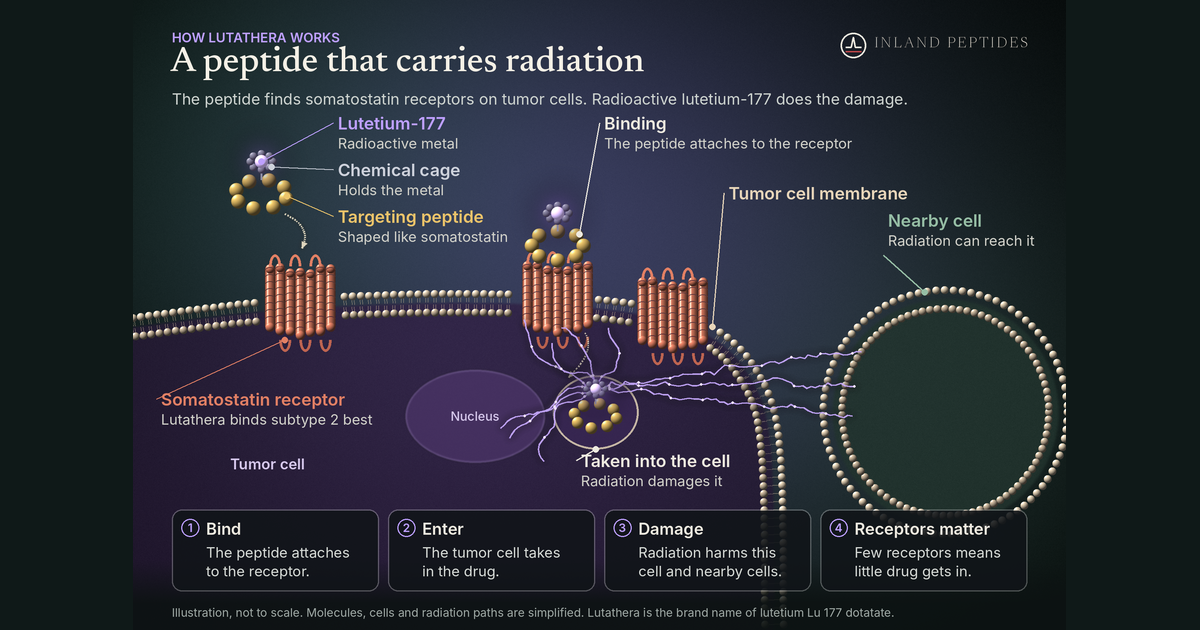
Lutathera’s FDA label covers adults and children 12 and older with somatostatin receptor-positive gastroenteropancreatic neuroendocrine tumors (GEP-NETs), meaning tumors that start in the gastrointestinal tract or pancreas. FDA first approved it for adults in 2018.
Tumors with few somatostatin receptors take up little of the drug. In the first major trial, scans had to show that tumors took up at least as much of a receptor-targeting tracer as healthy liver tissue.
Both major trials enrolled patients with well-differentiated tumors. Under a microscope, the tumor cells still resembled the tissue they came from.
What the Lutathera trials showed
A randomized trial in 229 people with advanced midgut neuroendocrine tumors compared Lutathera plus long-acting octreotide with a higher dose of octreotide alone. The patients’ tumors had grown despite treatment. Octreotide is a peptide that mimics somatostatin.
At 20 months, an estimated 65.2% of the Lutathera group were alive without their cancer worsening, compared with 10.8% of the octreotide-only group. Tumors shrank enough to count as a response in 18% of the Lutathera group and 3% of the comparison group.
In the final survival analysis, median survival was 48.0 months with Lutathera and 36.3 months with high-dose octreotide. That difference was not statistically significant, so the trial did not establish whether Lutathera helped patients live longer. Thirty-six percent of the comparison group later received radioactive peptide treatment outside the trial. This switch, called crossover, can shrink survival differences between groups.
A later randomized trial in 226 people with newly diagnosed, higher-grade GEP-NETs tested Lutathera as a first treatment. Participants were 15 or older, and their tumors were advanced, grade 2 or 3 and receptor-positive. The regimens matched the first trial: Lutathera plus standard-dose octreotide, or high-dose octreotide alone. Median time to progression or death was 22.8 months with Lutathera and 8.5 months without it.
The approval for children ages 12 and up rested on safety and radiation dose data from 9 adolescents, 4 of whom had GEP-NETs. The evidence that the drug works came from the trial in adults.
Lutathera risks and side effects
Lutathera exposes patients to radiation. Its label warns of:
Low blood cell counts.
Damage to the kidneys and liver.
Allergic reactions and sudden hormone surges from the tumor.
Harm to a developing fetus and possible loss of fertility.
In the 2017 trial, fewer than 10% of patients given Lutathera had serious drops in blood counts.
Two of 111 patients treated with Lutathera developed myelodysplastic syndrome during follow-up. This bone marrow cancer can progress to leukemia.
Lanreotide and octreotide: slowing growth or easing symptoms
Lanreotide and octreotide are peptides that mimic somatostatin, like Lutathera’s targeting peptide, but they carry no radiation.
The lanreotide label for neuroendocrine tumors covers adults with tumors of the digestive tract or pancreas. The tumors must be well or moderately differentiated, have grown into nearby tissue or spread farther, and be inoperable.
The placebo-controlled trial of lanreotide studied a narrower group: 204 people with receptor-positive, grade 1 or 2 GEP-NETs that did not cause hormone symptoms. Nearly all had shown no tumor growth in the months before they enrolled. At two years, an estimated 65.1% of people given lanreotide were alive without their cancer worsening, compared with 33.0% given placebo. Survival did not differ significantly. Diarrhea was the most common side effect.
Long-acting octreotide is approved to relieve severe diarrhea and flushing caused by carcinoid tumors that have spread.
Researchers also studied tumor growth in 85 people with well-differentiated midgut tumors that had spread. Median time to progression was 14.3 months with octreotide and 6 months with placebo. Too few patients had died to establish a survival difference.
How a peptide helps doctors find tumors
In Gallium Ga 68 dotatate, the targeting peptide carries radioactive gallium. A PET scanner detects its signal, showing doctors where tumors with somatostatin receptors are located.
What researchers are testing
Peptide cancer vaccines
The National Cancer Institute overview of cancer treatment vaccines explains how a vaccine can help the immune system attack cancer a patient already has.
A peptide vaccine contains short protein pieces that match a feature of tumor cells. Immune cells called T cells may learn to recognize that feature and attack cells that carry it.
Some vaccines use the same pieces for everyone with a certain cancer. Others are personalized. Researchers sequence a patient’s tumor, find its mutations and predict which new protein pieces, called neoantigens, those mutations create. The vaccine is built from that one patient’s neoantigens.
An immune response means researchers detected immune cells that recognized the vaccine’s target. It does not show that patients had fewer recurrences or lived longer.
Kidney and pancreatic cancer vaccine trials
In an early study of IMA901, a vaccine made of ten tumor peptides for advanced kidney cancer, patients whose immune systems responded to it tended to live longer. That association did not establish a treatment effect, since patients who mount strong immune responses may differ from others in ways that also affect survival.
In a randomized trial of 339 people with advanced clear-cell kidney cancer, adding IMA901 to sunitinib did not improve survival. Immune responses in that trial were weaker than in earlier studies.
GV1001 targets telomerase, an enzyme many cancer cells use to keep dividing. In a randomized trial of 1,062 people with advanced pancreatic cancer, adding GV1001 to chemotherapy did not improve survival. Median survival was 7.9 months with chemotherapy alone, 6.9 months when the vaccine followed chemotherapy, and 8.4 months when both were given together.
A later Korean trial of 148 people with advanced pancreatic cancer reported a different result. Median survival was 11.3 months with GV1001 and chemotherapy, compared with 7.5 months with chemotherapy alone.
The Korean study used a blood marker called eotaxin to assign patients to groups.
All 75 people in the vaccine group had high eotaxin levels.
The 73 people in the control group included 36 with high levels and 37 with low levels.
Only patients with high eotaxin levels were assigned at random. All patients with low levels received chemotherapy alone.
More patients also withdrew from the chemotherapy-only group (44% versus 24%). These differences make it difficult to tell how much the vaccine contributed to the survival result.
Melanoma vaccine studies
Researchers tested a vaccine targeting the protein gp100 in 185 people with advanced melanoma. Both groups received interleukin-2, an immune-boosting drug, and one group also received the vaccine.
Tumors shrank enough to count as a response in 16% of the vaccine group, compared with 6% of the interleukin-2 group. The median time before the cancer worsened was 2.2 months with the vaccine and 1.6 months without it. Median survival was 17.8 months with the vaccine and 11.1 months without it, but longer survival was not established.
Only people whose immune cells could display this particular peptide to T cells were eligible for the study.
In a study of 6 people with melanoma at high risk of recurrence after surgery, each participant received a vaccine built from up to 20 of their own tumor’s neoantigens. The vaccines triggered T cells against many of the targeted neoantigens. Four of the 6 had no recurrence about two years later.
The cancer returned in the other two. They then received a different immunotherapy drug, and their tumors disappeared. Those regressions cannot be credited to the vaccine alone.
A later report from the same vaccine study followed 8 vaccinated patients for a median of almost four years. All were alive, six had no active disease, and vaccine-trained T cells were still present. The study had no comparison group.
Peptides that deliver radiation or chemotherapy
Researchers paired a somatostatin-targeting peptide with lead-212 to make 212Pb-DOTAMTATE. As the lead breaks down, it produces elements that emit alpha particles, a different form of radiation from the beta particles released by lutetium-177.
In the first human study of 212Pb-DOTAMTATE, 20 people with receptor-positive neuroendocrine tumors received the drug. Tumors shrank in eight of the ten patients who received the dose selected for further study. Without a comparison group, the study could not tell whether treatment helped patients live longer. The most common side effects were nausea, tiredness and hair loss.
At a 2025 conference, researchers reported results for 35 patients who had never received radioactive peptide therapy. In an independent review of the scans, 20 patients had a tumor response. Six had severe kidney-related events during follow-up. The study had no comparison group, so it could not establish how much the drug contributed to those events or whether patients lived longer.
Melflufen in multiple myeloma
Melflufen delivers chemotherapy without targeting a receptor. Once the drug enters a cell, enzymes break it down and release the chemotherapy drug melphalan.
FDA granted melflufen accelerated approval in 2021 for certain adults whose multiple myeloma had returned or resisted several earlier treatments. That approval was based on a study without a comparison group. The confirmatory trial compared melflufen with pomalidomide in 495 people with multiple myeloma. Both groups also received the steroid dexamethasone.
The published trial reported a median of 6.8 months before progression or death with melflufen and 4.9 months with pomalidomide. The FDA disputed how the researchers counted progression.
Scans in 29 patients taking pomalidomide suggested their cancer had worsened, but progression was never confirmed. Under the original analysis plan, those cases did not count as progression and the difference between treatments was statistically uncertain. The published analysis counted all 29 as progressions. In the final decision, the FDA relied on the original plan.
Median survival in the FDA’s review was 19.7 months with melflufen and 25.0 months with pomalidomide. The trial could not establish whether melflufen increased deaths, but the possibility concerned the agency.
FDA withdrew U.S. approval in 2024. It cited two reasons: the trial did not confirm a clinical benefit, and the evidence did not show that melflufen was safe and effective under its approved conditions of use.
Peptides that attack cancer cells directly
Some peptides damage cancer cells by breaking open their outer membranes.
LTX-315 is a 9-amino-acid peptide designed to do this. Its first human study enrolled 39 people with advanced solid tumors. Each needed at least one tumor doctors could reach with a needle, and LTX-315 was injected directly into it.
At least one treated tumor shrank substantially in seven of 24 patients evaluated. In a separate assessment of 27 patients, none met the criteria for a response when researchers excluded the injected tumor. Biopsies showed more T cells in treated tumors.
Side effects included a temporary drop in blood pressure in 46% of patients and flushing in 28%. Four patients, about 10%, had severe allergic reactions, including anaphylaxis.
Researchers have also studied melittin, the main peptide in honeybee venom, in cells and mice.
In one set of experiments, honeybee venom and melittin killed human breast cancer cells grown in dishes, especially aggressive types. In the same study, mice given melittin with the chemotherapy drug docetaxel had slower tumor growth than mice given docetaxel alone.
Melittin can damage healthy cells and can break down before it reaches a tumor. A separate study in mice packaged it in tiny particles that carried it to tumors.
What do these findings mean for research peptides sold online?
The Lutathera trial showed that a prescription medicine delivering radioactive lutetium delayed progression in people with certain neuroendocrine tumors. The trial provides no evidence that a peptide sold for laboratory research treats cancer.