KPV is studied mainly for its effects on inflammation, while BPC-157 is studied mainly for tissue repair. Most findings come from cells and animals.
Both have been tested in animals with gut inflammation or injuries, which helps explain why they are often compared. Neither is an FDA-approved drug.
KPV and BPC-157 at a glance
| Feature | KPV | BPC-157 |
|---|---|---|
| What it is | Three amino acids. Matches the end of the hormone alpha-MSH. | Fifteen amino acids. Its sequence was reported in a protein from human stomach juice. |
| Main research areas | Gut inflammation, corneal wounds and skin-cell injury | Tendon, ligament, muscle and gut injuries |
| Proposed actions | Reducing inflammation signals in cells | Blood vessel growth, cell movement and tissue repair |
| Human evidence | No human studies identified by FDA | Five small studies identified by FDA; no established tissue-repair benefit |
| Animal and lab evidence | Mouse and rabbit experiments; studies in human cells | Mostly rat experiments; many cited studies share a research group |
| FDA status | Not FDA-approved | Not FDA-approved |
| Main limitation | No human evidence; gaps in formal safety testing | Human studies are small; animal findings do not establish human benefit |
What each compound is
KPV
KPV contains three amino acids: lysine (K), proline (P) and valine (V). Its name comes from their one-letter codes.
It matches the last three amino acids in alpha-MSH, a 13-amino-acid hormone involved in skin color and inflammation.
KPV sold for research is made in a lab.
BPC-157
BPC-157 contains 15 amino acids. Its sequence was reported as a fragment of a larger protein found in human stomach juice.
Still, research BPC-157 is made in a lab, not extracted from the stomach.
How KPV and BPC-157 may work
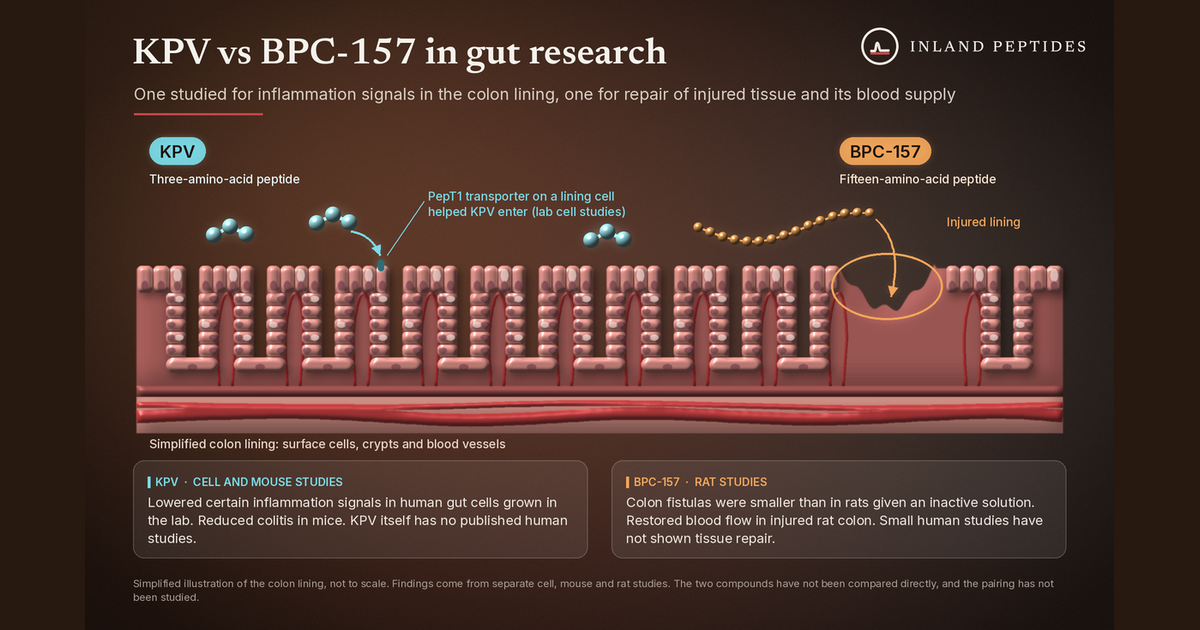
Cells send chemical messages that trigger inflammation. In a gut cell and mouse study, KPV reduced some of these signals in lab-grown human gut and immune cells.
PepT1, a protein that carries small peptides into cells, helped KPV enter the cells. Studies have also reported higher PepT1 levels in inflamed colon tissue.
In a blood vessel study, BPC-157 helped cells form tube-like structures and sped the return of blood flow to rat legs after an artery was blocked.
Other rat studies also reported faster healing of surgically joined bowel and restored blood flow in injured colon tissue.
BPC-157 has also reduced inflammation in injured animal tissue. Researchers have not established exactly how either peptide works.
What the research shows
No published study has compared KPV and BPC-157 directly in people or animals. So results from separate experiments cannot show which works better.
Has KPV been tested in people?
No. An FDA review of KPV found no clinical studies or other data documenting its use in people.
A human trial in ulcerative colitis tested a different peptide, KdPT, instead. Ulcerative colitis inflames and damages the colon lining. The trial does not provide human evidence for KPV.
KPV in animals and cells
In a mouse colitis study, mice given KPV regained weight faster and had fewer immune cells in the colon lining.
The study of gut cells also found less colon inflammation in two mouse models.
Some experiments used KPV in specially designed carriers. In a nanoparticle study, KPV inside coated particles protected the colon lining in mice better than KPV in particles without the coating. But this result applies to that delivery system, not to plain KPV.
Other experiments examined the eyes and skin:
- In a rabbit cornea study, for example, KPV sped healing of wounds on the clear front surface of the eye compared with a saltwater solution.
- In a skin cell study, KPV reduced cell death and an inflammatory messenger in human skin cells exposed to fine dust.
- In a donated-skin study, however, KPV alone did not cross human skin at detectable levels.
Still, less inflammation does not necessarily mean damaged tissue has healed.
BPC-157 in people
The FDA review of BPC-157 identified five small human studies.
One trial enrolled 53 people with ulcerative colitis. The group given BPC-157 improved more than the placebo group, which received an inactive treatment, but the difference was inconclusive. The results appeared only as a meeting abstract, rather than a full study report.
A safety study in 32 healthy volunteers was also reported only as an abstract. Three later reports on knee pain, bladder pain and a two-person safety test had no comparison group.
But these small, short studies do not establish that BPC-157 repairs tissue in people.
BPC-157 in animals
Rat experiments have examined several types of injury:
- Colon fistulas: researchers created an opening between the colon and skin. The openings were about 40 percent smaller in rats given BPC-157 than in rats given an inactive solution, and appeared closed by day 28. But the study did not confirm healing under a microscope.
- Pain reliever damage: in rats given very high doses of anti-inflammatory pain relievers such as aspirin, BPC-157 reduced visible damage to the stomach and small intestine.
- Tendon injuries: in a rat tendon study, BPC-157 improved tendon strength and walking compared with an inactive saltwater solution. Other animal studies have also reported benefits in injured ligaments and muscles.
Much of the cited animal work comes from the group that first described BPC-157. Other laboratories have published cell and blood vessel studies.
Why do people talk about combining KPV and BPC-157?
FDA reviews found websites promoting both peptides for gut health and injury recovery, which helps explain interest in combining them.
Some blends sold as KLOW list four peptides: KPV, BPC-157, TB-500 and GHK-Cu. These differ from a two-peptide KPV and BPC-157 pairing.
So far, no published study has tested KPV and BPC-157 together in animals or people. The advertised goals therefore do not establish that the combination works.
Safety and FDA approval
Neither peptide has enough human evidence to establish its safety.
For KPV, the FDA review found no formal toxicity studies, including studies of repeated exposure or cancer risk. Even tests showing that an engineered KPV formulation did not harm gut cells cannot establish safety in people.
The review found no KPV reports in FDA adverse event records, but missing reports do not show that a compound is safe. The FDA also lacked data to rule out immune reactions or peptide clumping.
BPC-157 has undergone animal safety tests. For example, single-dose tests in rats and dogs found no signs of immediate toxicity. But the FDA noted changes in some blood tests during longer experiments and gaps in the published data.
The small human studies reported no serious adverse events, but they could not rule out uncommon or long-term harms.
The FDA review found three adverse event reports involving injected BPC-157. One described darkening of the skin and gums after a BPC-157 and TB-500 product. The reaction was considered likely related to the product, but the responsible ingredient could not be identified.
The FDA has listed safety concerns for both compounds, including missing human data for KPV and possible immune reactions and peptide impurities for BPC-157.
Neither is an FDA-approved drug. Products sold for research are not intended for human use.
What the evidence means
KPV and BPC-157 cannot be ranked as treatments from this evidence. They were tested in different experiments, and neither has enough human evidence to establish safety or effectiveness.
