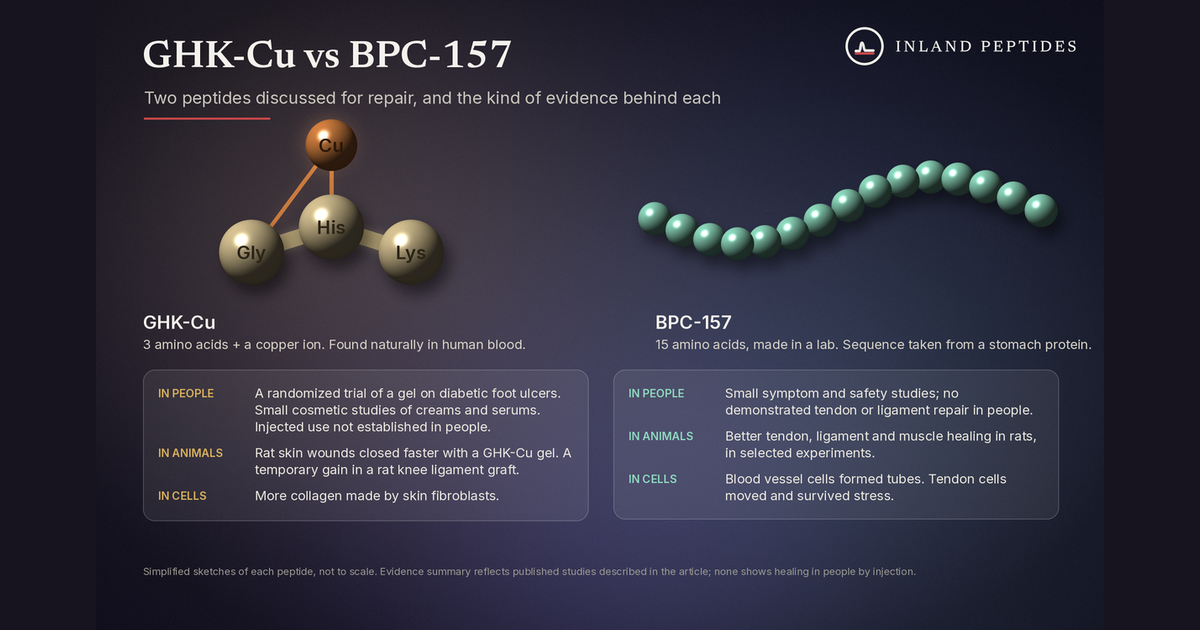
GHK-Cu is a three-amino-acid peptide bound to copper, and BPC-157 is a lab-made peptide of 15 amino acids.
Both appear in discussions about tissue repair, but their research differs. GHK-Cu has been studied in skin creams, wound gels and laboratory experiments. BPC-157 research focuses largely on animal injuries, with only a few small human studies.
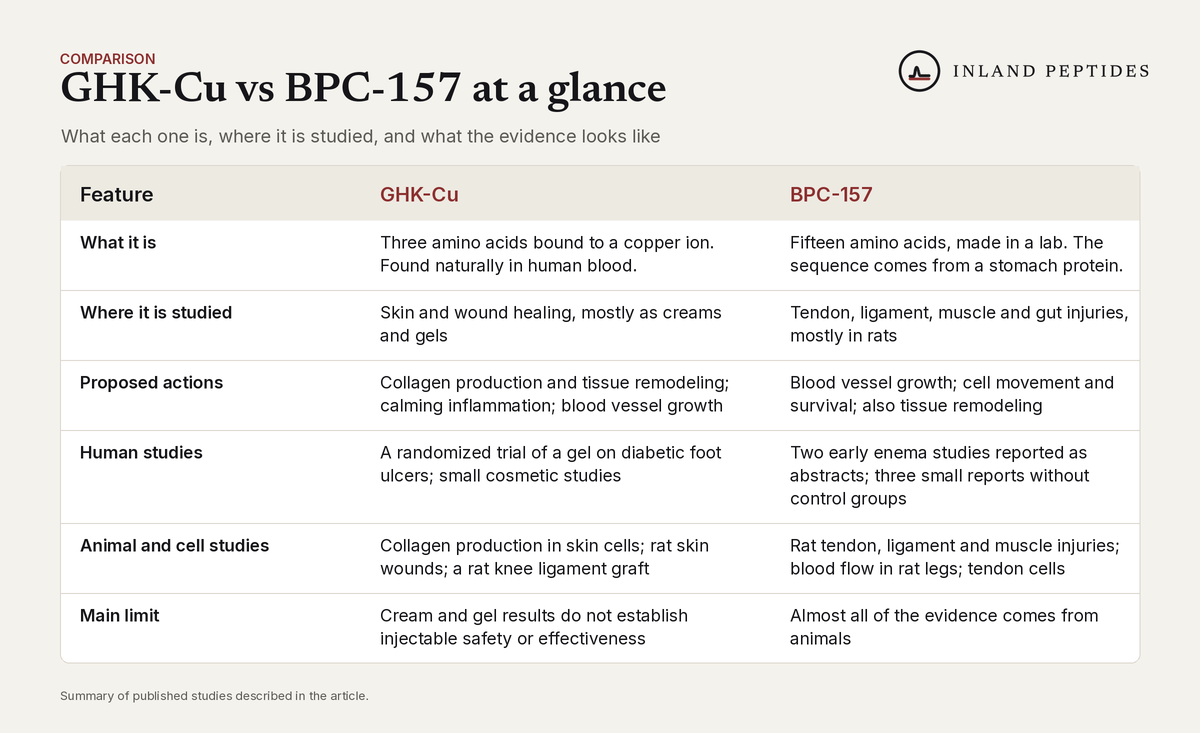
GHK-Cu and BPC-157 at a glance
| Feature | GHK-Cu | BPC-157 |
|---|---|---|
| What it is | Three amino acids bound to a copper ion. Found naturally in human blood. | Fifteen amino acids, made in a lab. The sequence comes from a stomach protein. |
| Where it is studied | Skin, wound healing and cosmetic products | Tendon, ligament, muscle and gut injuries, mostly in rats |
| Proposed actions | Collagen and tissue remodeling; inflammation and blood vessel growth | Blood vessel growth; cell movement and survival; also tissue remodeling |
| Human studies | A randomized trial of a gel on diabetic foot ulcers; small cosmetic studies | Two early meeting abstracts and three small reports without control groups in an FDA review |
| Animal and cell studies | Collagen production in skin cells; rat skin wounds; a rat knee ligament graft | Rat tendon, ligament and muscle injuries; blood flow in rat legs; tendon cells |
| FDA status | Not an approved drug. Sold as a cosmetic ingredient. Injectable forms are not approved. | Not an approved drug. Research products are not approved for human use. |
| Main limit | Cream and gel results do not establish injectable safety or effectiveness | Almost all of the evidence comes from animals |
What each compound is
GHK-Cu and copper
GHK is a chain of three amino acids: glycine, histidine and lysine. Researchers first identified it in human blood in the early 1970s.
When GHK binds a copper ion, it forms GHK-Cu, listed in skin care as copper tripeptide-1.
Researchers also study GHK without copper. But findings for that form do not automatically apply to GHK-Cu.
Where BPC-157 comes from
BPC-157 has 15 amino acids. Its sequence comes from part of a larger protein, called body protection compound, reported in human stomach juice.
BPC-157 itself, however, is made in a lab. The group that first described it produced much of the early research; other laboratories have since investigated how it works.
How their proposed actions differ
Researchers have proposed several ways these compounds might influence repair. Their actions overlap, but the studies emphasize different processes.
GHK-Cu research often examines tissue remodeling, the breakdown and replacement of material around cells, including collagen. In a cell culture study, it increased collagen production by fibroblasts, cells that build this material. Rat wound studies also found changes in tissue-remodeling enzymes and a lower inflammation marker.
BPC-157 studies, in contrast, often examine blood vessels and cell movement. In a blood vessel study, it helped cells form tube-like structures and improved blood flow in rats after an artery was blocked. In a tendon cell study, it helped cells move and survive stress without making them multiply faster.
GHK-Cu has also been studied for blood vessel growth, and BPC-157 for tissue remodeling. But these cell and animal results do not demonstrate healing in people.
What studies have reported
There is no published head-to-head study of GHK-Cu and BPC-157 in people or animals. Instead, the findings below come from separate experiments with different methods.
GHK-Cu in people
In a randomized, placebo-controlled trial, people with diabetic foot ulcers received either a GHK-Cu gel or the same gel without the peptide.
Both groups also received wound cleaning and footwear that reduced pressure on the foot.
For ulcers on the sole, the median reduction in wound area was 98.5 percent with GHK-Cu and 60.8 percent with plain gel. These figures describe wound shrinkage, not the percentage of patients whose ulcers healed completely.
Among sole ulcers treated immediately after the first cleaning, infection rates were 7 percent with GHK-Cu and 34 percent with plain gel. But the abstract does not report the patient count or treatment length.
A one-month study of 20 volunteers compared skin creams on opposite thighs. Collagen-building activity rose in 7 of 10 people using a copper peptide cream, compared with 5 of 10 using vitamin C and 4 of 10 using tretinoin. Still, the small, separately paired groups do not establish which cream worked best.
Two 12-week studies of face cream in 71 women and eye cream in 41 women were reported as conference abstracts. A 2025 review of topical GHK noted missing results and formulation details, limiting what readers can conclude.
In a laser-resurfacing trial completed by 13 people, a skin care regimen containing GHK-Cu did not improve redness, wrinkles or skin quality on objective measures compared with the regimen without it. Yet people using GHK-Cu reported higher satisfaction.
A small randomized study in 18 adults reported more and thicker eyebrow hairs with a GHK-Cu serum than with placebo after 12 weeks. This was a hair-growth study, not a wound-healing study.
These studies tested topical products, sometimes containing several ingredients. So they do not establish the safety or effectiveness of injected GHK-Cu.
GHK-Cu in animals and cells
In a rat skin wound study, wound area shrank by 64.5 percent with GHK-Cu gel after 13 days, compared with 45.6 percent with plain gel and 28.2 percent without treatment.
In a rat knee reconstruction study, GHK-Cu reduced joint looseness and increased tendon graft stiffness at six weeks compared with saline. But by twelve weeks, those differences were no longer significant, and there was no significant improvement in graft breaking strength, walking or tissue scores.
BPC-157 in people
An FDA review describes five human studies: two early meeting abstracts and three later reports without control groups.
The early studies used BPC-157 as an enema. A safety study enrolled 32 healthy volunteers, 24 receiving BPC-157; another trial enrolled 53 people with ulcerative colitis, an inflammatory bowel disease. Symptoms improved more with BPC-157 over two weeks, but the difference from placebo was inconclusive and the abstract provides limited detail.
In a chart review of 16 patients with knee pain, 11 of 12 receiving BPC-157 alone reported improvement, as did 3 of 4 receiving it with thymosin beta-4. There was no placebo group, follow-up was by phone, and most patients had no imaging.
In a bladder study, 12 women with interstitial cystitis, a painful bladder condition, received BPC-157 injected into the bladder wall. All reported mostly or completely resolved symptoms and no side effects. But there was no comparison group.
A two-person study of intravenous BPC-157 over two days reported no side effects or changes in selected blood markers. That is too little evidence to establish safety.
These studies assessed symptoms and safety. So none demonstrated that a tendon, ligament or joint healed.
BPC-157 in animals and cells
In rats with a cut Achilles tendon, BPC-157 improved the load the tendon could bear and how the animals walked, compared with rats given saline.
In rats with a cut knee ligament, BPC-157 improved function, strength and tissue appearance over 90 days.
Other experiments also reported improvements in injured muscle, tendon reattachment and gut injury. Still, findings vary by experiment and measurement, and many studies used injuries created by surgery in healthy young rats.
Why do people talk about combining GHK-Cu and BPC-157?
People discuss combining them to pursue two goals: skin and hair changes associated with GHK-Cu, and injury recovery associated with BPC-157.
Reporting in Time describes these goals and people using several peptides together in stacks or premixed blends. But it does not establish how often this particular pair is used.
Sellers list Glow blends as containing GHK-Cu, BPC-157 and TB-500, and Klow blends as adding KPV. Those listings describe advertised contents, not verified contents; Time reports testing that found a vial labeled as one blend contained the other.
These are users’ goals and sellers’ claims, not demonstrated benefits of combining the compounds. In fact, no published study has tested GHK-Cu and BPC-157 together in animals or people, and results from a blend cannot establish what each ingredient did.
Safety findings and research status
Neither GHK-Cu nor BPC-157 is an FDA-approved drug.
GHK-Cu also appears in cosmetics, which generally do not need FDA premarket approval. That does not make it an approved drug or establish the safety of injecting it.
The FDA has listed safety concerns for injectable GHK-Cu and BPC-157 proposed for compounding. These include possible immune reactions, impurities and limited human safety data.
An FDA review found no serious adverse events in the small BPC-157 human studies, but they were too small and short to establish safety. Animal tests found no deaths at single high doses, no birth defects in the tested rats and no DNA damage in the tests used. But some blood and liver markers changed during repeated exposure; these findings do not establish safety across products or routes.
The review also described three adverse event reports involving injected BPC-157. One concerned skin and gum darkening that returned when a woman resumed a product containing BPC-157 and TB-500. The FDA considered the product a likely cause but could not identify which peptide was responsible.
Research products containing either compound are sold for research use only, not FDA-approved for human use.
What the GHK-Cu and BPC-157 comparison shows
GHK-Cu has human studies of wound gels and cosmetic products, with mixed findings. Its laboratory research examines collagen and tissue remodeling, but topical results do not establish what injections would do.
BPC-157 has promising findings in selected animal injury models. But its few small human studies have not demonstrated tendon or ligament repair.
The main gap is whether either compound can safely produce those repair effects in people beyond the topical products already studied.