The history of peptides in medicine spans more than a century, beginning with insulin for diabetes in 1922.
They later expanded into childbirth, hormonal disorders, cancer care, osteoporosis and weight management.
Peptides, amino acids and proteins
Amino acids are small molecules that join to form chains.
Peptides and proteins are made of amino acid chains. Proteins are usually longer and fold into shapes that help them do their jobs.
There is no universal size cutoff between peptides and proteins. FDA uses a regulatory definition based on a specific amino acid sequence and more than 40 amino acids.
FDA classifies insulin as a protein because its two linked chains contain 51 amino acids in total. Insulin is also commonly called a peptide hormone.
Timeline at a glance
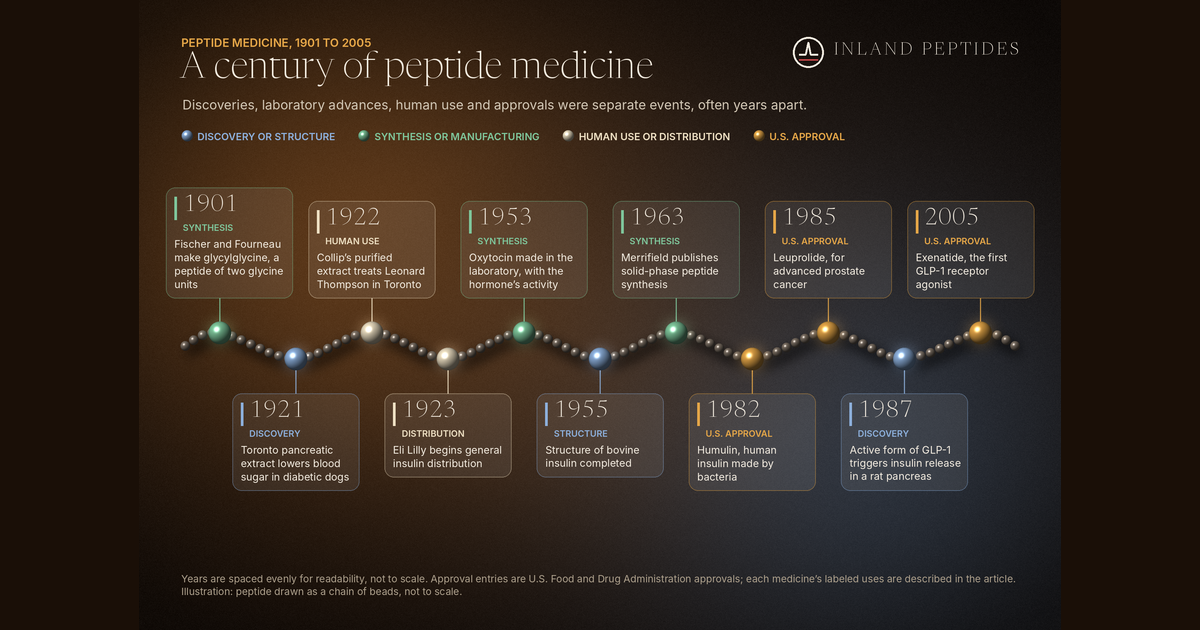
| Year | What happened | Type of milestone | Medical relevance |
|---|---|---|---|
| 1901 | Fischer and Fourneau make glycylglycine, two linked glycine molecules | Chemical synthesis | Demonstrated laboratory peptide synthesis |
| 1906 to 1908 | Zülzer treats eight patients with a pancreatic extract | Early human use | Experimental diabetes treatment; unreliable preparations |
| 1921 | Toronto team’s pancreatic extract lowers blood sugar in diabetic dogs | Discovery | Diabetes |
| 1922 | Collip’s purified extract successfully treats Leonard Thompson | Clinical treatment | Diabetes |
| 1923 | Eli Lilly begins general distribution of insulin | Distribution | Diabetes |
Mid-century: structures and blood tests
| Year | What happened | Type of milestone | Medical relevance |
|---|---|---|---|
| 1951 to 1953 | Sanger’s group publishes the order of the two chains of bovine insulin | Sequence determination | Protein chemistry |
| 1953 | Oxytocin sequence published; oxytocin built in the laboratory | Structure; synthesis | Uterine contractions in labor |
| 1954 | Synthetic vasopressin reported | Synthesis | Water balance |
| 1955 | Structure of bovine insulin completed, including its sulfur bridges | Structure | Protein chemistry |
| 1956 to 1960 | Yalow and Berson develop radioimmunoassay | Measurement method | Measuring hormones in blood |
| 1960 | Nicol and Smith report the sequence of human insulin | Sequence determination | Diabetes |
| 1963 | Merrifield publishes solid-phase synthesis | Manufacturing method | Faster chemical synthesis |
| 1969 | Thyrotropin-releasing hormone identified | Discovery and structure | Control of the thyroid |
| 1971 | Structure of gonadotropin-releasing hormone reported | Discovery and structure | Basis for leuprolide |
| 1973 | Structure of somatostatin reported | Discovery and structure | Basis for octreotide |
New medicines and GLP-1 research, 1978 onward
| Year | What happened | Type of milestone | Medical relevance |
|---|---|---|---|
| 1978 | First desmopressin product approved | U.S. approval | Central diabetes insipidus |
| 1978 to 1979 | Human insulin made in bacteria; results published | Experimental production | Diabetes |
| 1982 | FDA approves Humulin | U.S. approval | Diabetes |
| 1985 | FDA approves leuprolide | U.S. approval | Advanced prostate cancer |
| 1987 | Active form of GLP-1 shown to trigger insulin release in rat pancreas; human infusion study in seven volunteers | Discovery; human study | Later diabetes medicines |
| 1988 | FDA approves octreotide | U.S. approval | Symptoms of carcinoid tumors and VIPomas |
| 1992 | Exendin-4 isolated from Gila monster venom | Discovery | Later diabetes medicines |
| 1994 | Octreotide approved for acromegaly | U.S. approval | Excess growth hormone |
| 2002 | FDA approves teriparatide | U.S. approval | Osteoporosis |
| 2005 | FDA approves exenatide | U.S. approval | Type 2 diabetes |
| 2010 to 2023 | Liraglutide, semaglutide and tirzepatide approved | U.S. approvals | Type 2 diabetes; weight management |
1901: chemists build an amino acid chain
In 1901, Emil Fischer and Ernest Fourneau reported making glycylglycine, two linked glycine molecules, in Fischer’s Berlin laboratory.
The compound had no medical use, but it showed that chemists could build an amino acid chain.
1906 to 1923: insulin becomes a medicine
Insulin is a hormone made in the pancreas that helps the body use sugar from the blood.
Before insulin, near-starvation diets offered the best available treatment for severe diabetes. FDA’s history describes the grim choice as death by diabetes or death by starvation.
Earlier extracts, 1906 to 1908
Pancreatic extracts reached patients before the Toronto experiments.
Between 1906 and 1908, the Berlin physician Georg Zülzer treated eight patients with an alcohol-based pancreatic extract known as Acomatol.
Some patients improved, with less sugar and fewer ketones in their urine. Ketones form when the body breaks down fat for energy.
Side effects were common, including fever, sweating and vomiting.
Zülzer struggled to make consistent batches. A 1909 attempt to repeat his work stopped after high fever and other toxic effects in two patients. His project ended in 1914, when he was called up as a military doctor.
The extracts never became a reliable treatment.
Discovery in Toronto, 1921
Frederick Banting began experiments at the University of Toronto in May 1921. A surgeon with little research experience, he worked with student assistant Charles Best. Physiologist J.J.R. Macleod provided laboratory space, dogs and guidance.
Their pancreatic extracts lowered blood sugar in dogs whose pancreases had been removed.
Biochemist James Collip joined the team in December 1921. A history in Clinical Chemistry credits the success in purifying insulin largely to Collip.
Treating Leonard Thompson, January 1922
Leonard Thompson, a 14-year-old with diabetes, received the Toronto extract at Toronto General Hospital in January 1922.
Banting and Best’s preparation lowered his blood sugar only slightly and caused an abscess at the injection site.
Twelve days later, Thompson was given Collip’s purified extract. His blood sugar fell to normal within a day, and his condition improved.
Thompson lived another 13 years on insulin. He died in 1935, aged 27, of pneumonia and complications of diabetes.
The Toronto team published its clinical results in March 1922.
Distribution, 1923
Toronto’s laboratories could not meet demand. In May 1922, the university partnered with Eli Lilly and Company to increase production.
Insulin reached more clinics during a period of limited experimental distribution. Toronto allowed Lilly to begin general distribution in the fall of 1923.
Who received credit
Banting and Macleod received the 1923 Nobel Prize in Physiology or Medicine for discovering insulin.
Banting shared half his prize money with Best, and Macleod shared half his with Collip. Credit for the discovery remains debated.
NobelPrize.org explains that Best was not nominated that year, a requirement for consideration.
Romanian scientist Nicolae Paulescu had published findings in August 1921 showing that his pancreatic extract lowered blood sugar in diabetic dogs. His animal work did not produce a treatment for patients.
A 2023 historical review notes that the Nobel Prize recognized the advance into treating human diabetes.
The 1950s: hormone structures and blood tests
Insulin’s structure, 1951 to 1955
Frederick Sanger’s Cambridge group determined the structure of bovine insulin, the insulin from cattle.
Sanger and Hans Tuppy published the order of amino acids in one chain in 1951. Sanger and E.O.P. Thompson reported the other chain’s sequence in 1953.
In 1955, A.P. Ryle, Sanger, L.F. Smith and R. Kitai worked out the sulfur bridges linking the chains, completing the chemical structure.
The work showed that a protein has a precise amino acid sequence that chemists could determine. Sanger received the 1958 Nobel Prize in Chemistry for his work on protein structure, especially insulin.
D.S.H.W. Nicol and L.F. Smith reported the sequence of human insulin, which differs from bovine insulin, in a 1960 Nature paper.
Oxytocin and vasopressin, 1953 and 1954
The pituitary gland at the base of the brain releases oxytocin and vasopressin. Oxytocin causes uterine contractions during labor. Vasopressin, also called antidiuretic hormone, helps the kidneys conserve water.
In 1953, Hans Tuppy in Vienna and Vincent du Vigneaud’s U.S. group each published the amino acid sequence of oxytocin, a nine-amino-acid hormone.
Du Vigneaud’s group also built the proposed structure in 1953. The synthetic compound had oxytocin’s activity, helping confirm the structure.
The group reported a synthetic preparation with vasopressin’s biological properties in 1954. Du Vigneaud received the 1955 Nobel Prize in Chemistry, which recognized the first synthesis of a polypeptide hormone.
Chemical synthesis offered a way to produce hormones without extracting them from animal glands, which contain other active substances. Synthetic oxytocin entered obstetric care in the following years.
A 1960 clinical report described synthetic oxytocin use in 3,342 obstetric patients. This uncontrolled case series did not test its effectiveness against a comparison group. Sandoz Pharmaceuticals supplied the synthetic hormone.
Pitocin’s U.S. label describes synthetic oxytocin for starting or strengthening uterine contractions when medically indicated. It is prepared synthetically to avoid contamination with vasopressin and other peptides in gland extracts.
Measuring hormones in blood, 1956 to 1960
Rosalyn Yalow and Solomon Berson developed a sensitive blood test for insulin.
Their earlier work, published in 1956, showed that people treated with insulin could produce antibodies that bind it.
A 1959 Nature report showed that antibodies raised in guinea pigs against beef insulin could detect human insulin at the low levels found in fasting blood.
They published the full method, called radioimmunoassay, in 1960.
Researchers could now measure insulin in blood rather than estimate it from animal responses. The method was later used for other peptide hormones. Yalow received half of the 1977 Nobel Prize in Physiology or Medicine after Berson’s death.
1963 to 1973: faster synthesis and brain hormones
Solid-phase peptide synthesis, 1963
Building peptides required adding amino acids one at a time and separating the product from leftover chemicals after each step. Some product was lost with every separation.
These repeated losses made longer peptides difficult to produce efficiently.
R. Bruce Merrifield’s 1963 synthesis paper described a new method. He attached the first amino acid to a solid bead and added the others in sequence. Leftover chemicals could be washed away while the growing chain stayed attached.
The method improved yields, saved time and allowed automation. Merrifield received the 1984 Nobel Prize in Chemistry for developing it.
Hormones from the hypothalamus, 1969 to 1973
The hypothalamus controls the pituitary gland through chemical signals. In the 1960s, rival laboratories led by Roger Guillemin and Andrew Schally worked to identify those signals.
Each group processed about 5 million hypothalamic fragments: sheep tissue in Guillemin’s laboratory and pig tissue in Schally’s.
In 1969, they identified thyrotropin-releasing hormone. This three-amino-acid chain prompts the pituitary to release thyroid-stimulating hormone, which regulates the thyroid gland.
Schally’s group reported the structure of gonadotropin-releasing hormone in 1971, followed shortly by Guillemin’s group. This hormone controls the release of reproductive hormones.
Guillemin’s group reported the structure of somatostatin in 1973. The hormone suppresses growth hormone release.
Guillemin and Schally shared half of the 1977 Nobel Prize in Physiology or Medicine. Yalow received the other half.
1978 to 1994: new medicines and GLP-1 research
Desmopressin, 1978
Desmopressin is an analog, or modified version, of vasopressin.
The first U.S. desmopressin product, a nasal solution, was approved in 1978. Injection and tablet forms followed.
Its uses include central diabetes insipidus. People with this condition make or release too little vasopressin, so their kidneys lose large amounts of water in urine.
Human insulin made in bacteria, 1978 to 1982
For decades, insulin production depended on cattle and pig pancreases. FDA reports that making one pound of insulin in 1981 required 8,000 pounds of glands from 23,500 animals. That supplied about 750 patients for a year.
Recombinant DNA technology gives cells genetic instructions to make a protein they would not normally produce.
City of Hope and Genentech scientists used this technology to make human insulin in 1978. They placed artificial genes for the two chains of human insulin into E. coli bacteria, then joined the chains the bacteria produced. They published the work in early 1979.
Lilly partnered with Genentech to manufacture the insulin. FDA approved Humulin in October 1982, calling it the first approved medical product made with recombinant DNA technology.
Both chemical synthesis and production in modified cells remain in use. Some medicines combine the two methods.
Leuprolide, 1985
Leuprolide is a synthetic analog of gonadotropin-releasing hormone with greater potency than the natural hormone.
It initially stimulates the pituitary signals that drive sex hormone production, then suppresses them. In men, this lowers testosterone to very low levels.
FDA approved leuprolide in 1985 for the palliative treatment of advanced prostate cancer. Here, palliative treatment aims to control the disease and its symptoms rather than cure it.
A later FDA review records approvals for longer-acting depot forms for prostate cancer in 1989 and endometriosis in 1990. Depot forms release the drug slowly.
The active form of GLP-1, 1982 to 1987
GLP-1, short for glucagon-like peptide-1, is a hormone released by the gut after eating. It prompts the pancreas to release insulin when blood sugar is high.
In 1982, Joel Habener’s Massachusetts General Hospital team found a related peptide while studying the anglerfish glucagon gene. Work in mammals later showed that the gene also carries two glucagon-like peptides.
Svetlana Mojsov made pure candidate peptides and antibodies that could recognize them. In 1986, she, Habener and colleagues reported finding a shortened form of GLP-1 among the peptides in intestinal tissue extracts.
In 1987, Mojsov, Gordon Weir and Habener showed that tiny amounts of that shortened peptide stimulated insulin release from isolated rat pancreases. The longer form remained inactive. Jens Holst’s Copenhagen group reported a similar finding using pig tissue.
Octreotide, 1988
Octreotide is an eight-amino-acid, ring-shaped peptide that mimics somatostatin and lasts much longer in the body.
FDA approved Sandostatin, an octreotide product, in 1988 to control symptoms from carcinoid tumors and VIPomas. VIPomas release vasoactive intestinal peptide, a gut hormone. An FDA clinical pharmacology review records the later acromegaly approval in 1994. Acromegaly results from excess growth hormone.
The current label distinguishes the tumor-related uses:
Severe diarrhea and flushing linked to carcinoid tumors that have spread.
Profuse watery diarrhea linked to VIP-secreting tumors.
These uses concern hormone-related symptoms, not a demonstrated cure for the tumors.
Early human studies, 1987 to 1993
A London team including Stephen Bloom studied GLP-1 in seven healthy volunteers in 1987. Each volunteer received GLP-1 and a saline placebo on separate occasions, in random order. Saline is a saltwater solution.
GLP-1 raised insulin and lowered blood sugar and glucagon, a hormone that raises blood sugar.
When glucose was also given through a vein, GLP-1 increased insulin release and lowered blood sugar compared with placebo. After the glucose stopped, blood sugar fell into the range of hypoglycemia, or low blood sugar, under these experimental conditions.
A 1992 infusion study compared GLP-1 with a saline placebo in 4 people without diabetes and 11 with type 2 diabetes. Peak insulin levels rose 3- to 10-fold. With a meal, GLP-1 prevented the usual blood sugar rise for an hour in participants with diabetes.
A 1993 study tested GLP-1 and a saline placebo in 10 people with poorly controlled type 2 diabetes. Each received both, on separate occasions in random order. Fasting blood sugar reached normal levels within four hours with GLP-1, but not placebo. Insulin then fell toward its starting level while blood sugar remained stable.
The small groups and brief observation limited what these experiments could establish about lasting benefits and safety.
An enzyme called DPP-4 breaks down natural GLP-1 within minutes. Developing a practical medicine required finding ways to prolong its action.
2002 to 2024: osteoporosis and GLP-1 medicines
Teriparatide, 2002
Teriparatide contains the first 34 amino acids of human parathyroid hormone, the active part of the 84-amino-acid chain. It is made in genetically modified E. coli bacteria.
FDA approved Forteo, the teriparatide medicine, in 2002. Its original label covered:
Treating postmenopausal women with osteoporosis at high risk of fracture.
Increasing bone mass in men at high fracture risk whose osteoporosis had no known cause or was linked to low sex hormone levels.
A placebo-controlled study enrolled 1,637 postmenopausal women with osteoporosis, with a median treatment time of 19 months. In the spine X-ray analysis, new fractures occurred in 5.0% of women receiving teriparatide and 14.3% receiving placebo. Both groups received calcium and vitamin D.
In men, the original label reported increased bone density. It stated that the effect on fracture risk had not been studied.
Exenatide, 2005
John Eng and colleagues isolated exendin-4 from Gila monster venom in 1992.
Exendin-4 activates the GLP-1 receptor, a protein on cells that responds to GLP-1. It resists breakdown longer than GLP-1.
Exenatide, a synthetic version of exendin-4, is a 39-amino-acid peptide. FDA approved it in 2005 to improve blood sugar control in adults with type 2 diabetes.
It was the first GLP-1 receptor agonist approved in the United States. An agonist activates a receptor.
Liraglutide and semaglutide, 2010 to 2021
At Novo Nordisk, Lotte Bjerre Knudsen’s team attached a fatty acid to a modified GLP-1 peptide so it binds to albumin, a blood protein.
The modification helped liraglutide stay active longer. Its manufacture combines cell production and chemistry: yeast cells make the peptide, then the fatty acid is attached chemically.
FDA approved liraglutide as Victoza for type 2 diabetes in 2010 and as Saxenda for chronic weight management in 2014. Semaglutide, a later analog from Novo Nordisk, received approval as Ozempic for type 2 diabetes in 2017 and as Wegovy for chronic weight management in 2021.
A 68-week trial supporting Wegovy’s 2021 approval randomly assigned 1,961 adults to semaglutide or placebo. Participants had obesity, or overweight with a weight-related health condition, and did not have diabetes. Both groups received lifestyle support.
Average weight fell 14.9% with semaglutide and 2.4% with placebo. Nausea and diarrhea were the most common side effects. Digestive side effects led 4.5% of semaglutide recipients to stop treatment, compared with 0.8% receiving placebo. Novo Nordisk funded the trial.
Tirzepatide, 2022 and 2023
Tirzepatide activates receptors for GLP-1 and GIP. GIP is another gut hormone released after eating that stimulates insulin release.
FDA approved tirzepatide as Mounjaro for type 2 diabetes in 2022. Approval as Zepbound in 2023 covered adults with obesity, or overweight with a weight-related condition, alongside a reduced-calorie diet and increased physical activity.
Credit for GLP-1
Habener, Mojsov and Knudsen received the 2024 Lasker-DeBakey Clinical Medical Research Award for discovering and developing GLP-1-based drugs. The award materials also recognize contributors including Holst and Eng.
The history of peptides in medicine: different paths to the clinic
Peptide medicines reached patients through advances in purification, synthesis, manufacturing and drug design. Some reproduce natural hormones; others modify a hormone or use an active fragment.
Each medicine needed evidence for its intended use. Approval of one medicine does not establish that a different compound is safe or effective.