PT-141, also called bremelanotide, is the active ingredient in an FDA-approved medicine for a disorder involving distressing low sexual desire in premenopausal women. Melanotan 2 is a closely related peptide with far less research in people and no FDA approval.
The molecules differ in one chemical group. Both activate melanocortin receptors involved in pigmentation and sexual response.
PT-141 and Melanotan 2 at a glance
| Feature | PT-141 (bremelanotide) | Melanotan 2 (Melanotan II) |
|---|---|---|
| What it is | Cyclic peptide of seven amino acids ending in a free acid group; the active ingredient of Vyleesi | A closely related cyclic peptide ending in an amide group; bremelanotide was derived from it |
| Receptors | Activates several melanocortin receptor types; MC1R (pigment) and MC4R (brain) most relevant at treatment doses | Activates several melanocortin receptor types |
| Main human research | Two 24-week trials in 1,267 premenopausal women with low desire; a 12-week trial in 397 women; short erection studies in men | A two-week tanning pilot in 3 men; two crossover erection trials in 10 men each |
| Key human results | 24-week trials: greater desire and less distress than placebo; no significant difference in satisfying sexual events. Earlier 12-week trial: a small increase in satisfying sexual events in a pooled analysis | Darker skin in 2 of 3 men; erections in 8 of 10 men in one trial and after 12 of 19 treatment sessions in the other |
| Main safety findings | 24-week trials in women: nausea 40%, flushing 20%, headache 11%; short blood pressure rises; skin darkening in 1% | Trials in men: nausea, yawning, fatigue. Case reports (safety signals, products not laboratory-confirmed): prolonged erections, moles, melanoma |
| U.S. regulatory status | Vyleesi is FDA-approved for one indication in premenopausal women | Not FDA-approved; compounding nomination withdrawn |
What the names mean
PT-141 is the research code for bremelanotide, the active ingredient in the prescription medicine Vyleesi.
Melanotan II is another name for Melanotan 2. Researchers developed it from alpha-melanocyte-stimulating hormone, a natural hormone that signals skin cells to make pigment. Bremelanotide was later derived from Melanotan 2.
A shared compound name does not establish that a research product matches the preparation tested in a clinical trial.
A small study published in 2015 tested Melanotan 2 vials from three online shops. They contained 4.3 to 8.8 mg of peptide despite labels claiming 10 mg. Vials from two shops also contained unidentified impurities. These findings concern the products tested, rather than the wider market.
How the two molecules differ
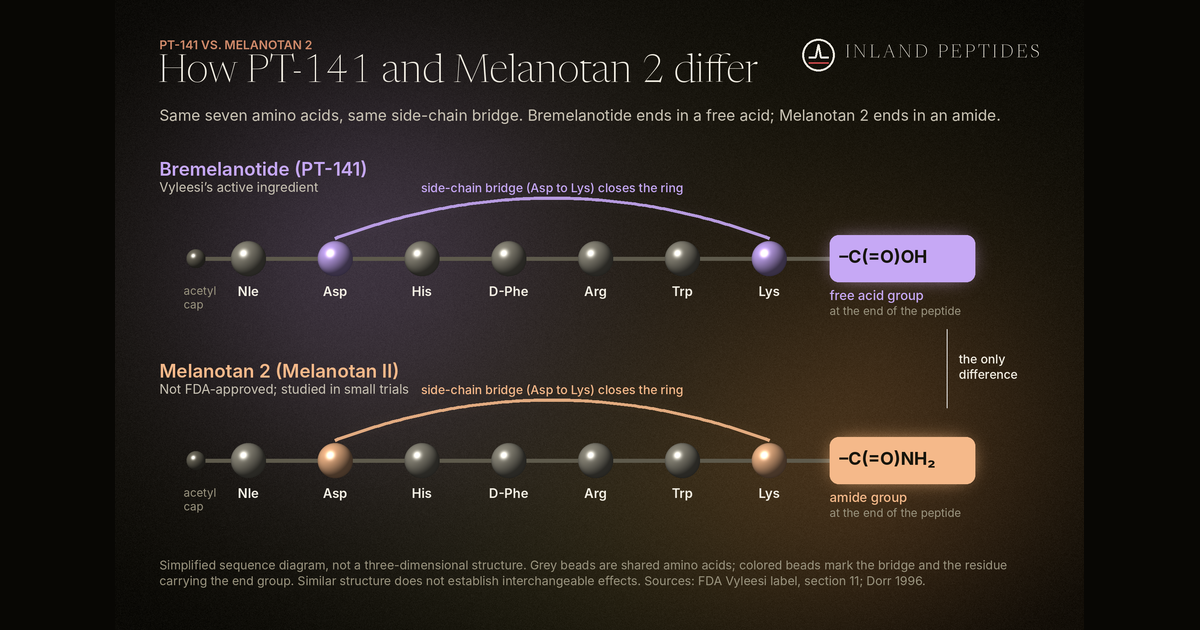
Both peptides contain the same sequence of seven amino acids, the building blocks of peptides. A bond between two amino-acid side chains, which branch off the main chain, forms a ring. This makes them cyclic peptides.
Bremelanotide has a free acid group at one end; Melanotan 2 has an amide group at that position.
How they act in the body
Receptors are proteins that respond to chemical signals. The melanocortin receptor MC1R helps pigment cells in the skin produce pigment. MC4R is found on nerve cells in the brain, including areas involved in sexual response.
Both compounds activate several types of melanocortin receptor. Vyleesi’s prescribing information identifies MC1R and MC4R as the most relevant to its effects. Exactly how bremelanotide improves low desire remains unknown.
Have they been compared directly?
No human treatment trial directly comparing PT-141 and Melanotan 2 was identified in this review.
The studies involved different groups of people and measured different outcomes. Their results cannot establish which compound works better.
What human studies of bremelanotide found
The main trials in women
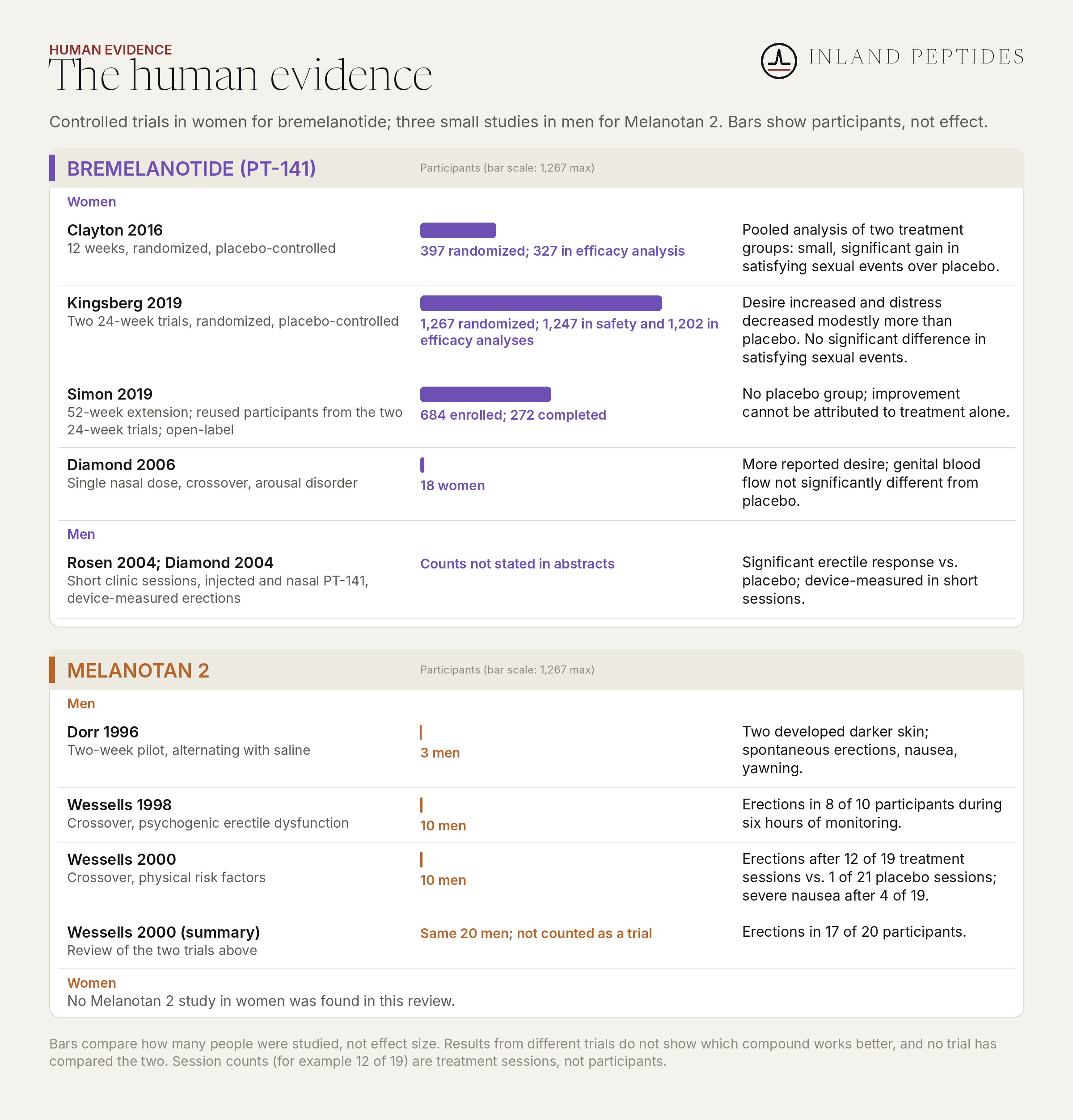
Two 24-week trials randomly assigned 1,267 premenopausal women, meaning women who had not reached menopause, to bremelanotide or placebo, an inactive comparison treatment.
All had acquired, generalized hypoactive sexual desire disorder. This means distressing low desire that developed after a period without the problem and occurred across situations and partners. Another condition, a relationship problem or a medication could not explain it.
Women receiving bremelanotide reported greater desire than those receiving placebo. Average gains were about 0.3 to 0.4 points greater on a scale from 1.2 to 6, where higher scores mean greater desire.
Distress also fell by about 0.3 points more with bremelanotide on a scale from 0 to 4, where lower scores mean less distress. Statistical tests supported both treatment differences in each trial, though the average improvements were modest.
The trials found no statistically significant difference in the change in satisfying sexual events between bremelanotide and placebo. This measure counted events within a defined period after study treatment.
More participants stopped treatment early with bremelanotide than with placebo: 40% versus 13% in the first trial and 39% versus 25% in the second, among women in the main efficacy analysis. Those who stayed may have differed from those who left, complicating interpretation.
Palatin Technologies, the developer, sponsored the trials and helped design, conduct, analyze and report them. AMAG Pharmaceuticals supported the publications. Several authors were employees, stockholders or consultants of these companies.
Extension and earlier trials
A 52-week extension enrolled 684 women who had completed the controlled phase without a serious adverse event; 272 finished the extension. Everyone knew they were receiving bremelanotide. Desire and distress scores improved from the original baseline among those assessed. With no placebo group and so many participants leaving, the study cannot establish continued benefit from the drug.
An earlier 12-week trial randomized 397 women; results were analyzed for 327. Combining results from two bremelanotide groups, researchers found a small increase in satisfying sexual events compared with placebo. Participants had low desire, arousal disorder or both. Palatin funded the trial.
A crossover study in 18 women with female sexual arousal disorder tested a nasal preparation. Each woman received bremelanotide and placebo at separate sessions. More reported desire after bremelanotide, but genital blood flow did not differ significantly from placebo.
Early studies in men
Early studies in men found erectile responses to injected PT-141 in healthy volunteers and in men with erectile dysfunction who responded poorly to sildenafil. Healthy men were observed without sexual images; men with erectile dysfunction were observed with them.
Studies of a nasal preparation found responses in healthy men and in men who responded to sildenafil. Both reports found statistically significant erectile responses compared with placebo.
These studies measured erections during short clinic sessions and cannot establish lasting improvement in sexual satisfaction. The authors included scientists affiliated with Palatin.
What human studies of Melanotan 2 found
The tanning pilot
A two-week pilot compared Melanotan 2 with saline in three men. Two developed measurably darker skin a week after treatment ended.
Reported symptoms included mild nausea, yawning and stretching. One man experienced sleepiness and fatigue. Intermittent spontaneous erections occurred for one to five hours after treatment.
The erection studies
The erections observed in the pilot led to two small crossover trials by one research group. Each man received Melanotan 2 and placebo at separate sessions while a device monitored erections for six hours.
In 10 men with psychogenic erectile dysfunction, meaning no known physical cause, 8 developed clinically apparent erections after Melanotan 2. By the study’s device-based measure, firm erections lasted an average of 38 minutes with Melanotan 2 versus 3 minutes with placebo.
In 10 men with physical risk factors for erectile dysfunction, erections were reported after 12 of 19 Melanotan 2 sessions versus 1 of 21 placebo sessions. The men also rated their desire higher after Melanotan 2.
A later summary of the group’s work reported erections in 17 of the same 20 men. It did not add another trial.
These studies documented erections without sexual stimulation during monitored sessions. They cannot establish long-term effectiveness, effects in women or how Melanotan 2 compares with approved treatments. The investigators included developers of the peptide.
Safety findings
Nausea and other common effects
In the 24-week bremelanotide trials, 40% of women receiving the drug reported nausea, compared with 1% receiving placebo. Eight percent stopped treatment because of nausea, the most common adverse reaction leading to withdrawal. Thirteen percent received an anti-nausea medicine.
Other reactions included flushing, or skin warmth and redness, in 20% versus under 1%; injection site reactions in 13% versus 8%; and headache in 11% versus 2%.
Bremelanotide can slow stomach emptying and reduce the absorption of some oral medicines. These include naltrexone, used to treat alcohol or opioid dependence.
In the 10-man Melanotan 2 study involving physical risk factors for erectile dysfunction, severe nausea followed 4 of 19 treatment sessions. Nausea, yawning and stretching were also reported in the other small studies.
Blood pressure
Bremelanotide can temporarily raise blood pressure and lower heart rate. A monitored study from the 12-week program found an average blood-pressure rise of about 2 to 3 mmHg, the standard unit for blood pressure, compared with placebo. The prescribing information reports that blood-pressure increases peak two to four hours after treatment and usually return to baseline within about 12 hours.
The medicine must not be used in people with uncontrolled high blood pressure or known heart or blood vessel disease. Its label also advises against use in people at high risk of heart disease.
The small Melanotan 2 studies provide less information about cardiovascular safety. A case report with laboratory-confirmed Melanotan 2 describes a man who developed a racing heart, high blood pressure, agitation and muscle breakdown after using an online product. He needed intensive care. This report cannot establish how often such reactions occur.
Pigmentation changes
In the 24-week bremelanotide trials, 1% of women reported darker patches on the face, gums or breasts, compared with none receiving placebo. A separate study using more frequent exposure reported pigmentation changes in 38% within about a week. Resolution was not confirmed in every affected participant, and changes were more likely in people with darker skin.
Case reports describe new or changing moles and melanoma after use of products sold as Melanotan. One woman who used a Melanotan 2 nasal spray developed a mucosal melanoma in the lining of her mouth. Other reports involved tanning-bed use or an inherited melanoma syndrome. Product identity was not reported as laboratory-confirmed. These cases do not establish that Melanotan caused the changes or cancers.
Prolonged erections
Priapism is a prolonged erection that can cause lasting damage. Reports describe it after use of products sold as Melanotan. In a 2021 case report, the patient needed surgery after other emergency treatment failed. In a 2019 case report, treatment worked without surgery, but erectile function had not recovered four weeks later. Neither report described laboratory confirmation of the product. These cases cannot establish how common the problem is.
The bremelanotide trials in women cannot establish this risk in men, and the early male studies were short and small.
What the evidence gaps mean
A published safety review covered 3,500 participants across 43 bremelanotide studies. Some trial participants were followed for up to 18 months. The Melanotan 2 evidence reviewed here consists of three short trials enrolling 3, 10 and 10 men, plus case reports.
Fewer reported side effects for Melanotan 2 do not mean it is safer.
Regulatory status
Vyleesi’s prescribing information limits its approved use to premenopausal women with acquired, generalized hypoactive sexual desire disorder. It is not indicated for postmenopausal women, men or enhancement of sexual performance.
Melanotan 2 is not FDA-approved for any use. FDA’s list of compounding ingredients that may pose safety risks includes Melanotan II among substances whose nominations were withdrawn. Withdrawal of a compounding nomination does not grant marketing approval.
Research material sold under either name is not an FDA-approved medicine.