Skin pigmentation and melanocortins are closely linked: pigmentation depends on melanin, the cells that make it and the signals controlling its production.
Treatments may aim to fade dark patches, restore lost color or address medical sensitivity to light. Cosmetic tanning is a separate goal.
This guide explains how medicines, melanocortin peptides and nonprescription products differ, and what their studies have found.
What affects skin pigmentation and melanocortins?
Pigmentation depends on the amount, type and distribution of melanin. Genetics, ultraviolet light, hormones and inflammation influence it. Melanocortin signaling is one of the pathways involved.
Cells called melanocytes make melanin in the lowest layer of the outer skin and pass it to surrounding cells. Brown-to-black eumelanin and yellow-to-red pheomelanin are its two main forms. Their mix is largely inherited.
Ultraviolet exposure can increase melanin production as part of the skin’s response to damage. The additional pigment absorbs some ultraviolet light.
Alpha-melanocyte-stimulating hormone activates a receptor on melanocytes called the melanocortin 1 receptor, or MC1R. This signal increases eumelanin production.
A study linked particular MC1R variants with red hair, fair skin and poor tanning. These associations vary between people.
The peptides discussed here are synthetic versions of that hormone, designed to activate melanocortin receptors and resist breakdown.
Different goals for pigmentation
Increasing pigment for a cosmetic tan or studying its protective effects in a medical setting.
Reducing excess pigment, such as facial melasma or dark marks left after acne or inflammation.
Restoring pigment lost through vitiligo, where immune damage to melanocytes leaves pale patches.
Addressing medical light sensitivity, such as the severe pain caused by erythropoietic protoporphyria.
An approach can be studied for more than one purpose. Afamelanotide, for example, has been studied for tanning, vitiligo and medical light sensitivity. Findings in one condition cannot automatically be applied to another.
How the main options compare
The table summarizes the approaches discussed here and their main findings or limitations.
| Medicine, compound or product | What it is | Medical purpose or research question | Main finding or limitation |
|---|---|---|---|
| Hydroquinone combination cream | Hydroquinone, tretinoin and a corticosteroid | Short-term treatment of moderate to severe melasma of the face | Cleared melasma in 13, 38% at eight weeks, exceeding two-ingredient combinations; hydroquinone can cause ochronosis |
| Azelaic acid cream | A topical medicine containing a dicarboxylic acid | Melasma | No significant difference from hydroquinone in a 329-woman trial; no ochronosis reported with azelaic acid in that trial |
| Ruxolitinib cream | A prescription cream that blocks an immune signaling pathway | Repigmentation in nonsegmental vitiligo | About 30% achieved at least 75% improvement in facial score versus 8, 13% with inactive cream; acne, itching and serious safety warnings |
| Topical corticosteroids and calcineurin inhibitors | Topical medicines that reduce immune activity | Repigmentation in vitiligo | A 20-child trial found repigmentation with clobetasol and tacrolimus; skin thinning with clobetasol and burning with tacrolimus |
| Narrowband UVB phototherapy | Medically selected and supervised ultraviolet light | Repigmentation in vitiligo; also used in other skin conditions | Established medical treatment; the comparison in the afamelanotide vitiligo study |
Melanocortin peptides studied for pigmentation
| Medicine, compound or product | What it is | Medical purpose or research question | Main finding or limitation |
|---|---|---|---|
| Afamelanotide (Melanotan I) | A synthetic 13-amino-acid melanocortin peptide | Increasing pain-free light exposure in erythropoietic protoporphyria; tanning and vitiligo research | More pain-free sunlight hours than placebo in two trials; can darken moles and freckles |
| Melanotan II | A shorter, cyclic synthetic melanocortin peptide | Tanning in a pilot study; erections and desire in separate studies | Darker skin in two of three men in a pilot; nausea, yawning and fatigue; reported mole changes do not establish causation |
Nonprescription products
| Medicine, compound or product | What it is | Medical purpose or research question | Main finding or limitation |
|---|---|---|---|
| Sunscreen | An over-the-counter drug applied to the skin | Reducing ultraviolet exposure | Reduces UV exposure and UV-driven tanning without stimulating melanin production |
| DHA self-tanner | A cosmetic color additive | A temporary surface tan | Creates surface color without producing melanin; color alone does not demonstrate UV protection |
| Beta-carotene supplements | A dietary pigment the body stores in skin | Protection from sunburn; sometimes sold for a tanned look | Seven-study analysis found reduced sunburn responses; high-dose supplements increased lung-cancer incidence in a trial of male smokers |
| Polypodium leucotomos extract | A fern extract sold as a supplement | Added to light therapy for vitiligo; photoprotection studies | Head-and-neck repigmentation differed nonsignificantly in a 50-person adjunctive trial |

Medical treatments for pigment conditions
Reducing excess pigment: melasma
Melasma treatments aim to reduce excess pigmentation, with sun protection helping limit further darkening.
One prescription cream combines hydroquinone, which inhibits melanin production, with tretinoin and a corticosteroid. Its prescribing information describes two eight-week trials involving 641 adults with moderate to severe facial melasma. Participants also used sunscreen and sun avoidance.
Investigators judged melasma cleared in 38 percent of participants receiving the combination in one trial and 13 percent in the other. Each result exceeded those for every two-ingredient combination, whose clearance rates were 15 percent or less in the first trial and 4 percent or less in the second.
Hydroquinone can also cause a gradual blue-black darkening called exogenous ochronosis.
A 24-week trial in 329 women compared azelaic acid and hydroquinone creams, both with sunscreen. About two-thirds of the azelaic acid group had good or excellent results. The treatments did not differ significantly on the reported measures, and no ochronosis was reported with azelaic acid.
Restoring lost pigment: vitiligo
Vitiligo treatments aim to reduce immune damage to pigment cells and support repigmentation.
The prescribing information for ruxolitinib cream describes two 24-week trials involving 674 people aged 12 and older with nonsegmental vitiligo affecting up to a tenth of the body. The medicine blocks part of the immune signaling involved in the condition.
About 30 percent receiving ruxolitinib achieved at least 75 percent improvement in a facial vitiligo score, compared with 8 to 13 percent receiving inactive cream. The score combines the affected area with the degree of pigment loss.
Responses continued to improve during a further 28 weeks when all participants received active treatment. This extension had no placebo comparison.
The prescribing information lists acne and itching at treatment sites as common reactions. The cream carries serious warnings about infections, cancers, cardiovascular events and blood clots. Some warnings draw on oral drugs in the same class; serious lower respiratory infections were also reported in the cream’s development program.
A two-month trial compared clobetasol, a corticosteroid, with tacrolimus, a calcineurin inhibitor, on two similar patches in each of 20 children. Average repigmentation was 49 percent and 41 percent, respectively. Clobetasol caused skin thinning in three children; tacrolimus caused burning in two.
Narrowband UVB is a medical light treatment selected and supervised by a clinician. It was the comparison treatment in the afamelanotide vitiligo study below. Its medical purpose and supervision distinguish it from recreational tanning.
A medical sensitivity to light: erythropoietic protoporphyria
Erythropoietic protoporphyria, or EPP, is an inherited disorder involving a buildup of a light-sensitive chemical in blood and skin. Visible blue light can activate it, causing severe burning pain within minutes of exposure. Pain can last for days with little visible skin change.
Afamelanotide increases pigment that absorbs light. Two randomized trials involving 167 treated participants compared it with placebo over six months in the United States and nine months in Europe. Researchers measured cumulative hours in direct sunlight without pain.
Over six months, US participants accumulated a median of about 69 pain-free hours with afamelanotide versus 41 with placebo. These were cumulative totals over the study.
The European trial also found more pain-free time and fewer phototoxic reactions with afamelanotide. Differences in measurement methods prevent a direct comparison of the two trials’ hour totals.
Quality of life improved in both trials. The drug’s manufacturer and others funded the studies.
Afamelanotide increases eumelanin without sunlight exposure. It can darken existing moles and freckles; a new or changing pigmented spot warrants clinical assessment.
What are the melanocortin peptides, and how are they named?
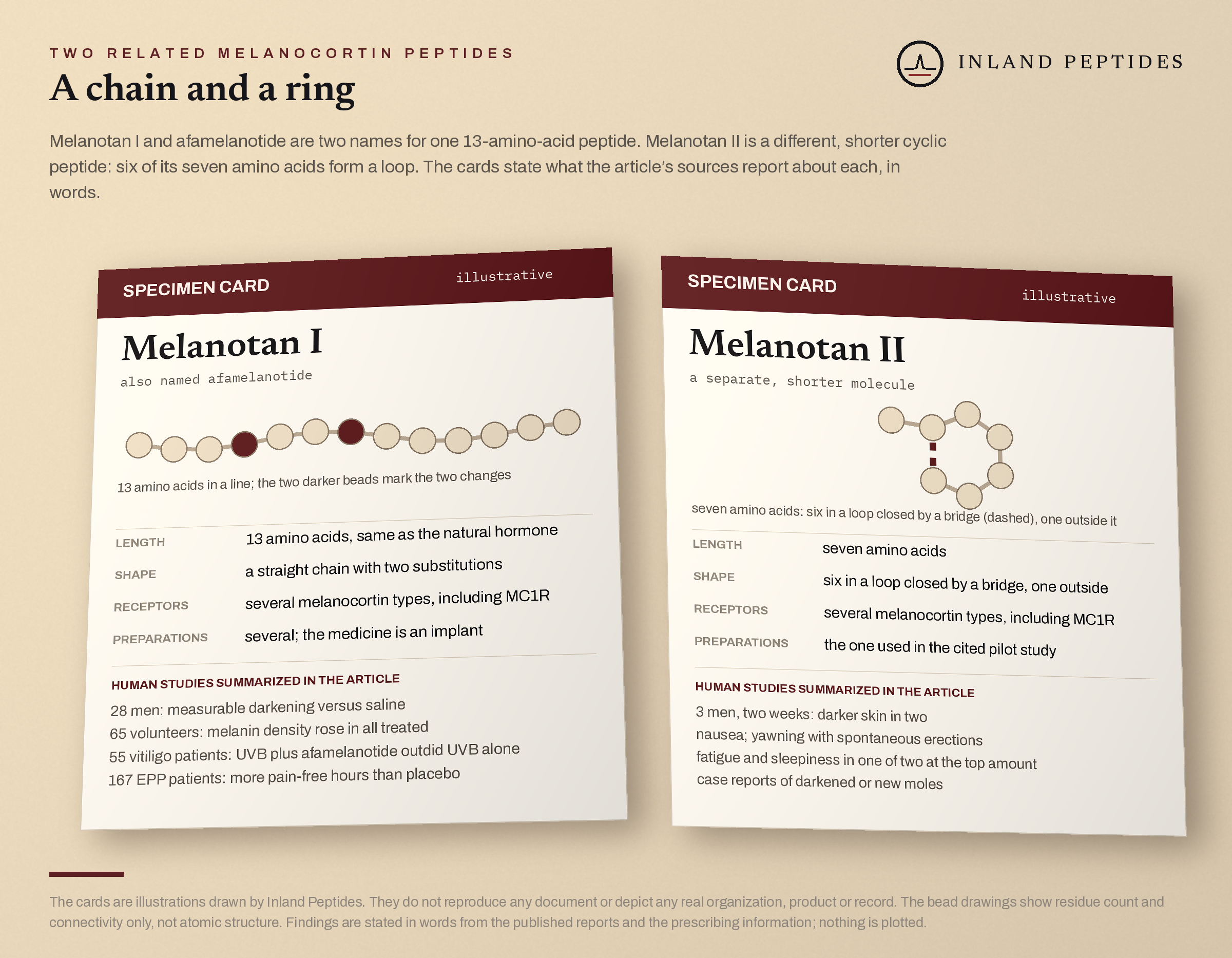
Melanotan I and afamelanotide name the same molecule. Melanotan II is a different, shorter peptide derived from the same natural hormone.
Afamelanotide is Melanotan I
Melanotan I is a modified version of the natural hormone alpha-MSH. It has 13 amino acids, with two changes that increase resistance to breakdown.
Afamelanotide is the drug name for the same molecule. It activates MC1R and other melanocortin receptor types.
A shared compound name does not establish that preparations are equivalent. The medicine is a controlled-release implant, while early tanning studies used other preparations. Clinical findings apply to the preparation and population studied.
What the human studies of Melanotan I found
An early controlled study in 28 healthy men compared the peptide with saline over 12 days. All used sunscreen. Skin darkened in both poor and good natural tanners receiving the peptide, but not in the placebo group. Peak darkening occurred one to three weeks after treatment ended.
A trial completed by 65 fair-skinned volunteers found increased melanin density in treated participants, greatest in those with the least pigment initially. Following laboratory UV exposure, participants who normally burned easily had fewer sunburn cells and less DNA damage in skin samples. These were short-term measurements, rather than evidence of long-term skin-cancer prevention.
In another study of 77 volunteers, melanin density rose more in treated people carrying certain MC1R variants than in those without them.
A trial in 55 patients with vitiligo found about 49 percent repigmentation at six months with afamelanotide plus narrowband UVB versus 33 percent with UVB alone. Repigmentation of the face and arms occurred earlier with the combination. Participants had medium to deeply pigmented skin, and responses varied by skin type.
These tanning and vitiligo studies did not establish long-term skin-cancer protection or safety over years of use.
Melanotan II is a different molecule
Melanotan II has seven amino acids. Six form a loop closed by a bridge between two side chains; one sits outside it. Like Melanotan I, it activates several melanocortin receptor types, including those on pigment cells and in the brain.
A pilot in three healthy men over two weeks documented darker skin in two participants a week after treatment ended. Mild nausea, yawning and spontaneous erections were reported. At the highest tested amount, one of the two men exposed to it experienced fatigue and sleepiness.
The erection findings led to separate sexual-function studies. This pigmentation pilot was very small and short.
Case reports have described new or darkened moles after products sold as melanotan. In one published report, a teenager with a familial mole condition developed tanning and mole darkening while using an internet-bought Melanotan II product and a tanning bed. An enlarging mole was removed and found to be abnormal but not cancerous.
The case report did not verify the product’s contents. Familial predisposition and UV exposure also complicate interpretation, so the observed changes do not establish causation.
The difference that matters
Melanotan I is a modified 13-amino-acid chain. Melanotan II has seven amino acids with an internal bridge. Both activate several melanocortin receptors, but their structures, pharmacological activity and human studies differ.
Nonprescription products: medicine, cosmetic or supplement?
Surface color, melanin production and ultraviolet protection are different effects. A product that produces one does not necessarily produce the others.
Sunscreen is an over-the-counter medicine
Sunscreen filters absorb or reflect ultraviolet light. Reducing that exposure can limit tanning and sun-related darkening of conditions such as melasma.
Sunscreen is an OTC medicine in the United States. Broad-spectrum products protect against UVA and UVB. The SPF number describes sunburn protection, which mainly concerns UVB.
Self-tanners are cosmetics
Dihydroxyacetone, or DHA, creates color by reacting with amino acids at the skin’s surface. The FDA describes it as a color additive. This reaction does not produce melanin.
A cosmetic tan does not demonstrate UV protection. Some self-tanners contain sunscreen ingredients; others do not. DHA is intended for external use, and inhalation during spray application is a safety concern.
Supplements sold for tanning or protection
Beta-carotene and Polypodium leucotomos have been studied for different effects.
Beta-carotene is a plant pigment that can accumulate in skin, producing a yellow-orange tint rather than a melanin tan. A pooled analysis of seven studies found reduced sunburn responses with beta-carotene supplementation, with effects associated with study duration.
In a large randomized trial involving more than 29,000 male smokers, high-dose beta-carotene supplements increased lung-cancer incidence compared with placebo. This finding concerns supplements in the studied population, rather than beta-carotene in ordinary foods.
Polypodium leucotomos is a fern extract. In a trial of 50 people with vitiligo, both groups received narrowband UVB, with either the extract or placebo, for about six months. Head-and-neck repigmentation was 44 percent versus 27 percent, a difference that did not reach statistical significance. Some smaller subgroups had larger differences, but those findings are separate from the overall comparison.
This trial tested an addition to phototherapy, rather than the extract alone. The overall result does not establish either benefit or the absence of an effect.
Which approach is best?
There is no single best approach. The medical goal and cause of the pigment change determine which treatments a clinician considers.
Fading melasma, restoring color in vitiligo and reducing EPP-related pain have different goals and measurements. Results across those conditions do not establish a universal ranking.
A qualified clinician can evaluate dark patches, pigment loss or light sensitivity. Study findings do not establish that a product sold for research is suitable for personal treatment.
The meaningful differences
Melasma medicines target excess pigmentation. The combination cream and azelaic acid have controlled-trial evidence; hydroquinone can cause ochronosis.
Vitiligo treatments aim to reduce immune damage and restore color. Evidence includes studies of ruxolitinib, clobetasol, tacrolimus and narrowband UVB.
Afamelanotide stimulates pigment production. Studies examined EPP-related light tolerance, tanning and repigmentation when added to UVB.
Sunscreens reduce UV exposure; DHA self-tanners produce surface color. Supplement research covers different outcomes and does not make these products interchangeable.
Melanotan I and Melanotan II are related but distinct molecules. Their structures and human studies provide the basis for a separate comparison.