NAD+ is a coenzyme used in cellular energy reactions. MOTS-c is a small peptide studied for its role in signaling how cells use sugar and fat.
They differ in both biology and evidence. Human studies have tested NAD+ directly and its precursors, the building blocks used to make it. Human MOTS-c studies have mainly measured the body’s own peptide, while treatment findings come from cells and animals.
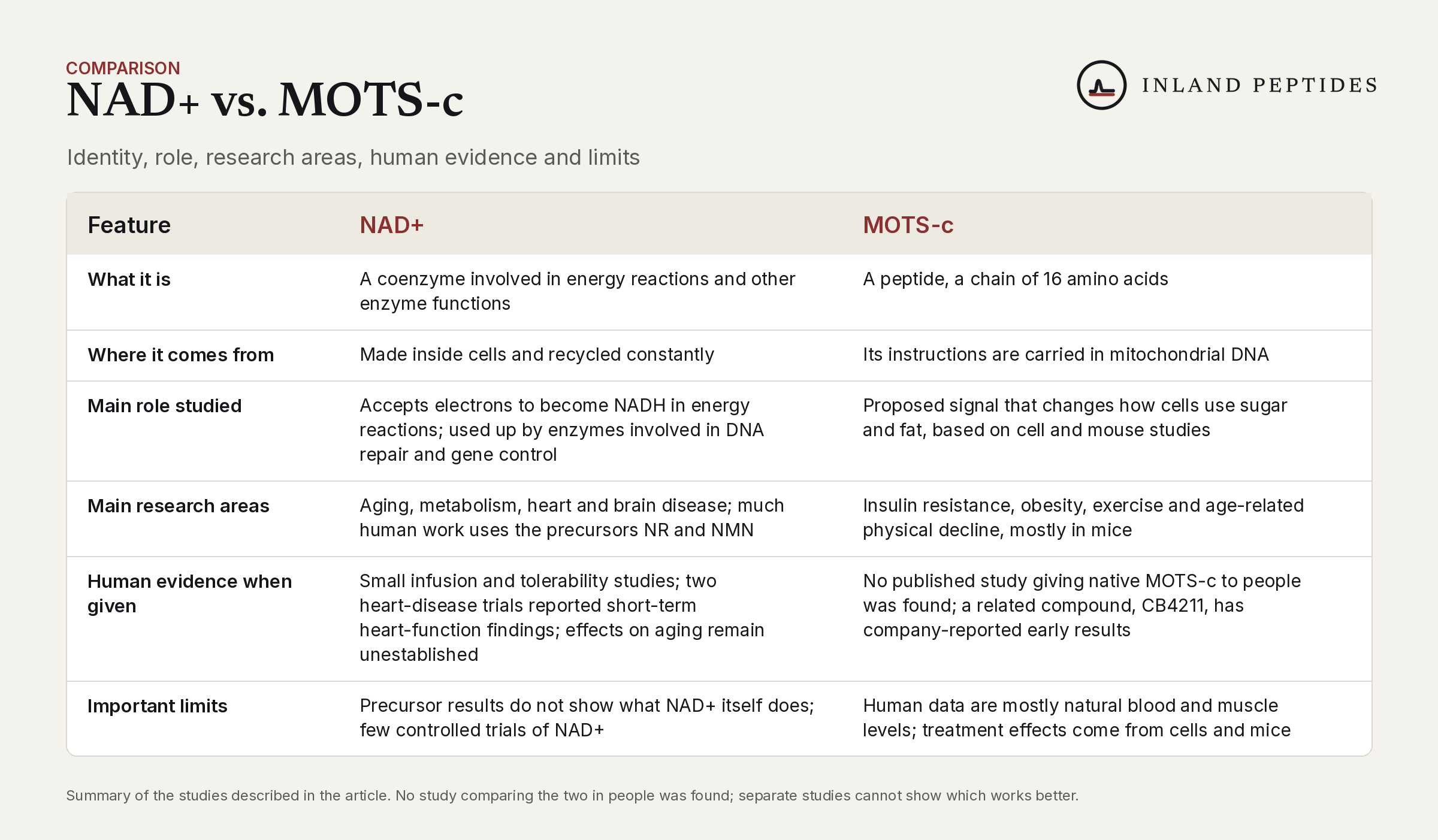
NAD+ and MOTS-c at a glance
| Feature | NAD+ | MOTS-c |
|---|---|---|
| What it is | A coenzyme involved in energy reactions and other enzyme functions | A peptide, a chain of 16 amino acids |
| Where it comes from | Made inside cells and recycled constantly | Its instructions are carried in mitochondrial DNA |
| Main role studied | Accepts electrons to become NADH in energy reactions; used up by enzymes involved in DNA repair and gene control | Proposed signal that changes how cells use sugar and fat, based on cell and mouse studies |
| Main research areas | Aging, metabolism, heart and brain disease; much human work uses the precursors NR and NMN | Insulin resistance, obesity, exercise and age-related physical decline, mostly in mice |
| Human evidence when given | Small infusion and tolerability studies; two heart-disease trials reported short-term heart-function findings; effects on aging remain unestablished | No published study giving native MOTS-c to people was found; a related compound, CB4211, has company-reported early results |
| Important limits | Precursor results do not show what NAD+ itself does; few controlled trials of NAD+ | Human data are mostly natural blood and muscle levels; treatment effects come from cells and mice |
What NAD+ is and what it does
NAD+ stands for nicotinamide adenine dinucleotide. It helps enzymes work, and cells continually make and recycle it using sources that include forms of vitamin B3.
A review of NAD+ biology describes two main roles:
Accepting electrons and becoming NADH, which carries them through reactions involved in releasing energy from food.
Being consumed in reactions involved in DNA repair and control of gene activity.
Studies in rodents and some human tissues have found lower NAD+ levels with age. This has prompted aging research, but does not establish that raising NAD+ slows aging in people.
What MOTS-c is and what it does
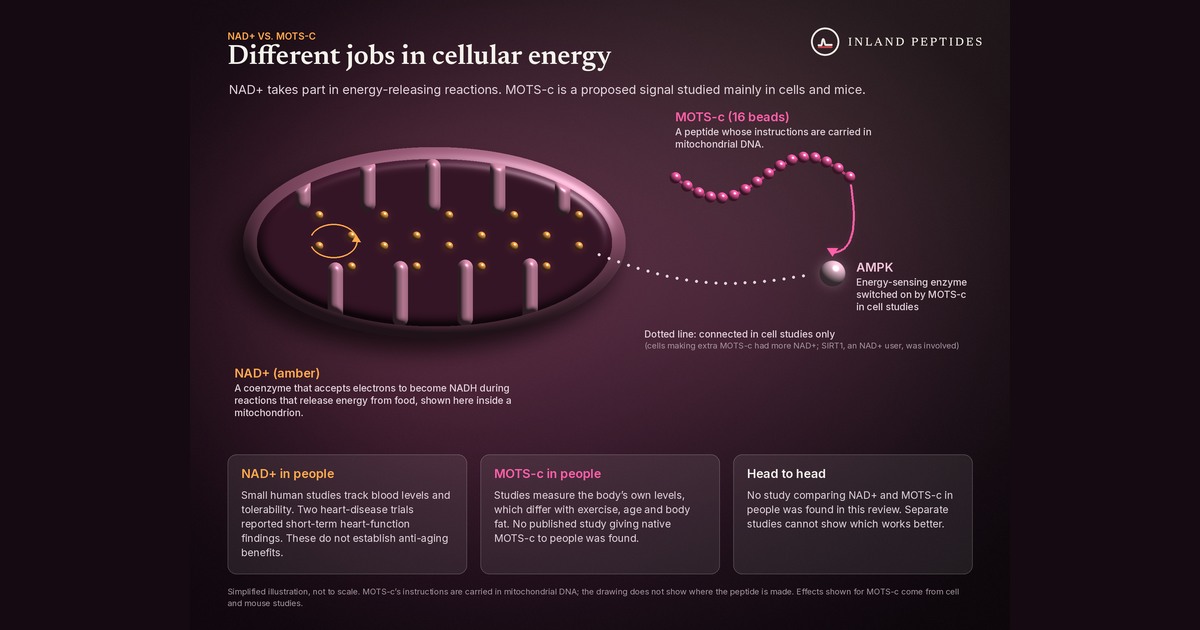
MOTS-c is a chain of 16 amino acids encoded by mitochondrial DNA. Mitochondria produce much of a cell’s energy and carry their own small set of genes.
The study that identified MOTS-c linked it to activation of AMPK, an enzyme that helps regulate fuel use. The experiments used cells and mice, with skeletal muscle appearing to be a main target.
Researchers describe MOTS-c as a metabolic signal. The proposed effects of administering it are supported mainly by laboratory and animal experiments.
Do NAD+ and MOTS-c do the same job?
No. NAD+ takes part directly in the reactions that release energy, while MOTS-c appears to act as a signal that changes how cells use fuel.
Their pathways overlap. In the original cell study, cells making extra MOTS-c had higher NAD+ levels. Blocking SIRT1, an enzyme that depends on NAD+, reduced some of MOTS-c’s effects on sugar use.
This cell finding does not establish a benefit from taking the two together.
NAD+ in people: the molecule versus its building blocks
Direct NAD+ studies and precursor studies test different molecules. Most of the human research on raising NAD+ has used nicotinamide riboside (NR) or nicotinamide mononucleotide (NMN), which the body can convert into NAD+.
A finding for NR or NMN cannot automatically be assigned to NAD+ itself. The studies below keep those results separate.
Studies that gave NAD+ itself
In an infusion pilot, eight healthy men received NAD+ and three received saline, a salt-water solution. Researchers tracked NAD+ and its breakdown products in blood and urine over eight hours.
Blood NAD+ did not rise during the first two hours of the six-hour infusion. The authors interpreted this as rapid removal from the blood. The study tested how the body handled NAD+, without assessing clinical benefits or aging. NAD+ Research Inc. helped fund it, and one author was a director.
NAD+ heart-disease trials
A randomized trial in 180 people with heart failure compared a week of NAD+ with placebo alongside standard medicines. Participants had heart failure caused by coronary artery disease.
The main measure was ejection fraction, the share of blood pumped out of the heart’s main pumping chamber with each beat. After one month, it rose by about 4.5 percentage points with NAD+ and 2.3 with placebo, a statistically significant difference.
The groups did not differ significantly on a heart-strain blood marker, unplanned heart-failure admissions over six months, or improvement in a symptom-based heart-failure rating.
This was one hospital’s trial, and the paper did not specify whether patients or the person measuring heart function knew the treatment assignments. The manufacturer supplied the product and helped fund the study.
A second randomized trial studied 120 people after a heart attack treated with a procedure to reopen a coronary artery. The NAD+ group had a higher average ejection fraction at 30 days, about 56.3% versus 53.4% with placebo. Major cardiac and stroke-related events did not differ significantly over six months.
This trial came from the same hospital and research group as the heart-failure study. The paper contains inconsistent figures for changes from baseline and conflicting descriptions of a heart-strain blood marker. Those reporting problems limit confidence in the findings. Neither trial establishes an anti-aging benefit in healthy people.
A systematic review found no eligible trials testing intravenous or intramuscular NAD+ for anti-aging or wellness benefits in its search through October 2025. The heart-disease trials tested different outcomes, and the newer trial was published after that search ended.
What precursor studies show
Studies of NR and NMN taken by mouth show that they raise NAD+-related compounds in blood. Their effects on health measures have been mixed:
In a 10-week NMN trial completed by 25 postmenopausal women with prediabetes and excess weight, muscle responded better to insulin than with placebo. Body composition, blood pressure, blood fats, strength and muscle energy capacity showed no significant improvement.
In a 12-week trial of NR in 40 men with obesity, insulin sensitivity and body composition did not improve compared with a placebo.
The systematic review found NR and NMN generally well tolerated over weeks to months. Effects on physical function, metabolism and blood-vessel measures were mixed or limited to particular tests.
These are results for NR and NMN, not for NAD+ given directly.
MOTS-c in people: natural levels versus treatment
No published study giving native MOTS-c to people was identified in this review.
Natural MOTS-c levels
In an exercise study of 10 young men, muscle MOTS-c rose about twelvefold after hard cycling and remained elevated four hours later. Blood levels rose about 1.5-fold and returned to baseline within four hours.
Another exercise study found only a nonsignificant upward trend in blood MOTS-c after endurance exercise. The findings do not show a consistent increase after every type of exercise.
A study comparing healthy men of different ages found lower blood MOTS-c but higher muscle MOTS-c in older groups. The older men providing blood were different from those providing muscle samples, so the study could not compare the two tissues within the same older person.
In an observational study of adults without diabetes, higher blood MOTS-c was associated with more abdominal fat among 125 Chinese participants. A female group with liver scans also showed an association with liver fat. These associations do not show that MOTS-c caused fat gain.
These studies describe naturally occurring MOTS-c. They do not test the effects of administering it.
Animal treatment studies
The treatment studies discussed here tested mice. In the original study, MOTS-c protected against high-fat-diet weight gain and insulin resistance, as well as age-related insulin resistance.
In the study that also examined exercise in people, treated mice performed better on physical tests at young, middle and old ages. Treatment begun late in life improved grip strength and walking and lowered blood sugar. The overall lifespan difference was not statistically significant.
Two senior authors of the exercise study reported being consultants and shareholders of CohBar, which was developing a MOTS-c-based drug.
CB4211 is a different molecule
CB4211 is a modified version of MOTS-c developed by CohBar. Findings for this analogue do not establish the effects of native MOTS-c.
CohBar reported results from a four-week comparison in 20 people with obesity and fatty liver. Its main goals were safety and tolerability.
The company reported similar liver-fat reductions in both groups. Two liver enzymes and blood sugar fell more with CB4211, but these were exploratory outcomes. Reported side effects included injection-site reactions. No peer-reviewed results paper was identified in this review.
Has anyone compared NAD+ and MOTS-c directly?
No study comparing NAD+ and MOTS-c in people was found in this review.
The studies differ in participants, treatments and outcomes. They can help explain the evidence for each molecule, but cannot establish which works better.
Safety findings
Neither NAD+ nor MOTS-c is an FDA-approved drug.
The infusion pilot observed no adverse events. The 180-person heart-failure trial reported one case of brief dizziness, and the 120-person heart-attack trial reported one case of transient nausea. Treatment was stopped for those patients. These short studies cannot establish long-term safety.
A retrospective clinic study reviewed six NAD+ clients and eight NR clients. The NAD+ group reported symptoms during infusion, including moderate-to-severe gastrointestinal symptoms, increased heart rate and chest pressure. The symptoms resolved when infusions ended.
This was a small, nonrandomized review of records. The clinic funded the work, its employees authored it, and the NR supplier donated product. The authors labeled the symptoms “adverse experiences”; their separate statement of no documented “adverse events” does not mean participants had no symptoms.
FDA has received reports of severe chills, shaking, vomiting and fatigue after NAD+ injectable products, sometimes requiring medical treatment. It described the reactions as consistent with excessive endotoxins, toxins from bacteria, and warned about food-grade ingredients being used for sterile products. This does not establish that NAD+ itself caused those reactions or that contamination explains all reported NAD+ symptoms.
An FDA review of MOTS-c found no human treatment studies or data on how the body handles the peptide. Its adverse-event database searches found no reports, which cannot establish safety or how many people used it. FDA also raised concerns about possible immune reactions to injected MOTS-c, including from peptide clumping.
What remains unresolved
Whether direct NAD+ has reliable benefits for aging, wellness or healthspan, the years spent in good health.
Replication of the heart-function findings by larger, independent studies.
Whether MOTS-c given to people has the effects reported in mice.
How the two compare, since no study found in this review tested both.
Long-term safety for either one.
NAD+ has an established role in cellular energy chemistry. Human research on administering it is limited and includes inconsistent reports and short studies. MOTS-c treatment findings come mainly from cells and animals. Neither research record establishes which is better for aging or whether combining them helps.