Immune modulation means changing an immune response. That can involve reducing inflammation, replacing missing antibodies, stimulating a specific function or training the system to recognize a threat.
Medicines, peptides and supplements affect different parts of this system. A stronger response is not always the goal.
The approaches discussed here include:
Prescription medicines and vaccines, each used for a defined medical reason.
Experimental peptides, including thymosin alpha-1, thymosin beta-4, LL-37 and KPV.
Nonprescription medicines that relieve symptoms.
Supplements such as vitamin D, vitamin C, zinc and probiotics.
Understanding what each product does and what its studies measured helps explain the findings.
What does the immune system do, and what does modulating it mean?
The immune system helps prevent or limit infection and responds to damaged cells. Immune modulation changes part of that response.
Two connected parts of the system help explain how these products work:
Innate immunity is the fast, general response: physical barriers such as skin, antimicrobial proteins, and cells that respond within hours to signals of infection or damage.
Adaptive immunity is a slower, targeted response. B cells make antibodies, while T cells coordinate responses or kill infected cells. Both can form lasting memory of a particular microbe.
Several related terms describe different immune problems:
Inflammation is a response to injury or infection that can cause swelling, heat, redness and pain. It supports healing but can damage tissue when excessive or persistent.
Immune deficiency means part of the system is missing or works poorly because of an inherited condition, disease or treatment. This can make infections more dangerous.
Allergy is an immune response to something that is not a threat, such as pollen.
Autoimmunity is an immune response against the body’s own tissue.
Allergy and autoimmunity show why increasing immune activity is not always helpful. An immune response can cause harm when it targets harmless substances or the body’s own tissue.
Some medicines therefore reduce immune activity.
How the main approaches compare
| Medicine, ingredient or compound | What it is | Medical purpose or research question | Main finding or important limitation |
|---|---|---|---|
| Corticosteroids (for example, prednisone) | Prescription steroid hormones | Dampening inflammation and immune activity in many conditions | Broad suppression; the label warns that new infections can appear and signs of infection can be masked |
| TNF blockers (for example, adalimumab) | Prescription antibodies that block one inflammatory signal | Rheumatoid arthritis, Crohn’s disease, psoriasis and related conditions | Targeted suppression; boxed warning for serious infections and malignancy |
| Immune globulin | Antibodies collected from donated human plasma | Replacing antibodies in people who make too few | Replacement, not stimulation; the intravenous product checked carries a boxed warning for blood clots and kidney injury |
| Filgrastim | A prescription growth factor for white blood cells | Raising infection-fighting cell counts after chemotherapy | Stimulates neutrophil production; warnings include spleen rupture |
| Vaccines | Preparations that imitate an infection | Building specific immune memory before exposure | Protection is against the specific disease targeted, not immunity in general |
Peptides studied for immune function
| Medicine, ingredient or compound | What it is | Medical purpose or research question | Main finding or important limitation |
|---|---|---|---|
| Thymosin alpha-1 (thymalfasin) | A 28 amino acid peptide | Hepatitis B, sepsis, cancers, and as a vaccine adjunct | A 1,106-person sepsis trial found no significant reduction in deaths; hepatitis B trials were small with mixed results |
| Thymosin beta-4 | A 43 amino acid peptide that binds actin inside cells | Tissue repair; inflammation in animal and cell models | Human studies discussed here examined healing and safety; the cited kidney inflammation finding came from mice |
| LL-37 | A 37 amino acid antimicrobial peptide the body makes | Antimicrobial, anti-inflammatory and wound-healing effects | A 25-person wound trial found faster growth of new tissue, without significant differences in wound-area reduction, inflammatory markers or bacterial counts |
| KPV | The last three amino acids of the hormone alpha-MSH | Intestinal inflammation | Reduced colitis severity in mice and inflammatory signaling in cells; these experiments do not establish human effects |
Nonprescription medicines and supplements
| Medicine, ingredient or compound | What it is | Medical purpose or research question | Main finding or important limitation |
|---|---|---|---|
| Antihistamines (for example, cetirizine) | Nonprescription allergy medicines | Temporarily relieving allergy symptoms | Block histamine’s effects; do not remove the underlying allergic sensitization |
| Vitamin D | A vitamin and hormone precursor | Preventing respiratory infections; autoimmune disease | No significant respiratory-infection reduction in pooled trials; an early autoimmune finding was no longer significant after additional cases were confirmed |
| Vitamin C | An essential vitamin | Preventing or shortening colds | Did not prevent colds in the general population; regular use shortened them modestly |
| Zinc | An essential mineral | Preventing or shortening colds | Little or no effect on prevention; may shorten colds, with more minor side effects and wide variation between products |
| Probiotics | Live microorganisms, defined by strain | Preventing upper respiratory infections | Pooled trials suggest fewer infections, low certainty; results belong to the strains tested |
Medicines that change the immune response
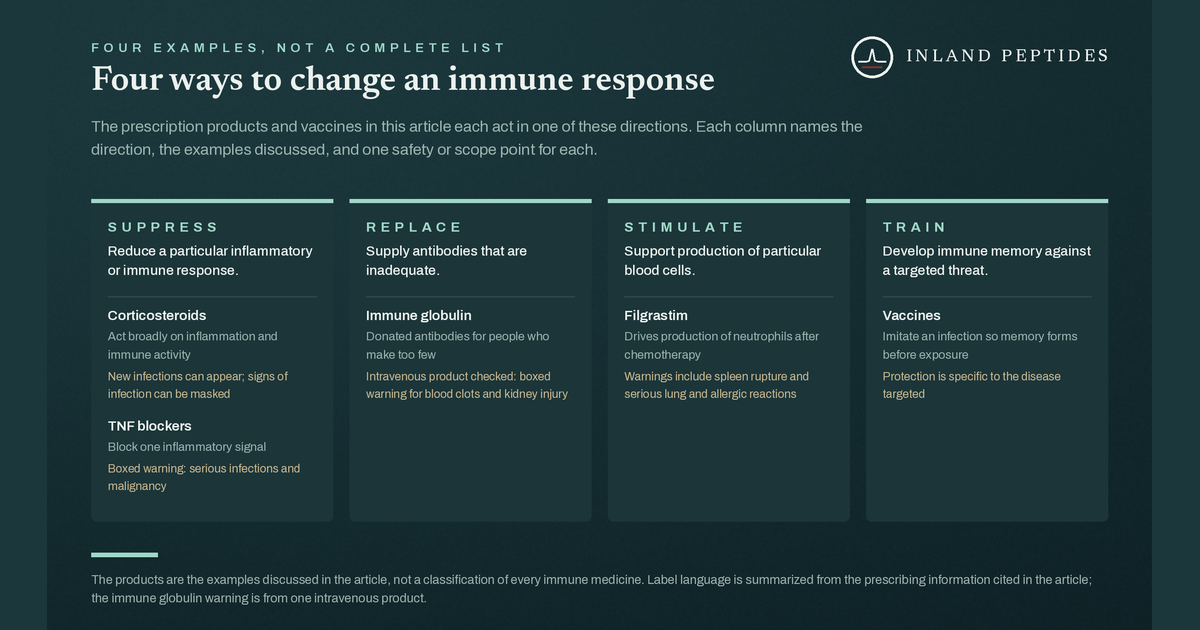
Immune medicines and vaccines can suppress a response, replace a missing component, stimulate a specific function or build immune memory. These are examples rather than a complete classification.
Suppressing part of the response
Corticosteroids such as prednisone act broadly on inflammation and immune activity. Their medical uses include allergic, rheumatic, skin, lung, blood and bowel conditions.
Prednisone’s label warns that corticosteroids can mask signs of infection and allow new infections to develop.
Adalimumab targets tumor necrosis factor, or TNF, a messenger protein involved in inflammation. Its prescribing information describes uses including rheumatoid arthritis, Crohn’s disease, ulcerative colitis and plaque psoriasis. It carries a boxed warning for serious infections and malignancy.
Blocking one inflammatory signal still lowers the body’s defense against some infections, including tuberculosis.
Replacing a missing component
People with certain inherited conditions or diseases make too few antibodies. Immune globulin supplies antibodies collected from donated plasma. One intravenous product’s label describes its use for primary humoral immunodeficiency and carries a boxed warning for blood clots and kidney injury.
The product supplies antibodies without teaching the body to make them.
Stimulating a specific function
Filgrastim stimulates production of neutrophils, white blood cells that fight bacterial infection. One medical use is reducing infections associated with low neutrophil counts after chemotherapy.
This is an example of stimulating a particular blood-cell population. Warnings include spleen rupture and serious lung and allergic reactions.
Vaccines: building specific memory
Vaccines expose the immune system to a target, or instructions for making one, so it can build antibodies and memory cells before encountering the disease.
That memory concerns the disease targeted rather than a general increase in immunity.
What the peptide research shows
Peptides studied for immune effects differ in their biological roles and evidence. The studies below examine specific diseases, inflammatory signals and wound outcomes.
Thymosin alpha-1, also called thymalfasin
Thymosin alpha-1 is a 28 amino acid peptide. Thymalfasin is the drug name for the synthetic form, and the two names refer to the same molecule.
Studies of its effects on T-cell responses have included chronic hepatitis B, sepsis, some cancers and vaccine responses in older adults.
A placebo-controlled trial in 1,106 adults with sepsis at 22 hospitals compared thymosin alpha-1 with placebo over seven days. Deaths within 28 days were 23.4 percent with the peptide and 24.1 percent with placebo. Neither this difference nor differences in secondary or safety outcomes were statistically significant.
An earlier trial in 361 patients reported fewer deaths with the peptide, but the difference was statistically uncertain. The larger trial was partly funded by a pharmaceutical company, and several investigators reported grants from that company.
The sepsis findings do not establish the effects in other conditions.
Hepatitis B findings were mixed. A pooled analysis of five trials with 353 patients found no difference in virus suppression at treatment completion or six months later. A difference appeared twelve months after treatment stopped.
One of those trials enrolled 97 patients and was randomized, double-blind and placebo-controlled. The response was numerically higher with the peptide but not statistically significant. The authors concluded that the results did not confirm benefits reported in other studies.
The peptide was generally well tolerated in these studies, but the clinical findings varied by condition and trial.
Thymosin beta-4 and the TB-500 name
Thymosin beta-4 is a different molecule despite the similar name. This 43 amino acid peptide binds actin, a structural protein, and helps organize the cell’s internal scaffolding.
Its research includes tissue repair and inflammation, separate from the thymosin alpha-1 studies above.
The human studies reviewed here examined wound healing, an eye surface condition and safety in healthy volunteers. They did not measure immune outcomes.
In mice with sepsis-induced kidney injury, thymosin beta-4 reduced kidney inflammation and cell death and suppressed an inflammatory signaling pathway. These animal findings do not establish clinical effects in people.
TB-500 is a product name that does not by itself establish molecular identity. Chemists examining a product sold as TB-500 identified a chemically modified seven amino acid fragment of thymosin beta-4 rather than the full peptide.
That analysis identifies one tested product. Findings about full-length thymosin beta-4 cannot automatically be applied to a fragment or another product carrying the TB-500 name.
Two other peptides with distinct questions
LL-37 is a 37 amino acid peptide the body makes as part of innate immunity. It disrupts bacterial membranes and also signals to immune cells, which is why it is studied for infection, inflammation and wound healing.
A placebo-controlled trial tested LL-37 cream in 25 people with diabetic foot ulcers and mild or no infection. Thirteen received the cream and twelve received placebo. Over four weeks, granulation tissue, which fills a wound bed, grew faster with LL-37. Wound-area reduction did not differ significantly between groups.
Two inflammatory markers rose in both groups, and bacterial counts did not fall more with the cream. The trial did not demonstrate anti-inflammatory or antibacterial effects on those measures.
KPV consists of the last three amino acids of alpha-melanocyte stimulating hormone, which has anti-inflammatory effects. In cells and in mice with chemically induced colitis, KPV reduced inflammatory signaling and colitis severity.
These cell and animal experiments do not establish effects in people with bowel disease.

Nonprescription medicines and supplements
Antihistamines and allergy symptoms
Nonprescription allergy medicines act on part of an immune response. Cetirizine, for example, temporarily relieves hay fever symptoms such as sneezing, a runny nose and itchy eyes.
It blocks histamine, a chemical released during an allergic response. Symptoms can improve while the immune system still recognizes pollen as a trigger.
Vitamin D
Immune cells have receptors for vitamin D, prompting research into its effects on infections and autoimmune disease.
An analysis of 40 trials with 61,589 participants found no statistically significant reduction in respiratory infections with vitamin D after several large trials were added. Results did not differ clearly by age, starting vitamin D level or supplementation pattern.
A trial of 25,871 adults aged 50 and over initially reported 22 percent fewer confirmed new autoimmune diagnoses with vitamin D than placebo over about five years.
Researchers kept following participants for two more years after supplementation ended. Additional diagnoses confirmed during follow-up, but beginning during the trial, made the original difference no longer statistically significant. There was also no significant difference across the full seven years.
The added follow-up was observational. It also allowed researchers to confirm cases that began during the randomized trial.
These findings concern supplementation in the studied population. Correcting a measured deficiency is a separate question.
Vitamin C and zinc
A pooled analysis of 29 comparisons involving more than 11,000 participants found that regular vitamin C did not prevent colds in the general population. Five trials in marathon runners, skiers and soldiers under extreme physical stress found roughly half as many colds with supplementation.
Another 31 comparisons examined cold duration. Regular vitamin C shortened colds by about 8 percent in adults and 14 percent in children. Starting it after symptoms began showed no consistent effect.
A review of 34 trials found little or no effect of zinc on cold prevention. It may shorten colds by about two days, but confidence in that finding was low and results varied widely. Trials tested lozenges, syrups and nasal products. Zinc used during a cold also increased minor side effects, including an unpleasant taste and stomach upset.
Preventing a cold and shortening one are separate outcomes.
Probiotics
Probiotics are live microorganisms. Findings about one strain and preparation do not necessarily apply to another.
A review of 24 trials, with data from about 7,000 participants pooled across 23 of them, found that probiotics may reduce upper respiratory infections and shorten episodes by about a day. They probably reduced antibiotic use for those infections. Confidence in most findings was low.
Most trials tested one or two strains for several months, often in milk-based foods for children.
Safety across the supplements
Zinc increased minor side effects in cold-treatment trials. Probiotic trials mainly reported mild digestive complaints. Short studies in generally healthy people do not establish long-term safety.
People with weakened immunity should discuss live-microorganism products and other immune-related supplements with a clinician familiar with their condition and treatment.
Which option is best for immune function?
There is no universal best option because these products address different needs.
Reducing inflammation, replacing antibodies, raising neutrophil counts and building vaccine memory are different medical goals. Supplement trials often ask narrower questions about infection frequency or cold duration.
The findings cannot be used to rank these approaches against each other.
A qualified clinician can assess medical decisions using the person’s condition, treatment and health history.
How the approaches differ
Purpose, mechanism and evidence help explain the differences.
Purpose. An allergy medicine relieves symptoms, while immune globulin supplies antibodies. Neither answers the same question as a study of intestinal inflammation or infection prevention.
Mechanism. Corticosteroids affect immune activity broadly, while TNF blockers target a particular signal. Even similarly named peptides, such as the two thymosins, have different biological roles.
Evidence. A result depends on the molecule, population and outcome studied. A human sepsis trial, a wound-healing study and a mouse colitis experiment answer different questions. Supplement findings also vary by ingredient, preparation and outcome.
This article is educational and is not medical advice.