Thymosin alpha-1 is studied mainly for its effects on immune responses. Thymosin beta-4 helps regulate cell structure and movement and is being studied for tissue repair.
They share a name because both were first found in extracts of the thymus, a gland in the chest where certain immune cells mature. They are different molecules, and results for one do not apply to the other.
Thymosin alpha-1 and thymosin beta-4 at a glance
| Feature | Thymosin alpha-1 | Thymosin beta-4 |
|---|---|---|
| What it is | 28 amino acids; first isolated from calf thymus; the pharmaceutical form is thymalfasin | 43 amino acids in its natural form; found in many cell types; the TB-500 fragment is a different compound |
| Main biological role studied | Affects immune-cell activity in laboratory and animal studies | Binds actin inside cells; studied for cell movement and tissue repair |
| Main human research | Sepsis, hepatitis B, liver failure | Dry eye and corneal wounds (eye drops), leg ulcers (gel), heart attack (injection), volunteer safety |
| Key human results | Large sepsis trial showed no survival benefit; hepatitis B and liver-failure findings are mixed | Two dry-eye trials found no clear advantage on main measures; heart-attack trial found no significant overall reduction in damaged heart muscle |
| U.S. regulatory status | Not an FDA-approved medicine | Not an FDA-approved medicine |
| Key limitations | Mixed findings; in some trials, patients or doctors knew which treatment was given | Results concern the products and conditions studied; no published human treatment study of the defined TB-500 fragment was identified |
What thymosin alpha-1 is
Thymosin alpha-1 is a chain of 28 amino acids, the building blocks of peptides. Researchers reported its amino-acid sequence in a 1977 study after isolating it from calf thymus.
Thymalfasin is manufactured thymosin alpha-1 used in medicines. A research product with the same ingredient name may differ from the medicine tested in a study.
What thymosin beta-4 is
Thymosin beta-4, as it occurs naturally in the body, is a chain of 43 amino acids. Despite its name, it is found in many kinds of cells, not only in the thymus.
The name TB-500 has been used inconsistently. FDA’s review of TB-500 defines it as a seven-amino-acid fragment of thymosin beta-4.
The beta-4 studies discussed here tested synthetic or recombinant products, not the fragment in FDA’s review. Recombinant peptides are made in living cells.
How their biology differs
Thymosin alpha-1 and immune signaling
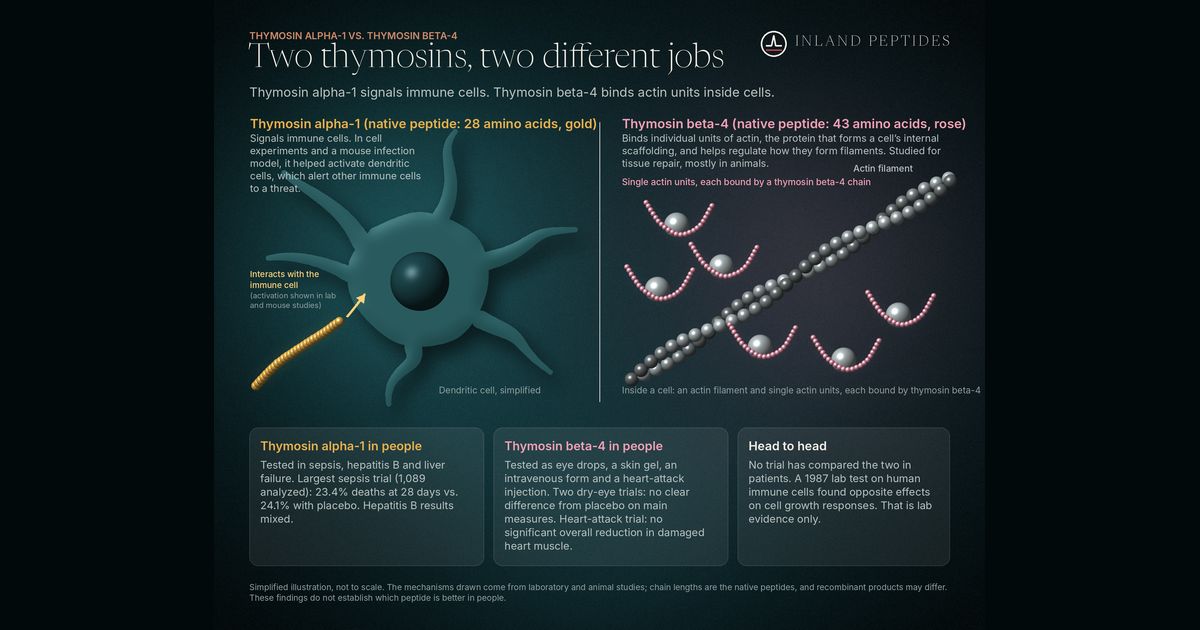
In cell experiments and a mouse infection model, thymosin alpha-1 helped activate dendritic cells, which alert other immune cells to a threat, and strengthened the response to a fungal infection.
Thymosin beta-4 and cell structure
A 1991 study showed that thymosin beta-4 binds individual units of actin, a protein that forms a cell’s internal scaffolding. This binding helps control how actin assembles into filaments that cells use to change shape and move.
Researchers have studied thymosin beta-4 for wound healing, eye injuries and heart damage because it affects cell movement. Most of this work has been in animals.
Have they been compared in patients?
No treatment trial comparing the two peptides in patients was identified in this review.
A 1987 experiment compared the two peptides in human immune cells grown in the laboratory. Thymosin alpha-1 increased the cells’ growth response, while thymosin beta-4 reduced it.
This cell experiment cannot tell us which peptide works better in patients or whether they have opposite effects on the human immune system.
Human research on thymosin alpha-1
Sepsis
Sepsis is a life-threatening reaction to infection that can weaken immune defenses. Researchers have tested whether thymosin alpha-1 helps patients survive it.
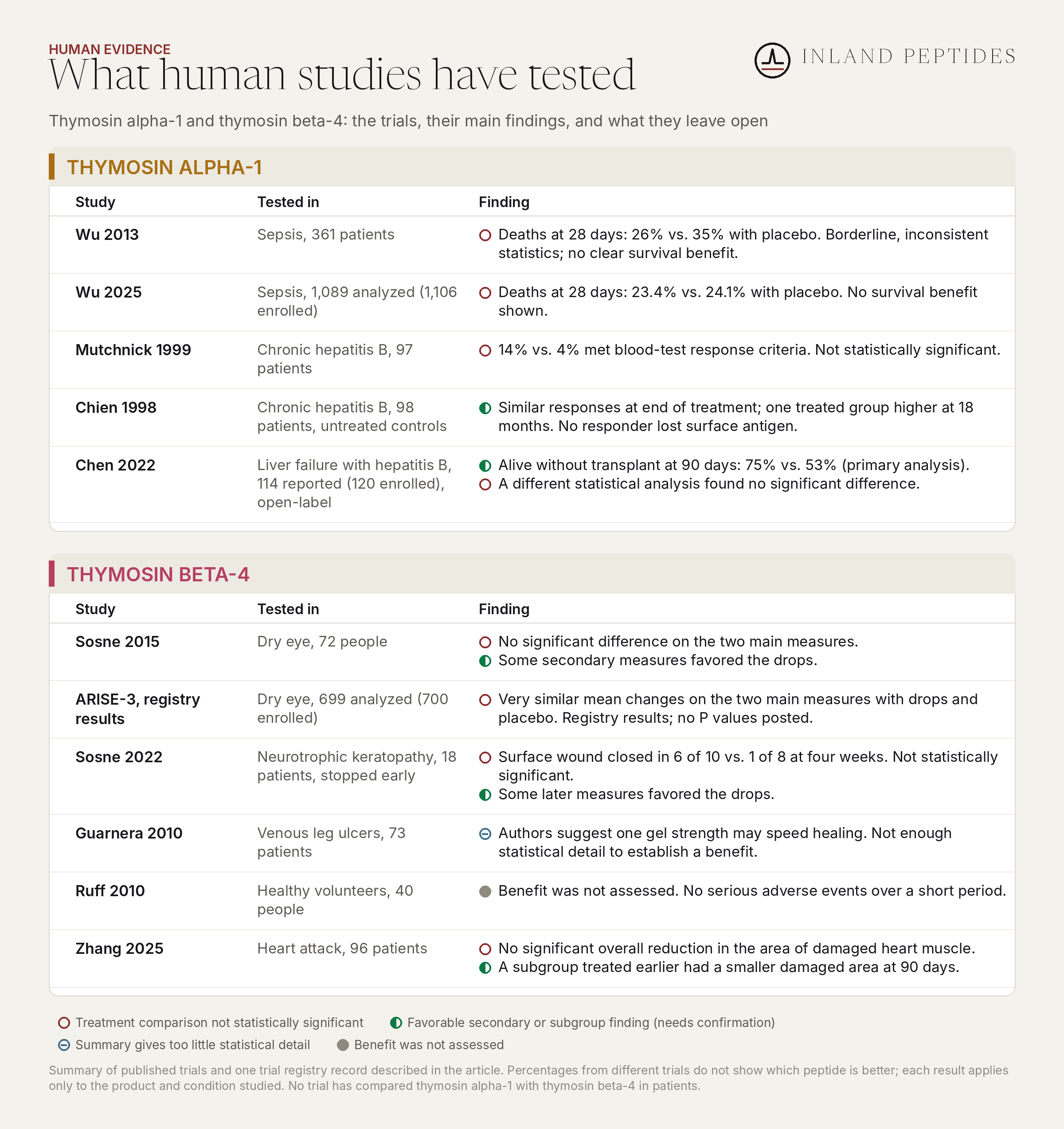
In a 361-patient sepsis trial at six Chinese hospitals, 26% of patients receiving thymosin alpha-1 died within 28 days, compared with 35% receiving placebo. Statistical tests gave borderline results that differed by method, leaving the survival benefit uncertain. Patients did not know which treatment they received, but their doctors did. Both groups received standard care.
A larger sepsis trial enrolled 1,106 adults at 22 hospitals in China and included 1,089 in its main analysis. Neither patients nor treating clinicians knew who received thymosin alpha-1 or placebo. Deaths within 28 days were 23.4% with the peptide and 24.1% with placebo. The trial found no survival benefit.
SciClone Pharmaceuticals, which sells thymalfasin, helped fund the trial. Several authors had received grants from the company. The authors reported that the funders had no role in designing the trial, collecting or interpreting its data, or preparing the paper.
Hepatitis B
Thymosin alpha-1 has been studied for chronic hepatitis B for decades, with mixed results.
In a 97-patient hepatitis B trial in the United States, 14% of patients receiving thymosin alpha-1 met the study’s blood-test criteria, compared with 4% receiving placebo. The difference was not statistically significant. To meet the criteria, patients had to have no detectable viral DNA in their blood and lose a viral marker called hepatitis B e antigen. These changes do not establish a cure.
A 98-patient study randomly assigned patients to two courses of thymosin alpha-1 or no treatment. Response rates were similar when treatment ended. At 18 months, one treated group had a higher blood-test response rate than the untreated group. None of the responders lost hepatitis B surface antigen, a viral protein that remained detectable in their blood.
Liver failure linked to hepatitis B
A trial of 120 patients with sudden liver failure on top of chronic hepatitis B compared standard care with or without thymosin alpha-1 for 12 weeks. The published results cover 114 patients: 56 treated and 58 controls.
At 90 days, 75% of the thymosin alpha-1 group were alive without a liver transplant, compared with 53% of the control group. New infections were also less common.
Patients and doctors knew who received the drug. Another statistical analysis found no significant survival difference, making the apparent benefit less certain.
Human research on thymosin beta-4
Eye drops for dry eye
RGN-259 is an eye drop containing thymosin beta-4.
A 72-person dry-eye trial found no statistically significant difference between RGN-259 and placebo on its two main measures: eye discomfort and corneal staining, a dye-based check for damage to the eye’s surface. The drops performed better on several additional measures, which carry less weight than the main results.
Results posted for a 700-person dry-eye trial showed very similar average changes in corneal staining and eye discomfort with RGN-259 and placebo. The registry gives no statistical test results for these comparisons. The drops’ developer sponsored the trial.
The registry lists no serious adverse events. An adverse event is a health problem reported during a study, whether or not treatment caused it. Reported nonserious problems included pain and irritation at the application site.
Eye drops for corneal wounds
Neurotrophic keratopathy is a rare condition in which the cornea, the clear front of the eye, loses nerve supply and does not heal properly.
In an 18-patient corneal-healing trial, the surface wound closed after four weeks in 6 of 10 patients using RGN-259 and 1 of 8 using placebo. This was the trial’s main measure, and the difference was not statistically significant. Some additional measures, including later healing results and comfort scores, favored the drops.
The trial stopped early because recruitment was slow. ReGenTree, the developer, funded the study and took part in its design, and three authors worked for ReGenTree or its parent company.
Gel for leg ulcers
Venous leg ulcers are slow-healing sores on the lower leg linked to poor blood flow through the veins.
A 73-patient leg-ulcer trial compared several strengths of thymosin beta-4 gel with placebo. The authors described its safety as acceptable and suggested that one strength might speed healing. The published summary gives too little statistical detail to tell whether the gel improved healing.
Intravenous safety study
A 40-person safety study tested synthetic thymosin beta-4 or placebo given by vein to healthy volunteers. Researchers checked safety and blood levels over a short period. Side effects were infrequent and mild or moderate, with no serious adverse events. The study did not test whether the peptide improved health.
Research after heart attack
A 96-patient heart-attack trial tested recombinant human thymosin beta-4 after a procedure to reopen a blocked coronary artery. Patients were randomly assigned to the peptide or placebo, and neither they nor the treating clinicians knew who received which treatment.
The trial found no statistically significant reduction in damaged heart muscle across the full group. Patients treated earlier after the artery-opening procedure had a smaller damaged area at 90 days, but this subgroup finding needs confirmation.
A smaller damaged area does not establish that patients live longer or recover better. Three authors were affiliated with Beijing Northland Biotech.
Safety findings
In the larger sepsis trial, adverse events were common in both groups: 66% with thymosin alpha-1 and 68% with placebo, with no statistically significant difference in rates. Serious adverse events occurred in 27% and 29%. The smaller sepsis trial recorded no serious adverse event judged related to the drug.
The 40-person intravenous beta-4 study reported no serious adverse events. The 18-patient corneal trial reported one adverse event judged related to treatment. Most beta-4 studies were small or short, leaving long-term safety uncertain.
FDA’s list of compounding ingredients that may pose safety risks includes thymosin alpha-1 and the beta-4 fragment sold as TB-500. Both were proposed for use in compounding, but those proposals were later withdrawn. FDA raised concerns about immune reactions to injected peptides and limited safety information. Its TB-500 findings concern the fragment, not full-length thymosin beta-4.
Regulatory status
Neither thymosin alpha-1 nor thymosin beta-4 is an FDA-approved medicine.
RGN-259 eye drops and the recombinant product studied after heart attacks remain investigational.