Between July 1, 2025, and September 30, 2026, New South Wales emergency departments recorded 1,180 presentations associated with peptide use. Monthly presentations rose from five in July 2025 to more than 217 in September 2026. NSW Health released the figures on October 19. The figures have raised concern about peptide hospitalizations, but they count emergency visits, not hospital admissions.
These were emergency visits whose records mentioned unapproved peptide use. The figures do not establish that a peptide caused each visit.
Nor does the increase establish what products patients received. In a separate case, Australia’s Therapeutic Goods Administration tested a vial sold as retatrutide, an investigational weight-loss drug. The product contained no retatrutide. It held undeclared semaglutide, the active ingredient in Ozempic and Wegovy, at about eight times the concentration found in registered semaglutide products.
The person who used the vial experienced severe vomiting, tore their esophagus and was hospitalized. The TGA described the injury as potentially fatal. Testing confirmed a mislabeled vial, but investigators did not establish the precise mechanism of injury. An eightfold difference in concentration does not necessarily mean the person administered eight times a standard dose.
Who has been harmed, and what happened to them?
Reported incidents range from liver injuries requiring hospitalization to emergency intubations and months of symptoms that patients attribute to experimental peptides. In many cases, the cause remains uncertain.
The largest identified cluster is in Victoria, where seven people were hospitalized with acute liver toxicity after using products sold as retatrutide. Clinicians reported that the injuries appeared within weeks of use and that patients became jaundiced and seriously unwell. One woman bought a vial labeled retatrutide in cash from a beautician and developed acute liver failure within a week of her second dose.
However, liver transplant specialist Marie Sinclair said the cause of the Victorian cases remained uncertain. Contamination was one possibility, but available tests did not establish it. Two laboratories examined vials recovered from patients without reaching a complete explanation.
The TGA’s chief medical adviser, Robyn Langham, suggested a possible batch problem but said her assessment was not based on an investigation. Canberra Health Services has also reported liver damage among patients who used products sold as retatrutide, without giving a count.
Peptide hospitalizations and deaths reported in the U.S.
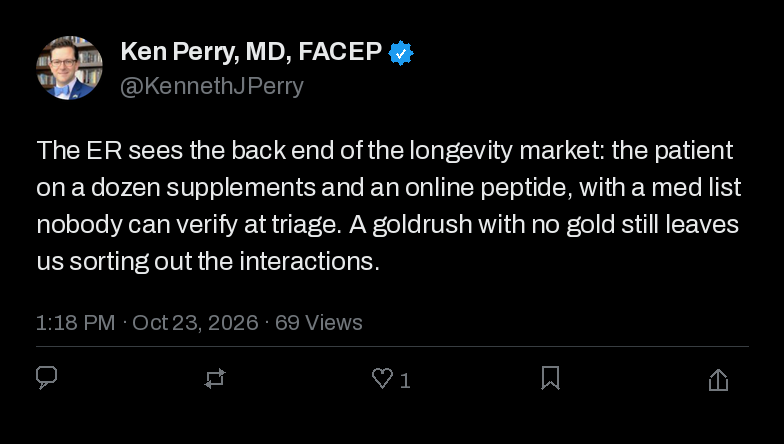
FDA received two fatal adverse-event reports involving products sold as retatrutide. One concerned a 41-year-old woman who reportedly suffered cardiac arrest; the other described a 49-year-old patient who reportedly experienced severe dehydration, malnutrition and cardiac arrest. CBS News obtained the redacted reports through a public-records request but could not independently verify the circumstances. Neither report establishes that the product caused the death.
KFF Health News interviewed Americans who believe unapproved peptides made them ill. One man who bought BPC-157 online described months of fatigue, anxiety and eye and muscle twitching. A 46-year-old software engineer who took BPC-157 with TB-4 reported a severe migraine and facial numbness lasting about two months. A Michigan school employee stopped taking BPC-157 and retatrutide after developing pain. These accounts document patients’ experiences, not confirmed diagnoses of peptide-induced illness.
At a Las Vegas anti-aging conference, two women were hospitalized and intubated after receiving injections of experimental peptides and vitamins at a booth. Nevada’s pharmacy board subsequently cited the physician operating the booth and colleagues for prescribing or administering drugs without a state medical license.
What do official safety records actually show?
The records show more emergency visits that mentioned peptide use, alongside warnings about serious symptoms and reports of suspected adverse events. They do not prove that the product involved caused each illness.
Four days before publishing its figures, NSW Health told clinicians to consider peptide exposure in patients with prolonged vomiting, unexplained hepatitis, acute pancreatitis, anaphylaxis, injection-site infections or sepsis. The bulletin also advised questions about peptide use before anesthesia because some products can delay gastric emptying and raise aspiration risk. It noted public reports of use in children as young as 12.
KFF Health News identified FDA reports concerning a woman hospitalized after taking BPC-157 and a man hospitalized with a life-threatening condition after taking an unnamed peptide. These are voluntary reports of suspected adverse events, not verified findings of cause.
What can go wrong with experimental peptides?
Many investigational peptides sold online have limited human safety data. Moreover, the evidence differs substantially from one compound to another.
Peptides include substances made naturally in the body, approved medicines such as insulin and GLP-1 drugs, and experimental compounds. Retatrutide has undergone late-stage human trials; BPC-157 has not been studied on a comparable scale. Their shared classification does not give them a shared safety profile.
Pieter Cohen, an associate professor at Harvard Medical School and an internist at Cambridge Health Alliance, told CNBC that a compound being a peptide “doesn’t mean it’s close to Ozempic in any way, shape or form” in either structure or effect.
How to weigh the safety evidence
Each type of evidence shows something different:
- Adverse effects recorded in clinical trials. Trials of compounds such as retatrutide can identify reactions under controlled conditions, but the results cannot establish the safety of unverified products sold online.
- Symptoms reported by patients. Patients can describe what happened after taking a product, but their accounts alone cannot establish the cause.
- Findings from animal studies. A 2020 study of BPC-157 in mice, rats, rabbits and dogs reported no serious toxicity. Researchers observed a reversible change in creatinine in dogs at the highest tested level and mild local irritation. Those findings do not establish safety in humans.
- Potential interactions. For compounds with little human research, interactions with medicines or other peptides are often poorly characterized. Lack of data does not establish that a particular interaction is harmful.
- Product and administration problems. Wrong ingredients, incorrect concentrations and contamination are not the same as adverse effects of a correctly manufactured compound.
FDA scientists recommended against adding seven peptides to a list of substances eligible for certain pharmacy compounding uses. For BPC-157, they concluded that available studies were too small and too short to establish safety or effectiveness for the uses under review.
What is actually inside gray-market peptide products?
Laboratory testing has found several different failures: inaccurate ingredient amounts, products containing an undeclared drug, samples in which the labeled ingredient could not be detected, and bacterial growth in one tested vial.
Wrong amount, right compound
An August peer-reviewed study examined three products labeled as 10-milligram vials of retatrutide and submitted to a community drug-checking service. All three contained material whose measured molecular weight matched that of retatrutide. That finding supports identification but does not, by itself, establish the full molecular structure. The measured amounts were 5.13 milligrams (51.3% of the label claim), 16.5 milligrams (165%) and 19 milligrams (190%).
The researchers also screened for metals. Several were below detection limits; trace lead, copper and zinc were below the exposure thresholds used in the analysis. The study did not test sterility or endotoxins. With only three samples, the researchers could not estimate how common labeling errors are across the market.
Leeder Analytical separately told Australia’s ABC that it had tested 18 products sold as retatrutide in 2026 and found only one matching its label. About 30 percent contained more than declared, about 30 percent less, and one contained no retatrutide. Because the same laboratory handled the published study, the two sets of findings are not independent confirmations.
Wrong compound, or no compound
WIRED bought four INDR Labs products from Mr. Green, a Brooklyn bodega. Their labels named BPC-157, retatrutide, PT-141 and NAD+. Testing arranged through Finnrick failed to detect the advertised active ingredient in any of the four. The laboratory could not identify exactly what the products contained. Mislabeling and degradation were possible explanations, not established causes. WIRED also reported low levels of heavy metals and endotoxins. The results arrived in August, and the article appeared September 15. NAD+ is not a peptide.
For an October investigation, CBS News bought three products labeled as retatrutide. CBS ordered two of them online, one from a clinic and one from a gym. University of Iowa researchers found both consistent with their retatrutide reference standard. The third, purchased at a Brooklyn bodega for $90, did not appear to contain a peptide. Researchers instead identified phenylacetic acid and recovered 13 bacterial colonies from the sample.
WIRED and CBS used different laboratories, but both examined products associated with Mr. Green and INDR Labs. Their results do not show how widespread similar problems are among other sellers. The two CBS online samples matched the reference standard, though those tests alone did not establish sterility, stability or consistency across vials.
Why a certificate of analysis does not settle it
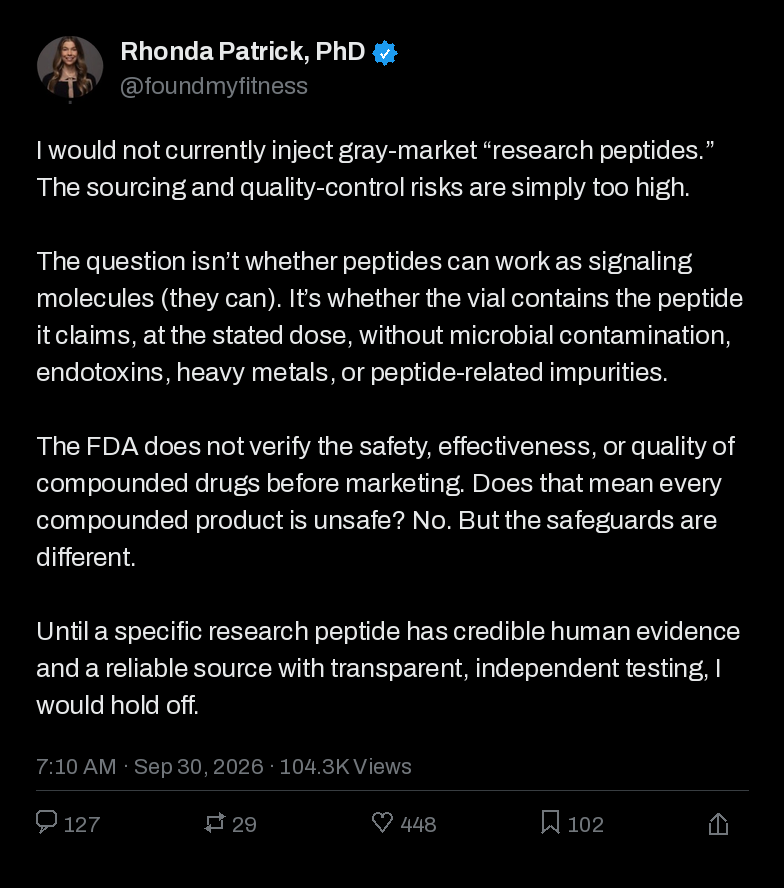
Chemical identity, amount, purity, sterility and bacterial endotoxins are different measurements. A certificate showing a result for one does not establish results for the others. For example, the Australian study measured molecular weight and peptide content without testing sterility or endotoxins.
A laboratory result also describes the sample tested, not necessarily every vial in the batch. NSW chief health officer Kerry Chant warned that labels, purity claims, professional-looking websites and influencer endorsements do not prove what a product contains.
Is this only a gray-market problem?
No. Licensed compounding pharmacies have also recalled injectable products linked to serious illnesses.
The CDC is investigating illnesses associated with injectable glutathione compounded from dietary-supplement-grade ingredients. In its September update, it reported more than 25 illnesses in at least four states, including at least three hospitalizations. One person was critically ill with shock and abnormal blood clotting. Investigators suspected elevated endotoxin levels. At least three Texas pharmacies recalled products.
So far, that investigation remains open. Glutathione is a naturally occurring tripeptide, but the concern here is manufacturing quality, not the pharmacological effects of the experimental compounds discussed elsewhere in this story. In other words, pharmacy licensing does not guarantee that every injectable product meets quality standards.
What are doctors and regulators saying?
Physicians have emphasized the lack of reliable human evidence for many experimental peptides. FDA staff and an independent advisory committee also reached different recommendations about their use in pharmacy compounding.
Johns Hopkins epidemiologist Caleb Alexander told CNBC that robust human studies are missing, leaving uncertainty about both risks and benefits. Harvard physician Pieter Cohen advised against using novel injectable peptides that have not been adequately studied. Alison Dempsey, a dermatologist at Weill Cornell Medicine and NewYork-Presbyterian Hospital, said public enthusiasm had outpaced the research.
In July 2026, the FDA’s Pharmacy Compounding Advisory Committee recommended adding six of seven peptides to a list of bulk substances for certain compounding uses. FDA staff had recommended against all seven. BPC-157, KPV and TB-500 each received eight votes in favor, six against and one abstention; MOTS-c received seven in favor, five against and two abstentions. The panel voted down Emideltide. The panel’s advice was not FDA approval or authorization to compound the substances. As of late October, the agency had not issued a final decision.
In five warning letters issued August 24, the FDA said online sellers were marketing peptide products for human use despite research-only disclaimers. The agency evaluated the websites’ overall presentation and promotion, not just the wording of their labels. A research-use disclaimer alone does not determine a product’s regulatory status.
What is still unknown?
For many reported cases, doctors still cannot establish exactly what a patient took, why the symptoms occurred or how often similar problems arise.
- Product identity. A vial’s label may not identify the substance a patient actually received. In the Victorian liver cases, two laboratories analyzed recovered vials, but the treating specialist said the results did not fully explain the injuries.
- Cause. The TGA confirmed that one vial contained an undeclared drug, but the precise cause of that patient’s injury remained uncertain. In other cases, investigators may not be able to distinguish a compound’s effects from those of an unexpected ingredient or an incorrect amount.
- Scale. The NSW data count emergency presentations mentioning peptide use, not injuries shown to result from peptides. Voluntary U.S. adverse-event reports also cannot establish causation or a reliable overall rate of harm.
- Long-term effects. Problems that emerge after repeated exposure may be difficult to identify without extended follow-up. For many investigational peptides, the available evidence does not show how frequently such problems occur.
Human clinical trials can provide better evidence about a compound’s benefits, adverse effects and longer-term risks. However, they cannot establish the contents, sterility or labeling accuracy of products bought from an unverified seller.
Testing in Australia and New York found incorrect amounts, unexpected ingredients and products in which the labeled substance could not be detected. The samples came from a limited number of sources and do not establish how common those failures are. For patients who became seriously ill, another question remains: whether the harm came from the compound itself, the amount administered or something else in the vial.