Peptide use is on the rise in the United States. In a May survey of 507 U.S. doctors, nearly half said a patient had told them about using a peptide the FDA hasn’t approved.
The survey came from Sermo, a company that polls physicians. It ran May 8 to 13 and covered heart doctors, dermatologists, hormone specialists, internists, neurologists and orthopedic surgeons. Forty-eight percent said a patient had brought it up in the past year.
And that only counts the patients who spoke up. Sermo’s own report says the number “may not even include the patients who are already self-administering compounds without telling their physician.”
Medical records suggest peptide use is on the rise
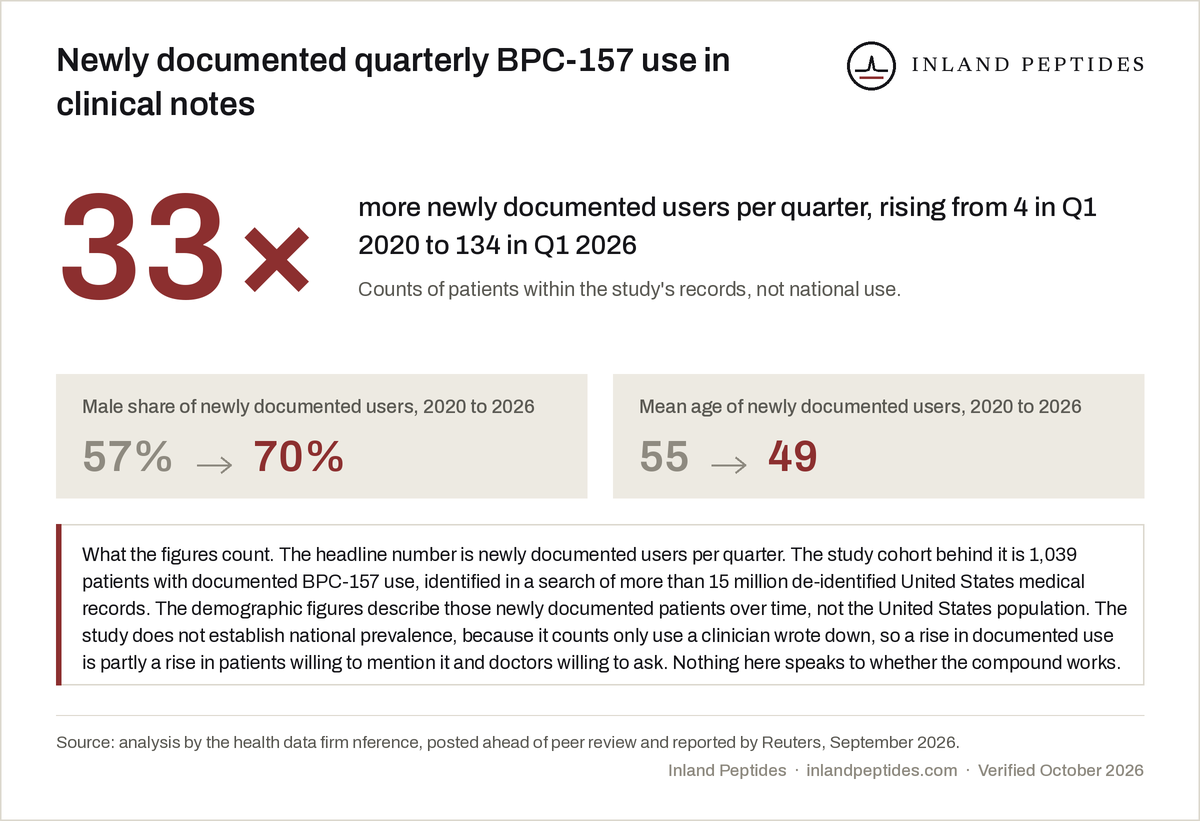
In September, Reuters reported on a health data company called nference that searched more than 15 million medical records for BPC-157. BPC-157 isn’t a prescription drug, so it never shows up in pharmacy data. The only place to find it is in doctors’ notes.
The company found 1,039 patients whose notes mentioned using it between 2020 and 2026. New cases went from 4 in early 2020 to 134 in early 2026, about 33 times as many, according to the company’s early paper.
The company used AI to sort real use from passing mentions in the notes. In a spot check, doctors agreed with it about 87 percent of the time.
The paper hasn’t been peer reviewed yet, and it only counts what patients told their doctors. “Most likely, very few doctors are even asking their patients, ‘Are you taking BPC-157?’” study leader Venky Soundararajan told Reuters.
Nearly all the patients in the study (96 percent of those with race on file) were white. So it doesn’t tell us how common BPC-157 is across the whole country.
Why Americans are turning to experimental peptides
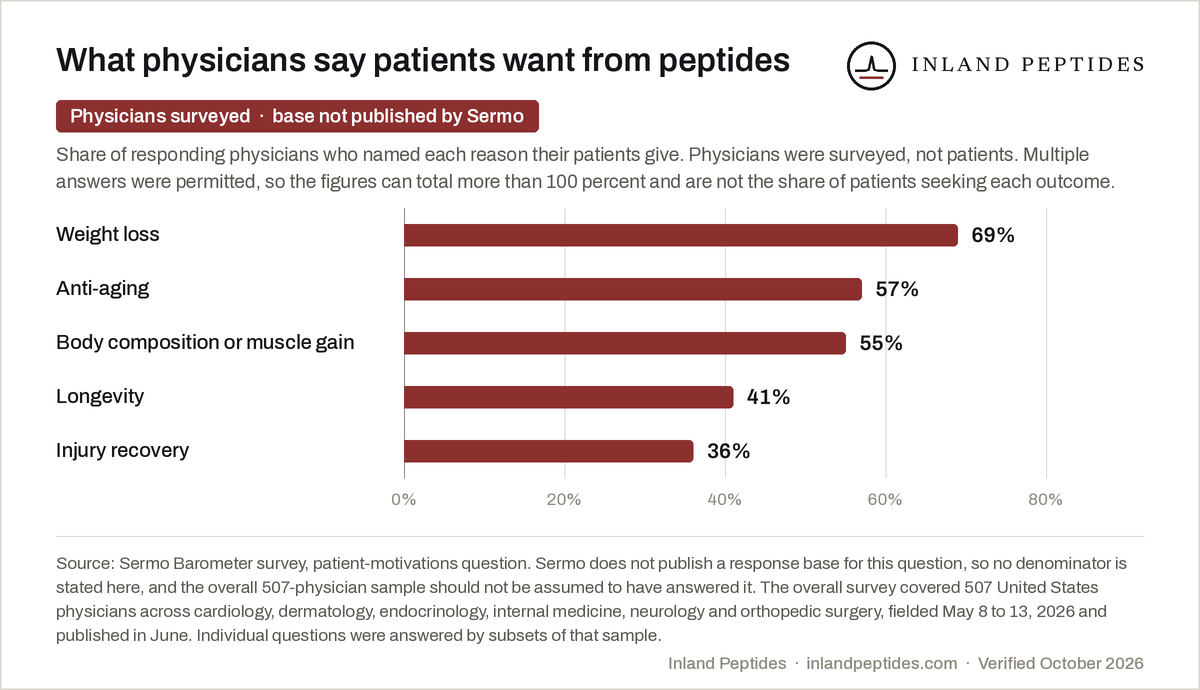
The Sermo survey also asked doctors what patients say they want from peptides:
- Weight loss: 69 percent
- Anti-aging: 57 percent
- Body composition: 55 percent
- Longevity: 41 percent
- Injury recovery: 36 percent
Doctors could pick more than one.
The three peptides people ask about most are BPC-157, TB-500 and GHK-Cu. The research behind each one is very different.
BPC-157 is sold for tendon, muscle and gut healing. Most of the research is in animals. Only three small human studies have been published.
TB-500 shows up in a lot of recovery blends. It isn’t the full thymosin beta-4 protein. The FDA describes it as a short, seven-amino-acid piece of it. The full protein has been tested in people, but FDA reviewers found no published human study of TB-500 itself.
GHK-Cu has a long history in skin creams. That doesn’t tell us whether injecting it is safe or does anything. None of the three is FDA-approved for use in people.
Doctors are feeling the pressure. About a third say patients’ unrealistic expectations are their biggest problem, and 21 percent say they get pushed to recommend unapproved treatments. Ninety percent are worried about patients using peptides on their own.
Peptide medicine has a long history
Peptide drugs aren’t new. On January 11, 1922, a 14-year-old named Leonard Thompson got the first insulin shot ever given to a person, at Toronto General Hospital.
It didn’t work. The dose was too weak, and impurities in the extract gave him an allergic reaction. A biochemist named James Collip spent the next twelve days cleaning it up. The second shot, on January 23, brought Thompson’s blood sugar down.
Insulin is a peptide. So are today’s GLP-1 drugs for diabetes and weight loss. But that track record doesn’t carry over to every peptide sold online. Most haven’t been through the same kind of human trials.
How the market moved from gym forums to podcasts and clinics
BPC-157 got its start where a lot of gray-market products do: bodybuilding forums, around 2010. That’s according to an investigation by Undark editor Sara Talpos, published with STAT News. Most of the supply came from Chinese labs selling through “research chemical” websites. By 2018, peptides had their own Reddit community.
From there, it spread to podcasts, longevity clinics and compounding pharmacies.
Today, 84 percent of the doctors Sermo surveyed say patients learn about peptides from social media, podcasts, influencers or online forums. About half say it happens often.
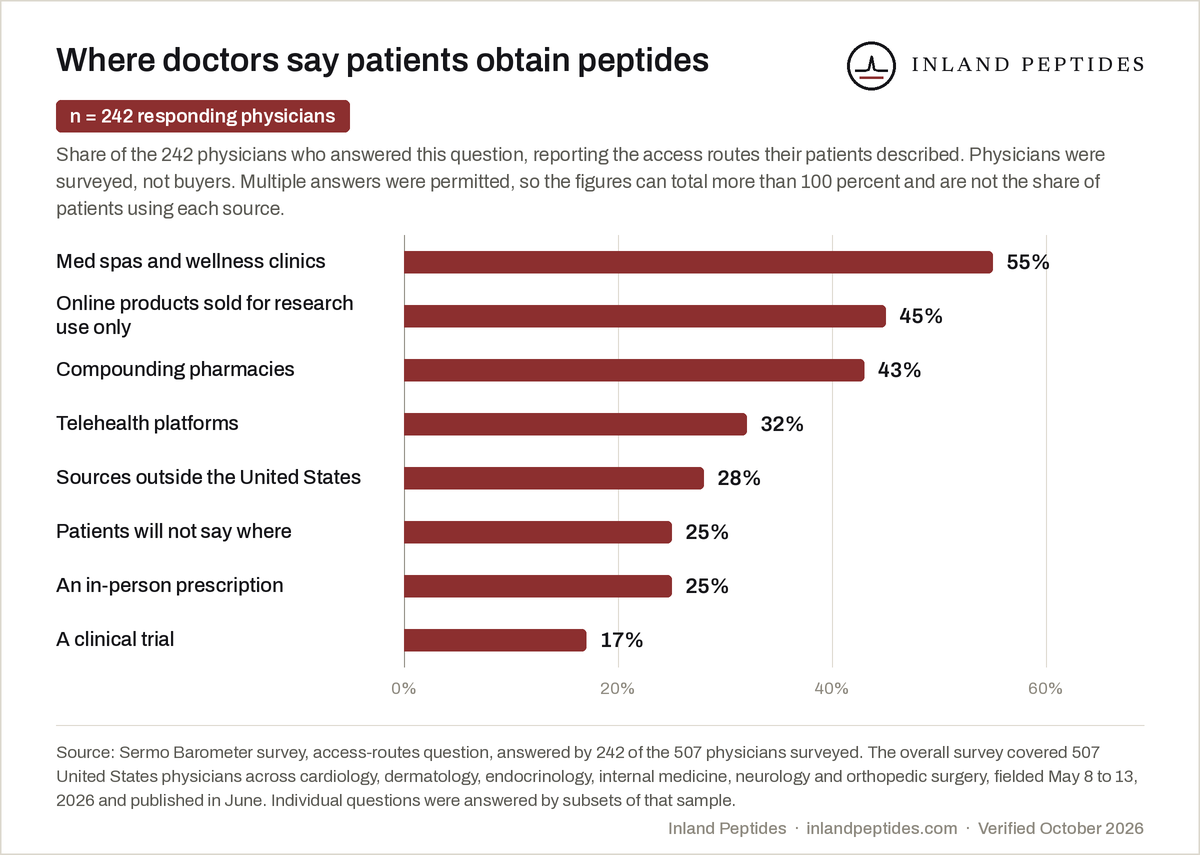
Sermo also asked the 242 doctors whose patients use peptides where those patients get them:
- Med spas and wellness clinics: 55 percent
- Research chemical websites: 45 percent
- Compounding pharmacies: 43 percent
- Telehealth: 32 percent
- Outside the United States: 28 percent
A quarter said their patients wouldn’t tell them.
“Patient peptide use feels like the wild west right now,” said Ashish Rana, an internal medicine physician on Sermo’s medical advisory board, in the company’s announcement of the findings.
The gray market behind the boom
Some online sellers label their vials “research use only” or “not for human or veterinary use.”
The FDA doesn’t just read the label. It looks at how a product is marketed and sold to decide what it’s really for. A lab supplier selling to researchers is different from a seller marketing injections to the public.
On August 24, the FDA sent warning letters to five online peptide sellers, including Peptide Partners and Royal Peptides. The letters cover semaglutide, tirzepatide, retatrutide, tesamorelin, bremelanotide and elamipretide.
Some of those are approved drugs in other forms. The FDA’s point was that these sellers were marketing their versions as unapproved drugs, which federal law doesn’t allow.
How the FDA treated the research-use-only label
The FDA said the label didn’t save them. “Despite statements on your product labeling marketing your products ‘for research use only’ and ‘not for human or veterinary use,’ evidence obtained from your website establishes that your products are intended to be drugs for human use,” the Peptide Partners letter states.
What gave them away was their own websites, which described what the compounds do in people. The FDA also pointed to the bacteriostatic water they sold alongside, which it said provides “the means to prepare an injectable drug for human administration.”
The letters apply to those sellers and what they said and sold. They aren’t a ruling against every research peptide sale.
Prosecutors and state boards step in
Doctors have been charged too. On April 1, a federal grand jury indicted Utah physician Justin Bradley Watkins. Prosecutors say he got unapproved peptides from China through a middleman and gave them to more than 200 patients. The list includes tirzepatide, semaglutide, retatrutide, BPC-157, TB-500, ipamorelin and GHK-Cu.
The charges are allegations, and he is presumed innocent.
In a July 24 investigation, Lauren Weber of The Washington Post contacted the pharmacy, medical and nursing boards in every state and D.C. Of the 41 pharmacy boards that answered, eight had publicly disciplined a practitioner or pharmacy over peptides.
The Post also found that states have limited power to inspect the clinics selling injections, and that some manufacturing and shipping practices were questionable.
That leads to the biggest question for any buyer: is what’s in the vial what the label says? “You don’t even know what you’re buying inside that bottle,” Matthew Fedoruk, chief science officer at the U.S. Anti-Doping Agency, told Undark.
That’s what independent lab testing is for. A certificate of analysis shows what a lab actually found in a specific batch: whether it’s the right compound, how pure it is, and whether it’s contaminated. It covers only the batch that was tested, and it doesn’t tell you whether a compound works. But it’s the only way to know you’re getting what you paid for.
Our guide to verifying peptide quality and reading a certificate of analysis shows what to look for.
What the science actually shows
BPC-157 has been studied for more than 30 years, with roughly 200 papers on PubMed. A team led by Predrag Sikiric at the University of Zagreb first described it in 1989. Most of the published studies include Sikiric or a close colleague as an author.
Almost all of that work is in animals and lab dishes. A review published in October in Acta Orthopaedica Belgica found just three human studies, 30 people in total, and none had a comparison group. It rated that evidence as very weak.
Some trials never released results. The drug company PLIVA never published its studies from the 2000s, and a later trial in Tijuana pulled its data from clinicaltrials.gov. Undark reported that Croatian records list Sikiric as part owner of the company behind the Tijuana trial, which his papers didn’t disclose.
Why the new data cannot show BPC-157 works
The nference records are a much bigger set of data, but they can’t show that BPC-157 works. Flynn McGuire, chief medical resident at University of Utah Health, pointed out to Reuters that there was “no placebo or untreated comparator.”
Without a comparison group, nobody can tell whether patients got better on their own, from other treatments, or because doctors only wrote down the good results. Only about a third of the records noted how patients responded. About half of the patients were also getting physical therapy, surgery or other drugs.
“We’ve cured cancer in mice plenty of times,” McGuire told Undark.
Anna Mapp, a University of Michigan chemist and president of the American Peptide Society, reviewed the original documents for Undark’s second investigation. BPC-157 is said to come from a protein in the body, but nobody has published that protein’s gene or full sequence. “That is troubling,” she said.
Scientists also haven’t found a specific receptor that BPC-157 acts on, so it’s unclear how it would work. That doesn’t mean it does nothing. Sikiric argues it works indirectly, through blood vessel repair and nitric oxide.
FDA staff reviewed the available studies, including five involving BPC-157, and concluded they didn’t prove it safe or effective for the uses proposed. That was a judgment on the evidence so far, not a call to stop research.
The FDA under pressure
Peptides fall into a few legal buckets: FDA-approved drugs, drugs made by compounding pharmacies, unapproved products sold for human use, and materials sold for lab research.
In September 2023, the FDA put more than a dozen peptides, including BPC-157, on a list of substances it considered too risky for pharmacies to compound. In July 2026, a newly rebuilt FDA advisory panel reviewed seven of them and voted to let pharmacies compound six, including BPC-157 and TB-500. That went against the advice of the FDA’s own staff scientists. The panel’s votes aren’t binding, and the FDA hasn’t acted on them yet.
On October 14, HHS and the FDA sent a proposal called “Interim Access Policy for Compounding Using Certain Peptides” to the White House, where it is still under review. It hasn’t been made public. White House officials have held meetings on it with groups and lobbyists on both sides.
Health Secretary Robert F. Kennedy Jr. explained the goal in a TV interview on October 20. “Americans are going to be buying these anyway,” he said, according to Reuters. He added that “our objective was to make sure that there is a regulated marketplace,” where buyers get what the label says, made in inspected facilities.
For more detail, see our report on the FDA peptide compounding proposal.
What happens next
The proposals on the table could bring some peptides through pharmacies and prescribers, add oversight of how they’re made, and crack down on sellers who market them illegally. Proving whether they actually work will still take clinical trials.
The interim policy hasn’t been published, so its details are still unknown.
Here’s where things stand. In one large set of medical records, documented BPC-157 use grew about 33-fold in six years. Nearly half the doctors Sermo surveyed have had a patient bring peptides up. And for BPC-157, TB-500 and injectable GHK-Cu, controlled human trials still haven’t proven the benefits sellers claim.
Until that research catches up, quality is the one thing a researcher can control. Every lot we sell is tested by an accredited laboratory in the United States, and each vial carries a lot number that matches its certificate of analysis.