Tesamorelin is an approved medicine studied for deep belly fat, while CJC-1295 is an unapproved research compound studied mainly for its effect on hormone levels.
Both are lab-made versions of growth hormone-releasing hormone (GHRH), the brain’s signal telling the pituitary gland to release growth hormone. Neither is growth hormone itself.
They differ in their structure, how long they last in the body and what human studies have measured. No published study has compared them directly.
| Tesamorelin | CJC-1295 (with DAC) | |
|---|---|---|
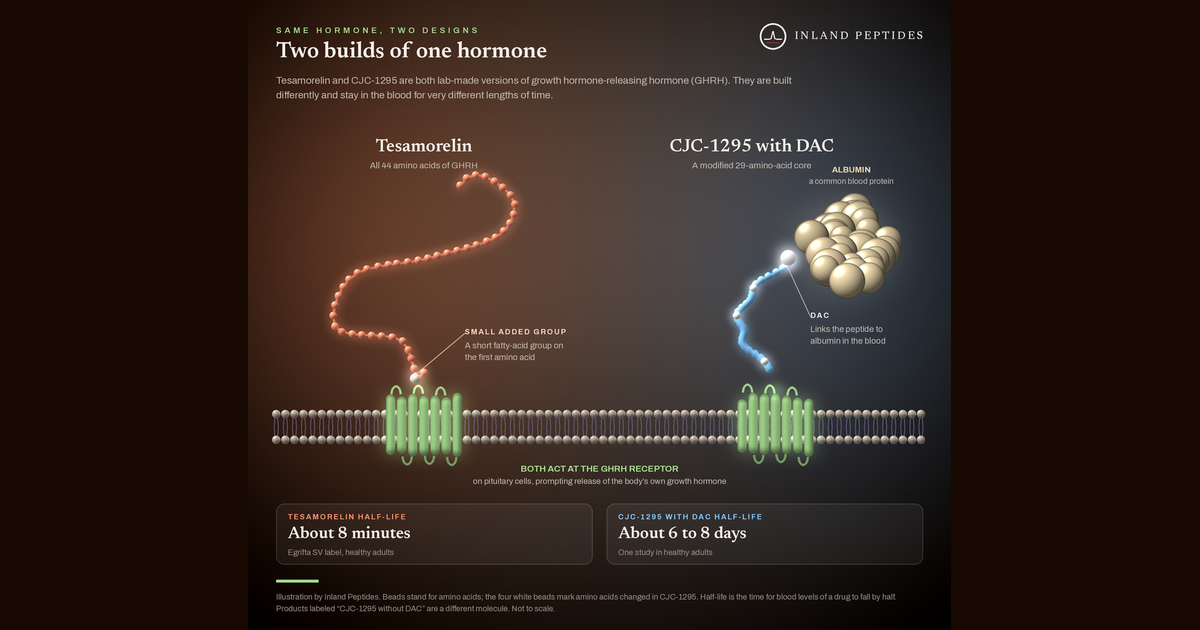
| What it is | The full 44-amino-acid chain of human GHRH with a small chemical group added to one end. | A modified 29-amino-acid piece of GHRH attached to a chemical add-on called DAC, which links it to a blood protein. |
| Receptor or pathway | GHRH receptor on the pituitary. | GHRH receptor on the pituitary. |
| Main human research areas | Visceral fat in adults with HIV; liver fat in HIV; abdominal obesity; blood sugar in type 2 diabetes; thinking skills. | Growth hormone and insulin-like growth factor 1 (IGF-1) levels in healthy adults. |
| Key evidence limitations | Most large trials enrolled adults with HIV. Visceral fat returned after treatment stopped. Long-term heart safety not established. | Small, short human studies, mostly hormone measurements. No published results on body composition or health outcomes. The findings do not automatically establish the same duration or outcomes for products labeled “without DAC.” |
| FDA status | Approved as Egrifta SV and Egrifta WR to reduce excess abdominal fat in adults with HIV and lipodystrophy. | Sold for research use only. Not FDA-approved for human use. |
Both start from the same hormone
Tesamorelin and CJC-1295 were both built from GHRH, but each changes it in a different way.
Natural GHRH is a chain of 44 amino acids, the building blocks of proteins. The first 29 amino acids are enough to trigger growth hormone release, so many lab-made versions use only that piece.
Each prompts the pituitary to release the body’s own growth hormone. The liver and other tissues then make insulin-like growth factor 1 (IGF-1), a hormone often measured as a sign of growth hormone activity.
Tesamorelin keeps the full chain
According to the Egrifta prescribing information, tesamorelin contains all 44 amino acids of human GHRH, with a small fatty-acid group attached to the first amino acid. It acts at GHRH receptors with a strength similar to the body’s own hormone.
CJC-1295 uses a shortened chain and a long-acting add-on
The original CJC-1295 has a 29-amino-acid core based on GHRH, with four amino acids changed. It also carries a chemical add-on called a drug affinity complex, or DAC.
Early laboratory studies in rats showed that the DAC lets the peptide attach to albumin, a common blood protein. That keeps it in circulation far longer than natural GHRH.
Does “CJC-1295” always mean the same thing?
No. The name is used for two different molecules, so findings for one do not automatically apply to the other.
Products labeled “CJC-1295 without DAC” are marketed as the same 29-amino-acid core with no add-on, often under the name modified GRF (1-29). GRF is an older name for GHRH.
An FDA review of CJC-1295 treats the two as different active ingredients. It also flags the inconsistent naming as a safety risk.
The published CJC-1295 studies discussed here tested the DAC form. The version without DAC is still different from tesamorelin, which has a longer chain and a different chemical change.
How long does each one last?
Tesamorelin has a short half-life in the blood, while CJC-1295 with DAC has a much longer one. Half-life is the time it takes for a drug’s blood level to fall by half.
- Tesamorelin: about 8 minutes in healthy adults, according to the Egrifta SV label.
- CJC-1295 with DAC: about 6 to 8 days in a study in healthy adults.
How long hormone levels stay raised is a separate measurement. In the same CJC-1295 study, growth hormone stayed above starting levels for six days or more after one injection, and IGF-1 for 9 to 11 days.
A follow-up study in 12 healthy men found that natural pulses of growth hormone release continued one week after a single injection. However, the study had no placebo group, which receives an inactive look-alike treatment.
These figures describe the DAC form only.
What human studies of tesamorelin found
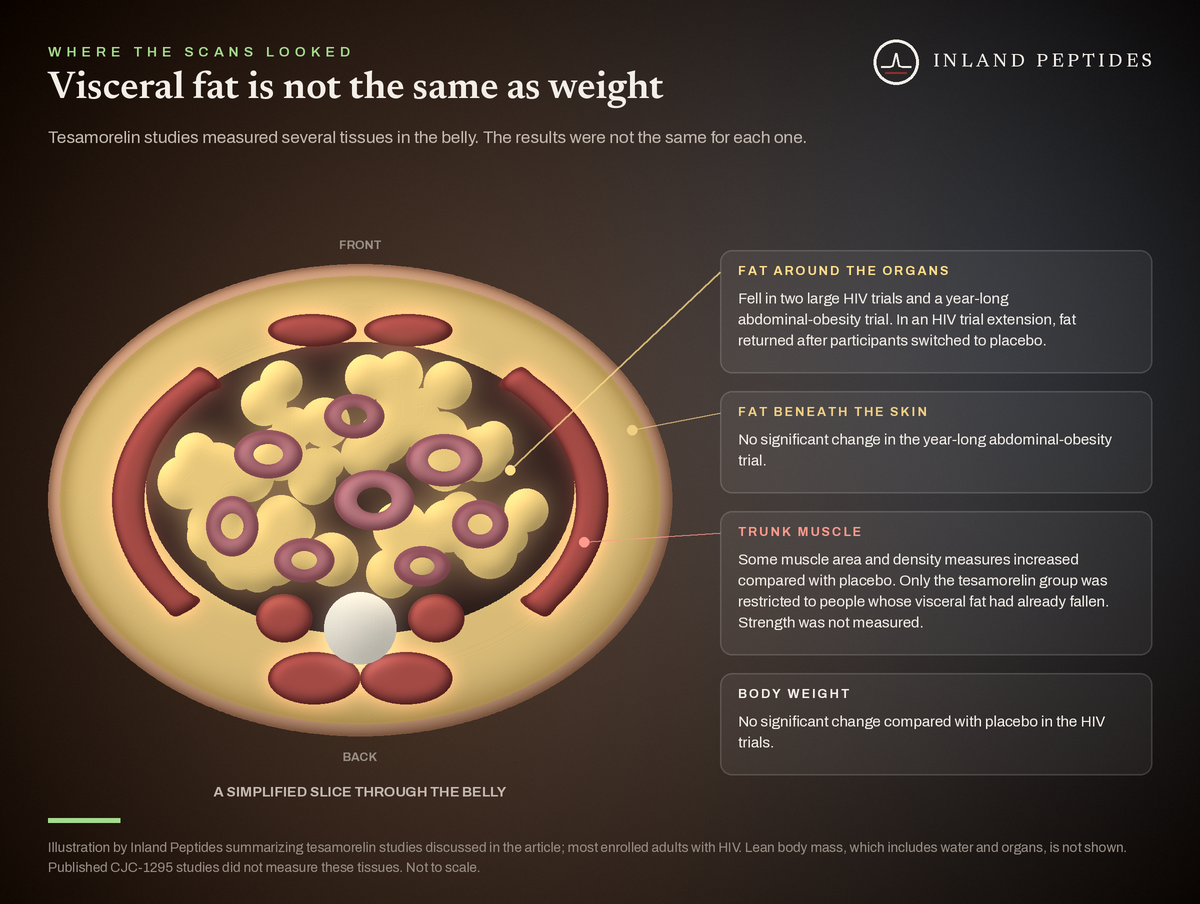
Tesamorelin’s main trials measured visceral fat in adults with HIV. Visceral fat is the fat packed around the internal organs, deep inside the belly.
The approved use is narrow
The prescribing information lists one use: reducing excess abdominal fat in adults with HIV and lipodystrophy. Lipodystrophy is an abnormal shift in where the body stores fat, and it can occur during HIV treatment.
The approval covers the Egrifta medicines for that use, so a research vial labeled tesamorelin is not an approved medicine.
The label also states that tesamorelin is not for weight loss and that its long-term heart safety has not been established.
Visceral fat fell in two large trials
In a 26-week trial of 412 patients with HIV and excess abdominal fat, visceral fat fell 15.2% with tesamorelin and rose 5.0% with placebo. A second trial of similar size also found a drop in visceral fat.
In an extension of the first trial, though, visceral fat returned in patients who switched to placebo.
Fat, muscle and body weight
In both HIV trials, visceral fat fell without a significant change in body weight compared with placebo.
However, fat beneath the skin behaved differently. In a year-long trial of 60 people with abdominal obesity and lower growth hormone levels, visceral fat fell compared with placebo, but fat beneath the skin did not change significantly.
The HIV trials also reported a rise in lean body mass of a little over 1 kilogram. Lean mass includes water and organs as well as muscle, so the increase does not mean all of it was muscle.
A later reanalysis of trial scans looked at trunk muscles. Compared with placebo, some measures of muscle area rose slightly and muscle density rose, a sign of less fat inside the muscle. But the tesamorelin group included only people whose visceral fat had already dropped by at least 8%. The analysis also did not measure strength.
Other human research
- Liver fat in HIV: liver fat fell in a six-month trial and in a year-long trial of patients with fatty liver disease.
- Type 2 diabetes: in a 12-week trial of 53 people, blood sugar control did not differ significantly from placebo.
Two trials of thinking skills reached different results:
- In a 20-week trial of 152 adults aged 55 to 87, with and without mild memory problems, thinking-skill scores improved more than with placebo.
- In a six-month trial of 73 people with HIV, abdominal obesity and thinking problems, improvement did not differ significantly from standard care. That trial was limited by its size and lack of a placebo group.
What human studies of CJC-1295 found
The published human studies of CJC-1295 enrolled small groups of healthy adults, tested the DAC form and measured hormone levels.
In the healthy-adult study described above, volunteers aged 21 to 61 received single or repeated injections of CJC-1295 or a placebo. After one injection, average growth hormone levels rose 2- to 10-fold and IGF-1 rose 1.5- to 3-fold. Larger and repeated doses produced greater hormone increases.
But these studies did not measure fat loss, muscle growth or other health outcomes. Higher hormone readings alone do not establish those effects.
A company trial of CJC-1295 in people with HIV-related belly fat, a group similar to the one tesamorelin is approved for, was stopped early. Its results have not been published.
Why the studies cannot rank them
The two compounds have not been compared directly in a published human study.
Tesamorelin’s main trials enrolled adults with HIV and measured fat on scans. In contrast, the published CJC-1295 studies enrolled healthy volunteers and measured hormones in blood.
Fat reduction in one group and higher hormone levels in another cannot show which compound works better.
Safety findings and evidence gaps
Tesamorelin’s safety data come from much larger studies, mostly in adults with HIV. CJC-1295, by contrast, has been tested in far fewer people.
Tesamorelin
In the HIV trials summarized in the prescribing information, side effects reported more often with tesamorelin than with placebo included injection-site reactions (17% compared with 6%), joint and muscle pain, swelling in the arms and legs, and higher blood sugar.
A higher rate suggests a link, but does not prove the drug caused every event.
The label prohibits use in people with active cancer and warns about recurrence after cancer treatment. These precautions concern stimulation of growth pathways. They do not mean the trials showed that tesamorelin caused tumor growth.
Other label warnings cover raised IGF-1, fluid retention, high blood sugar and allergic reactions. The label also rules out use during pregnancy and in people whose pituitary function has been disrupted.
CJC-1295
In the first of the healthy-adult trials, the FDA’s summary reports adverse events in 33 of 35 people given CJC-1295 and 2 of 7 given placebo. The most common were injection-site reactions, headache, flushing and diarrhea.
The same FDA review describes anecdotal reports that a participant in the stopped HIV trial had a heart attack and died shortly after a dose. According to those reports, the attending physician thought underlying heart disease was the most likely explanation. This account does not establish whether CJC-1295 contributed to the death.
In animal and laboratory studies summarized by the FDA, the DAC form caused injection-site damage in rats and dogs and signs of DNA damage in mouse pituitary cells. These findings do not establish the same effects in people.
What remains unknown
- Whether CJC-1295 changes fat, muscle or any health outcome in people.
- The long-term safety of either compound.
- How products labeled “CJC-1295 without DAC” behave in people.
What the comparison shows
Both act on the GHRH receptor, but their structures and human evidence differ.
Tesamorelin has a 44-amino-acid chain and a short half-life. The Egrifta medicines are approved to reduce excess abdominal fat in adults with HIV and lipodystrophy. Trials in that group found less visceral fat without significant weight loss. But fat returned after patients switched to placebo in a trial extension.
CJC-1295 with DAC has a modified 29-amino-acid core and an add-on that binds to a blood protein. Its half-life is measured in days. Published human studies showed higher hormone levels; a company trial of HIV-related belly fat stopped without published results.
The separate studies do not establish which compound works better.