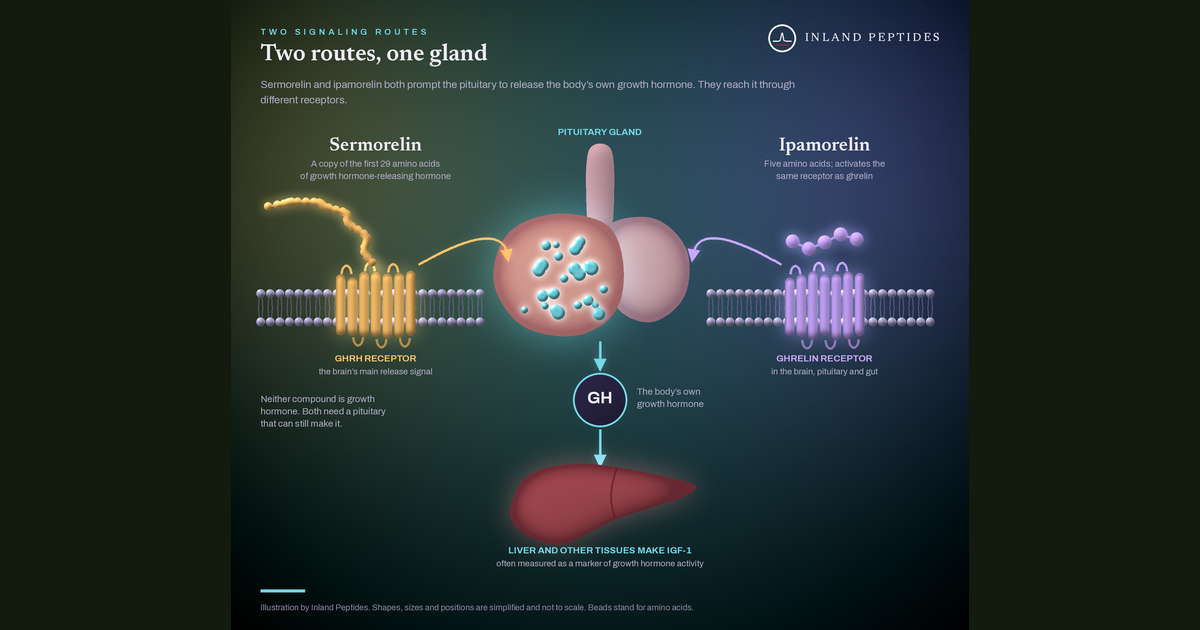
Ipamorelin activates the ghrelin receptor, while sermorelin acts through the growth hormone-releasing hormone receptor.
Both are lab-made peptides that prompt the pituitary gland to release the body’s own growth hormone. Neither is growth hormone itself.
Sermorelin was sold as an FDA-approved medicine for testing pituitary function and treating certain children with growth hormone deficiency. Ipamorelin has been studied in healthy volunteers and hospital patients but has never been FDA-approved.
| Ipamorelin | Sermorelin | |
|---|---|---|
| What it is | A lab-made peptide, five amino acids long. | A lab-made copy of the first 29 amino acids of growth hormone-releasing hormone. |
| Signal it imitates | Ghrelin, at the ghrelin receptor. | Growth hormone-releasing hormone (GHRH), at the GHRH receptor. |
| Main areas studied in humans | Growth hormone release in healthy men; bowel recovery after surgery. | Growth in children with growth hormone deficiency; testing pituitary function; hormones, body composition, sleep and thinking skills in older adults. |
| Important evidence limitations | Small studies, with the drug given by vein. Did not significantly speed bowel recovery. Not studied for sleep, exercise recovery or body composition. | Mostly older, small studies. In one randomized study of children, growth hormone produced faster growth. Adult body composition results were mixed, and sleep did not improve. |
| FDA status | Sold for research use only. Not FDA-approved for human use. | Formerly FDA-approved (Geref), later discontinued. Research vials are not FDA-approved for human use. |
How do their signals differ?
Sermorelin copies the brain’s hormone signal for releasing growth hormone. Ipamorelin, by contrast, activates the ghrelin receptor, a separate route to growth hormone release.
The brain signals the pituitary, a pea-sized gland beneath it, using growth hormone-releasing hormone, or GHRH. Sermorelin copies the first 29 amino acids of GHRH and activates the same receptor.
Ghrelin is made mostly in the stomach and signals hunger. Its receptor in the brain and pituitary also triggers growth hormone release. Ipamorelin is a smaller peptide containing some amino acids not found in the body’s proteins. Early laboratory and animal work showed that it triggers growth hormone release through this receptor, which is also found in the gut.
Either way, the pituitary releases growth hormone, and the liver and other tissues respond by making IGF-1, short for insulin-like growth factor 1. Blood tests often use IGF-1 as a marker of growth hormone activity.
Both compounds need a pituitary that can still make growth hormone. In fact, doctors used sermorelin to test that response. In separate studies, both compounds produced short-lived growth hormone responses when given through a vein.
Sermorelin was once an FDA-approved medicine
In the United States, sermorelin was sold under the brand name Geref in two forms.
One product tested whether the pituitary could release growth hormone. The other treated children with growth failure caused by growth hormone deficiency with no known cause.
The maker discontinued both products, and their approvals were later withdrawn at its request. In its withdrawal review, the FDA determined that Geref was not withdrawn from sale for safety or effectiveness reasons.
That approval applied to the Geref products, so it does not make compounded sermorelin or research vials FDA-approved medicines.
Ipamorelin reached a mid-stage trial for bowel recovery after surgery. But FDA reviewers reported that development for that use was discontinued. It has never been FDA-approved.
What human studies have found
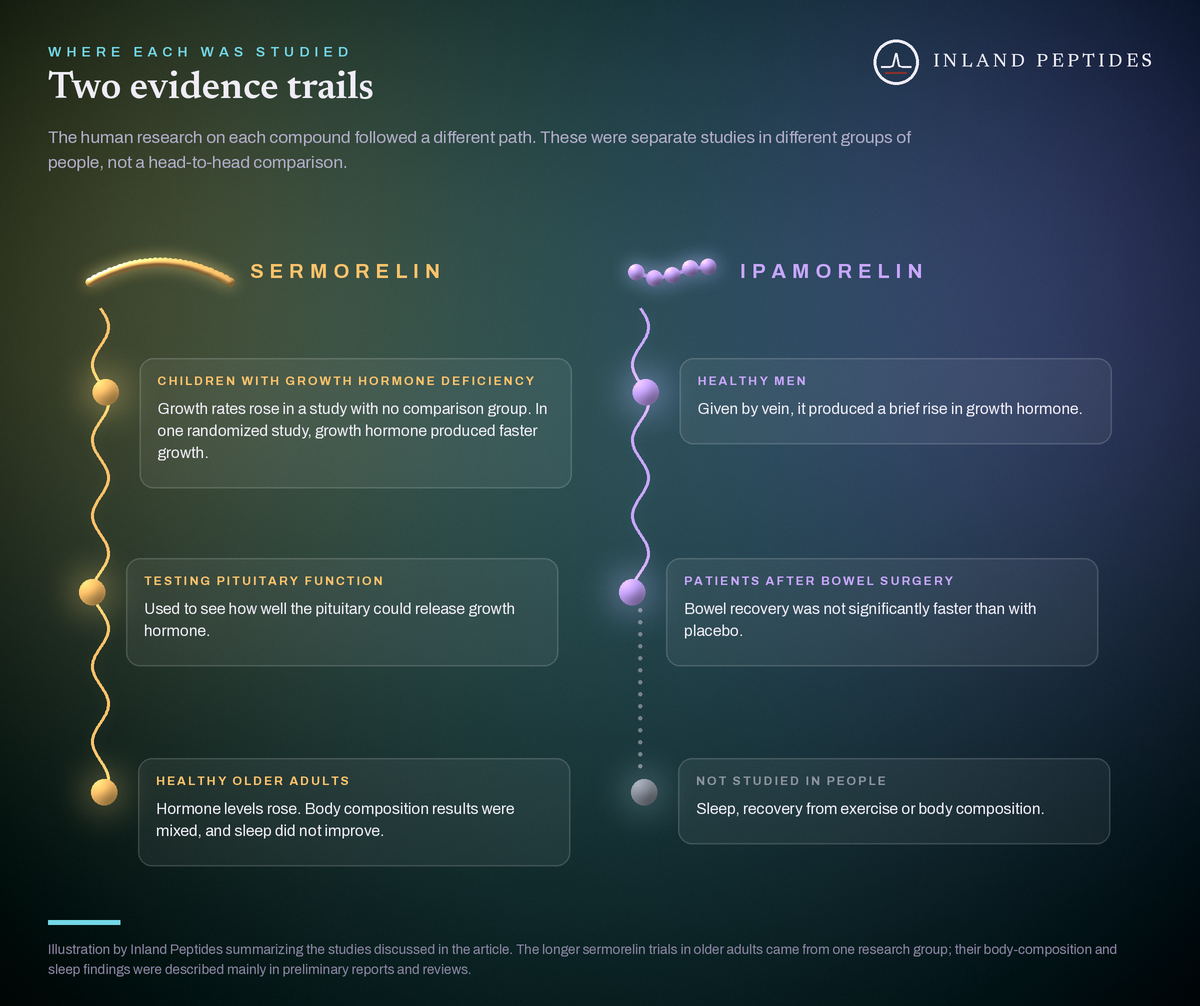
No published human study has compared ipamorelin with sermorelin directly. Instead, their evidence comes from separate studies in different groups of people.
Sermorelin in children
A study that enrolled 110 children with growth hormone deficiency included 86 in its effectiveness analysis. Their average growth rate roughly doubled during the first six months. But without a comparison group, the study cannot establish how much of that change came from treatment alone.
A six-month randomized study compared sermorelin with growth hormone in 60 children whose deficiency involved the brain’s releasing signal. Children given growth hormone grew faster than those given sermorelin by continuous infusion. The finding applies to those children and the treatment methods tested.
Sermorelin in older adults
In a two-week study in older men, the higher of two doses raised growth hormone and IGF-1 to levels similar to those of young men.
In a six-week study in older men, sermorelin raised nighttime growth hormone but not IGF-1. The 11 men had no change in weight or in muscle and fat measured by body scan.
Longer trials at the University of Washington compared sermorelin with placebo for five to six months in healthy older men and women.
The investigators’ preliminary report described lower body fat and higher lean mass, which includes muscle, in men and women not taking estrogen. Changes were smaller in women taking estrogen. A later review by the same group found no consistent improvement in physical function.
The trials also measured sleep. Preliminary findings showed slightly worse self-rated sleep with sermorelin and no change with placebo. The later review reported no improvement in sleep.
In a six-month study of 89 older adults, the group given sermorelin scored better than the placebo group on several tests of problem-solving and mental speed.
These University of Washington publications describe overlapping trials, rather than independent confirmations. Their body-composition and sleep findings were reported mainly in preliminary publications and reviews.
Ipamorelin
In a study in healthy male volunteers, ipamorelin given through a vein produced a single growth hormone peak at each dose tested.
Researchers also studied bowel recovery after surgery, when the intestines can temporarily stop moving normally. This condition is called postoperative ileus. In a trial after bowel surgery involving 114 adults, ipamorelin did not significantly speed recovery compared with placebo.
Sleep, exercise recovery and body composition
Ipamorelin’s studies did not measure sleep, exercise recovery or body composition. Sermorelin’s body-composition findings in older adults differed: the six-week study found no change, while preliminary reports from longer trials described less fat and more lean mass in some groups. Sleep did not improve. Exercise recovery was not studied.
Higher growth hormone or IGF-1 readings alone do not establish these benefits.
Safety findings and open questions
Both compounds have limited long-term safety data. Small studies cannot establish their overall safety.
Sermorelin
The children’s studies reported few side effects, mainly mild injection-site irritation. The study of 110 children reported no harmful changes in blood tests, including blood sugar.
Antibodies are proteins the immune system makes in response to a substance. Nearly all children given sermorelin in the randomized study developed antibodies to it. Antibody levels, however, were not linked to growth response and fell after treatment stopped.
In the longer older-adult trials, investigators described swelling and joint aches as very uncommon. Redness or swelling at the injection site was also rare.
Ipamorelin
Most patients in both groups of the bowel surgery trial had a health problem reported during the study. According to the FDA review of ipamorelin, low potassium and high blood sugar occurred more often in the ipamorelin group. Two patients given ipamorelin died after complications of their surgery. FDA reviewers said it was unclear whether the deaths were related to the drug.
Ipamorelin is often described as raising growth hormone without raising the stress hormone cortisol. That finding, though, comes from studies in pigs. It does not establish the same response in people.
Long-term questions
FDA reviewers evaluating ipamorelin noted warnings on approved growth hormone medicines, including high blood sugar and fluid retention. Those warnings do not establish that these peptides have the same risks. Still, the studies are too limited to rule those risks out.
What the comparison shows
Sermorelin and ipamorelin prompt growth hormone release through different receptors. Sermorelin has a history of approved pediatric and diagnostic uses. In older adults, preliminary reports described body-composition changes in some groups, without improved sleep.
Ipamorelin raised growth hormone in healthy men but did not significantly speed bowel recovery in surgical patients. The two compounds have not been compared directly in a published human study. Neither has been shown to improve sleep or exercise recovery.