Sermorelin matches the first 29 amino acids of the body’s growth hormone-releasing hormone, while CJC-1295 with DAC modifies that sequence and adds a group that keeps it in the blood for days.
Both act on the same receptor and prompt the pituitary gland to release the body’s own growth hormone.
Sermorelin was sold as the FDA-approved medicine Geref. CJC-1295, by contrast, has never been FDA-approved. No published human study has compared them directly.
| CJC-1295 (with DAC) | Sermorelin | |
|---|---|---|
| What it is | A 29-amino-acid piece of GHRH with four amino acids changed, plus a chemical add-on called DAC. | A lab-made peptide matching the first 29 amino acids of human GHRH. |
| Receptor or signal | GHRH receptor on the pituitary. | GHRH receptor on the pituitary. |
| Blood half-life | About 6 to 8 days in one study of healthy adults. | Short, measured in minutes, in one study of healthy men. |
| Main areas studied in people | Growth hormone and insulin-like growth factor 1 (IGF-1) levels in healthy adults. | Growth in children with growth hormone deficiency; pituitary testing; hormones, body composition, sleep and thinking in older adults. |
| Important evidence limitations | Small, short hormone studies. An HIV trial stopped without published results. Findings do not automatically apply to “without DAC” products. | Mostly small, older studies. Longer adult results come mainly from overlapping reports by one research program. |
| FDA status | Sold for research use only. Not FDA-approved for human use. | Formerly FDA-approved as Geref, later discontinued. Compounded and research products are not FDA-approved. |
Same hormone pathway, different structures
Both are based on growth hormone-releasing hormone, or GHRH.
GHRH signals the pituitary, a pea-sized gland at the base of the brain, to release growth hormone. The liver and other tissues then make insulin-like growth factor 1 (IGF-1), a hormone often measured as a sign of growth hormone activity.
Neither compound is growth hormone itself.
Sermorelin matches the first 29 amino acids
Natural GHRH is a chain of 44 amino acids, the building blocks of proteins. Yet the first 29 are enough to trigger growth hormone release. Sermorelin matches that 29-amino-acid sequence.
CJC-1295 changes four amino acids and adds DAC
The original CJC-1295 uses that 29-amino-acid stretch with four amino acids swapped for others. It also carries a chemical add-on called a drug affinity complex, or DAC.
Early laboratory studies in rats showed that the DAC lets the peptide attach to albumin, a common protein in the blood. That keeps it in circulation far longer than natural GHRH.
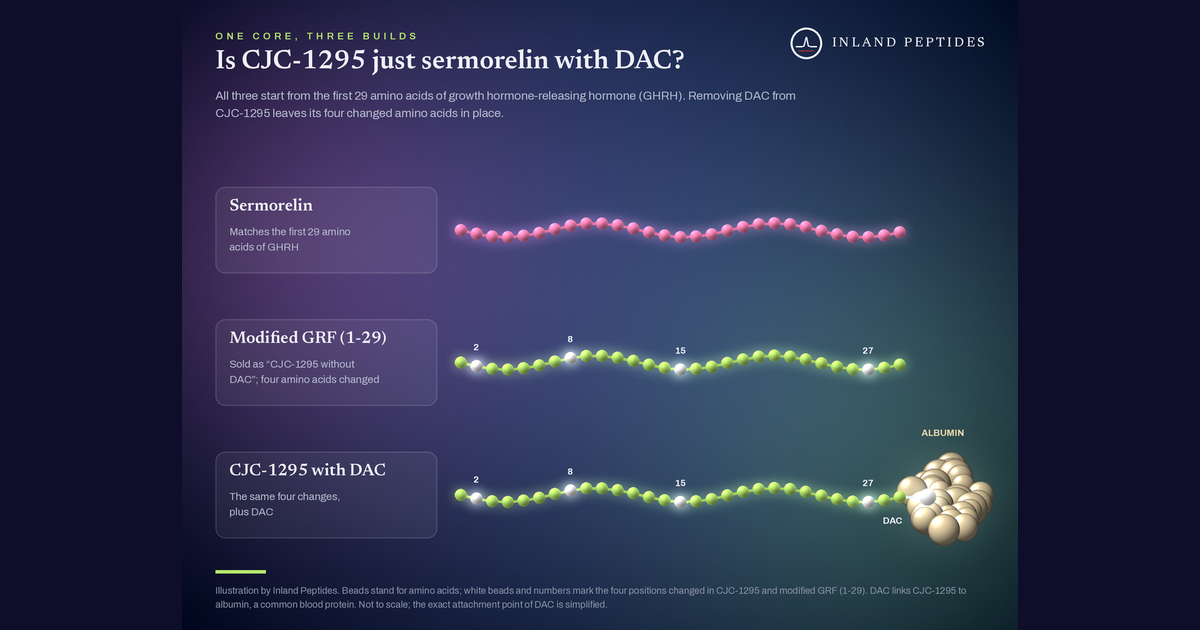
Is CJC-1295 just sermorelin with DAC added?
No. Even without DAC, the CJC-1295 core differs from sermorelin at four positions.
Products labeled “CJC-1295 without DAC” are marketed as the modified core without the add-on, often called modified GRF (1-29). GRF is an older name for GHRH. The four changed amino acids remain, so this molecule is still different from sermorelin.
An FDA review of CJC-1295 treats the versions with and without DAC as different active ingredients and flags the inconsistent naming as a safety risk.
The published human studies discussed here tested CJC-1295 with DAC. Their findings therefore do not establish the same duration or effects for products sold without DAC.
How long does each one last?
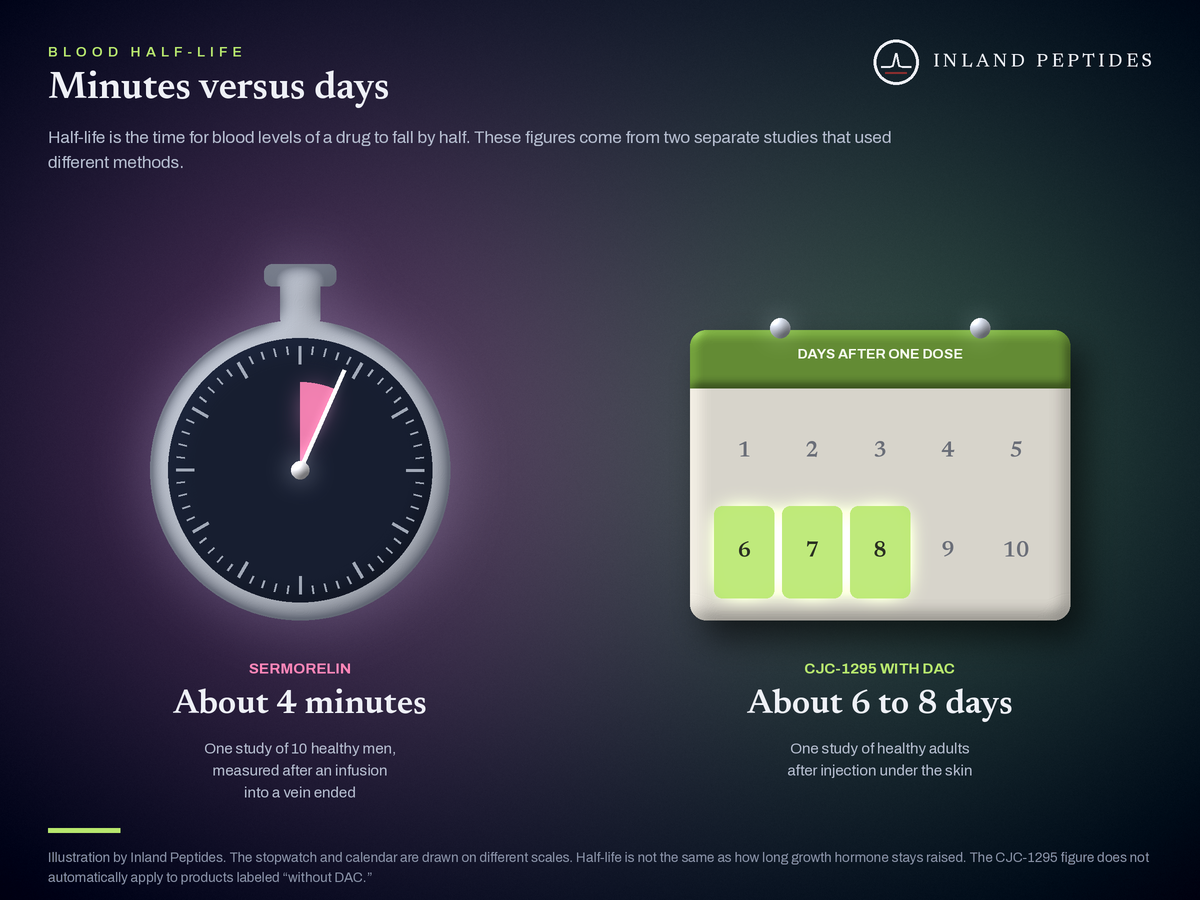
Sermorelin’s half-life in the blood is measured in minutes, while CJC-1295 with DAC has a half-life measured in days.
Half-life is the time it takes for a drug’s blood level to fall by half, rather than for the drug to leave the body completely.
Half-life
- Sermorelin: about 4 minutes in a study of 10 healthy men, measured after an infusion into a vein ended. The figure may differ with other formulations or routes.
- CJC-1295 with DAC: about 6 to 8 days in a separate study of healthy adults.
How long hormone levels stayed raised
Still, hormone levels can stay raised after the peptide’s blood level has fallen.
- Sermorelin: in a study of 30 healthy men, growth hormone stayed raised for about 3 hours after a single dose into a vein, even though the peptide itself was cleared quickly.
- CJC-1295 with DAC: in the healthy-adult study, growth hormone stayed above starting levels for six days or more after one injection, and IGF-1 for 9 to 11 days.
A follow-up study in 12 healthy men found that natural pulses of growth hormone release continued one week after a single CJC-1295 injection. Higher levels between pulses accounted for most of the increase. There was no placebo group, which receives an inactive look-alike treatment.
What human studies have found
The evidence comes from separate studies in different groups of people.
CJC-1295
The published CJC-1295 studies enrolled small groups of healthy adults and measured hormone levels.
In the healthy-adult study, volunteers aged 21 to 61 received single or repeated injections of CJC-1295 or a placebo. After one injection, average growth hormone levels rose 2- to 10-fold and IGF-1 rose 1.5- to 3-fold. Larger and repeated doses produced greater hormone increases.
But these studies did not measure body fat, muscle or sleep. Higher hormone readings alone do not establish improvements in those outcomes or overall health.
A company trial of CJC-1295 in people with HIV and excess belly fat was stopped early. Its results have still not been published.
Sermorelin in children
A study that enrolled 110 children with growth hormone deficiency included 86 in its effectiveness analysis. Their average growth rate roughly doubled during the first six months. But the study had no comparison group.
A six-month randomized study compared sermorelin with growth hormone in 60 children whose deficiency came from a lack of the brain’s releasing signal. Children given growth hormone grew faster than those given sermorelin by continuous infusion.
Sermorelin in older adults
In a two-week study in older men, the higher of two doses raised growth hormone and IGF-1 to levels similar to those of young men.
In a six-week study of 11 older men, sermorelin raised nighttime growth hormone but not IGF-1. Weight and scan-measured muscle and fat did not change significantly. Still, two of six strength measures and one endurance test improved.
That study had no placebo group, so it cannot show that sermorelin caused those improvements.
University of Washington trials compared sermorelin with placebo for five to six months in healthy older adults. They used the Geref medicine.
- Body composition: the investigators’ preliminary report described more lean mass and less body fat. A review by the same team reported the largest effect on fat around the organs. Changes were smaller in women taking estrogen, though. Lean mass includes water and organs as well as muscle, so the increase does not mean all of it was muscle.
- Physical function: in women not taking estrogen, function declined with placebo while some measures held steady with sermorelin. A later review by the same team found no consistent improvement overall.
- Sleep: participants given sermorelin rated their sleep slightly worse than before in the preliminary report, while the placebo group did not change. The team’s reviews also reported no improvement in sleep.
- Thinking skills: in a six-month study of 89 older adults, the group given sermorelin scored better than the placebo group on several tests of problem-solving and mental speed.
These University of Washington publications describe overlapping trials, rather than independent confirmations. Their body-composition and sleep findings were reported mainly in preliminary publications and reviews.
Why the studies cannot rank them
CJC-1295’s published studies measured hormone levels in healthy adults over a few weeks. In contrast, sermorelin was studied for growth in children and for hormones, body composition, sleep and thinking in older adults.
The longer hormone response to CJC-1295 does not establish better outcomes than sermorelin.
Sermorelin’s medical history
Sermorelin was sold in the United States under the brand name Geref in two forms:
- A diagnostic product used to test whether the pituitary could release growth hormone.
- A treatment for children with growth failure caused by growth hormone deficiency with no known cause.
The maker discontinued both products, and their approvals were later withdrawn at its request. In its withdrawal review, the FDA determined that Geref was not withdrawn from sale for safety or effectiveness reasons.
Approval applied to the Geref products. Compounded sermorelin and research vials, though, are not FDA-approved medicines.
CJC-1295 is sold for research use only. It is not FDA-approved for human use.
Safety findings and unanswered questions
Both compounds have limited long-term safety data. Small studies cannot establish their overall safety.
CJC-1295
In the first of the healthy-adult trials, the FDA’s summary reports adverse events in 33 of 35 people given CJC-1295 and 2 of 7 given placebo. The most common were injection-site reactions, headache, flushing and diarrhea. Even so, the study authors reported no serious adverse reactions.
The same FDA review describes anecdotal reports that a participant in the stopped HIV trial had a heart attack and died shortly after a dose. According to those reports, the attending physician thought underlying heart disease was the most likely explanation. This account does not establish whether CJC-1295 contributed to the death.
In animal and laboratory studies summarized by the FDA, the DAC form caused injection-site damage in rats and dogs and signs of DNA damage in mouse pituitary cells. These findings, however, do not establish the same effects in people.
Sermorelin
The children’s studies reported few side effects, mainly mild irritation at the injection site. The study that enrolled 110 children reported no harmful changes in blood tests, including blood sugar.
Antibodies are proteins the immune system makes in response to a substance. Nearly all children given sermorelin in the randomized study developed antibodies to it. But antibody levels were not linked to growth response and fell after treatment stopped.
The University of Washington investigators described fluid retention and joint aches as uncommon and generally mild. Redness or swelling at the injection site occurred occasionally.
What remains unknown
- Whether CJC-1295 changes body composition, sleep or any health outcome in people.
- Whether the University of Washington findings on body composition, sleep and thinking are reproduced in independent studies.
- The long-term safety of either compound in adults.
- How products labeled “CJC-1295 without DAC” behave in people.
What the comparison shows
Sermorelin matches the first 29 amino acids of GHRH and has a half-life of minutes. Geref was approved for certain children with growth hormone deficiency and for testing pituitary function. Adult studies reported hormone increases and mixed findings on body composition, physical function, sleep and thinking.
CJC-1295 with DAC has four amino-acid substitutions and an add-on that binds albumin. Its half-life is measured in days, and its published human findings concern hormone responses. The version sold without DAC is a different molecule.
Without a direct comparison, the research cannot show which one works better.