Memory problems, difficulty concentrating and daytime sleepiness can have different causes. Medicines, supplements and experimental compounds have been studied for different parts of memory, focus and brain health.
This guide explains the main approaches, what their studies found and how those findings relate to memory, attention and daily life.
The options fall into several groups:
Prescription medicines for the symptoms of Alzheimer’s disease.
Antibodies studied to change the disease process itself.
Prescription medicines for diagnosed attention disorders.
Medicines and drinks that act on alertness, including caffeine.
Dietary supplements sold for memory and brain health.
Experimental compounds, including the peptides Selank and Semax.
Improvement in one area, such as alertness, does not automatically mean improvement in another, such as memory.
How are forgetfulness, attention problems and dementia different?
Occasional forgetfulness, attention disorders and dementia can affect daily life in different ways.
Losing track of a name or forgetting why you entered a room is common. But a lapse alone does not establish a diagnosis or rule out a problem.
A clinician diagnoses an attention disorder through a structured assessment. Difficulty concentrating during a busy week does not by itself establish one.
Dementia is a lasting decline in thinking ability severe enough to interfere with daily life.
Memory loss is a familiar sign, but some forms begin with changes in language, planning, judgment, movement or behavior. Alzheimer’s disease is the most common cause of dementia.
Poor sleep, low mood, medicine side effects and other medical conditions can also affect concentration and memory. Identifying the cause helps determine what may help.
Brain signaling and the meaning of nootropic
Brain cells pass signals to each other using chemical messengers called neurotransmitters. Acetylcholine, dopamine and norepinephrine are three that come up repeatedly in this subject.
Learning and memory involve changes in how strongly brain cells connect and signal.
Studies may measure biological markers, such as a neurotransmitter level, brain activity on a scan or the protein brain-derived neurotrophic factor.
A marker can help explain a possible mechanism. However, whether people remember more or function better requires separate measurement.
Nootropic generally refers to a substance studied or marketed for effects on learning or memory.
The National Library of Medicine indexes it as a heading for drug research. The term alone does not establish that a product works.
How the main approaches compare
| Medicine, ingredient or compound | What it is | Medical purpose or research question | Reported finding and main limitation |
|---|---|---|---|
| Donepezil, rivastigmine, galantamine | Prescription medicines that raise acetylcholine levels | Symptoms of Alzheimer’s disease | In a long trial of donepezil, small benefits on a cognitive test and a daily-activities scale did not carry through to a significant difference in entry to institutional care or disability |
| Memantine | Prescription medicine acting on NMDA receptors | Moderate to severe Alzheimer’s disease | Added to donepezil over 24 weeks, cognitive scores rose slightly while placebo scores fell; daily function declined in both groups, less so with memantine |
Disease-modifying antibodies
| Medicine, ingredient or compound | What it is | Medical purpose or research question | Reported finding and main limitation |
|---|---|---|---|
| Lecanemab, donanemab | Monoclonal antibodies targeting amyloid, not peptides | Changing the disease process itself | Both slowed decline against placebo over 18 months on scales covering thinking and daily function; neither group improved, and brain swelling or bleeding appeared on scans in a sizeable minority |
Attention and alertness medicines
| Medicine, ingredient or compound | What it is | Medical purpose or research question | Reported finding and main limitation |
|---|---|---|---|
| Methylphenidate and other stimulants | Prescription medicines affecting dopamine and norepinephrine | Diagnosed attention disorders | A 14-month trial in diagnosed children found medication management better than behavioral treatment for most symptoms; labels warn on abuse, heart rate, blood pressure, sleep, appetite and mood |
| Atomoxetine | Prescription nonstimulant acting on norepinephrine reuptake | Diagnosed attention disorders in adults | Two 10-week trials found it better than placebo on a symptom rating scale; its label carries a boxed warning on suicidal thoughts and behaviors in pediatric patients |
| Modafinil | Prescription wakefulness medicine | Excessive sleepiness, and alertness during sleep loss | Improved alertness in sleep-deprived healthy adults, with no advantage over caffeine in a small study; its label warns of serious rash |
| Caffeine | Stimulant in coffee, tea and other products | Alertness and vigilance | Reduces the drop in alertness that comes with sleep loss, which is a different outcome from learning or long-term memory |
Experimental peptides
| Medicine, ingredient or compound | What it is | Medical purpose or research question | Reported finding and main limitation |
|---|---|---|---|
| Selank | Synthetic seven amino acid peptide based on tuftsin | Studied as an anti-anxiety treatment | A 62-patient comparison against a benzodiazepine in anxiety disorders; memory and focus were not measured |
| Semax | Synthetic seven amino acid peptide based on a fragment of ACTH | Studied in healthy volunteers, stroke recovery and brain imaging | A small 1996 report found better accuracy on a work task; imaging studies show brain activity changes with no cognitive test alongside them |
Supplements studied for memory, focus and brain health
| Medicine, ingredient or compound | What it is | Medical purpose or research question | Reported finding and main limitation |
|---|---|---|---|
| Ginkgo biloba | Plant extract sold as a supplement | Preventing dementia and cognitive decline | A trial of 3,069 older adults followed about six years did not demonstrate that ginkgo prevents dementia |
| Omega-3 fatty acids | Fats from fish oil, sold as a supplement | Slowing cognitive decline | A three-year trial in older adults found no significant cognitive difference from placebo |
| Multivitamins | Daily multivitamin and mineral tablets | Slowing age-related memory loss | Trials in adults 60 and over found small cognitive-test improvements; they did not assess dementia prevention and tested one product |
| B vitamins | Vitamins available in food and as supplements | Cognitive function | Correcting a deficiency is a different situation from supplementing someone who is not deficient |
| Bacopa monnieri | Herbal extract sold as a supplement | Memory and attention | A 54-person trial in older adults improved delayed recall and one attention measure, with no effect on two others |
| Creatine | Compound involved in muscle and brain energy | Working memory and reasoning | A 123-person crossover trial did not reach significance on its two main tests; the authors’ Bayesian analysis supported a small possible effect |
| Lion’s mane | Mushroom extract sold as a supplement | Memory, mood and stress | A 30-person trial in mild cognitive impairment improved scores that fell again after stopping; a 43-person trial in healthy young adults reported one favorable speed result, unfavorable recall findings and no effect elsewhere |
| Vitamin E, curcumin | Supplements sold for brain health | Cognition and dementia | A federal review found no evidence for vitamin E on the specified cognitive outcomes and insufficient evidence for curcumin |
Medicines used for the symptoms of Alzheimer’s disease
These medicines address symptoms rather than stopping the underlying disease.
Donepezil, rivastigmine and galantamine belong to one group. They slow the breakdown of acetylcholine, a neurotransmitter involved in memory and attention, which leaves more of it available.
Donepezil was tested in a long trial that randomly assigned 486 people with mild to moderate Alzheimer’s disease. Small, statistically significant benefits appeared on tests of cognition and daily activities over the first two years.
At three years, there was no statistically significant difference from placebo in entry to institutional care or progression of disability.
That trial tested donepezil, so its results cannot automatically be assigned to rivastigmine or galantamine.
Memantine works differently. It acts on NMDA receptors, part of a separate signaling system, and it is used in more advanced disease.
A 404-patient trial studied people with moderate to severe Alzheimer’s who were already taking donepezil. Over 24 weeks, cognitive scores rose slightly with memantine and fell with placebo.
Daily function declined in both groups, less so with memantine.
Medicines studied to change the disease itself
Other medicines target biological processes involved in Alzheimer’s disease.
Lecanemab and donanemab are monoclonal antibodies that target amyloid, a protein that builds up in the brain in Alzheimer’s disease. An antibody is a large immune protein, not a peptide.
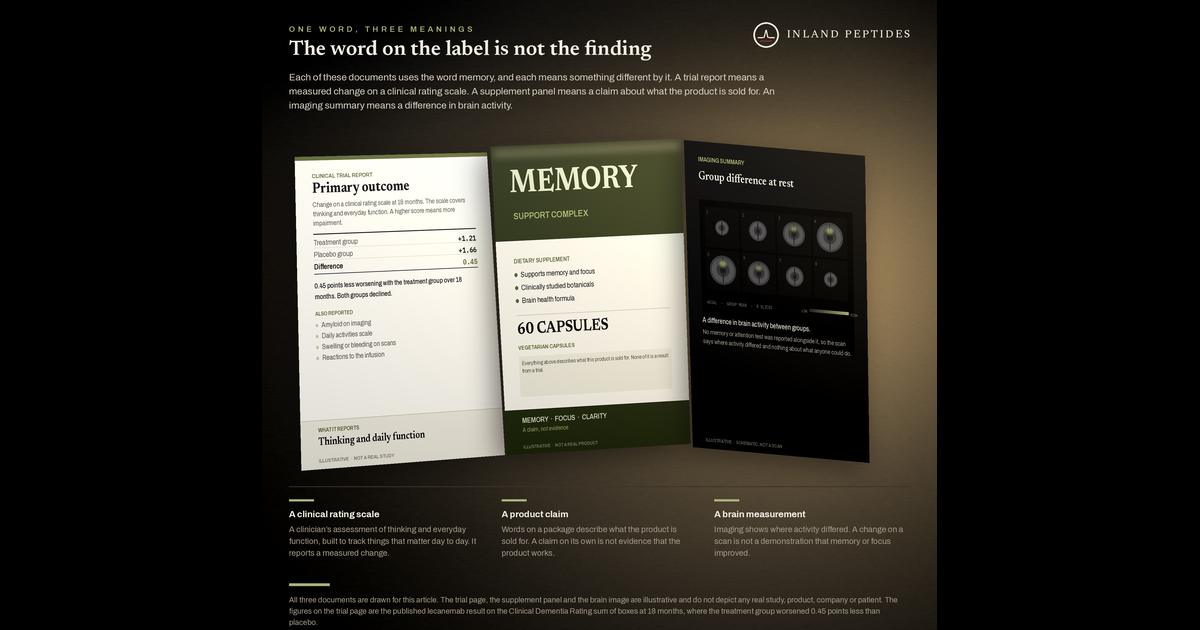
In an 18-month trial of lecanemab, 1,795 people with early Alzheimer’s disease received either the antibody or placebo. Both groups declined on the main clinical rating scale. The antibody group declined less, by 0.45 points over the 18 months.
A separate measure of everyday activities also favored lecanemab.
A trial of donanemab randomized 1,736 people with early symptomatic Alzheimer’s disease. Decline was slower with the antibody on its main measure, which combined cognition and daily function.
These clinical scales assess thinking and everyday function rather than memory alone.
Both trials also reported large reductions in brain amyloid.
Reduced amyloid shows an effect on the biological target. The clinical scales separately describe what happened to participants’ abilities.
Slower decline does not mean recovery of memory already lost or prevention of disease.
Brain swelling and bleeding (ARIA)
Both antibodies carry a risk of amyloid-related imaging abnormalities, or ARIA. These are areas of swelling or small bleeds visible on brain scans.
In the lecanemab trial, 12.6 percent of participants had ARIA involving brain swelling or fluid collection, and 26.4 percent had reactions to the infusion itself.
In the donanemab trial, brain swelling or fluid collection occurred in 24.0 percent of the antibody group and 2.1 percent of the placebo group. Of the 205 affected participants receiving donanemab, 52 had symptoms.
These events can be serious. Three deaths in the donanemab group and one in the placebo group were judged treatment related.
Brain scans are part of clinical monitoring for these risks.
Medicines for diagnosed attention disorders
Research in people diagnosed with an attention disorder addresses symptoms of that condition.
Stimulant medicines
For example, stimulants such as methylphenidate act on dopamine and norepinephrine signaling.
A 14-month randomized trial assigned 579 children aged 7 to 9.9 with ADHD to medication management, intensive behavioral treatment, both, or usual community care. All groups improved. Medication management and combined treatment produced greater improvement on most symptoms than behavioral treatment or community care.
Medication management and the combined approach did not differ significantly from each other on direct comparison.
The label for one methylphenidate product carries a boxed warning about abuse, misuse and addiction. Other warnings include cardiac risks, increased blood pressure and heart rate, psychiatric reactions and slowed growth in children.
Common reactions in adults include decreased appetite, insomnia, anxiety and increased heart rate.
Atomoxetine
Atomoxetine is a nonstimulant that affects norepinephrine signaling by selectively blocking its reuptake.
Two 10-week placebo-controlled studies enrolled 280 and 256 adults with diagnosed ADHD. Atomoxetine reduced inattentive and hyperactive symptoms more than placebo on a standard rating scale.
Fewer than one in ten participants stopped because of side effects, but tolerability in those studies does not describe every risk.
The atomoxetine label carries a boxed warning about suicidal thoughts and behaviors in patients aged 6 and older who are children or adolescents. Other warnings include severe liver injury and cardiovascular effects. Common reactions include decreased appetite and nausea.
These trials do not establish benefits for people without ADHD who take the medicines to study or work.
Why is alertness different from memory?
Alertness means being awake and able to sustain attention. Memory, by contrast, involves taking in information and recalling it later.
Caffeine, found in coffee, tea and other drinks, can reduce the loss of alertness and vigilance during sleep deprivation.
A controlled comparison in 50 adults tested alertness during about two and a quarter days without sleep. Roughly 41 hours into the experiment, participants received placebo, caffeine or one of three modafinil strengths.
Caffeine and the two higher modafinil strengths improved performance and perceived alertness compared with placebo, especially in the early morning.
Each group contained only ten people. Modafinil showed no advantage over caffeine, but that does not establish equivalence.
Improved performance during sleep loss does not mean its effects have been reversed.
Modafinil is a prescription medicine used for excessive sleepiness in certain sleep disorders. The modafinil label warns about serious rash, including Stevens-Johnson syndrome, and about hypersensitivity reactions, psychiatric symptoms and cardiovascular events. Headache was its most common adverse reaction in trials.
What does the research on Selank and Semax show?
Selank and Semax are synthetic peptides developed in Russia. The studies discussed here examine anxiety, work performance, stroke recovery and brain imaging.
Both consist of a natural peptide fragment joined to the same three amino acid tail, Pro-Gly-Pro.
Selank
Selank is a synthetic seven amino acid peptide based on tuftsin, a peptide involved in immune-cell activity.
One anxiety study compared Selank with medazepam, a benzodiazepine. It enrolled 62 patients with generalized anxiety disorder and neurasthenia, assigning 30 to Selank and 32 to medazepam.
The authors reported similar anti-anxiety effects, with additional stimulating and anti-fatigue effects for Selank.
However, the study had no placebo group, and similar reported effects do not establish equivalence. This article draws on the English abstract of the Russian-language paper.
The reported outcomes concern anxiety and a blood measure, rather than memory or concentration.
Selank also appears in a brain-imaging study discussed below.
Semax
Semax is a synthetic seven amino acid peptide based on a fragment of adrenocorticotropic hormone, or ACTH.
The 1996 Semax work-task study
A 1996 report from the laboratory that developed Semax studied 16 male power plant operators, eight assigned to Semax and eight to placebo in a double-blind design. A computer task measured speed and short-term memory across two working days.
The Semax group maintained task accuracy better across the shift and the following morning. The authors reported statistically significant differences.
The findings were mixed. Spontaneous responses without a stimulus increased in the Semax group by the end of the experiment. The authors could not explain this and suggested a possible anxiety-producing effect.
With eight men per group at one workplace, the findings have limited generalizability.
The report also examined brain electrical activity in two small groups of healthy men. One completed a memory task, but the paper reports brain rhythms rather than a score from that task.
Semax imaging and stroke studies
Later studies examined brain activity at rest. One reported a larger extent of part of a resting brain network after Semax than after placebo in 24 volunteers.
Another compared Selank, Semax and placebo in 52 people and found differences in connections between the amygdala and part of the temporal lobe.
Neither study reported a memory or attention test alongside the imaging. The findings concern brain activity and do not demonstrate improved abilities or brain growth.
A study of 110 patients after ischemic stroke examined Semax and rehabilitation timing. It measured blood levels of brain-derived neurotrophic factor, movement and independence in daily activities.
The authors reported higher levels of the blood marker and faster improvement on the independence scale with Semax.
The English abstract does not explain how participants were assigned to Semax or comparison care, leaving the design unclear. It reports no memory or concentration outcomes. The full paper is in Russian.
These studies describe brain activity changes and a favorable result on a small work task. They do not establish reliable everyday improvement in memory or focus.
The 1996 report described no considerable change in several monitored measures, including heart rate and blood pressure, during its brain-recording work. The Selank comparison did not report a formal safety analysis.
These small, short studies leave longer-term safety uncertain.
A note on the versions sold
Public chemical records identify Selank and Semax as specific sequences. Those records establish compound identity, not the contents or quality of a particular product.
Modified versions with chemical changes at the ends of the molecule are different compounds. The studies discussed here did not test those versions.
Nonprescription medicines, stimulants and supplements
Nonprescription medicines and dietary supplements belong to different U.S. regulatory categories. The FDA is not authorized to approve supplements for safety and effectiveness before they are marketed.
Products sold for memory and brain health are generally dietary supplements.
Stimulant describes an effect. Stimulants can appear in drinks, nonprescription medicines, supplements or prescriptions.
Do memory supplements work?
Findings depend on the ingredient, the participants and the outcome measured.
Some trials found no benefit. Others, by contrast, reported small improvements on particular tests.
A six-year trial compared a standardized Ginkgo biloba extract with placebo in 3,069 adults aged 75 and over. Dementia occurred at a similar rate in both groups.
The trial did not demonstrate that ginkgo prevents dementia.
A three-year trial in France and Monaco enrolled 1,680 adults aged 70 and over to study omega-3 fatty acids and a lifestyle program. Neither intervention alone nor their combination differed significantly from placebo on the cognitive measure.
Multivitamins
Multivitamin studies have reported small benefits in older adults.
COSMOS-Web randomly assigned 3,562 adults aged 60 and over to a multivitamin or placebo, with online testing each year for three years. Immediate word recall, the main outcome specified in advance, favored the multivitamin at one year and across the three years on average.
The multivitamin showed no significant effect on that study’s other cognitive measures.
An analysis combining three substudies, with more than 5,000 participants, found small advantages in overall cognition and memory. In the in-clinic substudy alone, the memory difference was significant, but the overall cognition difference was not.
The findings need several qualifications:
The differences were small.
The participants were adults aged 60 and over.
The studies measured test performance rather than dementia diagnoses.
One multivitamin product was tested. Its findings cannot automatically be assigned to other formulas.
Funding included the National Institutes of Health and nutrition and pharmaceutical companies.
Bacopa, creatine and lion’s mane
A trial in 54 older adults without signs of dementia examined a standardized Bacopa monnieri extract; 48 completed it. Delayed word recall and performance on a test of ignoring irrelevant information improved compared with placebo.
Divided attention and working memory, by contrast, did not improve. Stomach upset was the main complaint in both groups.
A creatine crossover trial in 123 adults found no statistically significant benefit on its two main tests or eight additional tasks using conventional analysis.
A Bayesian analysis, which uses a different statistical approach, supported a small possible effect.
Side effects were reported significantly more often with creatine. The authors concluded that larger studies were needed to confirm or rule out a small benefit.
Lion’s mane, or Hericium erinaceus, has been tested in different populations. A Japanese trial randomized 30 adults aged 50 to 80 with mild cognitive impairment. Scores on a dementia rating scale favored the mushroom at 8, 12 and 16 weeks, then fell significantly four weeks after it was stopped.
A separate pilot study randomized 43 adults aged 18 to 45, with 41 included in the 28-day analysis.
Results were mixed: a favorable speed finding on one task after a single exposure, unfavorable findings on some recall measures and no significant effects on the remaining tasks.
Stress scores were lower after 28 days in the lion’s mane group, although the overall treatment effect fell short of the study’s statistical significance threshold.
Both trials were small. The first author of the impairment study was affiliated with a mushroom company. A company supplied the product for the pilot study, whose authors reported no company role in the study or publication and no other external funding.
Vitamins and supplement risks
Correcting a vitamin deficiency differs from giving extra vitamins to someone without a deficiency.
A federal review of the evidence reports no evidence that vitamin E improves cognition or prevents progression from mild cognitive impairment to dementia, and insufficient evidence for curcumin.
Supplements also carry risks. The review notes possible bleeding risk with ginkgo, potentially lasting nerve damage from high-dose vitamin B6 and bleeding risk with high-dose vitamin E. It also describes a large trial in men that linked vitamin E supplementation with increased prostate cancer risk.
Across these studies, three distinctions matter:
A test score can change without an improvement that someone notices in daily life.
Results in healthy adults cannot automatically be transferred to people with impairment, or vice versa.
Results apply to the tested extract or formulation, rather than every product with the same ingredient name.
Which option is best for memory, focus and brain health?
There is no universal best option. The cause of the symptoms, the person’s health and the goal of treatment all matter.
These approaches were studied for different purposes, so they are not interchangeable.
Their trial results cannot be ranked directly. Studies differed in participants, duration and outcomes, from dementia diagnoses and symptom ratings to alertness, stroke recovery and word recall.
Study sizes also varied widely, as the chart shows.

Persistent or worsening memory or concentration problems warrant assessment by a qualified clinician.
Questions to ask about a memory or focus claim
These questions help connect a claim to the evidence behind it:
What was studied? Identify the exact molecule, extract or formulation.
Who was studied? A finding in people with a diagnosed condition may differ from one in healthy volunteers or laboratory models.
What was measured? Brain activity, blood markers, test performance and daily function answer different questions.
Does the finding concern memory, attention, alertness, anxiety or symptoms of a particular disease?
This article is educational and is not medical advice.