Thymosin beta-4 is a 43-amino-acid protein the body makes, while the defined TB-500 fragment contains seven amino acids and a chemical cap.
They are different molecules, but sellers and some publications also use TB-500 to mean the full protein or other material. The name alone does not reliably identify the molecule.
| Feature | Thymosin beta-4 | TB-500 (defined fragment) | Products labeled TB-500 |
|---|---|---|---|
| What it is | A natural protein the body makes. | A lab-made copy of seven amino acids from thymosin beta-4. | Name used for the fragment, full protein or other material. |
| Size | 43 amino acids. | 7 amino acids, plus a chemical cap on one end. | Varies. May be the fragment, the full protein or something else. |
| Main research | Human safety and eye-drop trials; animal wound studies. | Laboratory and animal metabolism studies; a cell wound test. | Rat tendon study; human reports involving mixtures. |
| Regulatory status | Not an FDA-approved drug. | Research use only; not FDA-approved for human use. | Not FDA-approved. |
| Main caution | Findings do not automatically establish the fragment’s effects. | Human treatment effects are not established. | The label alone does not confirm which molecule is inside. |
What is thymosin beta-4?
Thymosin beta-4 is a natural protein made of 43 amino acids, the building blocks of proteins.
Thymosin beta-4 binds actin, a protein that forms internal fibers that help cells change shape and move. It also holds individual actin units and helps control when those fibers form.
Lab-made versions have been tested in human safety studies and eye-drop trials.
What does TB-500 mean?
An FDA scientific review identifies TB-500 as a lab-made, seven-amino-acid fragment of thymosin beta-4.
Those amino acids come from a region involved in binding actin. But the fragment does not necessarily reproduce the full protein’s actions.
A small chemical cap, called an acetyl group, also sits at one end. The cap can change how the fragment behaves, so findings for an uncapped version do not automatically establish the same effects for TB-500.
Drug-testing researchers described a TB-500 preparation intended for horses. Belgian researchers who analyzed a seized package found the capped fragment rather than the full protein.
The name is not used consistently
FDA’s review also notes that websites use TB-500 and thymosin beta-4 interchangeably. A rat tendon paper also described its TB-500 product as synthetic thymosin beta-4.
An analysis of products sold online as TB500 and TB1000 found contents that did not consistently match their descriptions.
Why the distinction matters in research
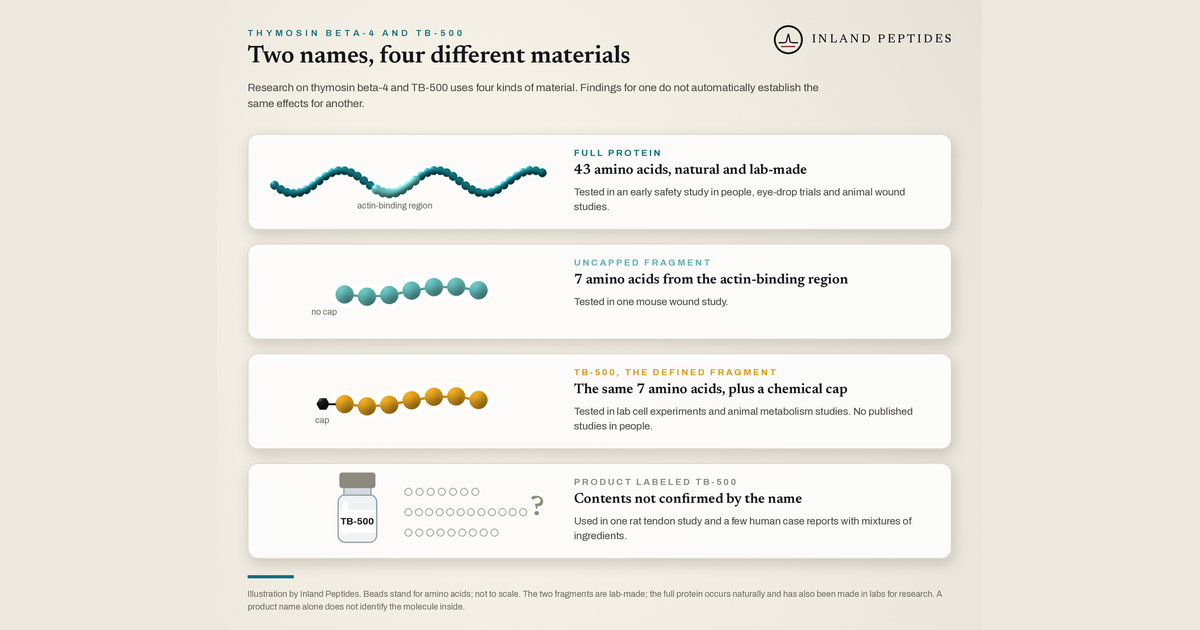
The research involves four categories. Related-molecule findings can provide context without establishing the same effects for each:
- Full-length thymosin beta-4: the complete 43-amino-acid protein tested in the controlled human trials discussed below.
- The uncapped seven-amino-acid fragment: tested in a mouse wound study.
- The capped fragment: the seven-amino-acid molecule identified as TB-500 in FDA’s review.
- Products labeled TB-500: material whose exact identity the study did not confirm.
What studies have reported
Full-length thymosin beta-4
In a rat wound study, thymosin beta-4 sped skin healing and increased collagen and new blood vessels compared with a saline control.
A safety study in 40 healthy volunteers reported infrequent, mild or moderate adverse events over two weeks of treatment, with no serious adverse events.
A dry eye trial involving 72 people did not meet its main goals, though some other measures of symptoms and the eye’s surface improved.
In a small eye-healing trial, 6 of 10 treated patients had healed damage on the clear front surface of the eye at the main assessment, compared with 1 of 8 given placebo, an inactive treatment. That difference was not statistically significant; later healing and some comfort measures favored treatment.
But the trial was small and ended early. These human studies, however, tested the full protein, not the capped fragment.
The uncapped fragment
In a mouse wound study, the uncapped fragment helped skin wounds heal in aged mice about as well as the full protein.
But the experiment tested one amount of the fragment in one type of wound.
The capped fragment
In a laboratory study, the capped fragment did not significantly speed scratch closure in fibroblasts, a type of connective tissue cell, under the conditions tested.
But one breakdown product did improve scratch closure. So the authors proposed that it might explain wound-healing effects attributed to TB-500.
The wound test used cells; rats in the same study were used to track breakdown products. The experiment does not settle whether the fragment affects wounds in the body.
Other research developed methods to detect the fragment and its breakdown products in horses’ blood and urine.
FDA’s review found no published human studies of the defined fragment.
Products labeled TB-500
In a rat tendon study, a product labeled TB-500 produced stronger tendons than an inactive injection after 30 days. The paper named its supplier but did not confirm the peptide’s sequence.
Three dental case reports described improvement in nerve injuries after material labeled TB-500 was combined with BPC-157 and other drugs. A knee pain chart review reported less pain in three of four patients given BPC-157 with a peptide called thymosin beta-4.
Neither report confirmed the exact molecule or, without a control group, showed which ingredient caused the improvement.
Direct comparisons are missing
No published human study directly compares full-length thymosin beta-4 with the capped fragment. Instead, the mouse study compared the full protein with the uncapped fragment.
Safety and research status
The safety record differs for each material.
The full-protein safety study reported mild or moderate adverse events, while the eye trials reported no significant safety problems. But these studies lasted weeks and do not establish long-term safety.
For the capped fragment, FDA’s review identified no animal toxicity studies and raised concerns about possible immune reactions from peptide clumping or impurities.
Reports involving mixtures also cannot establish the fragment’s safety on its own.
For a product labeled TB-500, interpreting safety findings also requires knowing which molecule it contains.
Neither molecule is FDA-approved for human use:
- Thymosin beta-4 has been tested as an investigational treatment in clinical trials.
- In contrast, the defined TB-500 fragment is sold for research use only.
Are thymosin beta-4 and TB-500 interchangeable?
No. The defined fragment and full-length protein are different molecules, and the TB-500 name is used inconsistently.
When interpreting a study or product description, check:
- Whether it identifies the full protein, a capped fragment or an uncapped fragment.
- Whether the identity was confirmed by testing or only stated on a label.
- Whether the findings came from people, animals or laboratory-grown cells.
- Whether other ingredients were tested alongside it.