BPC-157 is a lab-made peptide based on a stomach protein, while TB-500 is based on a short section of thymosin beta-4, a protein involved in cell movement.
Both are discussed for injury recovery, but their research differs. BPC-157 has animal experiments and a few small human studies; much of the evidence cited for TB-500 concerns related molecules. But no human study has compared them directly.
| Feature | BPC-157 | TB-500 |
|---|---|---|
| What it is | Lab-made peptide with 15 amino acids, based on a stomach protein. | Capped seven-amino-acid fragment of thymosin beta-4. Sellers also use the name for other material. |
| Link to tissue repair research | Bowel disease and tissue repair research. | Matches an actin-binding region involved in cell movement. |
| What researchers have studied | Tendon, ligament and muscle healing in rats; bowel, knee and bladder conditions in small human studies. | Rat tendon study used a product of unconfirmed sequence; mouse wound study used an uncapped fragment. |
| Human versus animal evidence | Two early controlled studies reported as abstracts; three small uncontrolled reports. | No standalone human trial of the capped fragment. Case reports used mixtures. |
| Regulatory status | Research use only; not FDA-approved for human use. | Research use only; not FDA-approved for human use. |
| Main limitation when comparing them | Small human studies with limited reporting or no comparison group. | Findings about related molecules may not apply to the capped fragment. |
What are BPC-157 and TB-500?
Both are lab-made chains of amino acids, the building blocks of proteins.
BPC-157 is based on a stomach protein
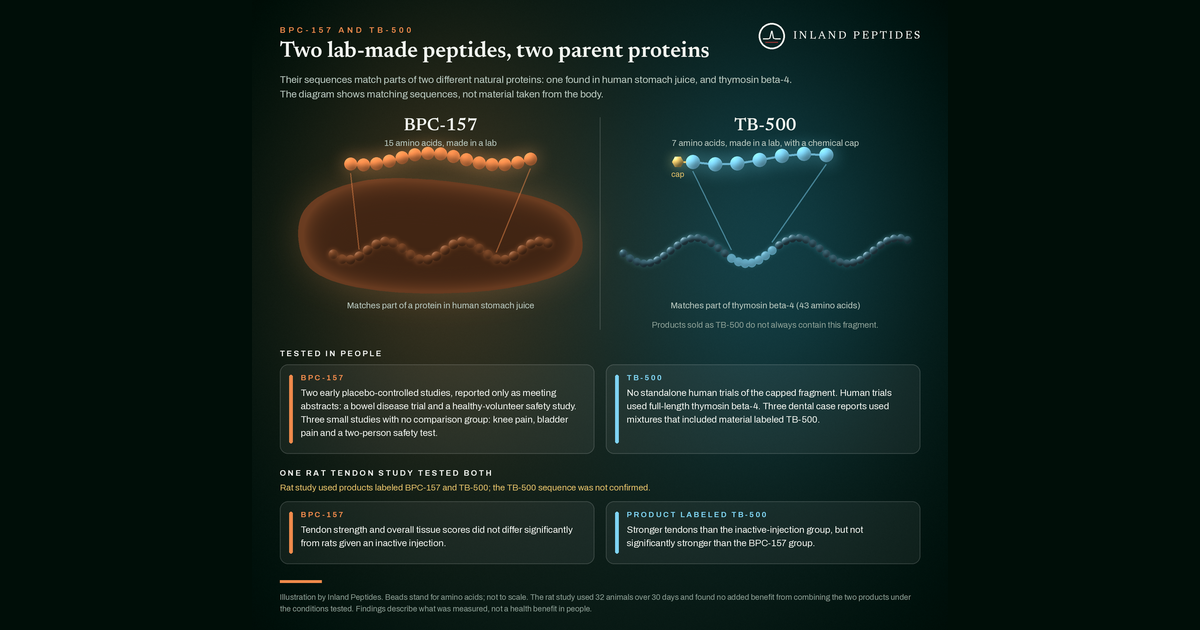
BPC stands for body protection compound. BPC-157 has 15 amino acids matching part of a protein found in human stomach juice.
Researchers have studied it for ulcerative colitis, an inflammatory bowel disease, and for tendon, ligament and muscle injuries, mostly in rats.
TB-500 is based on thymosin beta-4
Thymosin beta-4 is a naturally occurring protein with 43 amino acids. It binds actin, a protein that helps cells change shape and move.
An FDA scientific review identifies TB-500 as a seven-amino-acid fragment of thymosin beta-4 with a chemical cap at one end. Belgian researchers found this fragment in a seized TB-500 product.
Sellers and some publications also use TB-500 to mean the full protein or other related material. So here, TB-500 means the capped fragment; a product bearing that name may contain something different.
How each is thought to work
Cell and animal experiments provide most of the evidence about their proposed actions.
BPC-157 was tested directly
BPC-157 increased blood vessel growth in rat and cell experiments. It also increased a receptor involved in growth signaling in blood vessel cells.
In a rat tendon study, BPC-157 improved the strength, walking function and microscopic appearance of a cut Achilles tendon. Other rat studies also reported improved healing of ligaments and crushed muscle.
In laboratory-grown tendon cells, BPC-157 helped cells move and survive stress, but did not make them multiply faster.
Research on thymosin beta-4
Full-length thymosin beta-4 sped skin healing and increased blood vessel growth in a rat wound study.
The fragment’s seven amino acids match thymosin beta-4’s actin-binding region. In a mouse wound study, an uncapped version helped wounds heal in aged mice about as well as the full protein.
But that result does not establish the same effect for the capped fragment.
What human studies show
BPC-157 in people
A two-week, placebo-controlled study involved 53 people with ulcerative colitis. According to FDA’s review of BPC-157, disease scores improved in both groups, but the comparison did not establish a clear benefit for BPC-157. Placebo is an inactive treatment used for comparison.
This trial and an earlier safety study in 32 healthy volunteers were reported as brief meeting abstracts. FDA also considered the bowel-trial report too limited to establish effectiveness.
Three later, uncontrolled reports share the same lead author:
- Knee pain: in a review of 16 patients’ charts, 11 of 12 people given BPC-157 alone said their pain improved. They rated pain by phone; no exams or scans checked for tissue repair.
- Bladder pain: in a pilot study of 12 women with interstitial cystitis, a chronic bladder pain condition, 10 reported that their symptoms were gone after one treatment.
- Safety: a pilot study in two adults found no measurable changes in the selected blood markers for the heart, liver, kidneys, thyroid or blood sugar.
A systematic review rated the evidence from these three reports as very uncertain.
Human evidence related to TB-500
There are no standalone human trials of the capped fragment. Other human research has tested full-length thymosin beta-4 or mixtures containing material labeled TB-500.
Full-length thymosin beta-4 was well tolerated in a two-week safety study of healthy volunteers. A separate dry eye trial did not meet either of its main goals. Both tested the full protein.
In three dental case reports, patients with nerve injuries improved after receiving BPC-157, material labeled TB-500 and other drugs together. Without a comparison group, the reports cannot identify which ingredient helped. They also do not establish which TB-500 molecule was used.
One rat study tested both peptides
A rat tendon study tested products labeled BPC-157 and TB-500, separately and together, against an inactive injection. It involved 32 rats over 30 days after surgery. Four tendons per group underwent strength tests and four underwent microscopic examination.
- Product labeled TB-500: tendons were stronger than in the control group, but not significantly stronger than with BPC-157.
- BPC-157: tendon strength and overall tissue scores did not differ significantly from control.
- Combination: the experiment found no added benefit over either product alone.
The paper names a supplier but does not confirm the TB-500 sequence. So its findings cannot be assigned conclusively to the capped fragment.
Why BPC-157 and TB-500 are discussed together
Reuters describes combined BPC-157 and TB-500 use as the “Wolverine stack,” discussed for injury recovery.
One woman’s report summarized by FDA gave her reason for using a blend as “joint healing and wound healing support.”
An analysis of clinical notes identified 1,039 BPC-157 users, including 134 with documented TB-500 use. It was posted as a preprint without peer review; its authors work for the data company nference.
Reasons for BPC-157 use were recorded for 644 people, including pain, digestive problems, past injuries and healing after surgery. But the analysis did not give separate reasons for the TB-500 subgroup.
Blend labels also differ. FDA’s review describes products listing either a thymosin beta-4 fragment or “Thymosin-beta-4 (TB 500).” Labels do not verify the contents.
The knee report included four patients given BPC-157 with thymosin beta-4; three reported less pain. Like the dental cases, these observations cannot show whether combining the ingredients adds a benefit.
Safety findings and open questions
A safety study in four animal species found no serious toxicity from BPC-157. Still, dogs given the highest repeated dose had a temporary fall in creatinine, a blood marker related to kidney function.
In the early healthy-volunteer study, headache and gas were reported without an obvious difference from placebo. The three later uncontrolled reports described no side effects, but were too small to establish safety.
FDA has raised concerns about possible immune reactions and peptide-related impurities in both compounds. Overall, the available information does not establish their safety in people.
FDA considered a BPC-157/TB-500 product a likely cause of skin and gum darkening in one woman, because the reaction returned when she used it again. It could not identify BPC-157 as the responsible ingredient. A single report also cannot show how often a reaction occurs.
An analysis of products sold online as TB500 and TB1000 found contents that did not consistently match their descriptions.
Both are sold for research use only
Both compounds are sold for research use only and are not FDA-approved for human use.
What the comparison shows
BPC-157 has direct animal experiments and a small human research record. Much of the evidence cited for TB-500 concerns full-length thymosin beta-4, an uncapped fragment or products whose identity was not confirmed.
The rat comparison also did not establish that one product outperformed the other or that combining them added a benefit. Whether either repairs injuries in people remains unresolved.