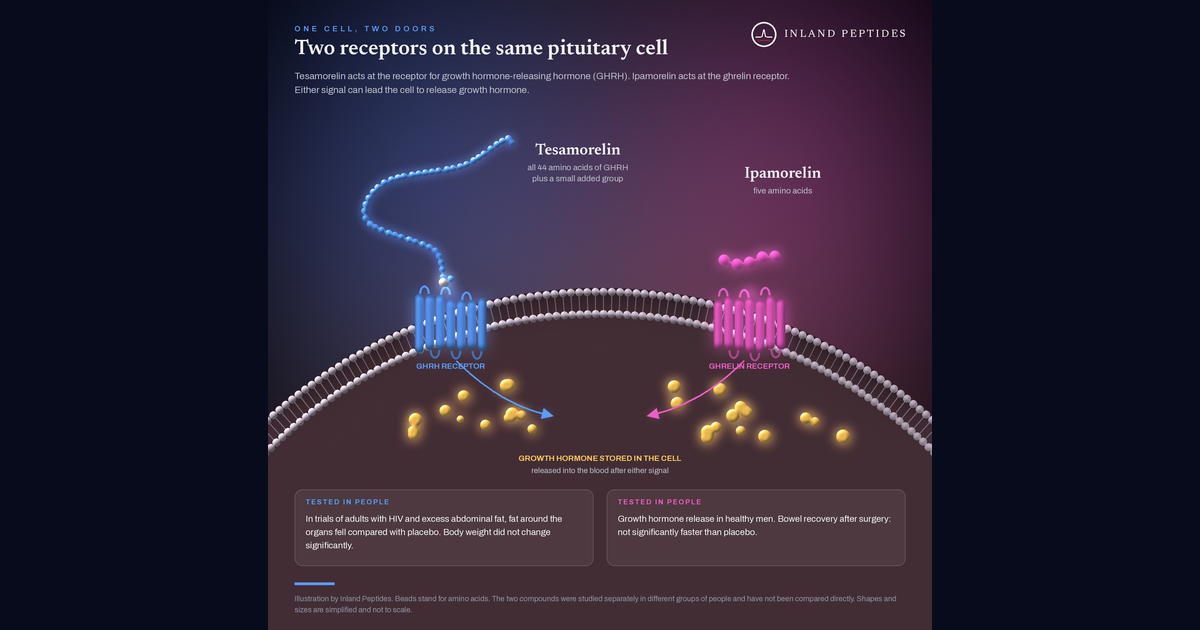
Tesamorelin acts through the growth hormone-releasing hormone receptor, while ipamorelin acts through the ghrelin receptor.
Both prompt the pituitary gland to release the body’s own growth hormone through different receptors.
Tesamorelin is approved to reduce excess abdominal fat in adults with HIV and lipodystrophy. Ipamorelin, by contrast, has been studied in healthy volunteers and patients recovering from bowel surgery. It is sold for research use only and is not FDA-approved for human use.
| Tesamorelin | Ipamorelin | |
|---|---|---|
| What it is | All 44 amino acids of growth hormone-releasing hormone (GHRH) plus a small fatty-acid group. | A small lab-made peptide of five amino acids, some not found in the body’s proteins. |
| Receptor | GHRH receptor on the pituitary. | Ghrelin receptor, found in the brain, pituitary and gut. |
| Medical or research context | Approved as Egrifta SV and Egrifta WR to reduce excess abdominal fat in adults with HIV and lipodystrophy. | Studied for growth hormone release and for bowel recovery after surgery. Research use only; not FDA-approved for human use. |
| Main evidence limitations | Most large trials enrolled adults with HIV. Long-term heart safety not established. | Few human studies. Did not significantly speed bowel recovery. Human studies have not established benefits for body fat, sleep or exercise recovery. |
Two routes to the same gland
Tesamorelin copies the brain’s main growth hormone signal, while ipamorelin imitates a different hormone, ghrelin.
Growth hormone-releasing hormone, or GHRH, signals the pituitary, a pea-sized gland at the base of the brain, to release growth hormone. Ghrelin is made mostly in the stomach and is best known for signaling hunger. Its receptor also helps control growth hormone release.
Growth hormone prompts the liver and other tissues to make IGF-1, short for insulin-like growth factor 1. Neither compound is growth hormone itself.
Tesamorelin is built from the full GHRH hormone
According to the Egrifta prescribing information, tesamorelin contains all 44 amino acids of human GHRH, with a short fatty-acid group attached to the first one.
Ipamorelin is a small, unrelated peptide
Ipamorelin has only five amino acids, and some are lab-made forms not found in the body’s proteins. Early laboratory and animal work showed that it triggers growth hormone release through the same receptor that ghrelin uses.
Medical uses and regulatory status
Tesamorelin has one approved use
The prescribing information lists one use: reducing excess abdominal fat in adults with HIV and lipodystrophy. Lipodystrophy is an abnormal shift in where the body stores fat, and it can occur during HIV treatment.
The label states that tesamorelin is not for weight loss. Its major trials measured a drop in visceral fat, the fat packed around the internal organs, without a significant change in overall body weight.
That approval covers the Egrifta products, so it does not make a research vial labeled tesamorelin an approved medicine.
Ipamorelin is sold for research use only
Ipamorelin reached mid-stage trials in hospital patients. According to an FDA review of ipamorelin, its development for that use was discontinued. It is not FDA-approved for human use.
What human studies of tesamorelin found
No published human trial has compared tesamorelin with ipamorelin.
Tesamorelin’s largest trials enrolled adults with HIV and excess abdominal fat and measured visceral fat on scans.
- In a 26-week trial of 412 patients, visceral fat fell 15.2% with tesamorelin and rose 5.0% with placebo, an inactive look-alike treatment.
- A second trial of 404 patients also found a drop in visceral fat compared with placebo.
But body weight did not change significantly compared with placebo in either trial.
In the first trial’s extension and the second trial, visceral fat returned in participants who switched from tesamorelin to placebo.
Smaller trials looked at other groups. Visceral fat also fell in a year-long trial of people with abdominal obesity who did not have HIV, and liver fat fell in a year-long trial of adults with HIV and fatty liver disease.
What human studies of ipamorelin found
Ipamorelin’s human research covers two settings: healthy volunteers and patients recovering from bowel surgery.
Growth hormone release in healthy men
In a study in healthy male volunteers, researchers tested several dose levels of ipamorelin through short infusions into a vein. Growth hormone levels peaked at about 40 minutes and then declined.
The study measured hormone levels rather than changes in muscle, fat, sleep or recovery.
Bowel recovery after surgery
After bowel surgery, the intestines often slow down or stop moving for a while. This is called postoperative ileus, and it can delay eating and leaving the hospital.
Researchers tested whether ipamorelin’s action at the ghrelin receptor could help bowel recovery. In a trial after bowel surgery that analyzed 114 adults, the typical time to tolerating a solid meal was about 7 hours shorter with ipamorelin than with placebo. Neither that difference nor the differences in other recovery measures were statistically significant.
How long do they last in the blood?
Their reported blood half-lives range from minutes to hours, based on different study methods.
- Tesamorelin: a half-life of about 8 minutes in healthy adults after an injection under the skin, according to the Egrifta SV label.
- Ipamorelin: a half-life of about 2 hours in the healthy-volunteer study, after a 15-minute infusion into a vein.
Half-life is the time it takes for a drug’s blood level to fall by half, not how long growth hormone stays raised. Different routes and methods also mean these figures are not a direct comparison.
Safety findings and unanswered questions
These studies involved different groups of people and cannot establish which compound is safer.
Tesamorelin
In the HIV trials summarized in the prescribing information, side effects reported more often with tesamorelin than with placebo included injection-site reactions (17% compared with 6%), joint and muscle pain, swelling in the arms and legs, and higher blood sugar.
The prescribing information also warns about raised IGF-1, fluid retention, high blood sugar and allergic reactions. It prohibits use in people with active cancer and calls for weighing the risk of recurrence after cancer treatment, because of concerns about stimulating growth pathways.
Ipamorelin
Most patients in both surgical-trial groups had some adverse event. The FDA review of ipamorelin notes that investigators described most events as mild to moderate and generally related to surgery or underlying disease.
The same review notes that low potassium and high blood sugar were reported more often with ipamorelin. Two patients given ipamorelin died after serious complications of their surgery. FDA reviewers said it is unclear whether the deaths were related to ipamorelin.
A trial lasting up to a week in hospital patients cannot establish long-term safety in healthy adults.
Ipamorelin is often described as selective for growth hormone. That idea comes from studies in pigs, where ipamorelin’s effects on the stress hormones ACTH and cortisol were not significantly different from those of GHRH. Those are animal findings, though, and do not establish the same effect in people.
What remains unknown
- Whether ipamorelin changes body composition, sleep or recovery in people.
- The long-term safety of either compound outside the groups studied.
What the comparison shows
Tesamorelin activates the GHRH receptor, whereas ipamorelin activates the ghrelin receptor.
Tesamorelin’s larger trials measured abdominal fat in adults with HIV and lipodystrophy. Ipamorelin’s human studies, in contrast, measured hormone release and bowel recovery after surgery. The surgical trial found no statistically significant improvement compared with placebo.
Their separate studies cannot show which compound works better.