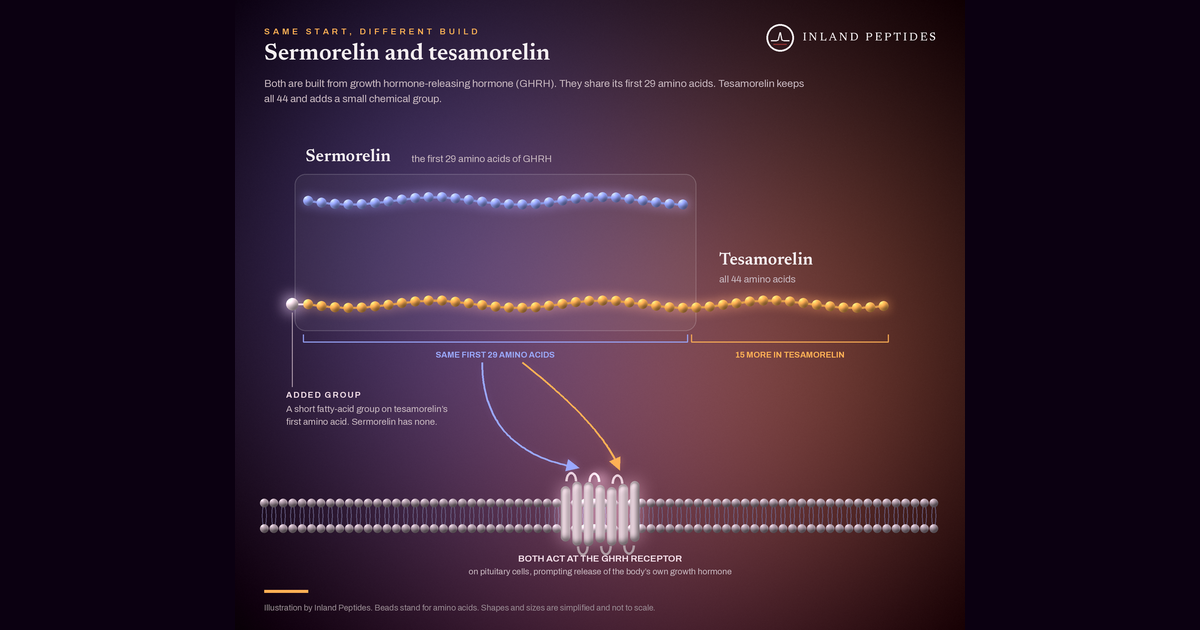
Sermorelin contains the first 29 amino acids of growth hormone-releasing hormone, while tesamorelin contains all 44 with an added chemical group.
Both prompt the pituitary gland to release the body’s own growth hormone. Sermorelin was once approved for childhood growth hormone deficiency and pituitary testing. Tesamorelin is approved to reduce excess abdominal fat in adults with HIV and lipodystrophy.
| Sermorelin | Tesamorelin | |
|---|---|---|
| What it is | A lab-made peptide matching the first 29 amino acids of human GHRH. | All 44 amino acids of human GHRH plus a small fatty-acid group on the first one. |
| Hormone pathway | GHRH receptor on the pituitary. | GHRH receptor on the pituitary. |
| Medical history | Formerly approved as Geref for testing pituitary function and for children with growth hormone deficiency. Later discontinued. | Approved as Egrifta SV and Egrifta WR to reduce excess abdominal fat in adults with HIV and lipodystrophy. |
| Main human findings | Faster growth in children; higher hormone levels in older adults; mixed body composition and physical-function results. | Less visceral fat in adults with HIV, without significant weight change. In trial extensions, the fat returned in people switched to placebo. |
| Important evidence limitations | Mostly small, older studies. Longer adult results come mainly from overlapping reports by one research program. | Most large trials enrolled adults with HIV. Long-term heart safety not established. |
No published human trial has compared the two directly.
Same pathway, different structures
Sermorelin and tesamorelin are both lab-made versions of growth hormone-releasing hormone, or GHRH.
GHRH signals the pituitary, a pea-sized gland at the base of the brain, to release growth hormone. Growth hormone then prompts the liver and other tissues to make IGF-1, short for insulin-like growth factor 1. Blood tests often use IGF-1 to assess growth hormone activity.
Neither compound is growth hormone itself.
Two differences in how they are built
Natural GHRH is a chain of 44 amino acids, the building blocks of proteins. The first 29 are enough to trigger growth hormone release.
- Length: sermorelin has only those first 29 amino acids. Tesamorelin has all 44.
- Added group: according to the Egrifta prescribing information, tesamorelin also has a short fatty-acid group attached to its first amino acid. Sermorelin has no such group.
How long do they stay in the blood?
Both have blood half-lives measured in minutes. Half-life is the time it takes for blood levels of a drug to fall by half.
- Sermorelin: about 4 minutes in a study of 10 healthy men, measured after an infusion into a vein ended.
- Tesamorelin: about 8 minutes in healthy adults after an injection under the skin, according to the Egrifta SV label.
These figures come from different studies and methods, so they are not a direct comparison.
Half-life is also different from how long growth hormone stays raised. In a study of 30 healthy men, growth hormone stayed raised for about 3 hours after a single dose of sermorelin into a vein.
Different medical histories
Sermorelin was sold as Geref
Sermorelin was sold in the United States under the brand name Geref in two forms:
- A diagnostic product used to test whether the pituitary could release growth hormone.
- A treatment for children with growth failure caused by growth hormone deficiency with no known cause.
The maker discontinued both products, and their approvals were later withdrawn at its request. In its withdrawal review, the FDA determined that Geref was not withdrawn from sale for safety or effectiveness reasons.
Tesamorelin is approved for one use
The prescribing information lists one use: reducing excess abdominal fat in adults with HIV and lipodystrophy. Lipodystrophy is an abnormal shift in where the body stores fat, and it can occur during HIV treatment.
The label states that tesamorelin is not for weight loss and that its long-term heart safety has not been established.
These approvals cover the branded Geref and Egrifta products. They do not make compounded preparations or research vials FDA-approved.
What human studies of sermorelin found
Growth in children
Most of sermorelin’s medical evidence comes from children with growth hormone deficiency. A study that enrolled 110 children analyzed growth in 86 of them. Their average growth rate roughly doubled during the first six months of treatment. The study had no comparison group.
A six-month randomized study compared sermorelin with growth hormone in 60 children whose deficiency came from a lack of the brain’s releasing signal. Children given growth hormone grew faster than those given sermorelin by continuous infusion.
Short studies in older men
In a two-week study, the higher of two doses raised growth hormone and IGF-1 to levels similar to those of young men.
In a six-week study of 11 older men, sermorelin raised nighttime growth hormone but not IGF-1. Weight and scan-measured muscle and fat did not change significantly. Two of six strength measures and one endurance test improved.
That study had no placebo group, a group given an inactive treatment for comparison, so the improvements cannot be attributed to sermorelin alone.
Longer trials at the University of Washington
University of Washington researchers studied sermorelin, using Geref, for five to six months in healthy older men and women, with placebo for comparison.
- Body composition: the investigators’ preliminary report described more lean mass and less body fat, with smaller changes in women taking estrogen.
- Physical function: some measures held steady with sermorelin in women not taking estrogen, while they declined with placebo. A later review by the same team found no consistent improvement overall.
- Sleep: sleep did not improve. In the preliminary report, people given sermorelin rated their sleep slightly worse.
- Thinking skills: in a six-month study of 89 older adults, the group given sermorelin scored better than the placebo group on several tests of problem-solving and mental speed.
These reports overlap and come from one research program, rather than independent confirmations. The body composition and sleep findings were reported in preliminary publications and reviews.
What human studies of tesamorelin found
Tesamorelin’s largest trials measured visceral fat in adults with HIV. Visceral fat is the fat packed around the internal organs, deep inside the belly.
Visceral fat fell, but weight did not
In a 26-week trial of 412 patients with HIV and excess abdominal fat, visceral fat fell 15.2% with tesamorelin and rose 5.0% with placebo. A second trial of 404 patients also found a drop in visceral fat.
In both trials, body weight did not change significantly compared with placebo. Losing visceral fat while weight stays steady is different from general weight loss.
In the trial extensions, visceral fat returned in participants who switched from tesamorelin to placebo.
Other tissues
- Fat beneath the skin: the second HIV trial found no change in abdominal fat beneath the skin. In a year-long trial of 60 people with abdominal obesity and lower growth hormone levels, visceral fat fell compared with placebo, while fat beneath the skin did not change significantly.
- Liver fat: liver fat fell in a six-month trial of adults with HIV and in a year-long trial of adults with HIV and fatty liver disease.
- Lean mass: the HIV trials reported a small rise in lean body mass. Lean mass includes water and organs as well as muscle, so it is not proof of muscle growth.
A later reanalysis of trial scans looked at trunk muscles. It compared the tesamorelin and placebo groups, but included only tesamorelin patients whose visceral fat had fallen by at least 8%. The placebo group had no such restriction.
Some measures of muscle area and density rose compared with placebo. Strength was not measured, so the scans do not show better physical function.
Blood sugar
In a 12-week trial of 53 people with type 2 diabetes, blood sugar control did not differ significantly from placebo.
Thinking skills
Three trials looked at thinking skills, with mixed results.
In a 20-week trial of 152 adults aged 55 to 87, with and without mild memory problems, thinking-skill scores improved more than with placebo.
In a six-month trial of 73 people with HIV, abdominal obesity and thinking problems, improvement did not differ significantly from standard care. That trial had no placebo group.
A 10-week pilot trial of 22 adults did not find a statistically significant improvement in thinking skills compared with placebo.
Why the studies cannot rank them
Sermorelin was studied mainly in children and healthy older adults, often in small studies. Tesamorelin’s largest trials enrolled adults with HIV and measured visceral fat on scans.
Because the people and measurements differ, these results cannot show which compound works better.
Safety findings and unanswered questions
Tesamorelin has a larger safety record, drawn mostly from adults with HIV. Sermorelin’s comes from smaller and older studies.
Sermorelin
The children’s studies reported few side effects, mainly mild irritation at the injection site. The study that enrolled 110 children reported no harmful changes in blood tests, including blood sugar.
In the randomized study of children, nearly all those given sermorelin developed antibodies to it. Antibodies are proteins the immune system makes when it reacts to a substance. These were not linked to how well the children grew and faded after treatment stopped.
In the University of Washington trials, the investigators described side effects related to fluid retention, such as swelling and joint aches, as uncommon and generally mild.
Tesamorelin
In the HIV trials summarized in the prescribing information, side effects reported more often with tesamorelin than with placebo included injection-site reactions (17% compared with 6%), joint and muscle pain, swelling in the arms and legs, and higher blood sugar.
These were reported trial events; not every event was necessarily caused by tesamorelin.
The prescribing information also warns about raised IGF-1, fluid retention, high blood sugar and allergic reactions. It prohibits use in people with active cancer and calls for weighing the risk of recurrence after cancer treatment, because of concerns about stimulating growth pathways.
What remains unknown
- Whether the University of Washington findings for sermorelin are reproduced in independent studies.
- How tesamorelin affects visceral fat in people without HIV, beyond the smaller trials.
- The long-term safety of either compound in adults.
What the comparison shows
Both compounds act at the GHRH receptor. Sermorelin contains the first 29 amino acids of GHRH; tesamorelin contains all 44 and an added chemical group.
Sermorelin’s approved uses involved childhood growth hormone deficiency and pituitary testing. Its adult studies explored hormone levels, body composition and aging. Tesamorelin’s strongest evidence concerns visceral fat in adults with HIV and lipodystrophy, rather than general weight loss.
A shared pathway does not make them interchangeable, and their separate studies cannot show that either one works better.