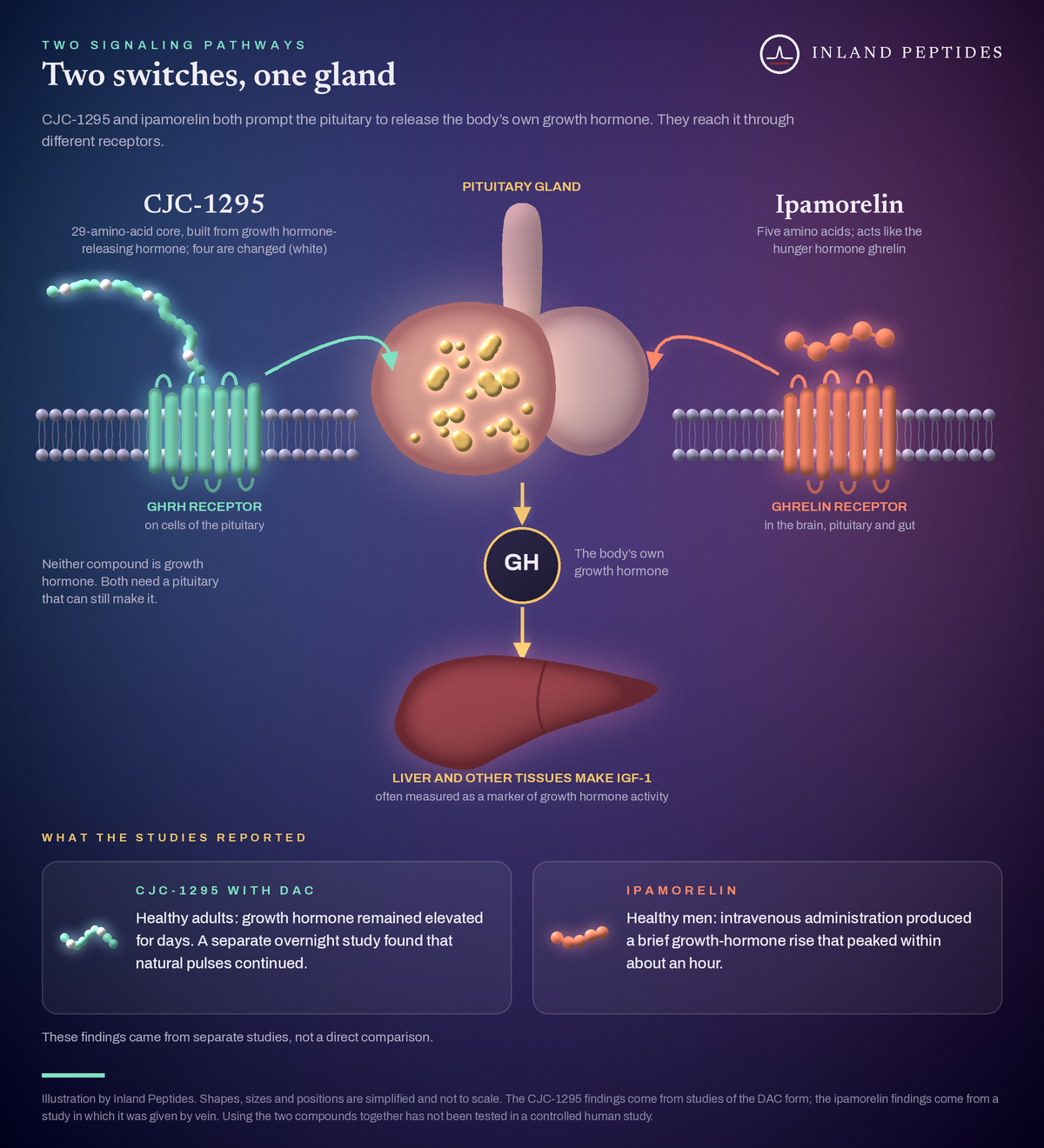
CJC-1295 acts through the growth hormone-releasing hormone receptor, while ipamorelin acts through the ghrelin receptor.
Both are lab-made peptides that prompt the pituitary gland to release the body’s own growth hormone. They have not been compared head to head in a controlled human study. Instead, the findings come from separate, small studies.
| CJC-1295 | Ipamorelin | |
|---|---|---|
| What it is | A modified growth hormone-releasing hormone peptide. Published clinical studies used the form with DAC. | A peptide that activates the ghrelin receptor. |
| Signaling pathway | GHRH receptor on the pituitary. | Ghrelin receptor in the brain, pituitary and gut. |
| Main areas studied in humans | Growth hormone and IGF-1 levels in healthy adults. | Growth hormone release in healthy men; bowel recovery after surgery. |
| Important evidence limitations | Small, short studies. No published studies of products labeled “without DAC,” or of whether raised hormone levels improve sleep, recovery or body composition. | Small studies of the drug given by vein. Did not significantly speed bowel recovery. Not studied for sleep, recovery or body composition in healthy people. |
| FDA status | Sold for research use only. Not FDA-approved for human use. | Sold for research use only. Not FDA-approved for human use. |
“CJC-1295” can mean two different products
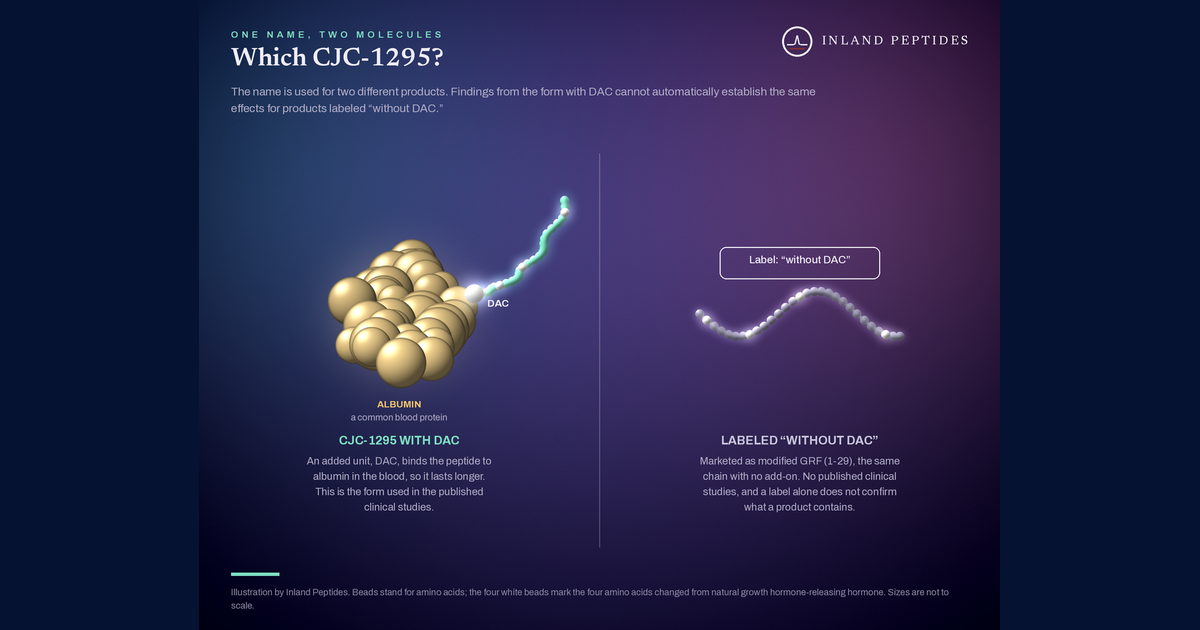
The name CJC-1295 is used for two different molecules, so findings for one do not automatically apply to the other.
The original CJC-1295 has a 29-amino-acid core based on growth hormone-releasing hormone, with four amino acids changed. It also has a chemical add-on called a drug affinity complex, or DAC. Early laboratory studies in rats showed that DAC lets the peptide attach to albumin, a common blood protein, so it stays in circulation longer.
Products labeled “CJC-1295 without DAC” are marketed as the same core with no add-on, often under the name modified GRF (1-29). GRF is an older name for growth hormone-releasing hormone. But a label alone does not confirm what a product contains.
An FDA review of CJC-1295 treats the two as different active ingredients and flags the inconsistent naming as a safety risk. The published clinical findings summarized here concern the DAC form. So they do not establish the same duration or effects for the form without DAC.
How do their signals differ?
They activate different receptors on the pituitary, a small gland beneath the brain.
The brain normally tells the pituitary to release growth hormone using a hormone called growth hormone-releasing hormone, or GHRH. CJC-1295 is built from the first part of GHRH and acts on the same receptor.
Ghrelin is a hormone made mostly in the stomach. It signals hunger and triggers growth hormone release through receptors in the brain and pituitary. Ipamorelin activates the ghrelin receptor, which is also found in the gut. Researchers have also studied it for bowel recovery.
Either way, the pituitary releases growth hormone, which prompts the liver and other tissues to make IGF-1, short for insulin-like growth factor 1. Blood tests often use IGF-1 as a marker of growth hormone activity.
Neither compound is growth hormone. Both need a pituitary that can still make it. FDA reviewers noted that people whose pituitary makes none would not be expected to respond.
In healthy adults, CJC-1295 with DAC kept growth hormone raised for days after one injection. By contrast, ipamorelin given by vein to healthy men produced a brief rise that peaked within about an hour.
What clinical studies of CJC-1295 measured
The published clinical studies of CJC-1295 used the DAC form in small groups of healthy adults. They measured hormone levels rather than health outcomes.
In a study in healthy adults, researchers gave CJC-1295 or a placebo to volunteers aged 21 to 61. After one injection, average growth hormone levels rose 2- to 10-fold and IGF-1 rose 1.5- to 3-fold. Larger and repeated doses produced greater hormone increases.
A follow-up study in 12 healthy men measured growth hormone overnight, before and one week after a single injection. Growth hormone rose, and the body’s natural pulses of release continued. The study had no placebo group, though.
These studies did not measure muscle growth, fat loss, sleep, healing or aging. Higher hormone readings alone do not establish those effects.
What human studies of ipamorelin found
Ipamorelin has been studied in two settings: a hormone study in healthy men and a trial in patients recovering from bowel surgery.
In a study in healthy male volunteers, ipamorelin was given through a vein. Each dose tested produced a single growth hormone peak.
After bowel surgery, the intestines can temporarily stop moving normally, a condition called postoperative ileus. It can cause bloating, nausea and vomiting, and delay eating and going home.
Ipamorelin did not significantly speed bowel recovery compared with placebo in a trial after bowel surgery. The trial included 114 adults. The authors noted its small size and the patients’ wide range of underlying conditions.
The same sponsor registered a larger follow-up trial that was listed as completed, but no results were posted to the registry. FDA reviewers reported that development of ipamorelin for this use was discontinued.
These surgical findings do not establish benefits in healthy people.
Why are CJC-1295 and ipamorelin combined?
On the gray market, a blend of CJC-1295 and ipamorelin is frequently sold and used by people outside of research.
Some forum users, for example, describe taking the blend hoping for better sleep and recovery. In one forum post, the author said they started CJC-1295 without DAC alongside ipamorelin for those reasons, and another post listed recovery and sleep among its author’s goals.
The proposed reason for pairing them is that the two compounds act on different receptors involved in growth hormone release, so using both might release more than either alone. But users’ goals and this proposed mechanism are not evidence of benefit. Nor has the combination been tested in a controlled human study.
Safety findings and open questions
Both compounds have limited safety data. Small studies cannot establish their overall safety.
CJC-1295
In the first healthy-adult study, the FDA’s summary reports adverse events in 33 of 35 people given CJC-1295 and 2 of 7 given placebo. Common events included injection-site reactions, headache, flushing and diarrhea. Most were more frequent at higher doses. Even so, the authors reported no serious adverse reactions.
A company trial in people with HIV-related belly fat was stopped early. The FDA’s review describes anecdotal reports that a participant had a heart attack and died shortly after a dose. According to those reports, the attending physician thought underlying heart disease was the most likely explanation. The trial’s results have not been published.
In animal and laboratory studies summarized by the FDA, the DAC form caused injection-site damage in rats and dogs and signs of DNA damage in mouse pituitary cells.
Ipamorelin
In the bowel surgery trial, most patients in both groups had an adverse event. The authors described most events as mild to moderate and related to surgery or underlying illness.
Some events, however, were reported more often with ipamorelin. According to the FDA review of ipamorelin, low potassium occurred in 12.5% of that group and 3.4% of the placebo group. High blood sugar at discharge was reported in 14.3% and 8.6%, respectively. Two patients given ipamorelin died after complications of their bowel surgery. FDA reviewers said it was unclear whether the deaths were related to the drug.
Ipamorelin is often described as raising growth hormone without raising the stress hormone cortisol. That finding, however, comes from studies in pigs, so it does not establish the same response in people.
Long-term safety remains uncertain
Neither compound has long-term controlled safety data.
FDA reviewers pointed to warnings on approved growth hormone medicines, including high blood sugar and fluid retention. Those warnings do not establish that these peptides have the same risks. Still, the available studies are too limited to rule those risks out.
What the comparison shows
CJC-1295 and ipamorelin prompt growth hormone release through different receptors. CJC-1295 with DAC kept growth hormone and IGF-1 raised for days in small studies of healthy adults. Products labeled without DAC, in contrast, have no published clinical data.
Ipamorelin produced a brief growth hormone rise in healthy men and did not significantly speed bowel recovery after surgery. Neither compound has been shown to improve sleep, recovery or body composition in healthy people. They also have not been tested together in a controlled human study.