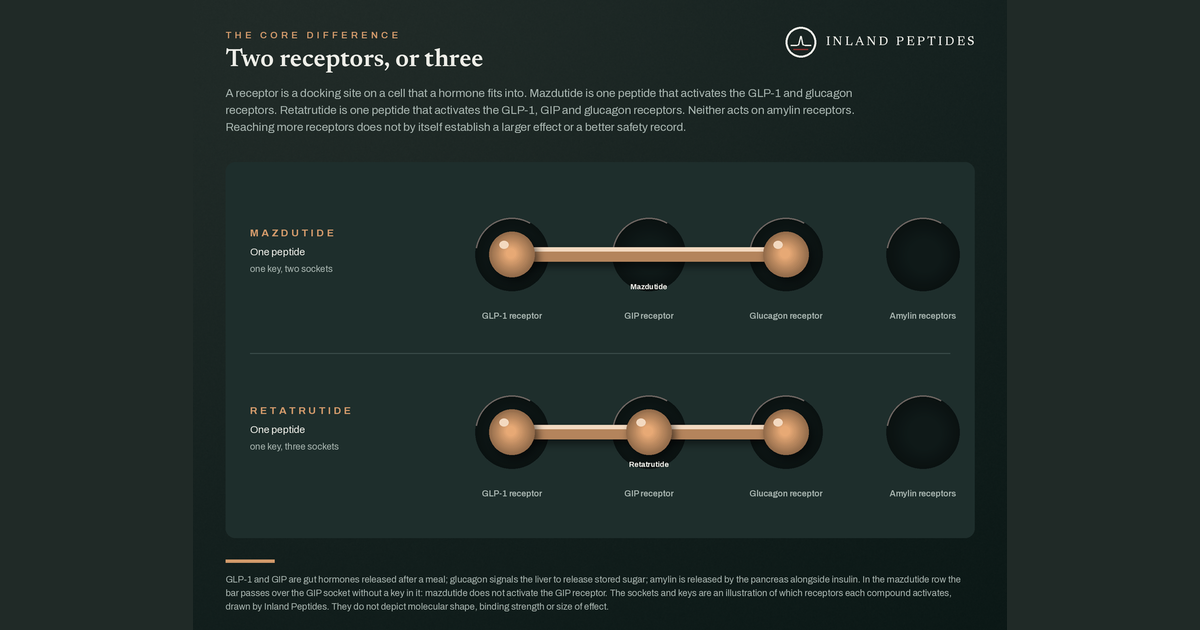
Mazdutide activates two hormone receptors, GLP-1 and glucagon, while retatrutide activates three: GLP-1, glucagon and GIP.
Both are laboratory-made peptides developed through Eli Lilly’s research and studied for weight management and type 2 diabetes.
They have been tested in separate trials, so their results cannot tell us which would work better in a direct comparison.
Mazdutide vs. retatrutide at a glance
| Mazdutide | Retatrutide | |
|---|---|---|
| What it is | One peptide that activates two receptors | One peptide that activates three receptors |
| Hormone targets | GLP-1 and glucagon | GLP-1, glucagon and GIP |
| Developer | Eli Lilly; licensed to Innovent Biologics for China | Eli Lilly |
| Main research areas | Weight management and type 2 diabetes; large trials in China and a smaller trial in the United States | Weight management and type 2 diabetes; large international trials |
| FDA approval | Sold for research use only. Not FDA-approved for human use. (Approved in China as a prescription medicine.) | Sold for research use only. Not FDA-approved for human use. |
| Studies discussed here | Trials against placebo and against dulaglutide | Trials against placebo |
What is mazdutide?
Mazdutide is a single laboratory-made peptide that activates the receptors for two hormones, GLP-1 and glucagon.
Eli Lilly developed mazdutide from oxyntomodulin, a natural gut hormone that acts on both receptors. Lilly licensed it to Innovent Biologics for development and sale in China. The studies discussed below include large trials in China and a smaller trial in the United States.
In China it is an approved prescription medicine for weight management and for type 2 diabetes.
What is retatrutide?
Retatrutide is a laboratory-made peptide from Eli Lilly that acts on three receptors at once: GLP-1, glucagon and GIP.
Like mazdutide it reaches the GLP-1 and glucagon receptors, but only retatrutide also engages GIP, giving it a third mechanism mazdutide does not have.
It is being evaluated in large international trials for weight management, type 2 diabetes and related conditions. Clinical-trial results do not establish the quality, safety or effects of research-use-only products labeled mazdutide or retatrutide.
How do their hormone targets differ?
Both activate the GLP-1 and glucagon receptors. Retatrutide also activates the GIP receptor, which mazdutide does not.
A receptor is a docking site on a cell. GLP-1 is a gut hormone released when you eat. It helps the pancreas release insulin when blood sugar rises, slows stomach emptying and signals fullness. GIP is another gut hormone that helps trigger insulin release after meals.
Glucagon signals the liver to release stored sugar. Researchers are also studying how activating its receptor affects the body’s energy use.
Activating three receptors instead of two does not by itself mean more weight loss or fewer side effects.
What has research found on weight?
Each compound has lowered weight compared with placebo in its own trials. A placebo is an inactive look-alike given to a comparison group.
Unless noted, the weight results below include people who stopped treatment as well as those who continued.
Mazdutide
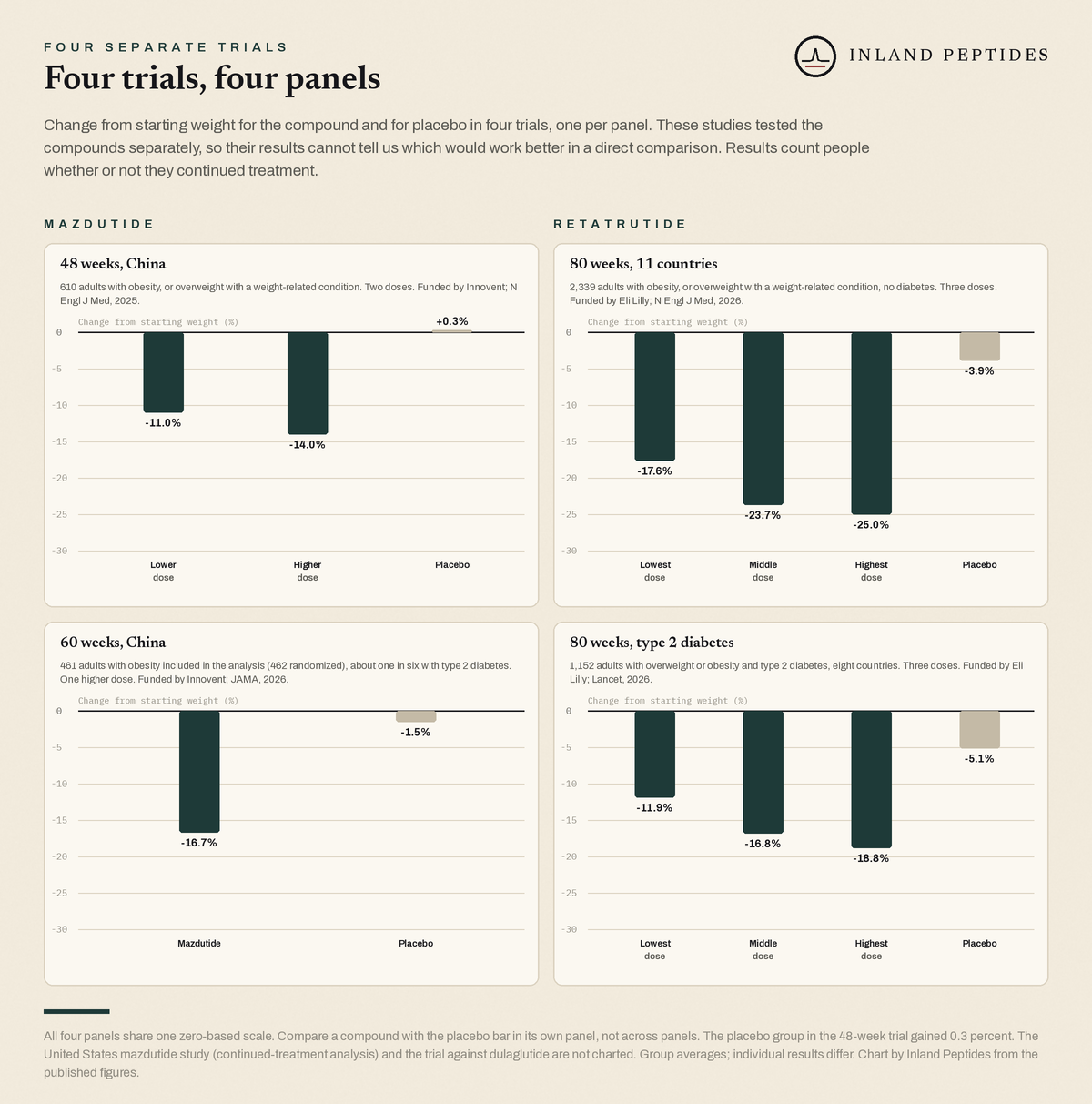
In a 48-week trial in China, average weight fell by about 11 percent with the lower mazdutide dose and about 14 percent with the higher one, while the placebo group gained about 0.3 percent. The trial enrolled 610 adults with obesity, or overweight with a weight-related condition, and was funded by Innovent.
In a 60-week trial in China at a higher dose, average weight fell by about 17 percent with mazdutide and about 1.5 percent with placebo, a difference of about 15 percentage points. The results included 461 adults with obesity, about one in six of whom had type 2 diabetes. It was funded by Innovent.
A smaller 48-week study in the United States reported its main result at 32 weeks. Average weight fell by about 7 to 18 percent across the mazdutide doses tested, compared with about 1 percent with placebo. These estimates, however, assume participants continued treatment. The study included 179 adults without diabetes and was funded by Eli Lilly.
Retatrutide
In an 80-week trial, average weight fell by about 18, 24 and 25 percent across three retatrutide doses, compared with about 4 percent with placebo. The Lilly-funded trial included 2,339 adults without diabetes who had obesity, or overweight with a weight-related condition.
In a separate 80-week diabetes trial, average weight fell by about 12, 17 and 19 percent across three doses, against about 5 percent with placebo. It enrolled 1,152 adults with overweight or obesity and type 2 diabetes.
Why these results do not show which works better
The large mazdutide trials ran for 48 to 60 weeks, while the retatrutide trials ran for 80 weeks. They also differed in their participants, doses and placebo results.
The results show how each compound performed against placebo. But they do not show which would produce more weight loss in a direct comparison.
What has research found on blood sugar?
Both compounds lowered HbA1c in studies of people with type 2 diabetes. HbA1c is a blood test that reflects average blood sugar over about three months. Changes in HbA1c are measured in percentage points.
Mazdutide lowered HbA1c slightly more than dulaglutide, an approved GLP-1 medicine, in a 28-week trial against dulaglutide. The additional reductions were about 0.24 and 0.30 percentage points across two mazdutide doses. The mazdutide groups also lost about 3.8 and 5.8 percentage points more body weight. The trial included 731 Chinese adults taking oral medicines for type 2 diabetes.
These findings apply to the doses tested, rather than every approved dulaglutide dose. Digestive problems were more common with mazdutide than with dulaglutide. Innovent funded the trial.
Retatrutide lowered HbA1c by about 1.7 to 1.9 percentage points in a 40-week diabetes trial, compared with about 0.8 with placebo. Average weight fell by about 12 to 15 percent, compared with about 3 percent. This Lilly-funded trial included 537 adults whose diabetes was inadequately controlled with diet and exercise alone.
How do the reported side effects compare?
Digestive problems were the most common adverse events reported with both compounds. Retatrutide trials also reported low blood pressure and unusual skin sensations, including tingling.
An adverse event is a health problem reported during a study, whether or not the treatment caused it. Because these trials studied different groups for different lengths of time, their rates cannot tell us which compound has fewer side effects.
Mazdutide
In the 48-week trial in China, digestive problems were the most common adverse events and were mostly mild to moderate. About 0.5 to 1.5 percent of people receiving mazdutide stopped treatment because of an adverse event, compared with 1 percent receiving placebo.
In the 60-week trial, about 53 percent of people receiving mazdutide reported vomiting, 47 percent reported nausea and 39 percent reported diarrhea. By contrast, the corresponding placebo rates ranged from about 1 to 7 percent. Most digestive events were mild to moderate. About 3 percent stopped treatment because of an adverse event, compared with none receiving placebo.
Serious adverse events were reported in about 7 percent of the mazdutide group and 5 percent of the placebo group. This category includes problems that require hospitalization or are otherwise medically significant.
In the United States study, about one in five people on the highest dose stopped treatment because of an adverse event, mostly digestive.
Retatrutide
In the 80-week trial without diabetes, about 29 to 42 percent of people receiving retatrutide reported nausea, compared with about 15 percent receiving placebo. Diarrhea was reported by about 25 to 34 percent, compared with 14 percent. Serious adverse events occurred in about 8 to 11 percent of the retatrutide groups, compared with 5.5 percent of the placebo group. Average pulse rate rose initially and then declined.
In the 80-week diabetes trial, up to 6 percent reported low blood pressure and up to 7 percent reported abnormal skin sensations. Placebo rates were about 1 percent or less. The study also counted people who stopped treatment because of an adverse event or death together: 4 to 12 percent across the retatrutide groups, compared with 5 percent receiving placebo.
In the 40-week diabetes trial, 2 to 5 percent of people receiving retatrutide stopped treatment because of an adverse event, compared with none receiving placebo.
So what is the difference?
Mazdutide activates GLP-1 and glucagon receptors, while retatrutide adds a third target, GIP. That extra target is the main difference in how the compounds work.
Both lowered weight and blood sugar in clinical trials, and digestive problems were common with both. Still, their separate studies cannot tell us which would work better or cause fewer side effects in the same people.
A clinician can explain prescription options for weight management or blood sugar control and whether they suit an individual’s needs.