Dulaglutide and semaglutide target the same hormone receptor, but semaglutide lowered blood sugar and weight more in a 40-week comparison at the strengths tested.
Both are GLP-1 medicines used for type 2 diabetes. Semaglutide is also used in prescription products for weight management.
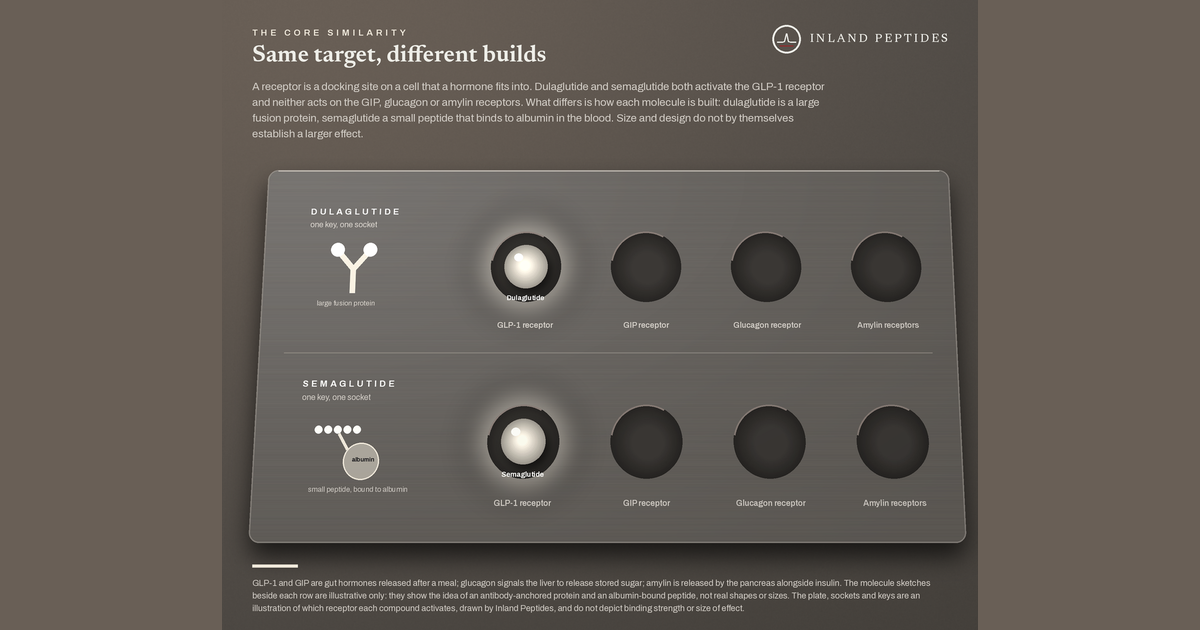
Their molecular designs differ. Dulaglutide joins GLP-1-like segments to part of an antibody. Semaglutide, by contrast, is a smaller modified peptide that binds to a blood protein.
A direct trial compared them in separate groups of people randomly assigned to either medicine.
Dulaglutide vs. semaglutide at a glance
| Dulaglutide | Semaglutide | |
|---|---|---|
| What it is | A large protein: two GLP-1-like segments attached to part of an antibody | A small modified GLP-1-like peptide with a fatty acid chain that binds a blood protein |
| Hormone receptor target | GLP-1 receptor | GLP-1 receptor |
| Developer and brand names | Eli Lilly; Trulicity | Novo Nordisk; Ozempic, Wegovy and Rybelsus |
| Main approved medical uses | Type 2 diabetes; heart-risk reduction in adults with type 2 diabetes and heart disease or risk factors | Type 2 diabetes (Ozempic, Rybelsus); weight management (Wegovy); other uses in specific groups |
| FDA information | Used in an FDA-approved prescription medication. | Used in FDA-approved prescription medications. |
| Main distinction in the evidence | Studied in type 2 diabetes; no approved weight-management product | Favored in the head-to-head diabetes trial; also tested at a weight-management strength |
Approval applies to a specific pharmaceutical product and use. It therefore does not establish the quality, safety or effects of research-use-only material labeled dulaglutide or semaglutide.
What is dulaglutide?
Dulaglutide is a GLP-1 medicine from Eli Lilly, sold as Trulicity.
It is a fusion protein with two identical chains. Each carries a GLP-1-like segment joined to part of a human antibody.
Its approved uses include blood sugar control in type 2 diabetes and reducing major cardiovascular events in adults with type 2 diabetes and established heart disease or multiple risk factors.
What is semaglutide?
Semaglutide is a GLP-1 medicine from Novo Nordisk, used in products including Ozempic, Rybelsus and Wegovy.
Ozempic and Rybelsus are approved for type 2 diabetes. Ozempic comes as injections and tablets; Rybelsus comes as tablets.
Wegovy is approved for weight management and comes as injections and tablets. The products have additional approved uses for specific patient groups, which differ by formulation.
They also differ in strength and the populations studied. Findings for one formulation and strength do not automatically apply to another.
How are their mechanisms similar, and what differs?
Both imitate GLP-1 and activate its receptor. Their structural modifications help them remain active longer than the natural hormone.
GLP-1 is a gut hormone released after eating. It helps the pancreas release insulin when blood sugar rises, slows stomach emptying and signals fullness to the brain. A receptor is a docking site on a cell.
Natural GLP-1 breaks down within minutes, but these medicines are designed to remain active for days.
Dulaglutide combines GLP-1-like segments with part of an antibody. Semaglutide instead has a fatty acid chain that binds to albumin, a blood protein. That binding helps it remain in the body longer.
Still, molecular size alone does not establish how well either medicine works.
What have direct comparison studies found?
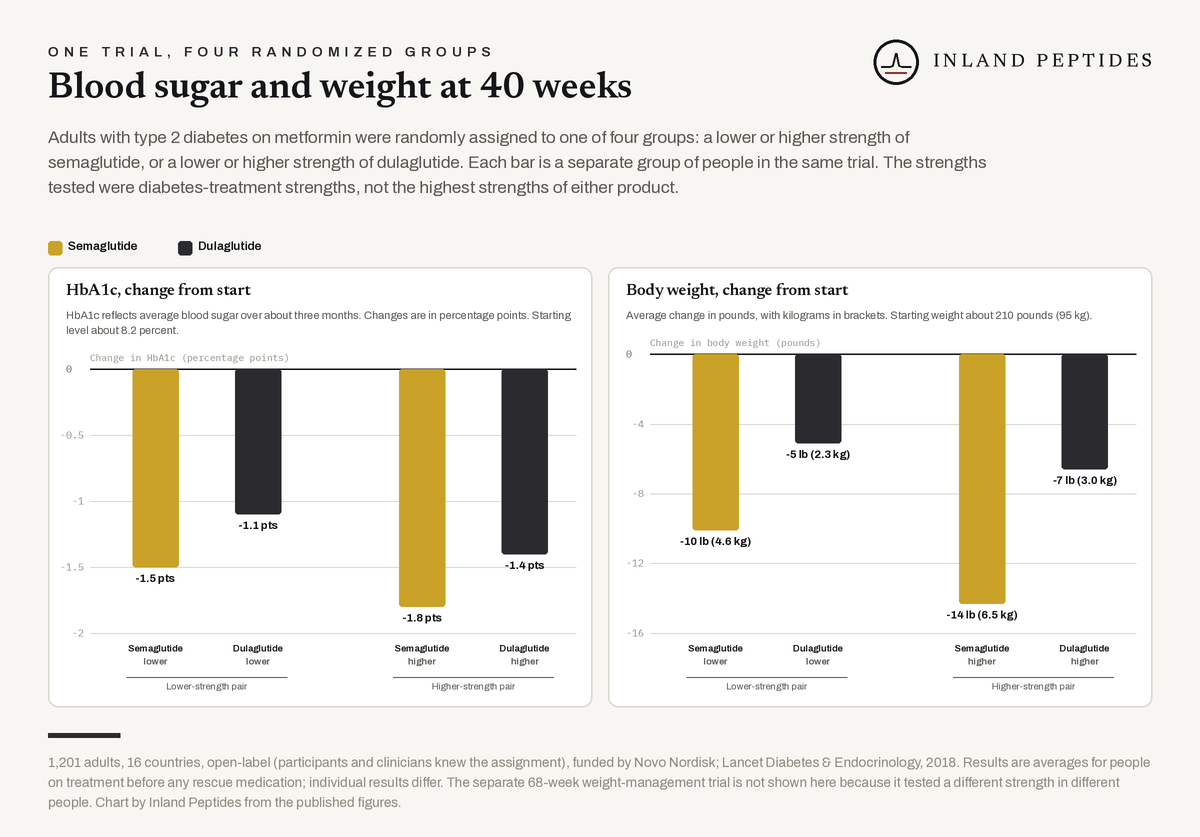
In a 40-week trial of 1,201 adults with type 2 diabetes, semaglutide lowered HbA1c and body weight more than dulaglutide in both strength comparisons.
HbA1c is a blood test reflecting average blood sugar over about three months. Its changes are measured in percentage points.
Participants were taking metformin and started with an average HbA1c of about 8.2 percent. They were randomly assigned to one of four groups: a lower or higher strength of either medicine. Novo Nordisk funded the trial, which took place in 16 countries.
Blood sugar
At the lower strengths, HbA1c fell by about 1.5 percentage points with semaglutide and 1.1 with dulaglutide. At the higher strengths, it fell by about 1.8 points with semaglutide and 1.4 with dulaglutide.
Body weight
At the lower strengths, average weight fell by about 10 pounds with semaglutide and 5 pounds with dulaglutide. At the higher strengths, it fell by about 14 pounds with semaglutide and 7 pounds with dulaglutide. Average starting weight was about 210 pounds.
What this trial did and did not test
The trial compared particular injectable diabetes-treatment strengths. It did not test the higher strengths also available for those products or semaglutide’s weight-management strength.
Participants and clinicians also knew which medicine each person received. That can affect reports of symptoms such as nausea.
In a smaller 52-week trial of 458 Japanese adults with type 2 diabetes, semaglutide tablets were compared with one dulaglutide strength. Its main focus was safety, with blood sugar and weight as secondary outcomes. At the highest tablet strength tested, HbA1c fell by about 1.7 points versus 1.4 with dulaglutide. Weight fell by about 3.5 pounds with semaglutide but rose by about 2 pounds with dulaglutide. Novo Nordisk funded it.
A 24-week trial of 120 Japanese adults with type 2 diabetes also found a lower HbA1c with semaglutide and fewer digestive symptoms with dulaglutide at the strengths tested.
What does this mean for weight-loss comparisons?
The direct comparison shows weight changes during diabetes treatment. But it does not establish how dulaglutide compares with semaglutide’s weight-management formulation and strength.
In a separate 68-week trial, average weight fell by about 15 percent with semaglutide and 2 percent with placebo, an inactive comparison treatment. The trial included 1,961 adults without diabetes who had obesity, or overweight with a weight-related condition. Novo Nordisk funded it. This study appears in Wegovy’s prescribing information.
Dulaglutide has no approved weight-management product, so its weight findings discussed here come from diabetes trials.
The 68-week study differed from the head-to-head trial in participants, strengths and design. So their results cannot establish which compound would produce more weight loss in the same population.
What side effects have studies reported?
Digestive problems were common with both medicines in the direct comparison. More people stopped semaglutide because of adverse events at the strengths tested.
An adverse event is a health problem reported during a study, whether or not treatment caused it.
In the 40-week trial, digestive problems occurred in about 43 and 44 percent of the semaglutide groups, compared with 33 and 48 percent of the dulaglutide groups. Nausea occurred in about 23 and 21 percent with semaglutide, compared with 13 and 20 percent with dulaglutide.
About 8 and 10 percent stopped semaglutide because of an adverse event, compared with 5 and 7 percent for dulaglutide. Digestive problems were the most common reason. Stopping treatment, though, did not necessarily mean leaving the study.
Serious adverse events occurred in about 6 to 8 percent of each group. These include events requiring hospitalization or considered medically significant for other reasons. Six people died during the trial: one in each semaglutide group and two in each dulaglutide group. But these counts alone do not establish that treatment caused the deaths.
Both medicines carry a boxed warning about thyroid tumors seen in rodents; the risk in people is unknown. Other label cautions include pancreatitis, gallbladder disease, dehydration-related kidney injury, and low blood sugar when combined with insulin or medicines that stimulate insulin release.
So what is the difference?
Dulaglutide and semaglutide activate the same receptor but have different molecular designs and prescription uses.
Semaglutide lowered blood sugar and weight more in the 40-week diabetes trial, while more people stopped it because of adverse events. Those findings apply to the strengths and population tested, rather than every formulation or weight-management treatment.
The trial does not establish which prescription medicine suits a particular person.
A clinician can assess medical treatment options for blood sugar or weight management based on individual needs.